Questions

M.C.Q (1 Marks)

Take a timed test

20 questions · self-marked practice — reveal the answer and mark yourself.

Question 11 Mark
Let $\overrightarrow{\text{E}}$ and $\overrightarrow{\text{B}}$ denote electric and magnetic fields in a frame S and $\overrightarrow{\text{E}}$ and $\overrightarrow{\text{B}}$ in another frame S moving with respect to S at a velocity $\overrightarrow{\text{v}}.$ Two of the following equations are wrong. Identify them.

  1. $\text{B}_\text{y},=\text{B}_\text{y}+\frac{\text{vE}_\text{z}}{\text{c}^2}$

  2. $\text{E}_\text{y},=\text{E}_\text{y}+\frac{\text{vB}_\text{z}}{\text{c}^2}$

  3. $\text{B}'_\text{y}=\text{B}_\text{y}+\text{v}\text{E}_\text{z}$

  4. $\text{E}'_\text{y}=\text{E}_\text{y}+\text{vB}_\text{z}$

Answer
  1. $\text{E}_\text{y},=\text{E}_\text{y}+\frac{\text{vB}_\text{z}}{\text{c}^2}$

  2. $\text{B}'_\text{y}=\text{B}_\text{y}+\text{v}\text{E}_\text{z}$

Explanation:

$\text{qE}=\text{qvB}$

$\Rightarrow\text{e}=\text{vB}$ By dimensionally b & care wrong

$\Rightarrow\text{v}\text{E}=\text{v}^2\text{B}$

$\Rightarrow\text{B}=\frac{\text{vE}}{\text{v} ^2}$
View full question & answer
Question 21 Mark
A charged particle goes undeflected in a region containing an electric and a magnetic field. It is possible that
  1. $\overrightarrow{\text{E}}||\overrightarrow{\text{B}},\ \overrightarrow{\text{v}}||\overrightarrow{\text{E}}$
  2. $\overrightarrow{\text{E}}$ is not parallel to $\overrightarrow{\text{B}}$
  3. $\overrightarrow{\text{v}}||\overrightarrow{\text{B}}$ but $\overrightarrow{\text{E}}$ is not parallel to $\overrightarrow{\text{B}}$
  4. $\overrightarrow{\text{E}}||\overrightarrow{\text{B}}$ but $\overrightarrow{\text{v}}$ is not parallel to $\overrightarrow{\text{E}}$
Answer
  1. $\overrightarrow{\text{E}}||\overrightarrow{\text{B}},\ \overrightarrow{\text{v}}||\overrightarrow{\text{E}}$

  2. $\overrightarrow{\text{E}}$ is not parallel to $\overrightarrow{\text{B}}$

Explanation:

$\Rightarrow\overrightarrow{\text{V}}\overrightarrow{\text{E}},\ \overrightarrow{\text{B}}\overrightarrow{\text{E}}$

In this case Magnetic force on the particle is zero & $\overrightarrow{\text{V}}$ is paralle to $\overrightarrow{\text{E}}.$ So charged particle goes undeflected in a region.

$\overrightarrow{\text{E}}$ is not parallel to $\overrightarrow{\text{B}},$ But $\overrightarrow{\text{V}}$ is parallel to $\overrightarrow{\text{E}}.$


View full question & answer
Question 31 Mark
An electric current i enters and leaves a uniform circular wire of radius a through diametrically opposite points. A charged particle q moving along the axis of the circular wire passes through its centre at speed v. The magnetic force acting on the particle when it passes through the centre has a magnitude:
  1. $\text{qv}\frac{\mu_0\text{i}}{2\text{a}}$
  2. $\text{qv}\frac{\mu_0\text{i}}{2\pi\text{a}}$
  3. $\text{qv}\frac{\mu_0\text{i}}{\text{a}}$
  4. $\text{Zero}$
Answer
  1. $\text{Zero}$

Explantion:

As the current is entering and exiting from two diametrically opposite points of a circular coil, the currents in the two semicircular sections are in the opposite direction.

The fields due to the two semi-circular sections at the centre is in the opposite direction.

Hence net feild is zero.

View full question & answer
Question 41 Mark
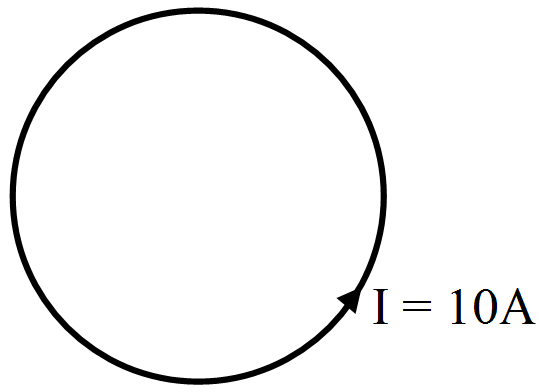
A circular loop of area 1cm2, carrying a current of 10A, is placed in a magnetic field of 0.1T perpendicular to the plane of the loop. The torque on the loop due to the magnetic field is:
  1. Zero
  2. 104N-m
  3. 102N-m
  4. 1N-m
Answer
  1. Zero

Explanation:

B = 0.1T

Area = 1cm2

Net torque on the loop due to the uniform magnetic field is always zero.

View full question & answer
Question 51 Mark
Which of the following particles will describe the smallest circle when projected with the same velocity perpendicular to a magnetic field?
  1. Electron
  2. Proton
  3. He+
  4. Li+
Answer
  1. Electron

Explanation:

$\text{F}=\text{q}\text{VB}=\frac{\text{mv}^2}{\text{r}}$

$\text{r}=\frac{\text{mV}}{\text{qB}}$

charqe electron = charqe of proton = charqe of He+ = charqe of Li+ But mass of electron is Lowest.

$\therefore$ (the electron so smallest + circle made by)

View full question & answer
Question 61 Mark
A charged particle is whirled in a horizontal circle on a frictionless table by attaching it to a string fixed at one point. If a magnetic field is switched on in the vertical direction the tension in the string.
  1. Will increase.
  2. Will decrease.
  3. Will remain the same.
  4. May increase or decrease.
Answer
  1. May increase or decrease.

Explanation:

B = B0j

The tension is the strong may increases or decreases.

View full question & answer
Question 71 Mark
A beam consisting of protons and electrons moving at the same speed goes through a thin region in which there is a magnetic field perpendicular to the beam. The protons and the electrons:
  1. Will go undeviated.
  2. Will be deviated by the same angle and will not separate.
  3. Will be deviated by different angles and hence separate.
  4. Will be deviated by the same angle but will separate.
Answer
  1. Will be deviated by different angles and hence separate.

Explanation:

$\vec{\text{F}}=\text{q}(\text{V}\times\text{B})$

Charge proton is poritive = e

Fp = evB

Charge of electron is negative = -e

Fe = -evB

They will be deviated by different angles and Hence separate.

View full question & answer
Question 81 Mark
Which of the following particles will experience maximum magnetic force circle when projected with the same velocity perpendicular to a magnetic field?
  1. Electron
  2. Proton
  3. He+
  4. Li++
Answer
  1. Li++

Explanation:

$|\text{F}|=|\text{qVB}|$

charge of  Li++ > charge of ( He+, proton, electron)

View full question & answer
Question 91 Mark
If a charged particle moves unaccelerated in a region containing electric and magnetic fields,
  1. $\overrightarrow{\text{E}}$ must be perpendicular to $\overrightarrow{\text{B}}$
  2. $\overrightarrow{\text{V}}$ must be perpendicular to $\overrightarrow{\text{E}}$
  3. $\overrightarrow{\text{V}}$ must be perpendicular to $\overrightarrow{\text{B}}$
  4. E must be equal to vB.
Answer
  1. $\overrightarrow{\text{E}}$ must be perpendicular to $\overrightarrow{\text{B}}$

  2. $\overrightarrow{\text{V}}$ must be perpendicular to $\overrightarrow{\text{E}}$

Explanation:

$\Rightarrow\text{E}\perp\overrightarrow{\text{B}}\ \&\ \overrightarrow{\text{V}}\perp\overrightarrow{\text{E}}$

View full question & answer
Question 101 Mark
Two ions have equal masses but one is singly-ionised and the other is doubly-ionised. They are projected from the same place in a uniform magnetic field with the same velocity perpendicular to the field.
  1. Both ions will move along circles of equal radii.
  2. The circle described by the singly-ionised charge will have a radius that is. double that of the other circle.
  3. The two circles do not touch each other.
  4. The two circles touch each other.
Answer
  1. The circle described by the singly-ionised charge will have a radius that is. double that of the other circle.

  1. The two circles touch each other.

Explanation:

$\text{r}=\frac{\text{mv}}{\text{qB}}$

If charge of singly ionized = e

Then charge of doubly ionized = ze

The circle described by the singly - ionized charge will have a radius double that of the other circle.

The two circle touch each other because brojected from the same place.

View full question & answer
Question 111 Mark
If a charged particle projected in a gravity-free room deflects:
  1. There must be an electric field.
  2. There must be a magnetic field.
  3. Both fields cannot be zero.
  4. Both fields can be non zero.
Answer
  1. Both fields cannot be zero.
  2. Both fields can be non zero.

Explanation:

If a charged particle is projected in a gravity free room with some velocity, then its deflection depends on whether the particle experiences electric force or magnetic force. If electric field or magnetic field is absent in the space, then the charged particle will continue to move in the same direction with the same velocity. Thus, both electric and magnetic fields cannot be zero.

If force on the charged particle due to electric field is equal and opposite to the force due to magnetic field, then

$\text{F}=\text{qE}=\text{qvB}$

$\text{v}=\frac{\text{E}}{\text{B}}$

Thus, if anyone of the two fields is non zero, the charged particle will get deflect. Therefore, the correct option is (c) and (d).

View full question & answer
Question 121 Mark
If a charged particle at rest experiences no electromagnetic force:
  1. The electric field must be zero.
  2. The magnetic field must be zero.
  3. The electric field may or may not be zero.
  4. The magnetic field may or may not be zero.
Answer
  1. The electric field must be zero.
  1. The magnetic field may or may not be zero.

Explanation:

Force on charged particle in an electric eld, $\text{F} = \text{qE} \ ...(1)$ 

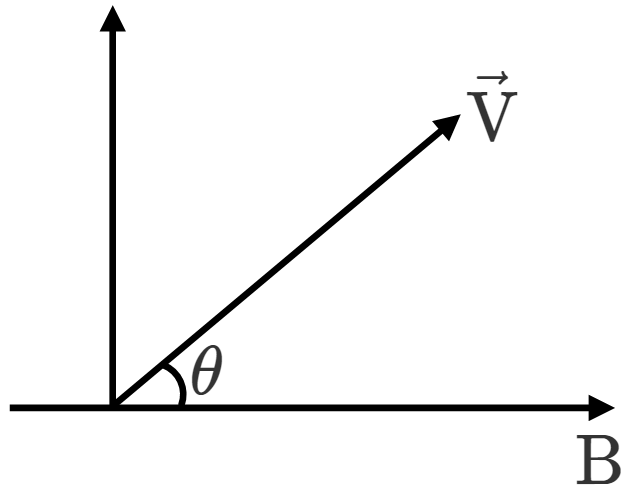
Force on charged particle in a magnetic eld $\text{F} = \text{q} (\text{v}\times\text{b}) = \text{qvB} \sin\theta \ ...(2) $

Where boldface letter represent vector nature of that quantity, q is charge of the particle, v is the velocity of the particle( if any), and $\theta$ is the angle between velocity and magnetic eld. 

From (1), FE = 0 only when either q = 0 or E = 0. 

Let q ≠ 0, and F ≠ 0, then we must have E ≠ 0 

From (2), if q ≠ 0, v ≠ 0 and B ≠ 0 even then FB can be 'zero' because of θ = 0° or 180°

View full question & answer
Question 131 Mark
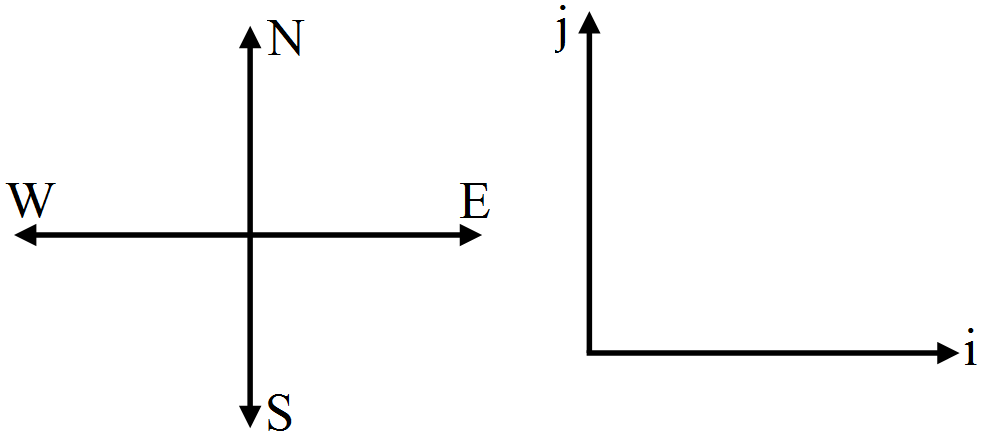
A positively charged particle projected towards east is deflected towards north by a magnetic field. The field may be:
  1. Towards west.
  2. Towards south.
  3. Upward.
  4. Downward.
Answer
  1. Towards west.

Explanation:

$\text{F}=\text{q}\big(\overrightarrow{\text{V}}\times\overrightarrow{\text{B}}\big)$

$\text{j}=\text{q}\big(\overrightarrow{\text{i}}\times\overrightarrow{\text{B}}\big)$

$\Rightarrow\text{B}\otimes$

 The magnetic field may be down ward direction.

View full question & answer
Question 141 Mark
A charged particle moves along a circle under the action of possible constant electric and magnetic fields. Which of the following are possible?
  1. $\text{E}=0,\ \text{B}=0$
  2. $\text{E}=0,\ \text{B}\not=0$
  3. $\text{E}\not=0,\ \text{B}=0$
  4. $\text{E}\not=0,\ \text{B}\not=0$
Answer
  1. $\text{E}=0,\ \text{B}\not=0$

Explanation:

A charged particle moves along a circle that mean Magnetic force is provides centripetal force that causes particle is move in a circle.

So, $\text{E}=0,\ \text{B}\not=0$

View full question & answer
Question 151 Mark
A charged particle moves in a uniform magnetic field. The velocity of the particle at some instant makes an acute angle with the magnetic field. The path of the particle will be:
  1. A straight line.
  2. A circle.
  3. A helix with uniform pitch.
  4. A helix with nonuniform pitch.
Answer
  1. A helix with uniform pitch.

Explanation:

$\vec{\text{F}}=\text{q}(\vec{\text{V}}\times\vec{\text{B}})=\text{qvB}\sin\theta$

Megnetic force doesn't change the speed of the particle. It change the direction of the velocity of the particle.

V $\cos\theta$ provide the displacement of the particle in Horizontal direction & force is provide the centripetal acceleration of the particle.

So the path of the particle will be a helix with uniform pitch.

View full question & answer
Question 161 Mark
An electron is moving along the positive x-axis. You want to apply a magnetic field for a short time so that the electron may reverse its direction and move parallel to the negative x-axis. This can be done by applying the magnetic field along:
  1. y-axis.
  2. z-axis.
  3. y-axis only.
  4. z-axis only.
Answer
  1. y-axis.
  2. z-axis.

Explanation:

$\text{F}=\text{q}(\overrightarrow{\text{V}}\times\overrightarrow{\text{B}})$

This can be done by applying the Magnetic field along y axis or z axis.

View full question & answer
Question 171 Mark
If a charged particle kept at rest experiences an electromagnetic force:
  1. The electric field must not be zero.
  2. The magnetic field must not be zero.
  3. The electric field may or may not be zero.
  4. The magnetic field may or may not be zero.
Answer
  1. The electric field must not be zero.
  1. The magnetic field may or may not be zero.

Explanation:

Since particle is at rest, i.e. v=0, hence Fm=0

For electric force, E≠0

View full question & answer
Question 181 Mark
A charged particle moves in a gravity-free space without change in velocity. Which of the following is are possible:
  1. $\text{E}=0,\ \text{B}=0$
  2. $\text{E}=0,\ \text{B}\not=0$
  3. $\text{E}\not=0,\ \text{B}=0$
  4. $\text{E}\not=0,\ \text{B}\not=0$
Answer
  1. $\text{E}=0,\ \text{B}=0$

  2. $\text{E}=0,\ \text{B}\not=0$

  1.  $\text{E}\not=0,\ \text{B}\not=0$

Explanation:

⇒ Particle move with constant velocity in ay direction. So, B = 0, E = 0

⇒ Particle move in a circle with constant speed. Magnetic force is provide the centripetal force that causes particle is move in a circle.

⇒ If qE = qvB and Magnetic & Electric force in opposite direction in this case particle also move with uniform speed.

View full question & answer
Question 191 Mark
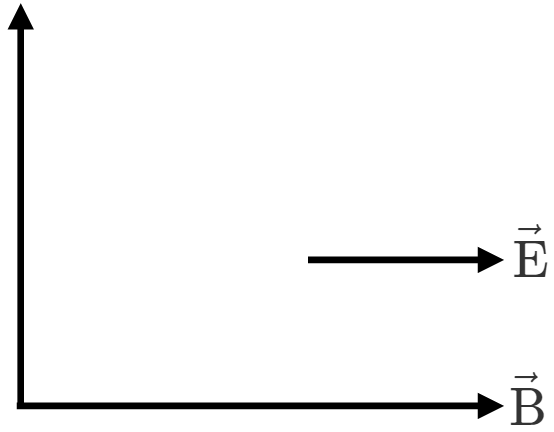
A particle moves in a region having a uniform magnetic field and a parallel, uniform electric field. At some instant, the velocity of the particle is perpendicular to the field direction. The path of the particle will be:
  1. A straight line.
  2. A circle.
  3. A helix with uniform pitch.
  4. A helix with nonuniform pitch.
Answer
  1. A helix with nonuniform pitch.

Explanation:

$\text{F}=\text{q}\vec{\text{E}}+\text{q}(\vec{\text{V}}\times\vec{\text{B}})$

$\text{F}=\text{q}\vec{\text{E}}$ provides the acceleration in 'x' direction.

$\text{F}_2=\text{}\text{q}(\vec{\text{V}}\times\vec{\text{B}})$ provides the centripetal Force.

The path of the particle will be ahelix with nonuniform pitch.

View full question & answer
Question 201 Mark
Which of the following particles will have minimum frequency of revolution when projected with the same velocity perpendicular to a magnetic field?
  1. Electron
  2. Proton
  3. He+
  4. Li+
Answer
  1. Li+

Explanation:

$\text{T}=\frac{2\pi\text{r}}{\text{v}\bot}\ ...(1)$

$\text{r}=\frac{\text{mv}_1}{\text{qB}}$

$\frac{\text{r}}{\text{v}\bot}=\frac{\text{m}}{\text{qB}}\ ...(2)$

from eq. (1) & (2) we get

$\text{T}=\frac{2\pi\text{m}}{\text{qB}}$

$\text{f}=\frac{1}{\text{T}}=\frac{\text{qB}}{2\pi\text{m}}$

Charge of all these particles are same but mass of Li+ is Highest.

 $\therefore\text{ mass}\uparrow,\ \text{f}\downarrow$

View full question & answer