Questions

5 Marks Questions

Take a timed test

6 questions · self-marked practice — reveal the answer and mark yourself.

Question 15 Marks
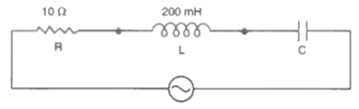
In the following circuit, calculate:
$i.$ the capacitance of the capacitor, if the power factor of the circuit is unity,
$ii$. the $Q-$ factor of this circuit. What is the significance of the $Q-$ factor in $ac$ circuit? Given the angular frequency of the $ac$ source to be $100 \text{rad/s}$. Calculate the average power dissipated in the circuit.
Image
Answer
$i$. Calculation of Capacitance
As power factor is unity,
$\therefore X _{ L }= X _{ C }$ also $L =200 \ mH$ and $R =10 \Omega$
$\Rightarrow \omega=\frac{1}{\sqrt{L C}}$
$100=\frac{1}{\sqrt{200 \times 10^{-3} \times C}}$
$10^4 \times 2 \times 10^2 \times 10^{-3} \times C =1$
hence ca[pacitance is given by, $C =\frac{1}{2 \times 10^3} F$
$=0.5 \times 10^{-3} F$
$=0.5 \ mF$
$ii. Q-$ factor of circuit and its importance Calculation of average power dissipated
Quality factor, $Q=\frac{1}{R} \sqrt{\frac{L}{C}}$
$=\frac{1}{10} \sqrt{\frac{200 \times 10^{-3}}{0.5 \times 10^{-3}}}$
$=\frac{1}{10} \times 20=2$
$ P = V _\text{ rms } I _\text{ rms } \cos \phi$
$=50 \times \frac{50}{10} \times 1 W$
$=250 \text { watts }$
View full question & answer
Question 25 Marks
$i$. Prove that an ideal capacitor in an ac circuit does not dissipate power.
$ii$. An inductor of $200 mH,$ a capacitor of $400 \mu f$, and a resistor of $10 \Omega$ are connected in series to ac source of $50 V$ of variable frequency. Calculate the
$a$. the angular frequency at which maximum power dissipation occurs in the circuit and the corresponding value of the effective current and
$b$. value of $Q-$ factor in the circuit.
Answer
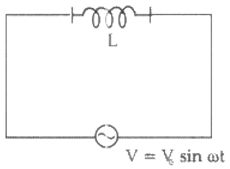
$i$. Given: $V = V _0 \sin \omega t$
$V =L \frac{d i}{d t} $
$\Rightarrow d i=\frac{V}{L} d t$

Image
$\therefore d i=\frac{V_0}{L} \sin \omega t \ d t$
Integrating, $I =-\frac{V_0}{\omega L} \cos \omega t$
$\therefore I=-\frac{V_0}{\omega L} \sin \left(\frac{\pi}{2}-\omega t\right)$
$=-I_0 \sin \left(\frac{\pi}{2}-\omega t\right)$
where, $I _0=\frac{V_0}{\omega L}$
Average power,
$P_{a v}=\int_0^T V I \ d t$
$=\frac{-V_0^2}{\omega L} \int_0^T \sin \omega t \cos \omega t\  dt$
$=\frac{-V_0^2}{2 \omega L} \int_0^T (\sin (2 \omega t) dt \sin)$ is an odd function so integral results into $ 0 \text {. }$
$=0 ,$ thus the power dissipated by the conductor is zero. 
$ii. a. \omega_0=\frac{1}{\sqrt{L C}}$
$=\frac{1}{\left(200 \times 10^{-3} \times 400 \times 40^{-6}\right)^{1 / 2}}$
$=\frac{1}{\sqrt{8 \times 10^{-5}}} \text{ rad / s}$
$=\frac{10^3}{\sqrt{80}} \text{ rad / s}$
$=111 \text{ rad / s}$
$I=\frac{V}{R}=\frac{50}{10}=5 A$
$b. Q=\frac{1}{R} \sqrt{\frac{L}{C}}$
$=\frac{1}{10} \sqrt{\frac{200 \times 10^{-3}}{400 \times 10^{-6}}}=\sqrt{5}$
View full question & answer
Question 35 Marks
Derive an expression for the electric potential at a point due to an electric dipole. Mention the contrasting features of electric potential of a dipole at a point as compared to that due to a single charge.
Answer
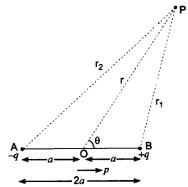
Consider an electric dipole having charges $-q$ and $+q$ at separation $'2a\ '.$ The dipole moment of dipole is $\vec{p}=q(\overrightarrow{2} a)$ directed from $- q$ to $+ q.$
The electric potential due to dipole is the algebraic sum of potentials due to charges $+q$ to $-q$
If $r_1$ and $r_2$ are distances of any point $P$ from charge $+q$ to $-q$ respectively as shown in the figure, then the potential due to electr dipole at point $P$ , is
Image
$V=\frac{1}{4 \pi \varepsilon_0} \frac{q}{r_1}-\frac{1}{4 \pi \varepsilon_0} \frac{q}{r_2}=\frac{q}{4 \pi \varepsilon_0}\left[\frac{1}{r_1}-\frac{1}{r_2}\right]
..(i)$
If $( r , \theta)$ are polar coordinates of point P with respect to mid$-$point $O$ of dipole, then
By geometry,
$r_1^2=r^2+a^2-2 a r \cos \theta \ldots \text { (ii) }$
and, $r_2^2=r^2+a^2-2 a r \cos \theta \ldots \text { (iii) }$
From $(ii), r_1^2=r^2\left[1-\frac{2 a \cos \theta}{r}+\frac{a^2}{r^2}\right]$
If $r \gg$ a i e., $\frac{a}{r}<<1$, then it is sufficient to retain terms only upto first order in $\left(\frac{a}{r}\right)$. $\therefore r_1^2=r^2\left[1-\frac{2 a \cos \theta}{r}\right] \Rightarrow r_1=r\left[1-\frac{2 a \cos \theta}{r}\right]^{\frac{1}{2}}$
Similarly from $(iii), r_2{ }^2=r^2\left[1+\frac{2 a \cos \theta}{r}\right] \Rightarrow r_2=r\left[1+\frac{2 a \cos \theta}{r}\right]^{\frac{1}{2}}$
From $(iv)$ and $(v), \frac{1}{r_1}=\frac{1}{r}\left[1-\frac{2 a \cos \theta}{r}\right]^{\frac{-1}{2}}$ and, $\frac{1}{r_2}=\frac{1}{r}\left[1+\frac{2 a \cos \theta}{r}\right]^{\frac{-1}{2}}$
Using binomial theorem and retaining terms upto first order in $\left(\frac{a}{r}\right)$ only, we have
$\frac{1}{r_1}=\frac{1}{r}\left[1-\left(-\frac{1}{2}\right) \frac{2 a \cos \theta}{r}\right]=\frac{1}{r}\left[1+\frac{a}{r} \cos \theta\right]$
and, $\frac{1}{r_3}=\frac{1}{r}\left[1-\frac{a}{r} \cos \theta\right]$
Substituting these values in $(i),$ we get
$V=\frac{q}{4 \pi \varepsilon_0}\left[\frac{1}{r}\left(1+\frac{a}{r} \cos \theta\right)-\frac{1}{r}\left(1-\frac{a}{r} \cos \theta\right)\right]$
$=\frac{1}{4 \pi \varepsilon_0} \frac{q}{r}\left[1+\frac{a}{r} \cos \theta-1+\frac{a}{r} \cos \theta\right]$
$=\frac{1}{4 \pi \varepsilon_0} \frac{q}{r}\left[\frac{2 a}{r} \cos \theta\right]=\frac{1}{4 \pi \varepsilon_0} \frac{(q 2 a) \cos \theta}{r^2}$
$\text { or, } V=\frac{1}{4 \pi \varepsilon_0} \frac{p \cos \theta}{r^2} $
But, $p \cos \theta=\vec{p} \cdot \hat{r}$ where, $\hat{r}$ is unit vector along position vector $\vec{O} P=\vec{r}$.
Electric potential due to an electric dipole is
$V=\frac{1}{4 \pi \epsilon_0} \frac{\vec{p} \cdot \hat{r}}{r^2}($ for $r \gg a )=\frac{1}{4 \pi \epsilon_0} \frac{\vec{p} \cdot \vec{r}}{r^3}$
Contrasting features: The electric potential due to a dipole depends on distance $r$ and also on the angle between position vector $\vec{r}$ and dipole moment $ \vec{p}$ . The electrostatic potential at large distances falls off, as $\frac{1}{r^2}$ and not as $\frac{1}{r}$ which is the characteristic of potential due to a single charge.
potential due to a single charge.
Special Cases:
$i.$ When point $P$ lies on the axis of dipole, then $\theta=0^{\circ}$
$\therefore \cos \theta=\cos 0=1$
$\therefore V=\frac{1}{4 \pi \varepsilon_0} \frac{p}{r^2}$
$ii.$ When point $P$ lies on the equatorial plane of the dipole, then
$\therefore \cos \theta=\cos 90^{\circ}=0$
$\therefore V=0$
It may be noted that the electric potential at any point on the equitorial line of a dipole is zero.
 
View full question & answer
Question 45 Marks
A parallel plate capacitor is charged by a battery. After some time the battery is disconnected and a dielectric slab with its thickness equal to the plate separation is inserted between the plates. What change, in any will take place in
i. charge on the plates
ii. electric field intensity between the plates
iii. the capacitance of the capacitor,
iv. a potential difference between the plates and
v. the energy stored in the capacitor? Justify your answer in each case. OR
Answer
i. The charge $q _0$ on the capacitor plates remains the same because the battery has been disconnected, before placing the dielectric slab.
ii. The surface charges induced on the dielectric slab reduce electric field intensity to a new value given by $E=\frac{E_0}{\kappa}$
iii. The reduction in the electric field induces the potential difference $V=E d=\frac{E_0 d}{k}=\frac{V_0}{k}$
iv. Due to the decrease in p.d., the capacitance increases k times $C=\frac{q_0}{V}=\frac{q_0}{V_0 / k }= K \frac{q_0}{V_0}=\kappa C _0$ v. Energy stored decreases by a factor of $\kappa$ :
$
U=\frac{1}{2} C V^2=\frac{1}{2}\left(\kappa C_0\right)\left(\frac{V_0}{K}\right)^2=\frac{1}{\kappa} \cdot \frac{1}{2} C_0 V_0^2=\frac{U_0}{\kappa}
$
View full question & answer
Question 55 Marks
When a parallel beam of a monochromatic source of light of wavelength $\lambda$ is incident on a single slit of width a, show how the diffraction pattern is formed at the screen by the interference of the wavelets from the slit. Show that, besides the central maxima $\theta=0$, secondary maxima are observed at $\theta=\left(n+\frac{1}{2}\right) \frac{\lambda}{a}$ and the minima at $\theta=\frac{n \lambda}{a}$. Why do secondary maxima get weaker in intensity with increasing n?
Answer
i.
Image
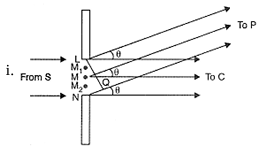
The diffraction pattern formed can be understood by adding the contributions from the different wavelets of the incident wavefront, with their proper phase differences. For the central point, we imagine the slit to be divided into two equal halves. The contribution of corresponding wavelets, in the two halves, are in phase with each other. Hence we get a maxima at the central point. The entire incident wavefront contributes to this maxima. Maxima and minima are produced when the path difference between waves is a whole number of wavelengths or an odd number of half wavelengths respectively. All other points, for which $\theta=\left(n+\frac{1}{2}\right) \frac{\lambda}{a}$ get a net non zero contribution from all the wavelets. Hence all such points are at the points of maxima.
Points for which $\theta=\frac{n \lambda}{a}$, the net contribution, from all the wavelets, is zero. Hence these points are point of minima.
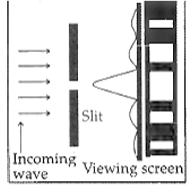
We thus get a diffraction pattern on the screen, made up of points of maxima and minima.

Image Secondary maxima keep on getting weaker in intensity, with increasing n. This is because, at the
ii. First secondary maxima, the net contribution is only from (effectively) $\frac{1}{3}$ rd of the incident wavefront on the slit.
iii. Second secondary maxima, the net contribution is only from (effectively) $\frac{1}{5}$ th of the incident wavefront on the slit and so on.
View full question & answer
Question 65 Marks
A compound microscope consists of an objective lens of focal length $2.0 \ cm$ and an eyepiece of focal length $6.25 \ cm$ separated by a distance of $15 \ cm$. How far from the objective should an object be placed in order to obtain the final image at
$a$ .the least distance of distinct vision $(25 \ cm),$ and
$b$. at infinity?
What is the magnifying power of the microscope in each case?
Answer
Given that,
Focal length of the objective lens, $f _1=2.0 \ cm$
Focal length of the eyepiece, $f _2=6.25 \ cm$
Distance between the objective lens and the eyepiece $, d = 15 \ cm$
$a$. Given that, Least distance of distinct vision $ d\ ' = 25 \ cm$
Image distance for the eyepiece, $v _2=-25 \ cm$
Object distance for the eyepiece $= u _2$
According to the lens formula,
$\frac{1}{v_2}-\frac{1}{u_2}=\frac{1}{f_2}$
$\frac{1}{u_2}=\frac{1}{v_2}-\frac{1}{f_2}$
$=\frac{1}{-25}-\frac{1}{6.25}=\frac{-1-4}{25}=\frac{-5}{25}$
$\therefore u _2=-5 \ cm$
Image distance for the objective lens, $v _1= d + u _2=15-5=10 \ cm$
Object distance for the objective lens $= u _1$
According to the lens formula,
$\frac{1}{v_1}-\frac{1}{u_1}=\frac{1}{f_1}$
$\frac{1}{u_1}=\frac{1}{v_1}-\frac{1}{f_1}=\frac{1}{10}-\frac{1}{2}=\frac{1-5}{10}=\frac{-4}{10}$
$\therefore u _1=-2.5 \ cm$ Magnitude of the object distance, $\left|u_1\right|=2.5 \ cm$
The magnifying power of a compound microscope is:
$m=\frac{v_1}{\left|u_1\right|}\left(1+\frac{d^{\prime}}{f_2}\right)=\frac{10}{2.5}\left(1+\frac{25}{6.25}\right)=4(1+4)=20$
$b$ .The final image is formed at infinity.
Therefore, image distance for the eyepiece, $v _2=\infty$
Object distance for the eyepiece $= u _2$
According to the lens formula, we have the relation,
$\frac{1}{v_2}-\frac{1}{u_2}=\frac{1}{f_2}$
$\frac{1}{\infty}-\frac{1}{u_2}=\frac{1}{6.25}$
$\therefore u _2=-6.25 \ cm$
Image distance for the objective lens, $v _1= d + u _2=15-6.25=8.75 \ cm$
Object distance for the objective lens $= u _1$
According to the lens formula,
$\frac{1}{v_1}-\frac{1}{u_1}=\frac{1}{f_1}$
$\frac{1}{u_1}=\frac{1}{v_1}-\frac{1}{f_1}=\frac{1}{8.75}-\frac{1}{2.0}=\frac{2-8.75}{17.5}$
$\therefore u_1=-\frac{17.5}{6.75}=-2.59 \ cm$
Magnitude of the object distance, $\left|u_1\right|=2.59 \ cm$
The magnifying power of a compound microscope is,
$m=\frac{v_1}{\left|u_1\right|}\left(\frac{d^{\prime}}{\left|u_2\right|}\right)=\frac{8.75}{2.59} \times \frac{25}{6.25}=13.51$
Thus, the magnifying power of the microscope is $13.51$
View full question & answer