Questions

M.C.Q (1 Marks)

🎯

Test yourself on this topic

12 questions · timed · auto-graded

MCQ 11 Mark
If copper wire is stretched to make its radius decrease by 0.1%, then the percentage change in its resistance is approximately
  • A
    -0.4%
  • B
    +0.8%
  • C
    +0.4%
  • D
    +0.2%
Answer
(c) +0.4%
View full question & answer
MCQ 21 Mark
The number of electrons made available for conduction by dopant atoms depends strongly upon
  • A
    doping level
  • B
    increase in ambient temperature
  • C
    energy gap
  • D
    options (a) and (b) both
Answer
(a) doping level
View full question & answer
MCQ 31 Mark
Colours observed on a CD (Compact Disk) is due to
  • A
    Reflection
  • B
    Diffraction
  • C
    Dispersion
  • D
    Absorption
Answer
(b) Diffraction
View full question & answer
MCQ 41 Mark
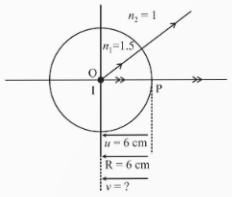
A point object is placed at the centre of a glass sphere of radius $6 \ cm$ and refractive index $1.5.$ The distance of virtual image from the surface of the sphere is
  • A
    $2 \ cm$
  • B
    $4 \ cm$
  • $6 \ cm$
  • D
    $12 \ cm$
Answer
Correct option: C.
$6 \ cm$
Image
$\frac{n_2}{v}-\frac{n_1}{u}=\frac{n_2-n_1}{R}$
$\frac{1}{v}-\frac{3}{2[-6]}=\frac{[1-3 / 2]}{-6}$
$\frac{1}{v}=\frac{-3}{12}+\frac{1}{12}=\frac{-2}{12}=\frac{-1}{6}$
$v=6 \ cm$
View full question & answer
MCQ 51 Mark
The distance of closest approach of an alpha particle is $d$ when it moves with a speed $V$ towards a nucleus.
Another alpha particle is projected with higher energy such that the new distance of the closest approach is $d/2.$ What is the speed of projection of the alpha particle in this case?
  • A
    $V / 2$
  • $\sqrt{2} V$
  • C
    $2 V$
  • D
    $4 V$
Answer
Correct option: B.
$\sqrt{2} V$
$d=\frac{\text { const }}{V_1^2} ...(1)$
$\frac{d}{2}=\frac{\text { const }}{V_2^2} ...(2)$
From equations$ (1)$ and $(2),$
$2=\frac{V_2^2}{V_1^2}$
$\Rightarrow V_2=\sqrt{2} V_1$
$\therefore V_2=\sqrt{2} V$
Given, $\left( V _1= V \right)$
 
View full question & answer
MCQ 71 Mark
In a series $\text{LCR}$ circuit, the voltage across the resistance, capacitance and inductance is $10 V$ each. If the capacitance is short circuited the voltage across the inductance will be
  • A
    $10 V$
  • B
    $10 \sqrt{2} V$
  • $10 / \sqrt{2} V$
  • D
    $20 V$
Answer
Correct option: C.
$10 / \sqrt{2} V$
When all the given components are connected
$I R=I X_C=I X_L=10 V$
$X_C=X_L=R$
$Z=\sqrt{R^2+\left(X_C-X_L\right)^2}$
$Z=\sqrt{R^2+(R-R)^2}$
$Z=R$
$V_S=I Z=I R=10 V$
So, the source voltage is also $10 V$ When the capacitor is short circuited then
$ Z =\sqrt{ R ^2+\left( X _{ L }\right)^2}$
$ =\sqrt{R^2+R^2}=R \sqrt{2}$
$V_{ L } = I ^{\prime} X _{ L }$
$=\frac{10}{\sqrt{2} R } \times R$
$=5 \sqrt{2} V$
View full question & answer
MCQ 81 Mark
A capacitor consists of two parallel plates, with an area of cross-section of $0.001 m^2$, separated by a distance of 0.0001 m. If the voltage across the plates varies at the rate of $10^8 V / s$, then the value of displacement current through the capacitor is
  • A
    $8.85 \times 10^{-3} A$
  • B
    $8.85 \times 10^{-4} A$
  • C
    $7.85 \times 10^{-3} A$
  • D
    $9.85 \times 10^{-3} A$
View full question & answer
MCQ 91 Mark
The diffraction effect can be observed in
  • A
    sound waves only
  • B
    light waves only
  • C
    ultrasonic waves only
  • D
    sound waves as well as light waves
Answer
(d) Sound waves as well as light waves
View full question & answer
MCQ 101 Mark
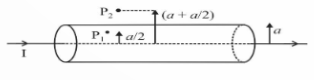
A long straight wire of circular cross section of radius'a carries a steady current $1$. The current is uniformly distributed across its cross section. The ratio of magnitudes of the magnetic field at a point $a/2$ above the surface of wire to that of a point a $2$ below its surface is
  • A
    $4:1$
  • B
    $1:1$
  • $4:3$
  • D
    $3:4$
Answer
Correct option: C.
$4:3$
Image

At  $P_2, B_2=\frac{\mu_0 I}{2 \pi\left(\frac{3 a}{2}\right)}=\frac{\mu_0 I}{3 \pi a}$
At $ P_1, B_1=\frac{\mu_0(I / 4)}{2 \pi(a / 2)}=\frac{\mu_0 I}{4 \pi a}$
$\therefore \frac{B_2}{B_1}=\frac{\left(\frac{\mu_0 I}{3 \pi a}\right)}{\left(\frac{\mu_0 I}{4 \pi a}\right)} $
$\Rightarrow \frac{B_2}{B_1}=\frac{4}{3}$
View full question & answer
MCQ 111 Mark
A conducting wire connects two charged conducting spheres such that they attain equilibrium with respect to each other. The distance of separation between the two spheres is very large as compared to either of their radii.
The ratio of the magnitudes of the electric fields at the surfaces of the two spheres is
  • A
    $\frac{r_1}{r_2}$
  • B
    $\frac{r_2}{r_1}$
  • C
    $\frac{r_2^2}{r_1^2}$
  • D
    $\frac{r_1^2}{r_2^2}$
Answer
(b) In the state of equilibrium,
The potential on the surface of bigger sphere the potential at the surface of the smaller sphere.
$\begin{aligned} & \frac{k q_1}{r_1}=\frac{k q_2}{r_2} \Rightarrow \frac{q_1}{q_2}=\frac{r_1}{r_2} \\ \therefore & \frac{ E _1}{ E _2}=\frac{q_1}{q_2} \frac{r_2^2}{r_1^2}=\frac{r_1}{r_2} \cdot \frac{r_2^2}{r_1^2}=\frac{r_2}{r_1}\end{aligned}$
View full question & answer
M.C.Q (1 Marks) - Physics STD 12 Science Questions - Vidyadip