Questions

2 Marks Questions

Take a timed test

6 questions · self-marked practice — reveal the answer and mark yourself.

Question 12 Marks
Which one of the following will describe the smallest circle when projected with the same velocity $v$ perpendicular to the magnetic field $B: (i)\ \alpha-$particle, and $(ii)\ \beta-$particle?
Answer
Radius, $r=\frac{m v}{q B}$
$\frac{r_\alpha}{r_\beta}=\frac{m_\alpha v}{q_\alpha B} \cdot \frac{q_\beta B}{m_\beta v}$
$=\frac{m_c q_\beta}{m_\beta q_\alpha}$
$=\frac{4 m_p \cdot e}{m_e \cdot 2 e}$
$=\frac{4 \times 1.67 \times 10^{-27}}{2 \times 9.1 \times 10^{-31}}$
$=\frac{1835}{2}$
$=917.5$
Thus $\beta-$particle will describe the circle of smallest radius.
View full question & answer
Question 22 Marks
A proton and an alpha particle having the same kinetic energy are, in turn, passed through a region of the uniform magnetic field, acting normal to the plane of the paper and travel in circular paths. Deduce the ratio of the radii of the circular paths described by them.
Answer
Derivation of ratio of the radii of the circular paths $r =\frac{m v}{q B}$
But $\frac{p^2}{2 m}=k$
$\Rightarrow p=\sqrt{2 m k}= mv$
$\Rightarrow \frac{r_\alpha}{r_p}=\frac{\sqrt{2 m_\alpha k_\alpha} / q_a B}{\sqrt{2 m_p k_p} / q_p B}$
But $k _\alpha= k _{ p }$
$\frac{r_\alpha}{r_p}=\frac{q_p}{q_\alpha} \sqrt{\frac{m_\alpha}{m_p}}$
Since, charge of alpha particle $q _\alpha=2 q _{ p }$
mass of alpha particle $m _\alpha=4 m_{ p }$
$\Rightarrow \frac{r_\alpha}{r_p}=\frac{q_p}{2 q_p} \sqrt{\frac{4 m_p}{m_p}}=1: 1$
View full question & answer
Question 32 Marks
An $\alpha$-particle moving with initial kinetic energy $K$ towards a nucleus of atomic number $Z$ approaches a distance $d$ at which it reverses its direction. Obtain the expression for the distance of closest approach $d$ in terms of the kinetic energy of $\alpha$-particle $K$.
Answer
When alpha particle approaches Nucleus,Kinetic energy of alpha particle will be converted into potential energy of the system. Kinetic energy of -particle is given as,
$K=\frac{1}{4 \pi \varepsilon_0} \frac{2 e . Z e}{d}$
where d is the distance of closest approach.
Or $d=\frac{2 Z e^2}{4 \pi \varepsilon_0 K}$
This is the required expression for the distance of closest approach d in terms of kinetic energy K.
View full question & answer
Question 42 Marks
Determine the number density of donor atoms which have to be added to an intrinsic germanium semiconductor to produce an n-type semiconductor of conductivity $5 \Omega^{-1} cm^{-1}$, given that the mobility of electron in $n-$type Ge is $3900 cm^2 /$ vs. Neglect the contribution of holes to conductivity.
Answer
Here $\sigma=5 \Omega^{-1} \ cm^{-1}, \mu_e=3900 \ cm^2 V^{-1} s^{-1}, n _{ e }= ?$
If we neglect the contribution of holes to conductivity, then
$\sigma=\frac{1}{\rho}=e n_e \mu_e$
$\therefore$ Electron density,
$ n _{ e }=\frac{\sigma}{e \mu_e}=\frac{5}{1.6 \times 10^{-19} \times 3900} \ cm^{-3}$
$=8.01 \times 10^{15} \ cm^{-3}$
View full question & answer
Question 52 Marks
Distinguish between diamagnetic and ferromagnetic materials in terms of
i. susceptibility and
ii. their behaviour in a non-uniform magnetic field
Answer
i. Susceptibility for diamagnetic material:
It is independent of magnetic field and temperature (except for bismuth at low temperature).
Susceptibility for ferromagnetic material:
ii. Behaviour in non-uniform magnetic field:
Diamagnetic substances are feebly repelled, whereas ferromagnets are strongly attracted by non-uniform field.
View full question & answer
Question 62 Marks
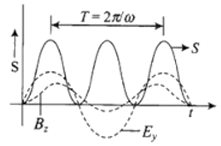
Poynting vectors $\vec{S}$ is defined as a vector whose magnitude is equal to the wave intensity and whose direction is along the direction of wave propogation. Mathematically, it is given by $\vec{S}=\frac{1}{\mu_0} \vec{E} \times \vec{B}$. Show the nature of $S$ vs $t$ graph.
Answer
Poynting vectors $S$ is defined as a vector whose magnitude is equal to the wave intensity and whose direction is along the direction of wave propagation.
 In an electromagnetic wave, let $\vec{E}$ be varying along $y-$ axis, $\vec{B}$ is along $z-$ axis and propagation of wave be along $x-$ axis.
Then $\vec{E} \times \vec{B}$ will tell the direction of propagation of energy flow in electromagnetic wave, along $x-$ axis. Let $\vec{E}= E _0 \sin (\omega t - kx ) \hat{j}$
$\vec{B}= B _0 \sin (\omega t - kx ) \hat{k}$
$S=\frac{1}{\mu_0}(\vec{E} \times \vec{B})=\frac{1}{\mu_0} E_0 B_0 \sin ^2(\omega t-k x)(\hat{j} \times \hat{k})$
$\Rightarrow S=\frac{E_0 B_0}{\mu_0} \sin ^2(\omega t-k x) \hat{i}( As \hat{j} \times \hat{k}=\hat{i})$
Since $\sin ^2(\omega t - kx )$ is never negative, $\vec{S}( x , t )$ always points in the positive $X-$ direction,
i.e, in the direction of wave propagation.
The variation of $|S|$ with time $T$ will be as given in the figure below:
Image
View full question & answer
2 Marks Questions - Physics STD 12 Science Questions - Vidyadip