Question 14 Marks
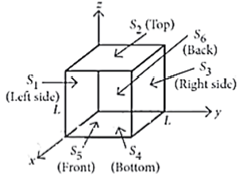
Net electric flux through a cube is the sum of fluxes through its six faces. Consider a cube as shown in figure, having sides of length $L =10.0 \ cm$. The electric field is uniform, has a magnitude $E =4.00 \times 10^3 NC ^{-1}$ and is parallel to the $xy$ plane at an angle of $37^{\circ}$ measured from the $+ x -$axis towards the $+ y -$axis.
$(i)$ Electric flux passing through surface $S_6$ is
$(a) \ -24 \ Nm ^2 C ^{-1}$
$(b) \ 32 \ Nm ^2 C ^{-1}$
$(c) \ -32 \ Nm ^2 C ^{-1}$
$(d)\ 24 \ Nm ^2 C ^{-1}$
$(ii)$ Electric flux passing through surface $S_1$ is
$(a)-32 \ Nm ^2 C ^{-1}$
$(b) -24 \ Nm ^2 C ^{-1}$
$(c)\ 32 \ Nm ^2 C ^{-1}$
$(d)\ 24 \ Nm ^2 C ^{-1}$
$(iii)$ The surfaces that have zero flux are
$(a) S _2$ and $S _4 \ (b) S_3$ and $S_6 \ (c) S _1$ and $S _2 \ (d) S _1$ and $S _3$
$(iv)$ he total net electric flux through all faces of the cube is $a) 24 \ Nm^2 C-1 c)-8 \ Nm^2 C-1$
$(a) \ 24 \ Nm ^2 C ^{-1} \ (b) \ 8 \ Nm ^2 C ^{-1} \ (c) \ -8 \ Nm ^2 C ^{-1} \ (d)$ zero
OR
The dimensional formula of surface integral $\oint \vec{E} \cdot d \vec{S}$ of an electric field is
$(a) \ \left[ M ^{-1} L^3 T^{-3} A\right]$
$(b)\ \left[ M L ^2 T^{-2} A^{-1}\right]$
$(c) \ \left[ ML ^3 T^{-3} A^{-1}\right]$
$(d) \ \left[ M L ^{-3} T^{-3} A^{-1}\right]$
$(i)$ Electric flux passing through surface $S_6$ is
$(a) \ -24 \ Nm ^2 C ^{-1}$
$(b) \ 32 \ Nm ^2 C ^{-1}$
$(c) \ -32 \ Nm ^2 C ^{-1}$
$(d)\ 24 \ Nm ^2 C ^{-1}$
$(ii)$ Electric flux passing through surface $S_1$ is
$(a)-32 \ Nm ^2 C ^{-1}$
$(b) -24 \ Nm ^2 C ^{-1}$
$(c)\ 32 \ Nm ^2 C ^{-1}$
$(d)\ 24 \ Nm ^2 C ^{-1}$
$(iii)$ The surfaces that have zero flux are
$(a) S _2$ and $S _4 \ (b) S_3$ and $S_6 \ (c) S _1$ and $S _2 \ (d) S _1$ and $S _3$
$(iv)$ he total net electric flux through all faces of the cube is $a) 24 \ Nm^2 C-1 c)-8 \ Nm^2 C-1$
$(a) \ 24 \ Nm ^2 C ^{-1} \ (b) \ 8 \ Nm ^2 C ^{-1} \ (c) \ -8 \ Nm ^2 C ^{-1} \ (d)$ zero
OR
The dimensional formula of surface integral $\oint \vec{E} \cdot d \vec{S}$ of an electric field is
$(a) \ \left[ M ^{-1} L^3 T^{-3} A\right]$
$(b)\ \left[ M L ^2 T^{-2} A^{-1}\right]$
$(c) \ \left[ ML ^3 T^{-3} A^{-1}\right]$
$(d) \ \left[ M L ^{-3} T^{-3} A^{-1}\right]$
Answer
View full question & answer→Net electric flux through a cube is the sum of fluxes through its six faces. Consider a cube as shown in figure, having sides of length $L =10.0 \ cm$. The electric field is uniform, has a magnitude $E =4.00 \times 10^3 NC ^{-1}$ and is parallel to the $xy$ plane at an angle of $37^{\circ}$ measured from the $+x-$axis towards the $+y-$axis.
$(i) (c) -32 \ \ Nm ^2 C ^{-1}$
Explanation$:$ Electric flux, $\phi=\vec{E} \cdot \vec{A}=E A \cos \theta$
where $\vec{A}=A \hat{n}$
For electric flux passing through $S _6, \hat{n}_{S_6}=-\hat{i} ($Back$)$
$\therefore \phi_{S_6}=-\left(4 \times 10^3 NC^{-1}\right)(0.1 m)^2 \cos 37^0$
$=-32 \ Nm^2 C^{-1}$
$(ii) (b) -24 \ Nm ^2 C ^{-1}$
Explanation$:$ For electric flux passing through $S _1, \hat{n}_{S_1}=-\hat{j} ($Left$)$
$\therefore \phi_{S_1}=-\left(4 \times 10^3 NC^{-1}\right)(0.1 m)^2 \cos 90^{\circ}=0$
$=-24 \ Nm^2 C^{-1}$
$(iii) (a) S _2$ and $S _4$
Explanation$:$ Here, $\hat{n}_{S_2}=+\hat{k} ($Top$)$
$\therefore \phi_{S_2}=-\left(4 \times 10^3 NC ^{-1}\right)(0.1 m)^2 \cos 90^{\circ}=0$
$\hat{n}_{S_3}=+\hat{j} \text { (Right) }$
$\hat{n}_{S_4}=-\hat{k} \text { (Bottom) }$
$\therefore \phi_{S_4}=-\left(4 \times 10^3 NC ^{-1}\right)(0.1 m)^2 \cos 90^{\circ}=0$
$\text { And, } \hat{n}_{S_5}=+\hat{i} \text { (Front) }$
$ \therefore \phi_{S_5}=+\left(4 \times 10^3 NC^{-1}\right)(0.1 m)^2 \cos 37^{\circ}=0$
$=32 \ Nm^2 C^{-1} $
$S_2$ and $S_4$ surface have zero flux.
$(iv) (d)$ zero
Explanation$:$ As the field is uniform, the total flux through the cube must be zero, i.e., any flux entering the cube must leave it.
$\ce{OR}$
$(c) \left[ M L ^3 T^{-3} A^{-1}\right]$
Explanation$:$ Surface integral $\oint \vec{E} \cdot d \vec{S}$ is the net electric flux over a closed surface $S.$
$\therefore\left[\phi_E\right]=\left[ M L ^3 T^{-3} A^{-1}\right]$
$(i) (c) -32 \ \ Nm ^2 C ^{-1}$
Explanation$:$ Electric flux, $\phi=\vec{E} \cdot \vec{A}=E A \cos \theta$
where $\vec{A}=A \hat{n}$
For electric flux passing through $S _6, \hat{n}_{S_6}=-\hat{i} ($Back$)$
$\therefore \phi_{S_6}=-\left(4 \times 10^3 NC^{-1}\right)(0.1 m)^2 \cos 37^0$
$=-32 \ Nm^2 C^{-1}$
$(ii) (b) -24 \ Nm ^2 C ^{-1}$
Explanation$:$ For electric flux passing through $S _1, \hat{n}_{S_1}=-\hat{j} ($Left$)$
$\therefore \phi_{S_1}=-\left(4 \times 10^3 NC^{-1}\right)(0.1 m)^2 \cos 90^{\circ}=0$
$=-24 \ Nm^2 C^{-1}$
$(iii) (a) S _2$ and $S _4$
Explanation$:$ Here, $\hat{n}_{S_2}=+\hat{k} ($Top$)$
$\therefore \phi_{S_2}=-\left(4 \times 10^3 NC ^{-1}\right)(0.1 m)^2 \cos 90^{\circ}=0$
$\hat{n}_{S_3}=+\hat{j} \text { (Right) }$
$\hat{n}_{S_4}=-\hat{k} \text { (Bottom) }$
$\therefore \phi_{S_4}=-\left(4 \times 10^3 NC ^{-1}\right)(0.1 m)^2 \cos 90^{\circ}=0$
$\text { And, } \hat{n}_{S_5}=+\hat{i} \text { (Front) }$
$ \therefore \phi_{S_5}=+\left(4 \times 10^3 NC^{-1}\right)(0.1 m)^2 \cos 37^{\circ}=0$
$=32 \ Nm^2 C^{-1} $
$S_2$ and $S_4$ surface have zero flux.
$(iv) (d)$ zero
Explanation$:$ As the field is uniform, the total flux through the cube must be zero, i.e., any flux entering the cube must leave it.
$\ce{OR}$
$(c) \left[ M L ^3 T^{-3} A^{-1}\right]$
Explanation$:$ Surface integral $\oint \vec{E} \cdot d \vec{S}$ is the net electric flux over a closed surface $S.$
$\therefore\left[\phi_E\right]=\left[ M L ^3 T^{-3} A^{-1}\right]$