Questions

M.C.Q (1 Marks)

Take a timed test

12 questions · 1 auto-graded MCQ + 11 self-marked written.

MCQ 11 Mark
A microscope is focused on a mark. Then a glass slab of refractive index 1.5 and thickness 6 cm is placed on the mark. To get the mark again in focus the microscope should be moved
  • A
    9 cm upward c) 4 cm upward
  • B
    2 cm downward
  • C
    4 cm upward
  • D
    2 cm upward
Answer
(d) 2 cm upward
Explanation: Shift $S = t \left(\frac{1-1}{\mu}\right)$
Substituting the given data we get,
$S=6\left(\frac{1-1}{1.5}\right)$
or, $S=6\left(\frac{1-2}{3}\right)=2 cm$ upward
View full question & answer
MCQ 21 Mark
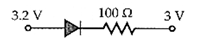
The current in the circuit shown in the figure considering ideal diode is
Image
  • A
    200A
  • B
    $2 \times 10^{-4} A$
  • C
    20A
  • D
    $2 \times 10^{-3} A$
Answer
(d) $2 \times 10^{-3} A$
Explanation: $I=\frac{(3.2-3) V }{100 \Omega}=2 \times 10^{-3} A$
View full question & answer
MCQ 31 Mark
An electric dipole placed in a non-uniform electric field can experience
  • A
    always a force and a torque.
  • B
    neither a force nor a torque.
  • C
    a force but not a torque.
  • D
    a torque but not a force.
Answer
(a) always a force and a torque.
Explanation: always a force and a torque.
View full question & answer
MCQ 41 Mark
In Huygens' theory, light waves
  • A
    are transverse waves and require no medium to travel.
  • B
    are longitudinal waves and require a medium to travel.
  • C
    are transverse waves and require a medium to travel.
  • D
    are longitudinal waves and require no medium to travel.
Answer
(b) are longitudinal waves and require a medium to travel.
Explanation: According to Huygens, light waves are longitudinal waves and require a material medium to travel. For this reason Huygens assumed the existence of a hypothetical medium called luminiferous aether.
View full question & answer
MCQ 51 Mark
Consider the two idealised systems: (i) a parallel plate capacitor with large plates and small separation and (ii) a long solenoid of length L > > R, radius of cross-section. In (i), E is ideally treated as a constant between plates and zero outside. In (ii), magnetic field is constant inside the solenoid and zero outside. These idealised assumptions, however, contradict fundamental laws as below:
  • A
    case (ii) contradicts Gauss's law for magnetic fields.
  • B
    case (i) contradicts Gauss's law for electrostatic fields.
  • C
    case (ii) contradicts en $\oint H \cdot d 1=I_{e n}$
  • D
    case (i) agrees with $\oint E . d 1=0$
Answer
(a) case (ii) contradicts Gauss's law for magnetic fields.
Explanation: case (ii) contradicts Gauss's law for magnetic fields.
View full question & answer
MCQ 61 Mark
A coil of wire of a certain radius has $100$ turns and a self$-$inductance of $15\ mH.$ The self$-$inductance of a second similar coil of $500$ turns will be:
  • A
    $15\ mH$
  • $375\ mH$
  • C
    $45\ mH$
  • D
    $75\ mH$
Answer
Correct option: B.
$375\ mH$
$L \propto N^2$
$\therefore L_2=\left(\frac{N_2}{N_1}\right)^2 L_1$
$=\left(\frac{500}{100}\right)^2 \times 15\ mH$
$=375\ mH $
View full question & answer
MCQ 71 Mark
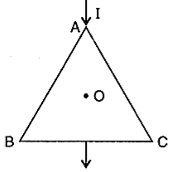
An equilateral triangle is made by uniform wires AB, BC, CA. A current I enteres at A and leaves from the midpoint of BC. If the lengths of each side of the triangle is L, the magnetic field B at the centroid O of the triangle is:
Image
  • A
    $\frac{\mu_0}{4 \pi}\left(\frac{4 I}{L}\right)$
  • B
    $\frac{\mu_0}{4 \pi}\left(\frac{2 I}{L}\right)$
  • C
    $\frac{\mu_0}{2 \pi}\left(\frac{4 I}{L}\right)$
  • D
    zero
Answer
(d) zero
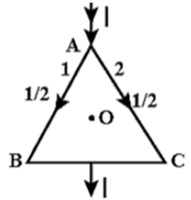
Explanation: Equal current flows in part 1 and 2 of triangular loop as shown in the figure. As both part of the triangular loop is symmetric about point O, so magnetic field at O due to both parts is equal and opposite to each other. Thus magnitude of magnetic field at O due to part 1 cancel out the magnitude of magnetic field at O due to part 2. Hence net magnetic field at O is zero.
Image
View full question & answer
MCQ 81 Mark
The capacitors, each of $4 \mu F$ are to be connected in such a way that the effective capacitance of the combination is $6 \mu F$. This can be achieved by connecting
Answer
(b) Two of them connected in series and the combination in parallel to the third.
Explanation: Two of them connected in series and the combination in parallel to the third.
View full question & answer
MCQ 91 Mark
The magnetic moment $(\mu)$ of a revolving electron around the nucleus varies with principal quantum number n as
  • A
    $\mu \propto n$
  • B
    $\mu \propto \frac{1}{n}$
  • C
    $\mu \propto \frac{1}{n^2}$
  • D
    $\mu \propto n^2$
Answer
(a) $\mu \propto n$
Explanation: Orbital magnetic moment of an electron,
$\mu=n \frac{e h}{4 \pi m_e}$ i.e., $\mu \propto n$
View full question & answer
MCQ 101 Mark
In a compound microscope, maximum magnification is obtained when the final image
  • A
    coincides with the objective
  • B
    is formed at the least distance of distinct vision
  • C
    coincides with the object
  • D
    is formed at infinity
Answer
(b) is formed at the least distance of distinct vision
Explanation: Magnification of compound microscope is given by
$m =\left(\frac{v_o}{u_o}\right)\left(1+\frac{D}{t_o}\right)$ when final image is formed at near point
Whereas, $m =\left(\frac{ v _o}{ u _o}\right)\left(\frac{D}{f_e}\right)$, when final image is formed at infinity.
Hence, magnification is maximum when final image is formed at near point (least distance of distinct vision).
View full question & answer
MCQ 111 Mark
Two bulbs each marked 100 W, 220 V are connected in series across 220 V supply. The power consumed by them, when lit, is
  • A
    220W
  • B
    zero
  • C
    100W
  • D
    50W
Answer
(d) 50 W
Explanation: 50 W
View full question & answer
MCQ 121 Mark
In the middle of the depletion layer of reverse biased p-n junction, the:
  • A
    potential is maximum
  • B
    potential is zero
  • C
    electric field is zero
  • D
    electric field is maximum
Answer
(c) electric field is zero
Explanation: When a p-n junction is reverse biased, the width of the depletion region increases. As a result, the electric field is greatly reduced. Practically, it becomes zero.
View full question & answer
M.C.Q (1 Marks) - Physics STD 12 Science Questions - Vidyadip