Question 15 Marks
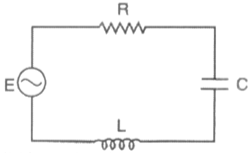
A resistor of $400 \Omega$, an inductor of $\frac{5}{\pi} H$ and a capacitor of $\frac{50}{\pi} \mu F$ are connected in series across a source of alternating voltage of $140 \sin 100 \pi t V$. Find the voltage $(rms)$ across the resistor, the inductor and the capacitor. Is the algebraic sum of these voltages more than the source voltage? If yes, resolve the paradox. $($Given, $\sqrt{2}=1.414 ).$
Answer
View full question & answer→$C=\frac{50}{\pi} \mu F, L=\frac{5}{\pi} H, R=400 \Omega$
As applied voltage, $V=140 \sin 100 \pi t$ Comparing it with $V=V_0 \sin \omega t$,
Inductive reactance, $X_L=\omega L$
$X_L=100 \pi \times 5 / \pi=500 \Omega$
Capacitive reactance, $X_C=\frac{1}{\omega C}$
$X_c=\frac{1}{100 \pi \times \frac{80}{\nabla} \times 10^{-6}}=200 \Omega$
Impedance of the $AC$ circuit,
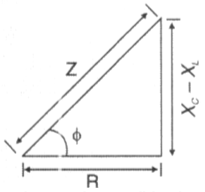
$Z=\sqrt{R^2+\left(X_L-X_C\right)^2}$
$=\sqrt{1409^2+(500-200)^2}$
$Z=\sqrt{1600+900=500 \Omega}$
Maximum current in the circuit,
$I_0=\frac{V_0}{Z}=\frac{140}{500}$
$I_{ rms }=\frac{I_0}{\sqrt{2}}=\frac{140}{500 \times \sqrt{2}}=0.2 A$
$ V _{\text {rms }}$ across resistor $R, V_{r m s}=I_{r m s} R$
$V_{r m s}=0.2 \times 400=80 V$
$V _{\text {rms }}$ across inductor, $V_L=I_{ rms } X_L$
$V_L=0.2 \times 500=100 V$
$V _{\text {rms }}$ across capacitor, $V_C=I_{ rms } X_C$
$V_C=0.2 \times 200=40 V$
Now, $V$
Here, $V \neq V_R+V_L+V_C$
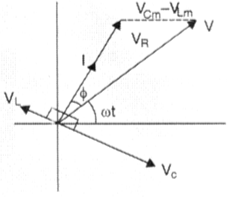
Because $V_C, V_L$ and $V_R$ are not in same phase,
$\therefore V=\sqrt{V_R^2+\left(V_L-V_C\right)^2}$
$V=\sqrt{80^2+(100-40)^2}=100 V$
which is same as the applied rms voltage.
As applied voltage, $V=140 \sin 100 \pi t$ Comparing it with $V=V_0 \sin \omega t$,
Inductive reactance, $X_L=\omega L$
$X_L=100 \pi \times 5 / \pi=500 \Omega$
Capacitive reactance, $X_C=\frac{1}{\omega C}$
$X_c=\frac{1}{100 \pi \times \frac{80}{\nabla} \times 10^{-6}}=200 \Omega$
Impedance of the $AC$ circuit,
$Z=\sqrt{R^2+\left(X_L-X_C\right)^2}$
$=\sqrt{1409^2+(500-200)^2}$
$Z=\sqrt{1600+900=500 \Omega}$
Maximum current in the circuit,
$I_0=\frac{V_0}{Z}=\frac{140}{500}$
$I_{ rms }=\frac{I_0}{\sqrt{2}}=\frac{140}{500 \times \sqrt{2}}=0.2 A$
$ V _{\text {rms }}$ across resistor $R, V_{r m s}=I_{r m s} R$
$V_{r m s}=0.2 \times 400=80 V$
$V _{\text {rms }}$ across inductor, $V_L=I_{ rms } X_L$
$V_L=0.2 \times 500=100 V$
$V _{\text {rms }}$ across capacitor, $V_C=I_{ rms } X_C$
$V_C=0.2 \times 200=40 V$
Now, $V$
Here, $V \neq V_R+V_L+V_C$
Because $V_C, V_L$ and $V_R$ are not in same phase,
$\therefore V=\sqrt{V_R^2+\left(V_L-V_C\right)^2}$
$V=\sqrt{80^2+(100-40)^2}=100 V$
which is same as the applied rms voltage.