Questions

M.C.Q (1 Marks)

🎯

Test yourself on this topic

12 questions · timed · auto-graded

MCQ 11 Mark
The radius of curvature of the curved surface of a plano$-$convex lens is $20 \ cm.$ If the refractive index of the material of the lens be $1.5,$ it will
  • A
    act as a concave lens irrespective of side on which the object lies
  • B
    act as a convex lens only for the objects that lie on its curved side
  • C
    act as a concave lens for the objects that lie on its curved side
  • act as a convex lens irrespective of the side on which the object lies
Answer
Correct option: D.
act as a convex lens irrespective of the side on which the object lies
The relation between focal length $f ,$ the refractive index of the given material $\mu, R _1$ and $R _2$ is known as lens maker's formula and it is $\frac{1}{f}=(\mu-1)\left(\frac{1}{R_1}-\frac{1}{R_2}\right)$
$R_1=\infty, R_2=-R$
$f=\frac{R}{(\mu-1)}$
Image
Here, $R = 20 \ cm, \mu= 1.5.$ On substituting the values, we get
$ f=\frac{R}{\mu-1}=\frac{20}{1.5-1}=40 \ cm $
As $f >0$ means converging nature.
Therefore, the lens act as a convex lens irrespective of the side on which the object lies.
View full question & answer
MCQ 21 Mark
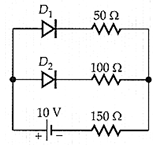
Assume that each diode shown in the figure has a forward bias resistance of $50 \Omega$ and an infinite reverse bia resistance. The current through the $150 \Omega$ resistance is
Image
  • $0.04$
  • B
    zero
  • C
    $0.05$
  • D
    $0.66$
Answer
Correct option: A.
$0.04$
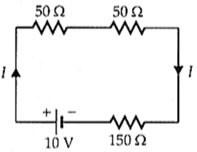
Diode $D_1$ is forward biased and offers $50 \Omega$ resistance. Diode $D_2$ is reverse biased and offers infinite resistance. The equivalent circuit is
Image
Current through the $150 \Omega$ resistance,
$I=\frac{10}{50+50+150}$
$=\frac{10}{250}=0.04 A$
View full question & answer
MCQ 31 Mark
Select the correct statements. Coulomb’s law correctly describes the electric force that:
i. binds the electrons of an atom to its nucleus.
ii. binds the protons and neutrons in the nucleus of an atom.
iii. binds atoms together to form molecules.
  • A
    (i), (ii), and (iii)
  • B
    (i) and (iii)
  • C
    (ii) and (iii)
  • D
    (i) and (ii)
Answer
(b) (i) and (iii)
Explanation: According to Coulomb’s law, electric force binds the electrons of an atom to its nucleus and atoms together to form molecules.  
View full question & answer
MCQ 41 Mark
Consider a ray of light incident from air onto a slab of glass (refractive index $n$ ) of width d , at an angle $\theta$. The phase difference between the ray reflected by the top surface of the glass and the bottom surface is
  • A
    $\frac{4 \pi d}{\lambda}\left(1-\frac{1}{n^2} \sin ^2 \theta\right)^{1 / 2}$
  • B
    $\frac{4 \pi d}{\lambda}\left(1-\frac{1}{n^2} \sin ^2 \theta\right)^{1 / 2}+2 \pi$
  • C
    $\frac{4 \pi d}{\lambda}\left(1-\frac{1}{n^2} \sin ^2 \theta\right)^{1 / 2}+\frac{\pi}{2}$
  • D
    $\frac{4 \pi d}{\lambda}\left(1-\frac{1}{n^2} \sin ^2 \theta\right)^{1 / 2}+\pi$
Answer
(d) $\frac{4 \pi d}{\lambda}\left(1-\frac{1}{n^2} \sin ^2 \theta\right)^{1 / 2}+\pi$
Explanation: The ray reflected by the top surface of the glass and the bottom surface is:-
$\frac{4 \pi d}{\lambda}\left(1-\frac{1}{n^2} \sin ^2 \theta\right)^{1 / 2}+\pi$
View full question & answer
MCQ 51 Mark
A paramagnetic sample shows a net magnetisation of $8 Am ^{-1}$ when placed in an external magnetic field of $0.6 \ T$ at a temperature of $4 \ K .$ When the same sample is placed in an external magnetic field of $0.2 \ T$ at a temperature of $16 \ K ,$ the magnetisation will be
  • A
    $6 Am ^{-1}$
  • $\frac{2}{3} Am ^{-1}$
  • C
    $2.4 Am ^{-1}$
  • D
    $\frac{32}{3} Am ^{-1}$
Answer
Correct option: B.
$\frac{2}{3} Am ^{-1}$
On increasing the temperature magnetic susceptibility of paramagnetic material decreases or vice versa . According to Curie law, we can deduce a formula for the relation between magnetic field induction, temperature and magnetisation.
i.e., $I ($magnetization$) \propto \frac{B(\text { magnetic field induction })}{t(\text { temperature in kelvin })}$
$\Rightarrow \frac{I_2}{I_1}=\frac{B_2}{B_1} \times \frac{t_1}{t_2}$
Let us suppose, here $I _1=8 Am ^{-1}$
$ B _1=0.6 T, t _1=4 K$
$B _2=0.2 T, t _2=16 K$
$\Rightarrow \frac{0.2}{0.6} \times \frac{4}{16}=\frac{I_2}{8}$
$\Rightarrow I_2=8 \times \frac{1}{12}=\frac{2}{3} Am ^{-1}$
View full question & answer
MCQ 61 Mark
A conducting circular loop is placed in a uniform magnetic field, $B =0.025 T$ with its plane perpendicular to the loop. The radius of the loop is made to shrink at a constant rate of $1 \ mm \ s ^{-1}$. The induced emf when the radius is $2 \ cm ,$ is
  • A
    $2 \mu V$
  • $\pi \mu V$
  • C
    $2 \pi \mu V$
  • D
    $\frac{\pi}{2} \mu V$
Answer
Correct option: B.
$\pi \mu V$
$\phi=B \pi r^2 \cos 0^{\circ}=B \pi r^2$
$|\varepsilon|=\frac{d \phi}{d t}=\frac{d}{d t}\left(\pi r^2 B\right)$
$=2 \pi r B \frac{d r}{d t}$
When $r =2 \ cm=2 \times 10^{-2} m \frac{d r}{d t}$
$=1 \ mm \ s^{-1}=10^{-3} ms^{-1}$
$|\varepsilon|=0.025 \times \pi \times 2 \times 2 \times 10^{-2} \times 10^{-3}$
$=0.100 \times \pi \times 10^{-5}$
$=\pi \mu V$
View full question & answer
MCQ 71 Mark
The magnetic moment of a current (l) carrying circular coil of radius (r) and number of turns (n) varies as
  • A
    $\frac{1}{r^2}$
  • B
    r
  • C
    $\frac{1}{r}$
  • D
    $r^2$
Answer
(d) $r ^2$
Explanation: $M = IA = I \times \pi r ^2$ i.e., $M \propto r^2$
View full question & answer
MCQ 81 Mark
Submarine cables act as
  • A
    spherical capacitor
  • B
    cylindrical capacitor with inner cylinder earthed
  • C
    cylindrical capacitor with inner cylinder earthed
  • D
    cylindrical capacitor with outer cylinder earthed
Answer
(d) cylindrical capacitor with outer cylinder earthed
Explanation: A submarine cable consists of an inner conductor which carries power. This conductor is covered by an insulator, which acts as a dielectric. The dielectric material is covered by a metal coating called shield, which is connected to ground. The cable acts as a cylindrical capacitor, with the conductor acting as the inner cylinder, and the metal shield as the outer cylinder which is connected to earth.  
View full question & answer
MCQ 91 Mark
The $\mu_0$ is also known as :
  • A
    magnetic dipole
  • B
    Absolute Permittivity
  • C
    Magnetic dipole moment
  • D
    Magnetic flux
Answer
(b) Absolute Permittivity
Explanation: Absolute Permittivity  
View full question & answer
MCQ 101 Mark
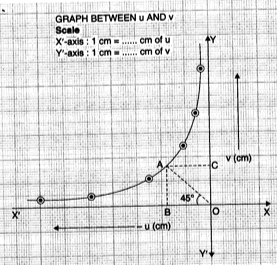
The graph drawn with object distance along abscissa & image as ordinate for a convex lens is
  • A
    straight
  • B
    circle
  • C
    rectangular hyperbola
  • D
    parabola
Answer
(c) rectangular hyperbola 
Explanation: 
Image
View full question & answer
MCQ 111 Mark
Inversion temperature of a thermocouple is the temperature of the hot junction at which the emf is:
  • A
    minimum
  • B
    Low
  • C
    maximum
  • D
    zero
Answer
(d) zero
Explanation: At the temperature of inversion, thermo emf is zero.  
View full question & answer
MCQ 121 Mark
The formation of depletion region in a p-n junction diode is due to
  • A
    movement of dopant atoms
  • B
    drift of electrons only
  • C
    diffusion of both electrons and holes
  • D
    drift of holes only
Answer
(c) diffusion of both electrons and holes
Explanation: diffusion of both electrons and holes  
View full question & answer
M.C.Q (1 Marks) - Physics STD 12 Science Questions - Vidyadip