Questions

1 Marks Question

Take a timed test

5 questions · self-marked practice — reveal the answer and mark yourself.

Question 11 Mark
Raindrops of radius 1mm and mass 4mg are falling with a speed of 30m/s on the head of a bald person. The drops splash on the head and come to rest. Assuming equivalently that the drops cover a distance equal to their radii on the head, estimate the force exerted by each drop on the head.
Answer
r = 1mm = 10-3
‘m’ = 4mg = 4 × 10⁻⁶kg
s = 10-3m.
v = 0
u = 30m/s.
So, $\text{a}=\frac{\text{v}^2-\text{u}^2}{2\text{s}}=\frac{-30\times30}{2\times10^{-3}}=-4.5\times10^5\text{m/s}^2\text{(decelerating)}$
Taking magnitude only deceleration is 4.5 × 10⁵m/s2
So, force F = 4 × 10-6 × 4.5 × 105 = 1.8N
View full question & answer
Question 21 Mark
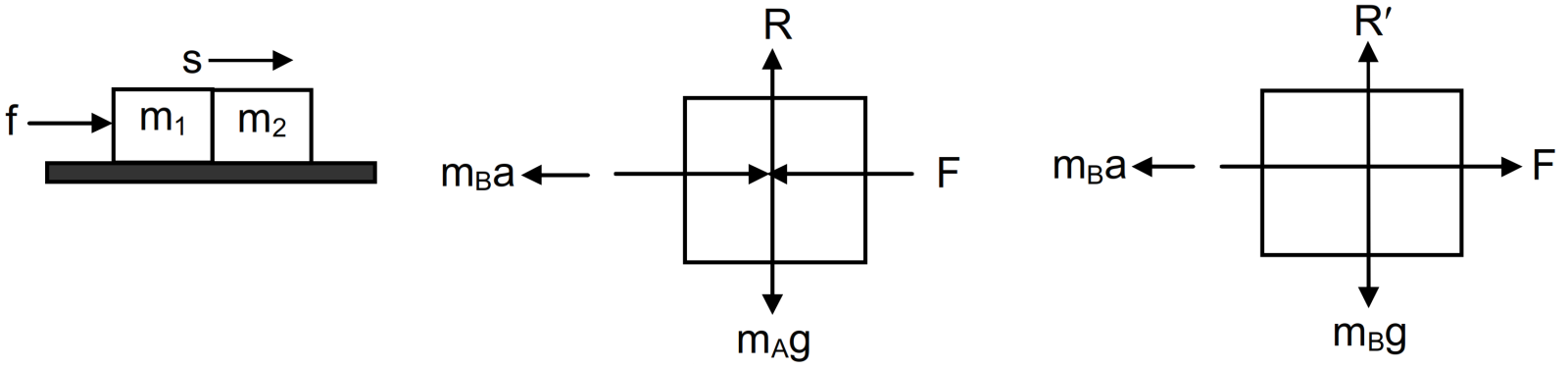
Two blocks A and B of mass mA and mB respectively are kept in contact on a frictionless table. The experimenter pushes the block A from behind so that the blocks accelerate. If the block A exerts a force F on the block B, what is the force exerted by the experimenter on A?
Answer
Let, F → contact force between mA & mB.

And, f → force exerted by experimenter.

F + mA a - f = 0

mB a - f = 0

⇒ F = f - mA a ...(i)

⇒ F = mB a …(ii)

From eqn. (i) and eqn. (ii)

⇒ f - mA a = mB a

⇒ f = mB a + mA a

⇒ f = a (mA + mB)

$\Rightarrow\text{f}=\frac{\text{F}}{\text{m}_{\text{B}}}(\text{m}_{\text{B}}+\text{m}_{\text{A}})=\text{F}\Big(1+\frac{\text{m}_{\text{A}}}{\text{m}_{\text{B}}}\Big)$ $\Big[\text{because }\text{a}=\frac{\text{F}}{\text{m}_{\text{B}}}\Big]$

$\therefore$ The force exerted by the experimenter is $\text{F}\Big(1+\frac{\text{m}_{\text{A}}}{\text{m}_{\text{B}}}\Big)$

View full question & answer
Question 31 Mark
The acceleration of a particle is zero as measured from an inertial frame of reference. Can we conclude that no force acts on the particle?
Answer
No. The acceleration of the particle can also be zero if the vector sum of all the forces is zero, i.e. no net force acts on the particle.
View full question & answer
Question 41 Mark
Consider a book lying on a table. The weight of the book and the normal force by the table on the book are equal in magnitude and opposite in direction. Is this an example of Newton's third law?
Answer
Yes, this is an example of Newton’s third law of motion, which sates that every action has an equal and opposite reaction.
View full question & answer
Question 51 Mark
An object is placed far away from all the objects that can exert force on it. A frame of reference is constructed by taking the origin and axes fixed in this object. Will the frame be necessarily inertial?
Answer
Yes, if the force on the object is zero, its acceleration w.r.t. all the other objects will we zero. So, the frame will necessarily be an inertial frame.
View full question & answer