Questions

2 Marks Questions

🎯

Test yourself on this topic

35 questions · timed · auto-graded

Question 12 Marks
Suppose, we think of fission of a $^{56}_{26}\text{Fe}$ nucleus into two equal fragments, $^{28}_{13}\text{Al}.$ Is the fission energetically possible? Argue by working out Q of the process. Given $\text{m}(^{56}_{26}\text{Fe})=55.93494\text{ u and m }(^{28}_{13}\text{Al})=27.98191\text{ u}.$
Answer
Q- value is given by,
$\text{Q}=\Big[\text{m}(^{56}_{26}\text{Fe})-2\text{m}(^{28}_{13}\text{Al})\Big]\times931.5\text{ MeV}$
$=\big[55.93494-2\times27.98191\big]\times931.5\text{ MeV}$
$\text{Q}=-0.02886\times931.5\text{ MeV}=-26.88\text{ MeV},$ which is negative.
Since, the Q-value is negative (energy released from the reaction is negative), the fission is not possible energetically.
View full question & answer
Question 22 Marks
The half-life of $^{90}_{38}\text{Sr}$ is 28 years. What is the disintegration rate of 15 mg of this isotope?
Answer
Half life of $^{90}_{38}\text{Sr },\ \text{t}_{1/2}=28\text{ Years}$
= 28 × 365 × 24 × 60 × 60
= 8.83 × 108 S
Mass of the isotope, m = 15 Mg
90 g of $^{90}_{38}\text{Sr }$atom contains 6.023 × 1023 (Avogadro's number) atoms.
View full question & answer
Question 32 Marks
Two stable isotopes of lithium $^6_3\text{Li }\text{ and }\ ^7_3\text{Li}$  have respective abundances of 7.5% and 92.5%. These isotopes have masses 6.01512 u and 7.01600 u, respectively. Find the atomic mass of lithium.
Answer
Mass of lithium isotope $^6_3\text{Li },\ \text{m}_1=6.01512\text{ u}$
Mass of utntum isotope $^7_3\text{Li },\ \text{m}_2=7.01600\text{ u}$
Abundance of $^6_3\text{Li },\ \text{n}_1=7.5\%$
Abundance of $^7_3\text{Li },\ \text{n}_2=92.5\%$
The atomic mass of lithium atom is given as:
$\text{m}=\frac{\text{m}_1\text{n}_1+\text{m}_2\text{n}_2}{\text{n}_1+\text{n}_2}$
$=\frac{6.01512\times7.5+7.01600\times92.5}{92.5+7.5}$
= 6.940934 u
View full question & answer
Question 42 Marks
The three stable isotopes of neon: $^{20}_{10}\text{Ne},\ ^{21}_{10}\text{Ne }\text{ and }\ ^{22}_{10}\text{Ne}$ have respective abundances of 90.51%, 0.27% and 9.22%. The atomic masses of the three isotopes are 19.99 u, 20.99 u and 21.99 u, respectively. Obtain the average atomic mass of neon.
Answer
Atomic mass of $^{20}_{10}\text{Ne },\ \text{m}_1=19.99\text{ u}$
Abundance of $^{20}_{10}\text{Ne },\ \text{n}_1=90.51\%$
Atomic mass of $^{21}_{10}\text{Ne },\ \text{m}_2=20.99\text{ u}$
Abundance of $^{21}_{10}\text{Ne },\ \text{n}_2=0.27\%$
Atomic mass of $^{22}_{10}\text{Ne },\ \text{m}_3=21.99\text{ u}$
Abundance of $^{22}_{10}\text{Ne },\ \text{n}_3=9.22\%$
The average atomic mass of neon is given as:
$\text{m}=\frac{\text{m}_1\text{n}_1+\text{m}_2\text{n}_2+\text{m}_3\text{n}_3}{\text{n}_1+\text{n}_2+\text{n}_3}$
$=\frac{19.99\times90.51+20.99\times0.27+21.99\times9.22}{90.51+0.27+9.22}$
$=20.1771\text{ u}$
View full question & answer
Question 52 Marks
Find the energy equivalent of one atomic mass unit, first in Joules and then in MeV. Using this, express the mass defect of ${ }_8^{16} O$ in $MeV / c ^2$.
Answer
$
lu =1.6605 \times 10^{-27} kg
$
To convert it into energy units, we multiply it by $c^2$ and find that energy equivalent $=1.6605 \times 10^{-27} \times\left(2.9979 \times 10^8\right)^2 kg m ^2 / s ^2$
$
\begin{array}{l}
=1.4924 \times 10^{-10} J \\
=\frac{1.4924 \times 10^{-10}}{1.602 \times 10^{-19}} eV \\
=0.9315 \times 10^9 eV \\
=931.5 MeV
\end{array}
$
or, $1 u =931.5 MeV / c ^2$
For ${ }_8^{16} O , \quad \Delta M=0.13691 u =0.13691 \times 931.5 MeV / c^2$
$
=127.5 MeV / c ^2
$
The energy needed to separate ${ }_8^{16} O$ into its constituents is thus $127.5 MeV / c ^2$.
View full question & answer
Question 62 Marks
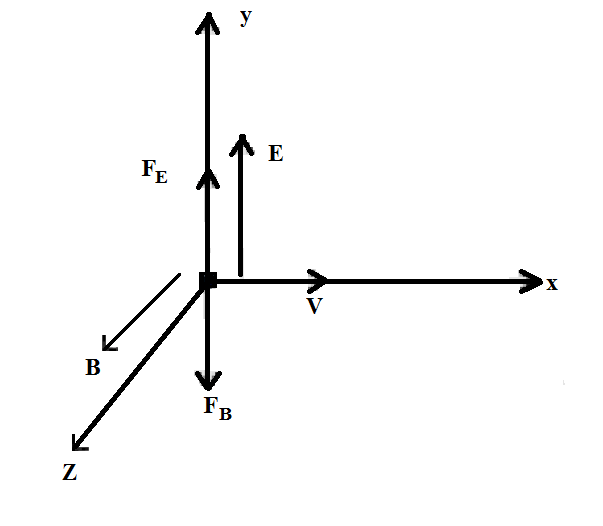
Find the condition under which the charged particles moving with different speeds in the presence of electric and magnetic field vectors can be used to select charged particles of a particular speed.
Answer
The velocity $\vec{v}$, of the charged particles, and the $\overrightarrow{E}$ and $\overrightarrow{B}$ vectors, should be mutually perpendicular. Also the forces on q, due to $\overrightarrow{E}$ and $\overrightarrow{B}$ must be oppositely directed.

$qE=qvB$

$or\text{ }v=\frac{E}{B}$

Alternate Answer

Force due to electric field $= q\overrightarrow{E}$

Force due to magnetic field $=q\text{ }(\overrightarrow{v}\times\overrightarrow{B} )$

The required condition is

$q\overrightarrow{E}=-q\text{ }(\overrightarrow{v}\times\overrightarrow{B})$

$[or\text{ }\overrightarrow{E}=-(\overrightarrow{v}\times\overrightarrow{B})=(\overrightarrow{B}\times\overrightarrow{v})]$

View full question & answer
Question 72 Marks
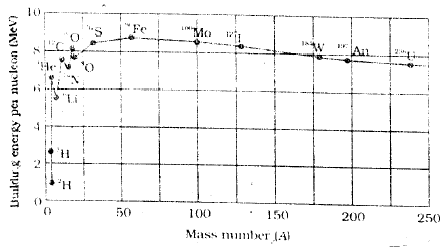
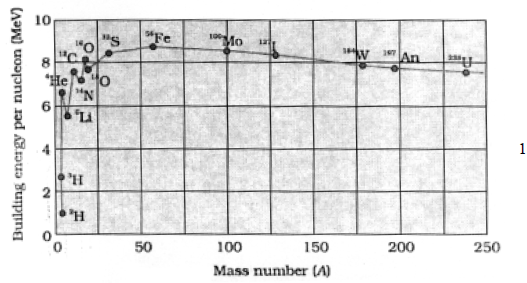
Using the curve for the binding energy per nucleon as a function of mass number A, state clearly how the release in energy in the processes of nuclear fission and nuclea fusion can be explained.
View full question & answer
Question 82 Marks
Draw a plot of the binding energy per nucleon as a function of mass number for a large number of nuclei, 2⩽ A⩽240. How do you explain the constancy of binding energy per nucleon in the range 30 < A < 170 using the property that nuclear force is short - ranged?
View full question & answer
Question 92 Marks
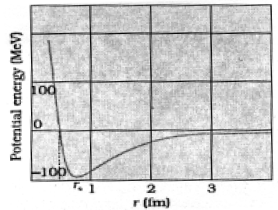
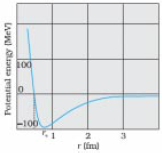
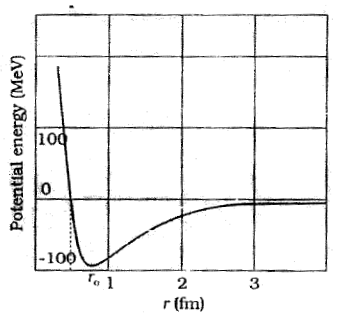
Draw a plot of potential energy of a pair of nucleons as a function of their separation. Write two important conclusions which you can draw regarding the nature of nuclear forces.
Answer

Two important conclusions:

  1. The nuclear force between two nucleons falls rapidly to zero at distances more than a few femtometres;
  2. The nuclear force is attractive for r > r0.
  3. The nuclear force is repulsive for r < r0.
  4. The nuclear force is a strong force.
View full question & answer
Question 102 Marks
  1. The mass of a nucleus in its ground state is always less than the total mass of its constituents - neutrons and protons. Explain.
  2. Plot a graph showing the variation of potential energy of a pair of nucleons as a function of their separation.
Answer
  1. The mass of a nucleus in its ground state is always less than total mass of its constituents – neutrons and protons, because this mass difference is converted into energy which holds the nucleons inside the nucleus.
  2. Plot.

View full question & answer
Question 112 Marks
Calculate the energy released in MeV in the following nuclear reaction:
$^{238}_{92}\text{U}\rightarrow^{234}_{90}\text{Th} + ^{4}_{2}\text{He} + \text{Q}$
$\bigg[\text{Mass of } ^{238}_{92}\text{U} = 238.05079\text{ u}$
$\text{Mass of } ^{234}_{90}\text{Th} = 234.043630\text{ u}$
$\text{Mass of } ^{4}_{2}\text{He} = 4.002600\text{ u}$
$1\text{u} =193.5\text{MeV}/\text{c}^{2}\bigg]$
Answer
Mass defect

= 0.00456 u

$\text{Energy released, E =}\Delta\text{m}\times931\text{MeV}$

$ = 4.245\text{MeV}.$

View full question & answer
Question 122 Marks
Draw a graph showing the variation of potential energy between a pair of nucleons as a function of their separation. Indicate the regions in which the nuclear force is. (i) attractive, (ii) repulsive.
Answer
  1. graph:

  1. for r > ro  Attraction.
  2. or r < ro  Repulsion.
View full question & answer
Question 132 Marks
A heavy nucleus X of mass number 240 and binding energy per nucleon 7.6 MeV is split into two fragments Y and Z of mass numbers 110 and 130. The binding energy of nucleons in Y and Z is 8.5 MeV per nucleon. Calculate the energy Q released per fission in MeV
Answer
X240 y110 + Z130 + Q

Energy released per nucleon = 8.5 MeV - 7.6 MeV = 0.9 MeV

Therefore energy released= 0.9 × 240 MeV = 216 MeV

Alternate Answer

Energy released = [240 × 8.5 – 7.6 ( 110+130)] MeV = 216 MeV.

View full question & answer
Question 142 Marks
A radioactive nucleus ‘A’ undergoes a series of decays according to the following scheme:

$\text{A} - \xrightarrow{a}\text{A}_{1} \xrightarrow{\beta}\text{A}_{2}\xrightarrow{\alpha}\text{A}_{3}\xrightarrow{\gamma}\text{A}_{4}$

The mass number and atomic number of A are 180 and 72 respectively. What are these numbers for A4?

Answer
$^{180}_{72}\text{A}\xrightarrow{\alpha}$$^{176}_{70}\text{A}_{1}\xrightarrow{\beta^{-}}$$^{176}_{71}\text{A}_{2}\xrightarrow{\alpha}$$^{172}_{69}\text{A}_{3}\xrightarrow{\gamma}$$^{172}_{69}\text{A}_{4}$

Alternate Answer

$^{180}_{72}\text{A}\xrightarrow{\alpha}$$^{176}_{70}\text{A}_{1}\xrightarrow{\beta^{+}} $$^{176}_{69}\text{A}_{2}\xrightarrow{\alpha}$$^{172}_{67}\text{A}_{3}\xrightarrow{\gamma}$$^{172}_{67}\text{A}_{4}$

View full question & answer
Question 152 Marks
A nucleus  $\frac{23}{10}$ Ne undergoes β− decay and becomes $\frac{23}{11}$Na. Calculate the maximum kinetic energy of electrons emitted assuming that the daughter nucleus and anti-neutrino carry negligible kinetic energy.

$\left\{\text{mass of} \frac{23}{10} Ne = 22.994466 u\right\}$

$\left\{\text{mass of}\frac{23}{11}Na=22.989770u\right\}$

$\left\{ 1u = 931.5\text{MeV}/ c^{2}\right\}$

Answer
  1. Mass defect $(\bigtriangleup\text{m})$

$= ( \text{mass of} \frac{23}{10}\text{Ne}) - (\text{mass of} \frac{23}{11}\text{Na} + \text{mass of}$$ ^{0}_{-1}\beta$

$\cong 0.004696 \text{u}$

  1. Maximum kinetic energy of the electron emitted $= ( \bigtriangleup \text{m})c^{2}$

$= 0.004696 \times 931.5\text{MeV}$

$= 4.37 \text{ MeV}.$

View full question & answer
Question 162 Marks
Draw a plot of potential energy of a pair of nucleons as a function of their separation. What is the significance of negative potential energy in the graph drawn?
Answer
 

Nuclear forces are attractive.

View full question & answer
Question 172 Marks
Define activity of a sample of a radioactive substance. The value of the disintegration constant of a radioactive substance is 0.0693h-1. Find the time after which the activity of a sample of this substance reduces to one-half that of its present value.
Answer
Activity of a radioactive substance is defined as the number of nucleiatoms decaying per second.
$\text{R}=\frac{\text{dN}}{\text{dt}}$
$\text{R}=\text{R}_0\Big(\frac{1}{2}\Big)^{\frac{\text{t}}{\text{T}}}$
$\frac{\text{R}_0}{2}=\text{R}_0\Big(\frac{1}{2}\Big)^{\frac{\text{t}}{\text{T}}}$
$\frac{\text{t}}{\text{T}}=1$
$\text{t}=\text{T}=\frac{.693}{\lambda}$
$=\frac{.693}{.0693\text{h}^{-1}}$
$\text{t}=10\text{hrs}$
View full question & answer
Question 182 Marks
Define the term ‘Half-life’ of a radioactive substance. Two different radioactive substances have half-lives T1 and T2 and number of undecayed atoms at an instant, N1 and N2, respectively. Find the ratio of their activities at that instant.
Answer
Half-life, in radioactivity, the interval of time required for one-half of the atomic nuclei of a radioactive sample to decay (change spontaneously into other nuclear species by emitting particles and energy), or, equivalently, the time interval required for the number of disintegrations per second of a radioactive material to decrease by one-half.
Activity of 1:-
$\Big(\frac{\text{dN}}{\text{dt}}\Big)_1=\lambda_1\text{N}_1$
$\lambda_1=\frac{0.693}{\text{T}_1}$
Activity of 2:-
$\Big(\frac{\text{dN}}{\text{dt}}\Big)_2=\lambda_2\text{N}_2$
$\lambda_2=\frac{0.693}{\text{T}_2}$
$\frac{\big(\frac{\text{dN}}{\text{dt}}\big)_1}{\big(\frac{\text{dN}}{\text{dt}}\big)_2}=\frac{\lambda_1\text{N}_1}{\lambda_2\text{N}_2}$
$=\frac{\text{T}_2\text{N}_1}{\text{T}_1\text{N}_2}$
View full question & answer
Question 192 Marks
The decay constant of $\text{ }^{197}_{80}\text{Hg}$ (electron capture to $\text{ }^{197}_{79}\text{Au}$) is 1.8 × 10⁻⁴ S-1.
  1. What is the half-life?
  2. What is the average-life?
  3. How much time will it take to convert 25% of this isotope of mercury into gold?
Answer
  1. $\text{t}_{\frac{1}{2}}=\frac{0.693}{\lambda}$ [$\lambda\rightarrow$ Decay constant]

$\Rightarrow\text{t}_{\frac{1}{2}}=3820\text{sec}=64\text{min}$

  1. Average life $=\frac{\text{t}_{\frac{1}{2}}}{0.693}=92\text{min}.$
  2. $0.75=1\text{e}^{-\lambda\text{t}}\Rightarrow\text{In }0.75=-\lambda\text{t}$

$\Rightarrow\text{t}=\text{In}\frac{0.75}{-0.00018}=1598.23\text{sec.}$

View full question & answer
Question 202 Marks
Complete the following decay schemes.
  1. $\text{ }^{226}_{88}\text{Ra}\rightarrow\alpha+$
  2. $\text{ }^{19}_8\text{O}\rightarrow\text{ }^{19}_9\text{F}+$
  3. $\text{ }^{25}_{13}\text{Al}\rightarrow\text{ }^{25}_{12}\text{Mg}+$
Answer
  1. $\text{ }^{226}_{88}\text{Ra}\rightarrow\text{ }^4_2\alpha+\text{ }^{222}_{26}\text{Rn}$

  2. $\text{ }^{19}_8\text{O}\rightarrow\text{ }^{19}_9\text{F}+\bar{\text{e}}+\bar{\text{v}}$

  3. $\text{ }^{25}_{13}\text{Al}\rightarrow\text{ }^{25}_{12}\text{Mg}+\text{e}^++\text{v}$

View full question & answer
Question 212 Marks
He23 and He13 nuclei have the same mass number. Do they have the same binding energy?
Answer
The nuclei He23 and He13 have the same mass number. He23 has two protons and one neutron. He23 has one proton and two neutrons. As He3 has only one proton hence the repulsive force between protons is missing in 1He3, so the binding energy of 1He3 is greater than that of 2He3.
View full question & answer
Question 222 Marks
When a boron nucleus $\big(\text{ }^{10}_5\text{B}\big)$ is bombarded by a neutron, an $\alpha$-particle is emitted. Which nucleus will be formed as a result?
Answer
It is given that when a boron nucleus$\big(\text{ }^{10}_5\text{B}\big)$ is bombarded by a neutron, an $\alpha$-particle is emitted.
Let X nucleus be formed as a result of the bombardment.
According to the charge and mass conservation,
$ \ \ \ \ \ \ \ \ \ \ \ \ \ \ \ \ \text{ }^{10}_5\text{B}+^1_0\text{n}\rightarrow\text{X}+^4_2\text{He}\\\text{Charge}: \ \ 5 \ \ \ \ \ \ \ \ \ 0 \ \ \ \ \ \ \ 3 \ \ \ \ \ \ \ \ \ 2\\\text{Mass}:\ \ \ \ 10 \ \ \ \ \ \ \ \ \ 1 \ \ \ \ \ \ \ 7 \ \ \ \ \ \ \ \ \ 4$
The mass number of X should be 7 and its atomic number should be 3.
$\therefore\text{X}=^7_3\text{Li}$
View full question & answer
Question 232 Marks
A free neutron beta-decays to a proton with a half-life of 14 minutes.
  1. What is the decay constant?
  2. Find the energy liberated in the process.
Answer
$\text{In}\rightarrow\text{P + e}^-$
We know : Half life $=\frac{0.6931}{\lambda}$ (Where $\lambda$ = decay constant).
$\lambda=\frac{0.6931}{14\times60}=8.25\times10^{-4}\text{S}$ [As half life = 14min = 14 × 60sec].
Energy = [Mn - (MP + Me)]u = [(Mnu - Mpu) - Mpu]c2 = [0.00189u - 511KeV/c2]
= [1293159 ev/c2 - 511000ev/c2]c2 = 782159eV = 782Kev.
View full question & answer
Question 242 Marks
Assuming the nuclei to be spherical in shape, how does the surface area of a nucleus of mass number A1 compare with that of a nucleus of mass number A2?
Answer
Radius of nucleus of mass number A is:
$\text{R}=\text{R}_0\text{A}^{\frac{1}{3}}$ where R0 = 1.2 × 10⁻¹⁵m = constant
$\therefore \frac{\text{S}_1}{\text{S}_2}=\Big(\frac{\text{R}_1}{\text{R}_2}\Big)^2=\Big(\frac{\text{A}_1}{\text{A}_2}\Big)^{\frac{2}{3}}$
View full question & answer
Question 252 Marks
Why do stable nuclei never have more protons than neutrons?
Answer
Stable nuclei never have more protons than neutrons because protons are positively charged and repel one another electrically. This repulsion becomes so great in nuclei with more than 10 protons or so, that an excess of neutrons which produce only attractive forces, is required for stability.
View full question & answer
Question 262 Marks
Give the mass number and atomic number of elements on the right hand side of the decay process.
$^{220}_{86}\text{Ru}\ \ \rightarrow\ \ \text{Po}\ \ +\ \ \text{He}$
Answer
The complete equation representing mass number and atomic number is given below:
$^{220}_{86}\text{Ru}\ \ \rightarrow\ \ ^{216}_{84}\text{Po}\ \ +\ \ ^4_2\text{He}$
For Polonium Z = 84, A = 216
For Helium $(\alpha-$particle$)$ Z = 2, A = 4
View full question & answer
Question 272 Marks
If the nucleons of a nucleus are separated far apart from each other, the sum of masses of all these nucleons is larger than the mass of the nucleus. Where does this mass difference come from?
Answer
According to mass-energy equivalence relation E =mc2 this mass difference in nucleus remains in the form of binding energy. When nucleons are separated this binding energy of nucleus is converted into mass.
View full question & answer
Question 282 Marks
In the decay 64Cu → 64Ni + e+ + v, the maximum kinetic energy carried by the positron is found to be 0.650MeV.
  1. What is the energy of the neutrino which was emitted together with a positron of kinetic energy 0.150MeV?
  2. What is the momentum of this neutrino in kg-m/s?
Use the formula applicable to a photon.
Answer
64Cu → 64Ni + e+ + v,

Emission of nutrino is along with a positron emission.

  1. Energy of positron = 0.650MeV.

Energy of Nutrino = 0.650 - KE of given position = 0.650 - 0.150 = 0.5MeV = 500Kev.

  1. Momentum of Nutrino $=\frac{500\times1.6\times10^{-19}}{3\times10^8}\times10^3\text{J}=2.67\times10^{-22}\text{kg m/s}.$
View full question & answer
Question 292 Marks
A radioactive nucleus A undergoes a series of decay according to following scheme:
$\text{A}\ \xrightarrow{\ \alpha\ }\ \text{A}_1\ \xrightarrow{\ \beta\ }\ \text{A}_2\ \xrightarrow{\ \alpha\ }\ \text{A}_3\ \xrightarrow{\ \text{g}\ }\ \text{A}_4$
The mass number and atomic number of A are 180 and 72 respectively. What are these numbers for A4?
Answer
The decay scheme may completely be represented as:
$^{180}_{72}\text{A}\ \xrightarrow{\alpha}\ ^{176}_{70}\text{A}_1\ \xrightarrow{\beta}\ ^{176}_{71}\text{A}_2\ \xrightarrow{\alpha}\ ^{172}_{69}\text{A}_3\ \xrightarrow{\gamma}\ ^{172}_{69}\text{A}_4$Clearly, mass number of A4 is 172 and atomic number is 69.
View full question & answer
Question 302 Marks
Radioactive 131I has a half-life of 8.0 days. A sample containing 131I has activity $20\mu\text{Ci}$ at t = 0.
  1. What is its activity at t = 4 days?
  2. What is its decay constant at t = 4.0 days?
Answer
$\text{t}_{\frac{1}{2}}=8.0\text{ days};\text{ A}_0=20\mu\text{Cl}$

  1. $\text{t}=4.0\text{ dys};\lambda=\frac{0.693}{8}$

$\text{A = A}_{0}\text{e}^{-\lambda\text{t}}=20\times10^{-6}\times\text{e}^{\big(\frac{-0.693}{8}\big)\times4}$

$=1.41\times10^{-5}\text{Ci}=14\mu\text{Ci}$

  1. $\lambda=\frac{0.693}{8\times24\times3600}=1.0026\times10^{-6}.$
View full question & answer
Question 312 Marks
Lithium (Z = 3) has two stable isotopes 6Li and 7Li. When neutrons are bombarded on lithium sample, electrons and $\alpha$-particles are ejected. Write down the nuclear process taking place.
Answer
$\text{ }^6_3\text{Li + n}\rightarrow\text{ }^7_3\text{Li};\text{ }^7_3\text{Li + r}\rightarrow\text{ }^8_3\text{Li}$
$\text{ }^8_3\text{Li}\rightarrow\text{ }^8_4\text{Be + e}^-+\text{v}^-$
$\text{ }^8_4\text{Be}\rightarrow\text{ }^4_2\text{He}+\text{ }^4_2\text{He}$
View full question & answer
Question 322 Marks
The selling rate of a radioactive isotope is decided by its activity. What will be the second-hand rate of a one month old $\text{ }^{32}\text{P}\big(\text{t}_{\frac{1}{2}}=14.3\text{days}\big)$ source if it was originally purchased for 800 rupees?
Answer
$\text{t}_{\frac{1}2{}}=14.3\text{ days};\text{ t}=30\text{ days}=1\text{ month}$
As, the selling rate is decided by the activity, hence A0 = 800 disintegration/sec.
We know, $\text{A = A}_0\text{e}^{-\lambda\text{t}}$ $\Big[\lambda=\frac{0.693}{14.3}\Big]$
$\text{A}=800 \times 0.233669 = 186.935 = 187\text{ rupees.}$
View full question & answer
Question 332 Marks
57Co decays to 57Fe by $\beta^+-\text{ emission.}$- emission. The resulting 57Fe is in its excited state and comes to the ground state by emitting $\gamma-\text{rays}.$ The half-life of $\beta^+-\text{decay}$ is 270 days and that of the $\gamma-\text{emissions}$ is 10-8 s. A sample of 57Co gives 5.0 × 10⁹ gamma rays per second. How much time will elapse before the emission rate of gamma rays drops to 2.5 × 10⁹per second?
Answer
According to the question, the emission rate of $\gamma-\text{rays}$ will drop to half when the $\beta^+\text{decays}$ to half of its original amount. And for this the sample would take 270 days.
$\therefore$ The required time is 270 days.
View full question & answer
Question 342 Marks
Calculate the mass of an $\alpha$-particle. Its binding energy is 28.2MeV.
Answer
Let the mass of $'\alpha'$ particle be xu.
$'\alpha'$ particle contains 2 protons and 2 neutrons.
$\therefore$ Binding energy = (2 × 1.007825u × 1 × 1.00866u - xu)C2 = 28.2MeV (given).
$\therefore$ x = 4.0016u.
View full question & answer
Question 352 Marks
The masses of 11C and 11B are respectively 11.0114u and 11.0093u. Find the maximum energy a positron can have in the $\beta^+$-decay of 11C to 11B.
Answer
Given:
Mass of 11C, m(11C) = 11.0114u
Mass of 11B, m(11B) = 11.0093u
Energy liberated in the $\beta^+$ decay (Q) is given by
Q = [m(11C) - m(11B) - 2me]c2
= (11.0114u - 11.0093u - 2 × 0.0005486u)c2
= 0.0010028 × 931MeV
= 0.9336MeV = 933.6keV
For maximum KE of the positron, energy of neutrino can be taken as zero.
$\therefore$ Maximum KE of the positron = 933.6keV
View full question & answer
2 Marks Questions - Physics STD 12 Science Questions - Vidyadip