The force on a north pole,$\overrightarrow{\text{F}}=\text{m}\overrightarrow{\text{B}},$ is parallel to the field $\overrightarrow{\text{B}}.$ Does it contradict our earlier knowledge that a magnetic field can exert forces only perpendicular to itself?
View full solution →Question types
Permanent Magnets question types
54 questions across 4 question groups — pick any mix to generate a Physics paper with step-by-step answer keys.
54
Questions
4
Question groups
5
Question types
Sample Questions
Permanent Magnets questions
One sample from each question group in this chapter. Select any group above to see the full set with answer keys.
Compare the direction of the magnetic field inside a solenoid with that of the field there if the solenoid is replaced by its equivalent combination of north pole and south pole.
An iron needle is attracted to the ends of a bar magnet but not to the middle region of the magnet. Is the material making up the ends of a bar magnet different from that of the middle region?
Two bar magnets are placed close to each other with their opposite poles facing each other. In absence of other force the magnets are pulled towards each other and their kinetic energy increases. Does it contradict our earher knowledge that magnetic forces cannot do any work and hence cannot increase kinetic energy of a system?
Sketch the magnetic field lines for a current-carrying circular loop near its centre. Replace the loop by an equivalent magnetic dipole and sketch the magnetic field lines near the centre of the dipole. Identify the difference.
Can the earth's magnetic field be vertical at a place? What will happen to a lreely suspended magnet at such a place? What is the value of dip here?
Can the dip at a place be zero? 90°?
Can we have a single north pole? A single south pole?
Do two distinct poles actually exist at two nearby points in a magnetic dipole?
Magnetic scalar potential is defined as
View full solution →$\text{U}(\overrightarrow{\text{r}_2})-\text{U}(\overrightarrow{\text{r}_1})=-\int\limits^{\vec{\text{r}}_2}_{\vec{\text{r}_1}} \vec{\text{B}}.\text{d}\vec{\text{l}}.$
Apply this equation to a closed curve enclosing a long atraicht wire. The RHS of the above equation is then
$-{\mu}_\text{o} \text{ i}$ by Ampere's law. We see that $\text{U}(\vec{\text{r}_2})\neq\text{U}(\vec{\text{r}_1})$ even when $\vec{\text{r}_2}=\vec{\text{r}_1}.$Can we have a magnetic acalar potential in this case?The magnetic moment of the assumed dipole at the earth's centre is 8.0 × 10²² A-m2. Calculate the magnetic field B at the geomagnetic poles of the earth. Radius of the earth is 6400km.
Figure shows some of the quipotential surfaces of the magnetic scalar potential. Fmd the magnetic field B at a point in the region.
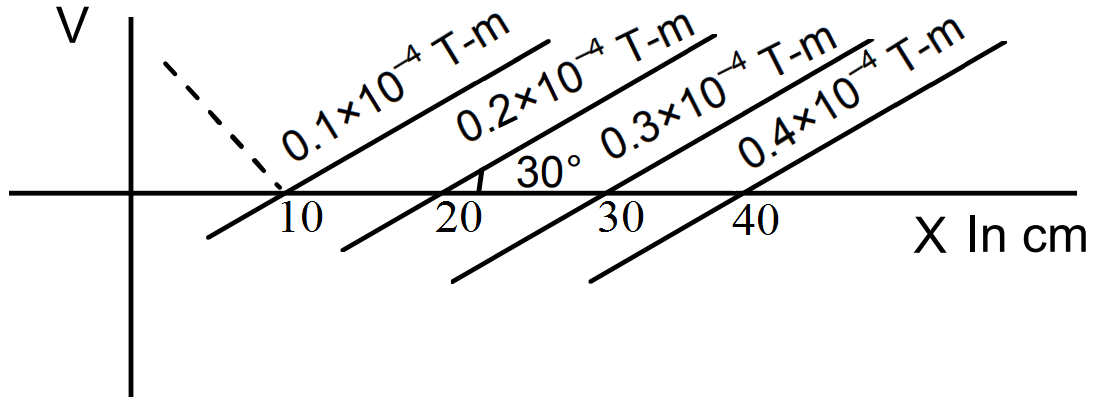
The magnetic field due to the earth has a horizontal component of $26\mu\text{T}$ at a place where the dip is 60°. Find the vertical component and the magnitude of the field.
View full solution →A bar magnet takes $\frac{\pi}{10}$ second to complete one oscillation in an oscillation magnetometer. The moment of inertia of the magnet about the axis of rotation is 1.2 × 10⁻⁴ kg-m2 and the earth's horizontal magnetic field is $30\mu \text{T}.$ Find the magnetic moment of the magnet.
View full solution →Show that the magnetic field at a point due to a magnetic dipole is perpendicular to the magnetic axis if the line joining the point with the centre of the dipole makes an angle of $\tan^{-1}(\sqrt{2})$ with the magnetic axis.
View full solution →Consider a magnetic dipole kept in the north to south direction. Let P1, P2, Q1, Q2 be four points at the same distance from the dipole towards north, south, east and west of the dipole respectively. The directions of the magnetic field due to the dipole are the same at:
- P1 and P2
- Q1 and Q2
- P1 and Q1
- P2 and Q2
A horizontal circular loop carries a current that looks clockwise when viewed from above. It is replaced by an equivalent magnetic dipole consisting of a south pole S and a north pole N:
- The line SN should be along a diameter of the loop.
- The line SN should be perpendicular to the plane of the loop.
- The south pole should be slow the loop.
- The north pole should be below the loop.
Two short magnets of equal dipole moments M are fastened perpendicularly at their centre (figure). The magnitude of the magnetic field at a distance d from the centre on the bisector of the right angle is: 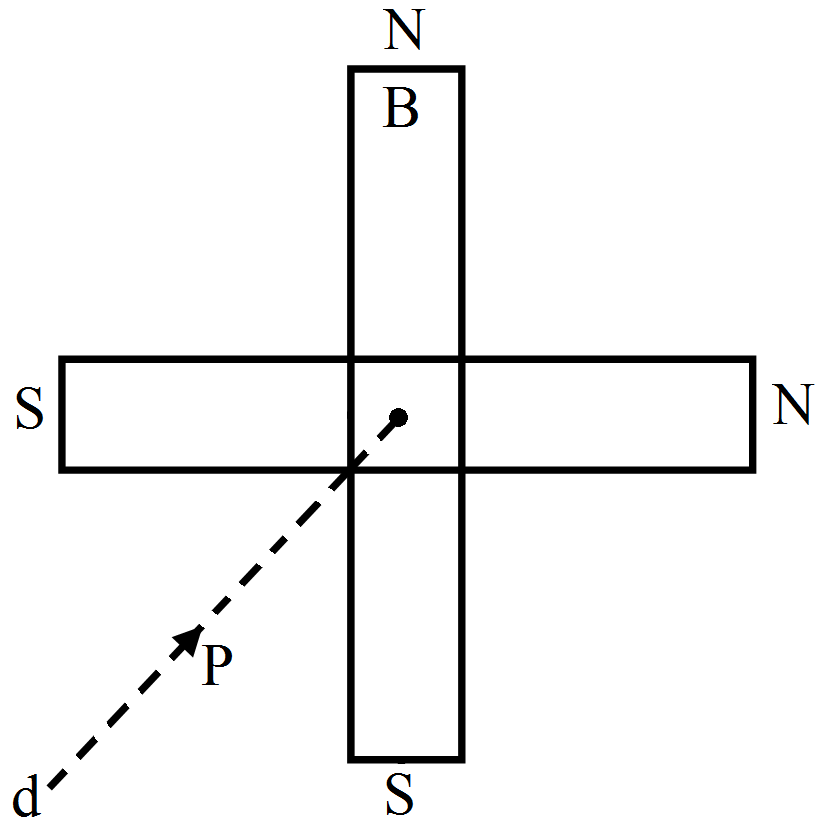
View full solution → - $\frac{\mu_0}{4\pi}\frac{\text{m}}{\text{d}^3}$
- $\frac{\mu_0}{4\pi}\frac{\sqrt{2}\text{M}}{\text{d}^3}$
- $\frac{\mu_0}{4\pi}\frac{\sqrt[2]{2}\text{M}}{\text{d}^3}$
-
$\frac{\mu_0}{4\pi}\frac{2\text{M}}{\text{d}^3}$
Magnetic meridian is:
- A point.
- A line along north-south.
- A horizontal plane.
- A vertical plane.
Let r be the distance of a point on the axis of a magnetic dipole from its centre. The magnetic field at such a point is proportional to:
View full solution →- $\frac{1}{\text{r}}$
- $\frac{1}{\text{r}^2}$
- $\frac{1}{\text{r}^3}$
- None of these.
Generate a Permanent Magnets paper free
Pick question groups from the list above, set marks and difficulty, and export a branded PDF with step-by-step answer keys. First 3 chapters free — no signup.