Questions · Page 3 of 3

3 Marks Question

Question 1013 Marks
The focal lengths of a convex lens for red, yellow and violet rays are 100cm, 98cm and 96cm respectively. Find the dispersive power of the material of the lens.
Answer
The focal length of a lens is given by
$\frac{1}{\text{f}}=(\mu-1)\Big(\frac{1}{\text{R}_1}-\frac{1}{\text{R}_2}\Big)$
$\Rightarrow(\mu-1)=\frac{1}{\text{f}}\times\frac{1}{\Big(\frac{1}{\text{R}_1}-\frac{1}{\text{R}_2}\Big)}=\frac{\text{k}}{\text{f}}\ ...(1)$
So, $\mu_\text{r}-1=\frac{\text{K}}{100}\ ...(2)$
$\mu_\text{y}-1=\frac{\text{K}}{98}\ ...(3)$
And $\mu_\text{v}-1=\frac{\text{K}}{96}\ ...(4)$
So, Dispersive power $=\omega=\frac{\mu_\text{v}-\mu_\text{r}}{\mu_\text{y}-1}=\frac{(\mu_\text{v}-1)-(\mu_\text{r}-1)}{(\mu_\text{y}-1)}=\frac{\frac{\text{K}}{96}-\frac{\text{K}}{100}}{\frac{\text{K}}{98}}$ $=\frac{98\times4}{9600}=0.0408$
View full question & answer
Question 1023 Marks
The magnifying power of a simple microscope is given by $1+\frac{\text{D}}{\text{f}},$ where D is the least distance for clear vision. For farsighted persons, D is greater than the usual. Does it mean that the magnifying power of a simple microscope is greater for a farsighted person as compared to a normal person? Does it mean that a farsighted person can see an insect more clearly under a microscope than a normal person?
Answer
The magnifying power of a simple microscope depends on the ratio $\frac{\text{D}}{\text{f}}$ for a farsighted person. Here, D for a farsighted person is greater than that for a normal person, but the value of f remains the same. Therefore, the magnifying power of a simple microscope is greater for a farsighted person compared to that for a person with normal vision. Also, a farsighted person can see the insect more clearly under the microscope than a person with normal vision.
View full question & answer
Question 1033 Marks
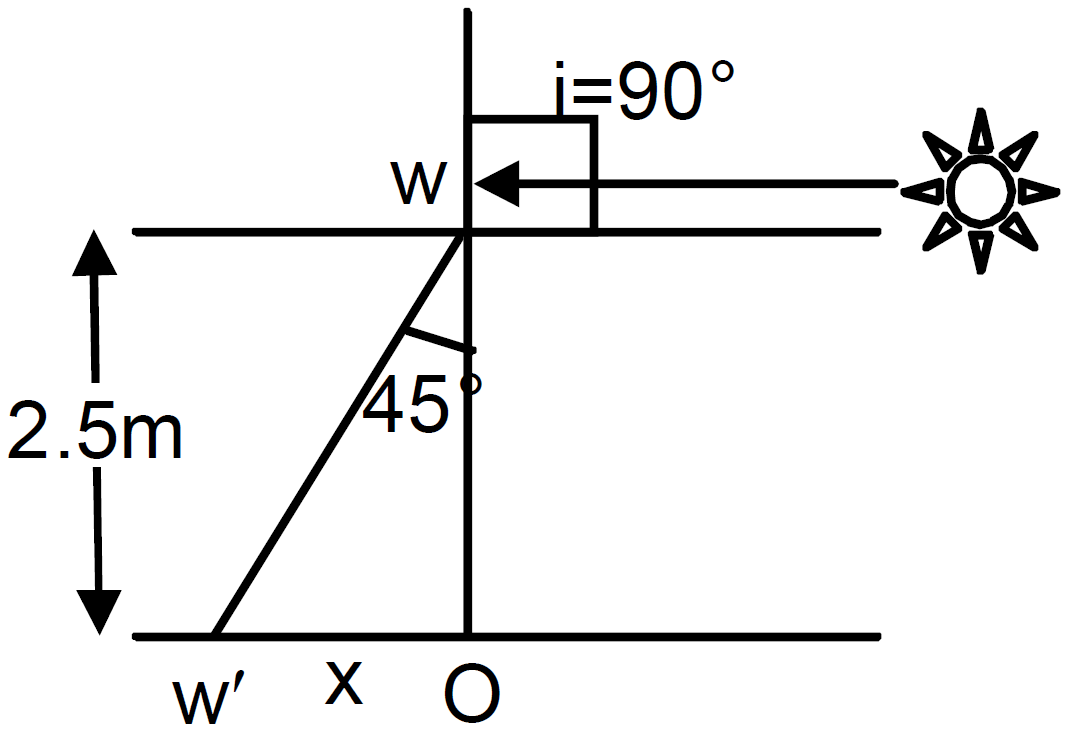
A small piece of wood is floating on the surface of a 2.5m deep lake. Where does the shadow form on the bottom when the sun is just setting? Refractive index of water $=\frac{4}{3}.$
Answer

Height of the lake = 2.5m

When the sun is just setting, $\theta$ is approximately = 90°

$\therefore \ \frac{\sin\text{i}}{\sin\text{r}}=\frac{\mu_2}{\mu_1}\Rightarrow\frac{1}{\sin\text{r}}=\frac{\frac{4}{3}}{1}\Rightarrow\sin\text{r}=\frac{3}{4}\Rightarrow\text{r}=49^{\circ}$

As shown in the figure, $\frac{\text{x}}{2.5}=\tan\text{r}=1.15$

$\Rightarrow\text{x}=2.5\times1.15=2.8\text{m}.$

View full question & answer
Question 1043 Marks
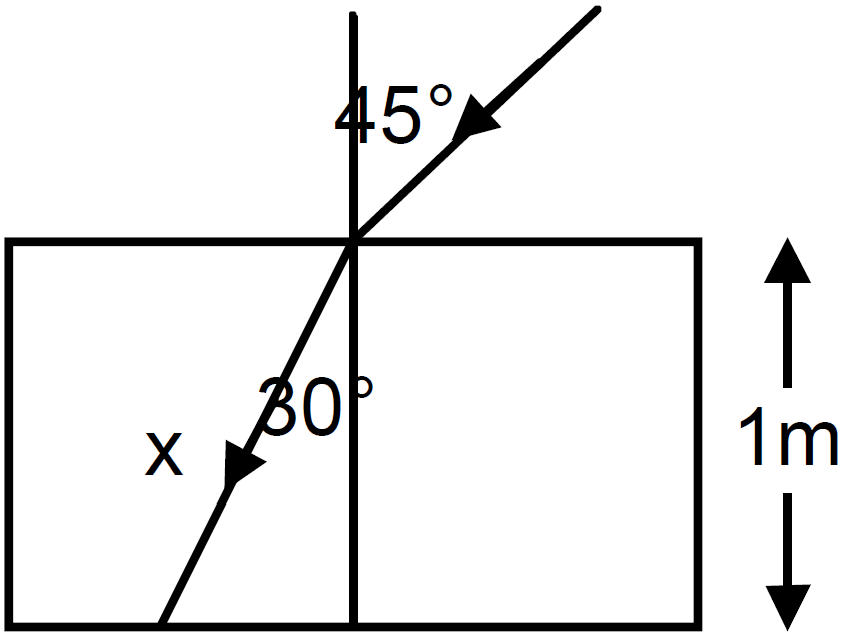
A light ray falling at an angle of 45° with the surface of a clean slab of ice of thickness 1m is refracted into it at an angle of 30°. Calculate the time taken by the light rays, to cross the slab. Speed of light in vacuum = 3 × 10⁸m/s
Answer

We know, $\frac{\sin\text{i}}{\sin\text{r}}=\frac{3\times10^8}{\text{v}}=\frac{\sin45^{\circ}}{\sin30^{\circ}}=\sqrt{2}$

$\Rightarrow\text{v}=\frac{3\times10^8}{\sqrt{2}}\text{m}/\text{sec}$

Distance travelled by light in the slab is,

$\text{x}=\frac{1\text{m}}{\cos30^{\circ}}=\frac{2}{\sqrt{3}}\text{m}$

So, time taken $=\frac{2\times\sqrt{2}}{\sqrt{3}\times3\times10^8}=0.54\times10^{-8}=5.4\times10^{-9}\text{sec}.$

View full question & answer
Question 1053 Marks
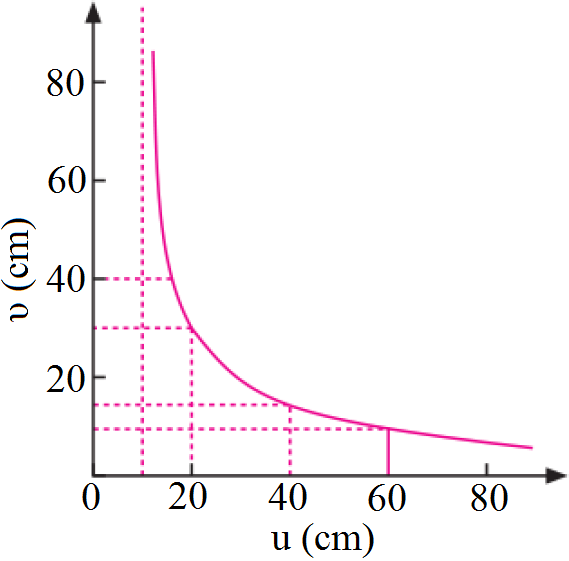
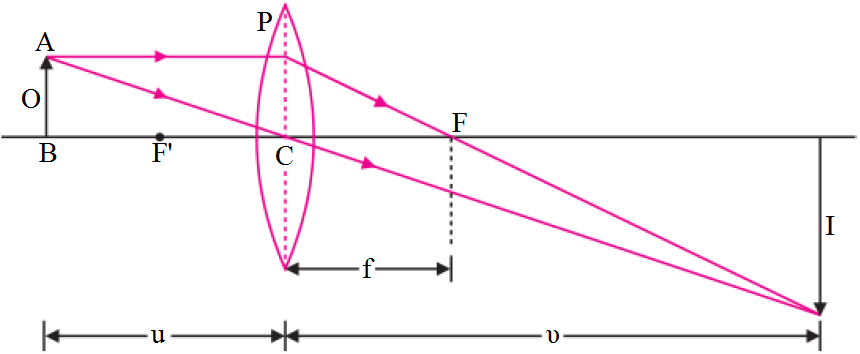
A lens forms a real image of an object. The distance from the object to the lens is u cm and the distance of the image from the lens is v cm. The given graphs shows variation of v with u.
  1. What is the nature of the lens?
  2. Using the graph, find the focal length of this lens.
View full question & answer
Question 1063 Marks
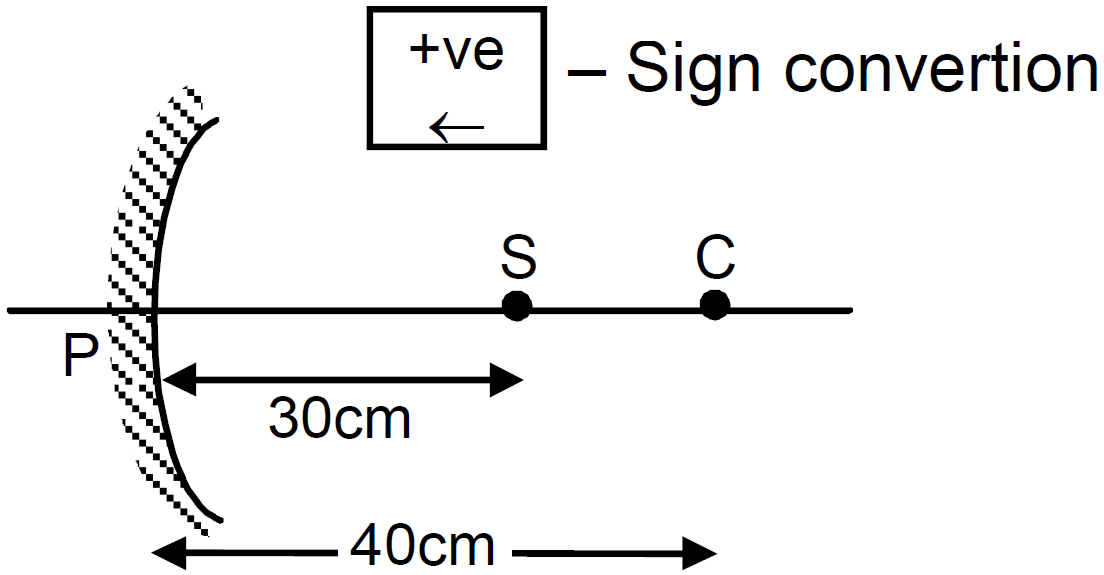
A concave mirror having a radius of curvature 40cm is placed in front of an illuminated point source at a distance of 30cm from it. Find the location of the image.
Answer

u = -30cm, R = -40cm

From the mirror equation,

$\frac{1}{\text{v}}+\frac{1}{\text{u}}=\frac{2}{\text{R}}$

$\Rightarrow \frac{1}{\text{v}}=\frac{2}{\text{R}}-\frac{1}{\text{u}}=\frac{2}{-30}-\frac{1}{-30}=-\frac{1}{60}$

or, v = -60cm

So, the image will be formed at a distance of 60cm in front of the mirror.

View full question & answer
Question 1073 Marks
A simple microscope has a magnifying power of 3.0 when the image is formed at the near point (25cm) of a normal eye.
  1. What is its focal length?
  2. What will be its magnifying power if the image is formed at infinity?
Answer
The simple microscope has, m = 3, when image is formed at D = 25cm

  1. $\text{m}=1+\frac{\text{D}}{\text{f}}\Rightarrow3=1+\frac{25}{\text{f}}$

$\Rightarrow\text{f}=\frac{25}{2}=12.5\text{cm}$

  1. When the image is formed at infinity (normal adjustment)

Magnifying power $=\frac{\text{D}}{\text{f}}=\frac{25}{12.5}= 2.0$

View full question & answer
Question 1083 Marks
Two lenses of power 10D and -5D are placed in contact.
  1. Calculate the power of lens combination.
  2. Where should an object be held from the lens, so as to obtain a virtual image of magnification 2?
Answer
  1. Given P1 = 10 D,

P2 = -5D

Power of Combination, P = p1 + P2 = 10D - 5D = 5D

  1. Focal length (Convergent lens) $\text{f}=\frac{1}{\text{P}}=\frac{1}{5}\text{m}$

$=0.20\text{m}=20\text{cm}$

(Convergent lens)

Magnification $\text{m}=\frac{\text{v}}{\text{u}}=+2$

$\Rightarrow\text{v}=2\text{u}$

From lens formula (u is negative) $\frac{1}{\text{f}}=\frac{1}{\text{v}}-\frac{1}{\text{u}}$

$\frac{1}{20}=\frac{1}{2\text{u}}-\frac{1}{\text{u}}$

$\Rightarrow-\frac{1}{2\text{u}}=\frac{1}{20}$

$\Rightarrow\text{u}=-10\text{cm}.$

View full question & answer
3 Marks Question - Page 3 - Physics STD 12 Science Questions - Vidyadip