Question 14 Marks
A person goes to bed at sharp 10:00 pm every day. Is it an example of periodic motion? If yes, what is the time period? If no, why?
Answer
View full question & answer→It is not motion at first place.
4 questions · timed · auto-graded
$\text{T}=2\pi\sqrt{\frac{\ell}{\text{g}}}$
$\Rightarrow4=2\pi\sqrt{\frac{\ell}{\text{g}}}\ ...(1)$
When the car makes accelerated motion, let the acceleration be a0$\text{T}=2\pi\sqrt{\frac{\ell}{\text{g}^2+\text{a}_0^2}}$
$\Rightarrow3.99=2\pi\sqrt{\frac{\ell}{\text{g}^2+\text{a}_0^2}}$
Now, $\frac{\text{T}}{\text{T}'}=\frac{4}{3.99}=\frac{\big(\text{g}^2+\text{a}_0^2\big)^{\frac{1}{4}}}{\sqrt{\text{g}}}$ Solving for ‘a0’ we can get a0 $=\frac{\text{g}\text{}}{10}\text{ms}^{-2}$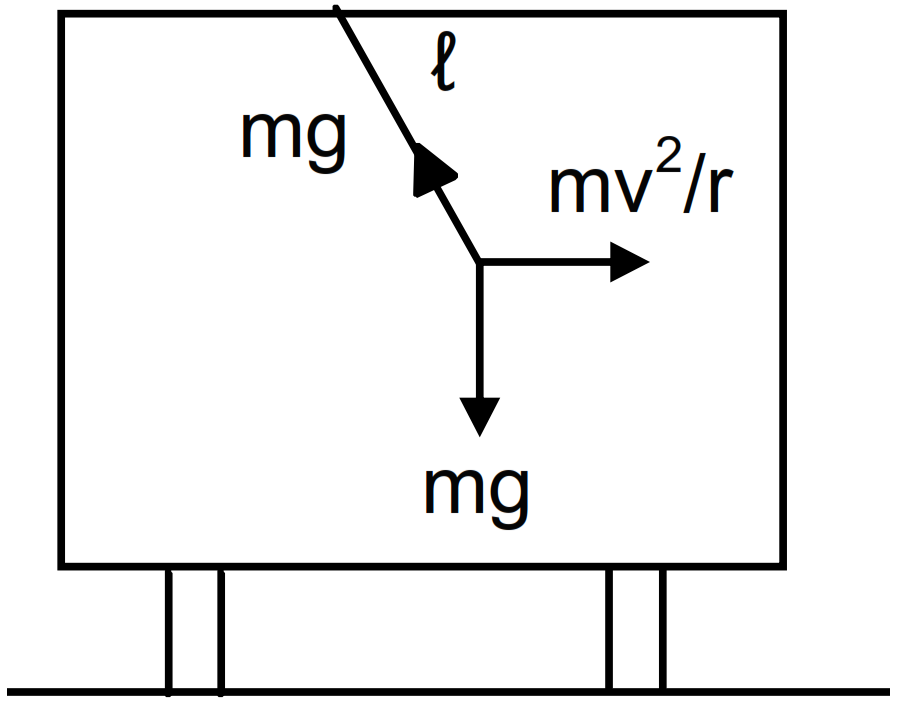
From the freebody diagram,
$\text{T}=\sqrt{(\text{mg})^2+\Big(\frac{\text{mv}^2}{\text{r}^2}\Big)}$
$=\text{m}\sqrt{\text{g}^2+\frac{\text{v}^4}{\text{r}^2}}=\text{ma}$ where a = acceleration $=\Big(\text{g}^2+\frac{\text{v}^4}{\text{r}^2}\Big)^{\frac{1}{2}}$
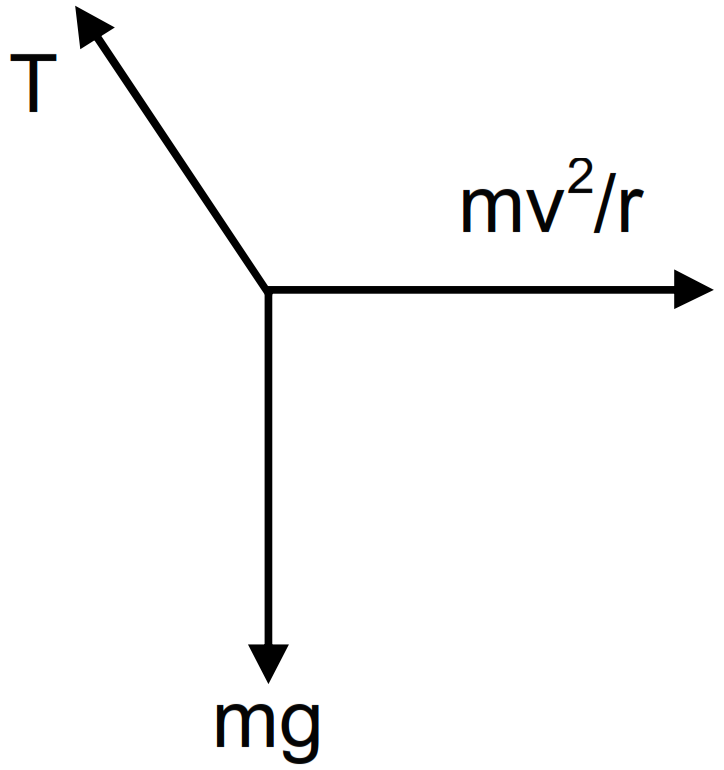
The time period of small accellations is given by,
$\text{T}=2\pi\sqrt{\frac{\ell}{\text{g}}}=2\pi\sqrt{\frac{\ell}{\Big(\text{g}^2+\frac{\text{v}^4}{\text{r}^2}\Big)^{\frac{1}{2}}}}$

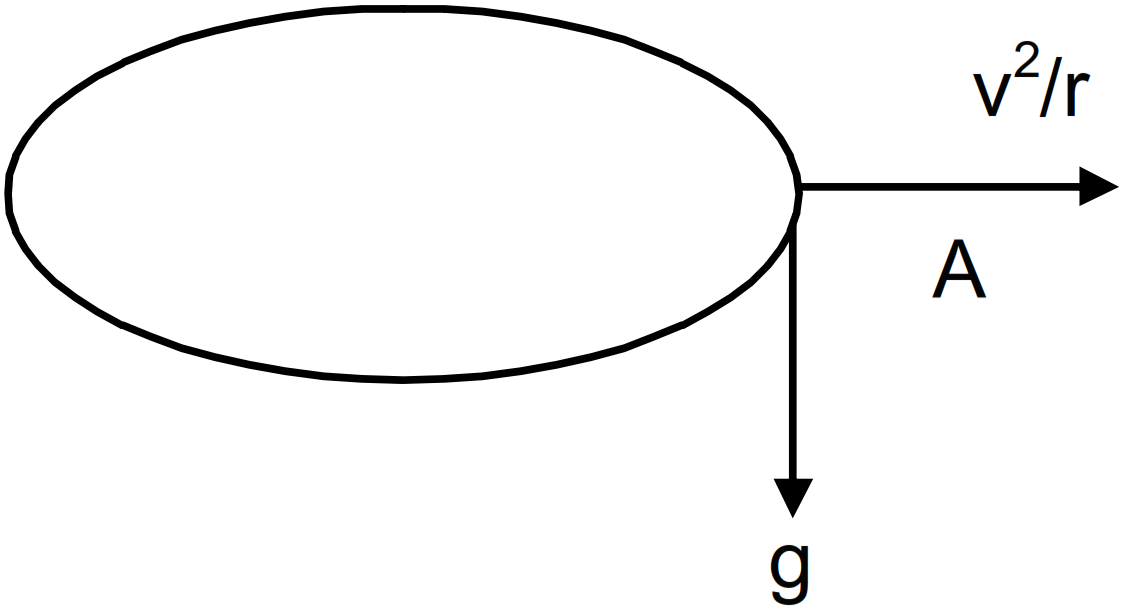
$\text{T}=2\pi\sqrt{\frac{\ell}{\text{g}}}=2\pi\sqrt{\frac{0.03}{9.8}}=0.34$ secound.
$\text{a}=\frac{\text{v}^2}{\text{r}}=\frac{\text{4}^2}{2}=8\text{m/s}^2$
Resultant Acceleration $\text{A}=\sqrt{\text{g}^2+\text{a}^2}=\sqrt{100+64}=12.8\text{m/s}^2$
Time period $\text{T}=2\pi\sqrt{\frac{\ell}{\text{A}}}=2\pi\sqrt{\frac{0.03}{12.8}}=0.30$ second.