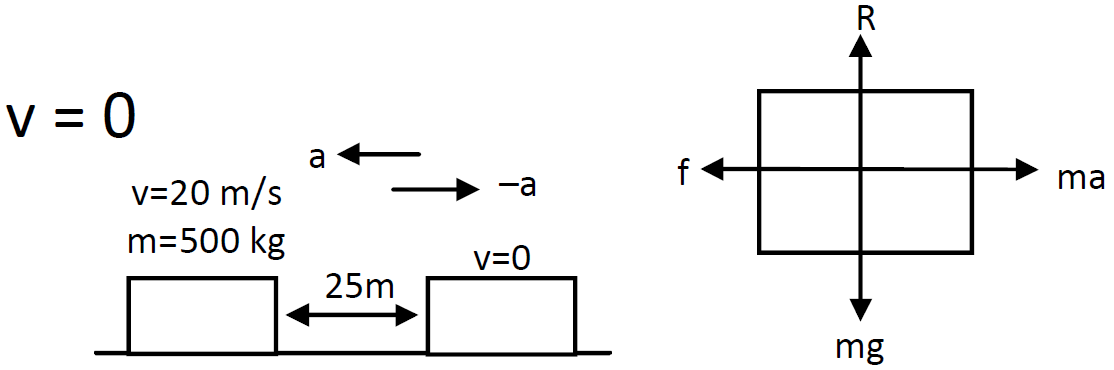
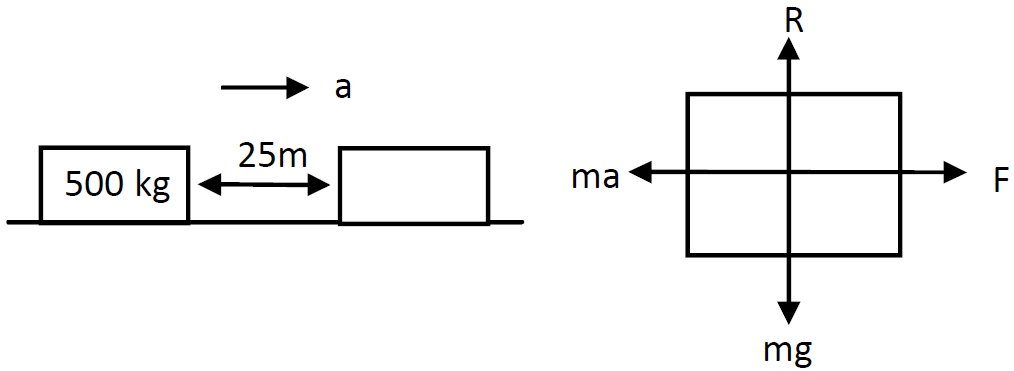
m = 500kg, s = 25m, u = 72km/ h = 20 m/ s,
$\text{a}=\frac{\text{v}^2-\text{u}^2}{2\text{s}}$
$\Rightarrow\frac{400}{50}=8\text{m}/\text{sec}^2$
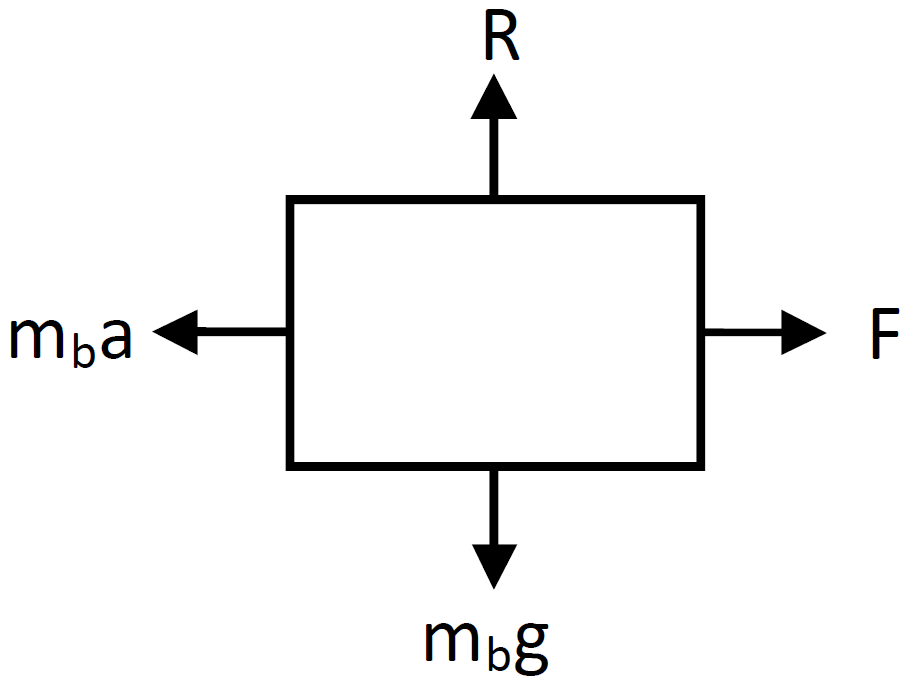
Frictional force F = ma = 500 × 8 = 4000N
27 questions · self-marked practice — reveal the answer and mark yourself.
m = 500kg, s = 25m, u = 72km/ h = 20 m/ s,
$\text{a}=\frac{\text{v}^2-\text{u}^2}{2\text{s}}$
$\Rightarrow\frac{400}{50}=8\text{m}/\text{sec}^2$
Frictional force F = ma = 500 × 8 = 4000N

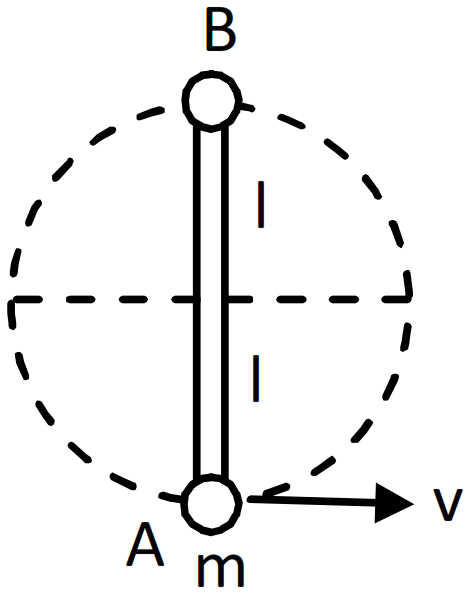
Let the velocity of the body at A is ‘V’ for minimum velocity given at A velocity of the body at point B is zero.
Applying law of conservation of energy at A & B.
$\frac{1}{2}\text{mv}^2=\text{mg}(2\ell)$
$\Rightarrow\text{v}=\sqrt{(4\text{g}\ell)}=2\sqrt{\text{g}\ell}$

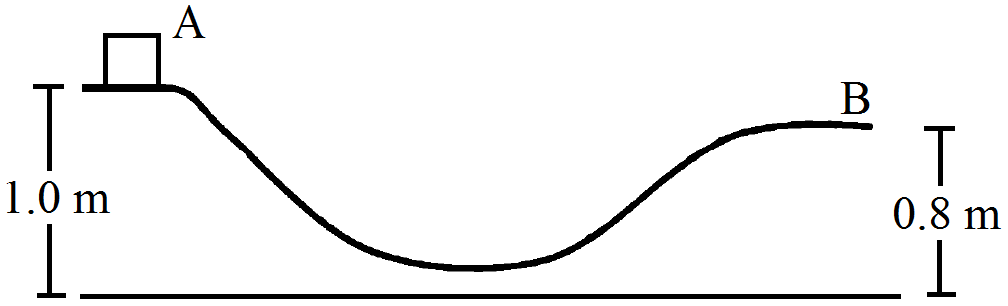
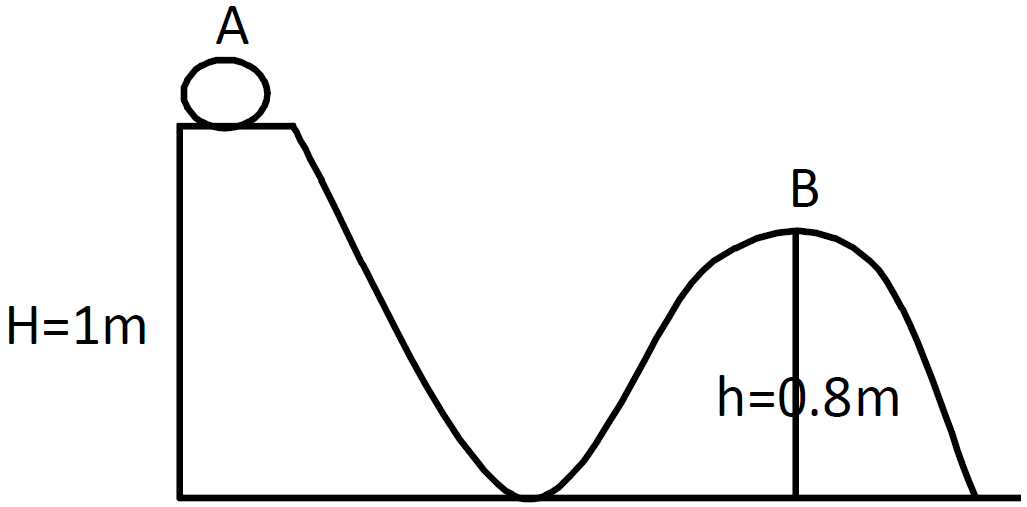
Given, m = 1kg, H = 1m, h = 0.8m
Here, work done by friction = change in P.E. [as the body comes to rest]
⇒ Wf = mgh - mgH
= mg(h - H)
= 1 × 10(0.8 - 1)
= -2J
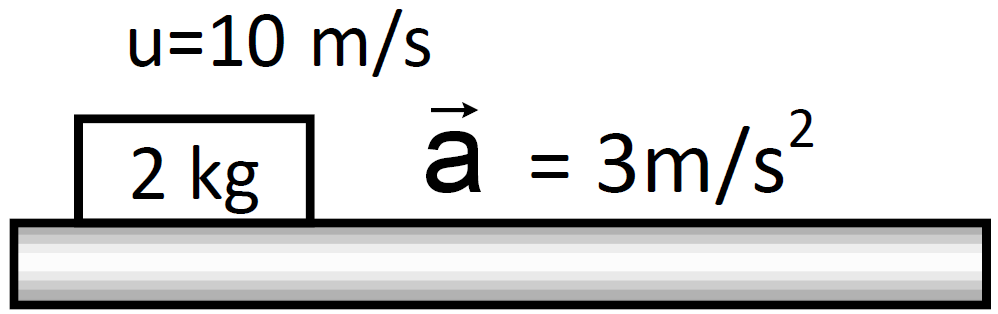
Mb = 2kg
u = 10m/s
a = 3m/s2
t = 5s
ν = u + at
= 10 + 3 × 5 = 25m/s
$\therefore$ Final $\text{K.E.}=\frac{1}{2}\text{mv}^2$
$=\frac{1}{2}\times2\times625=625\text{J}$
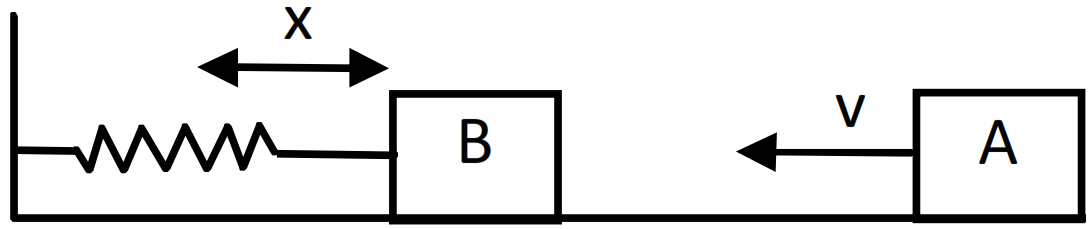
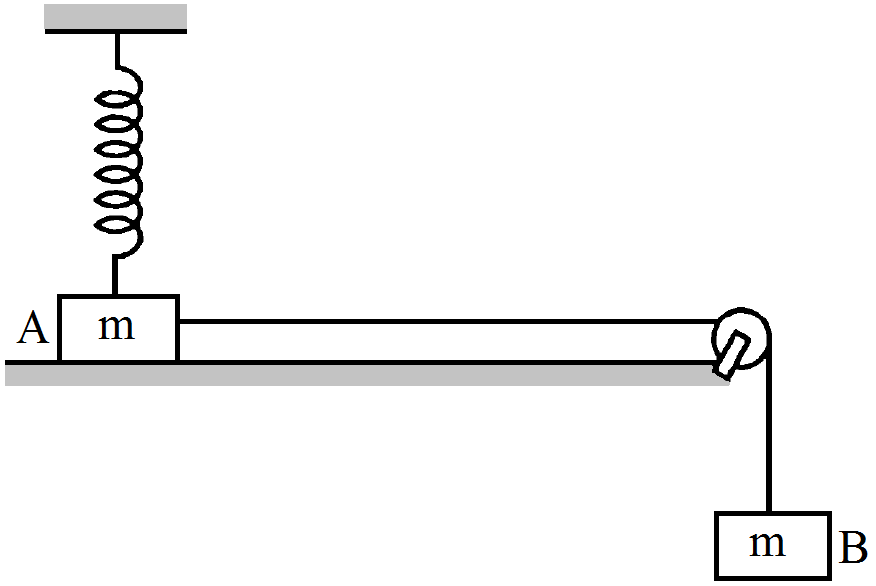
Let the velocity of the body at A be v
So, the velocity of the body at B is $\frac{\text{v}}{2}$
Energy at point A = Energy at point B
So, $\frac{1}{2}\text{mv}_\text{A}^2=\frac{1}{2}\text{mv}_\text{B}^2-\frac{1}{2}\text{kx}^{2+}$
$\Rightarrow\frac{1}{2}\text{kx}^2=\frac{1}{2}\text{mv}_\text{A}^2-\frac{1}{2}\text{mv}_\text{B}^2$
$\Rightarrow\text{kx}^2=\text{m}\Big(\text{v}_\text{A}^{2+-}\text{v}_\text{B}^2\Big)$
$\Rightarrow\text{kx}^2=\text{m}\Big(\text{v}^2-\frac{\text{v}^2}{4}\Big)$
$\Rightarrow\text{k}=\frac{3\text{m}\text{v}^2}{4\text{x}^2}$
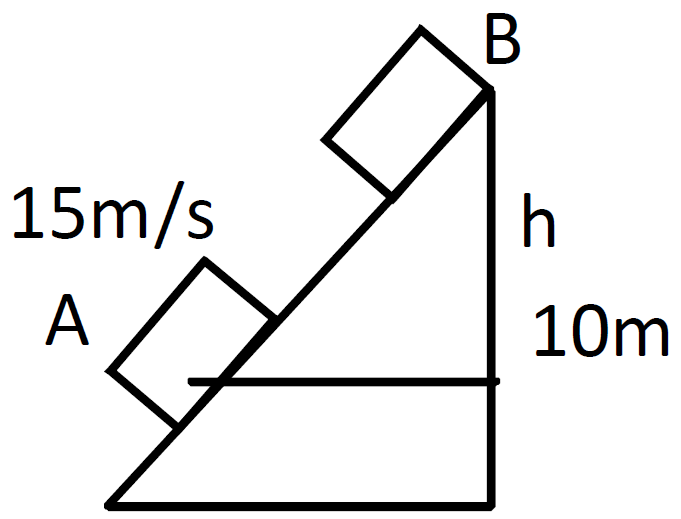
m = 1400kg, v = 54km/h = 15m/sec, h = 10m
Work done = Total K.E. - Total P.E.
$=0+\frac{1}{2}\text{mv}^2-\text{mgh}$
$=\frac{1}{2}\times1400\times(15)^2-1400\times9.8\times10$
$=157500-137200$
$=20300$
So, work done against friction, Wt = 20300J
$\vec{\text{r}}_1=2\hat{\text{i}}+3\hat{\text{j}}$
$\vec{\text{r}}_2=3\hat{\text{i}}+2\hat{\text{j}}$
So, displacement vector is given by,$\vec{\text{r}}=\vec{\text{r}}_1-\vec{\text{r}}_2$
$\Rightarrow\vec{\text{r}}=\Big(3\hat{\text{i}}+2\hat{\text{j}}\Big)-\Big(2\hat{\text{i}}+3\hat{\text{j}}\Big)$
$=\hat{\text{i}}-\hat{\text{j}}$
So, work done $=\vec{\text{F}}\times\vec{\text{S}}$$=5\times1+5(-1)=0$

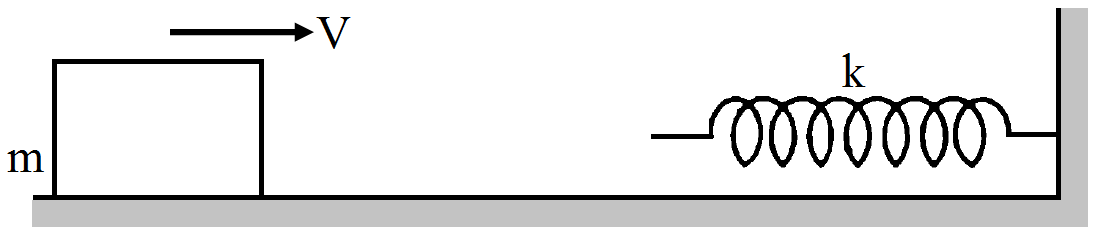
Let the compression be x.
According to law of conservation of energy,
$\frac{1}{2}\text{mv}^2=\frac{1}{2}\text{k}\text{x}^2$
$\Rightarrow\text{x}^2=\frac{\text{mv}^2}{\text{k}}$
$\Rightarrow\text{x}=\text{v}\sqrt{\Big({\frac{\text{m}}{\text{k}}\Big)}}$
No. It will be in the opposite direction and magnitude will be less due to loss in spring.
mb = 2kg, s = 40m, a = 0.5m/sec2
So, force applied by the man on the box
F = mba = 2 × (0.5) = 1N
$\omega=\text{FS}=1\times40=40\text{J}$
$\text{mgh}+\frac{1}{2}\text{mu}^2+\frac{1}{2}\text{mv}^2$
$\Rightarrow10\times40+\frac{1}{2}\times2500=\frac{1}{2}\text{v}^2$
$\Rightarrow\text{v}^2=3300$
$\Rightarrow\text{v}=57.4\text{m}/\text{sec}\approx58\text{m}/\text{sec}$
$\text{p}=\frac{\text{w}}{\text{t}},$ Work W = pt = 460 × 117.56J
Again, $\text{W}=\text{FS}=\frac{460\times117.56}{200}$$=270.3\text{N}\approx270\text{N}$
$=30\text{kg}/\text{min}=0.5\text{kg}/\text{sec}$
power $\text{P}=\frac{\text{mgh}}{\text{t}}$$=(0.5)\times9.8\times10=49\text{W}$
So, horse power (h.p) $=\frac{\text{p}}{746}=\frac{49}{746}=6.6\times10^{-2}\text{hp}$$=177.6\ \text{J}\approx118\text{J}$

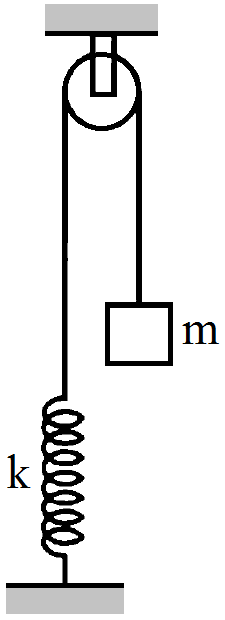
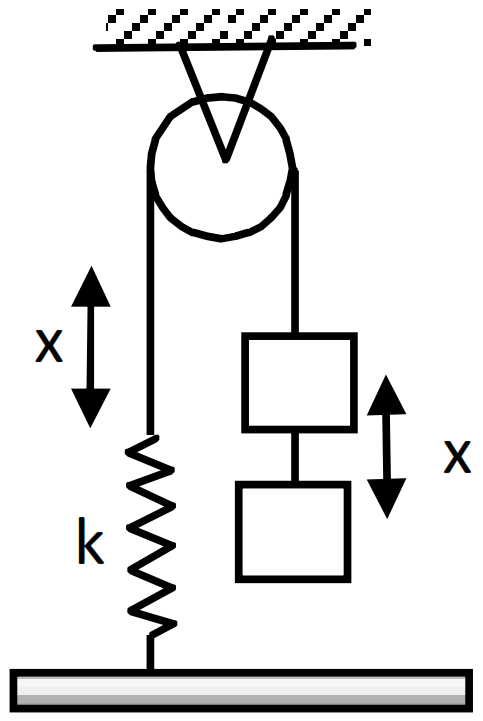
$\Rightarrow\text{x}=2\text{mg}/\text{k}$

$=\Big(\frac{1}{2}\Big)\times(0.2)\times9+(0.2)\times(9.8)\times(1.5)=3.84\text{J}$
h.p. used $=\frac{3.84}{746}=5.14\times10^{-3}$$\text{W}=\int\limits_0^\text{d}\text{Fdx}$
$\text{W}=\int\limits_0^\text{d}\text{(a+bx)dx}$
$=\Big[\text{ax}+\Big(\frac{\text{bx}^2}{2}\Big)\Big]_0^\text{d}$
$=\Big[\text{a}+\frac{1}{2}\text{bd}\Big]\text{d}$
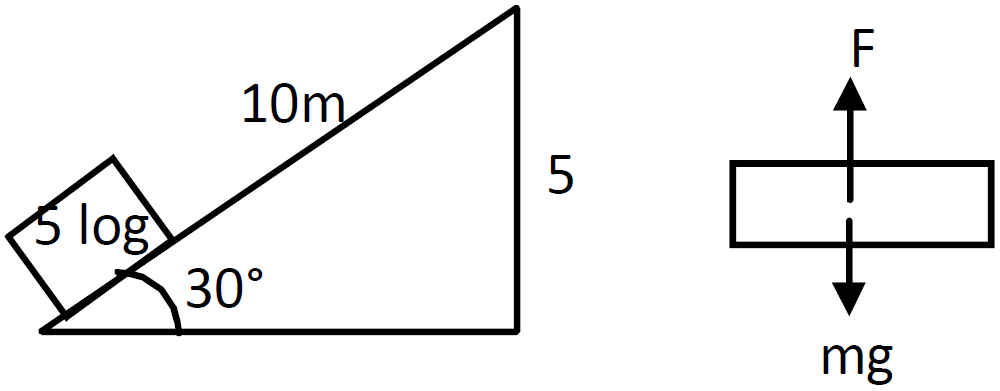
$\text{m} = 5\text{kg}$
$\theta=30^\circ$
$\text{S} = 10\text{m}$
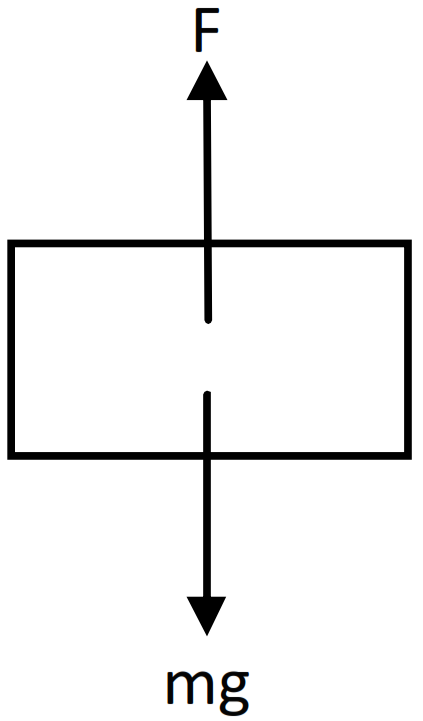
$\text{F} = \text{mg}$
So, work done by the force of gravity
$\omega=\text{mgh}$
$= 5\times9.8\times5 = 245\text{J}$

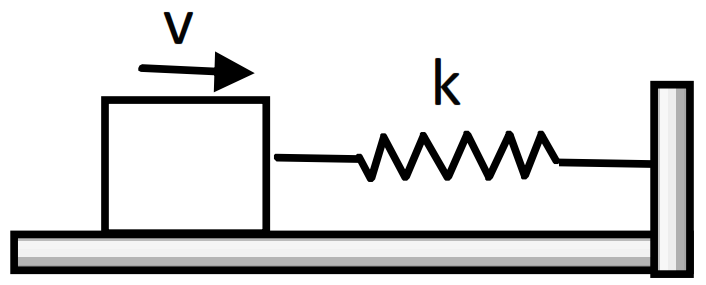
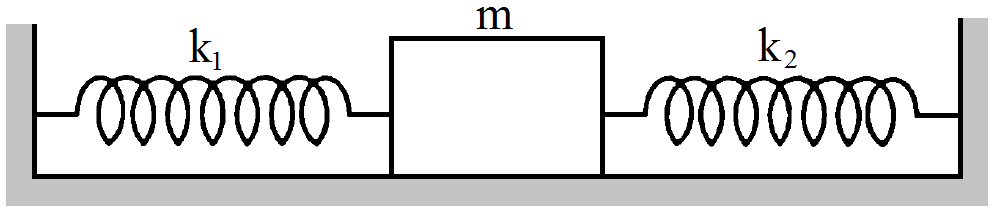
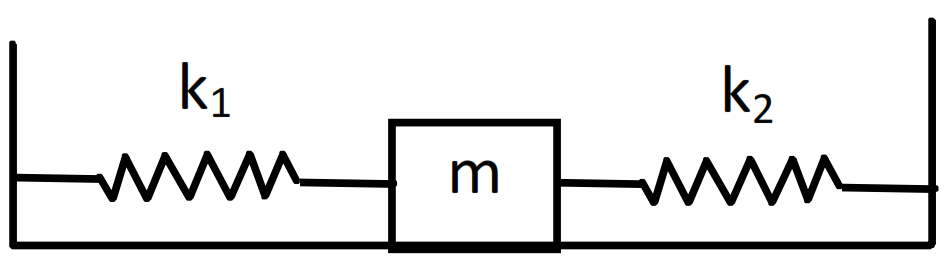
The body is displaced x towards right.
Let the velocity of the body be v at its mean position.
Applying law of conservation of energy.
$\frac{1}{2}\text{mv}^2=\frac{1}{2}\text{k}_1\text{x}^2+\frac{1}{2}\text{k}_2\text{x}^2$
$\Rightarrow\text{mv}^2=\text{x}^2(\text{k}_1+\text{k}_2)$
$\Rightarrow\text{v}^2=\frac{\text{x}^2(\text{k}_1+\text{k}_2)}{\text{m}}$
$\Rightarrow\text{v}=\text{x}\sqrt{\frac{\text{k}_1+\text{k}_2}{\text{m}}}$
m = 2000kg, s = 12m, t = 1min = 60sec
So, work $\text{W}=\text{F}\cos\theta=\text{mgs}\cos0^\circ$ $[\theta=0^\circ,$ for minimum work$]$
$=2000\times10\times12=240000\text{J}$
So, power $\text{p}=\frac{\text{W}}{\text{t}}=\frac{240000}{60}=4000\text{watt}$
h.p $=\frac{4000}{746}=5.3\text{hp}$
m = 500kg, u = 0, v = 72km/h = 20m/s
$\text{a}=\frac{\text{v}^2-\text{u}^2}{2\text{s}}$
$\Rightarrow\frac{400}{50}=8\text{m}/\text{sec}^2$
force needed to accelerate the car F = ma = 500 × 8 = 4000N
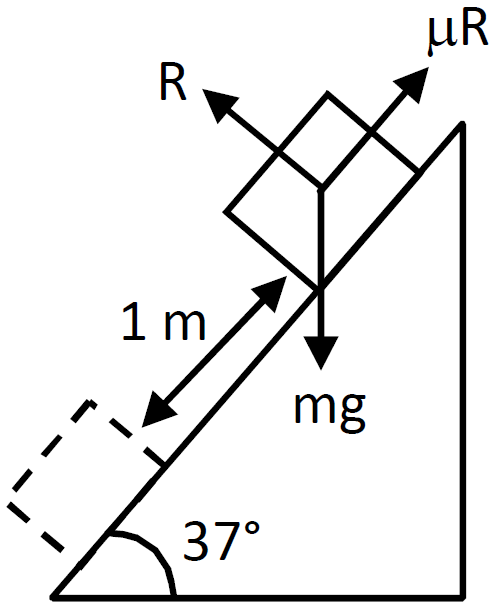
$\text{m}_\text{b}=250\text{g}=.250\text{kg}$
$\theta=37^\circ,\text{S}=1\text{m}.$
Frictional force $\text{f}=\mu\text{R}$
$\text{mg}\sin\theta=\mu\text{R}\ \dots(1)$
$\text{mg}\cos\theta \dots(2)$
so, work done against $\mu\text{R}=\mu\text{RS}\cos0^\circ=\text{mg}\sin\theta$
$\text{S}=0.250\times9.8\times0.60\times1=1.5\text{J}$
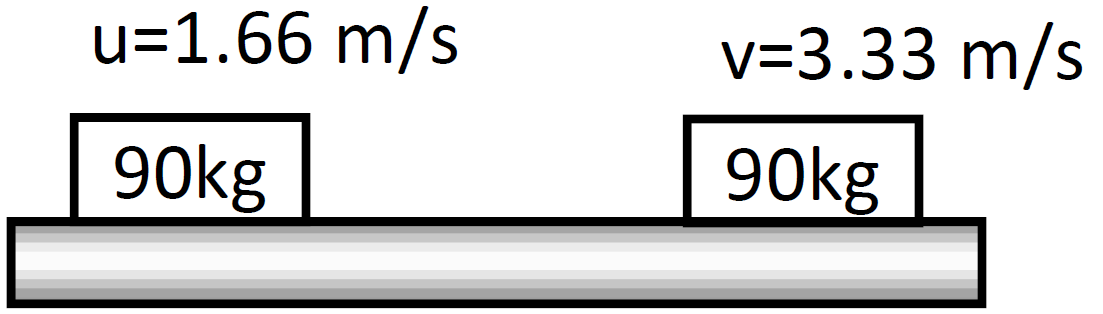
M = mc + mb = 90kg
u = 6.0km/h = 1.666 m/sec
ν = 12 km/h = 3.333 m/sec
Increase in K.E.
$=\frac{1}{2}\text{Mv}^2-\frac{1}{2}\text{mu}^2$
$=\frac{1}{2}90\times(3.333)^2-\frac{1}{2}90\times(1.66)^2$
$=499.4-124.6$
$=374.8\approx375\text{J}$