Questions

2 Marks Questions

Take a timed test

27 questions · self-marked practice — reveal the answer and mark yourself.

Question 12 Marks
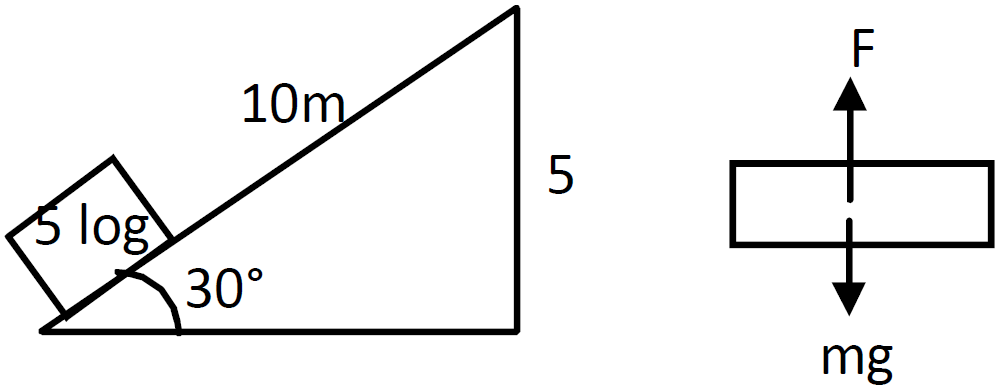
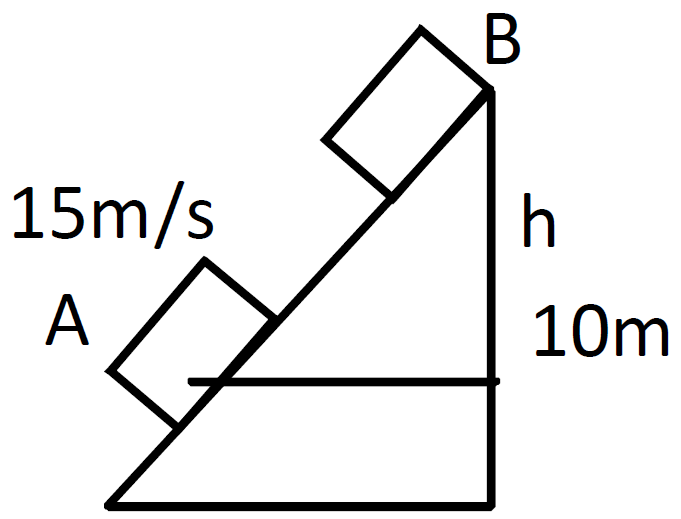
A heavy box is kept on a smooth inclined plane and is pushed up by a force F acting parallel to the plane. Does the work done by the force F as the box goes from A to B depend on how fast the box was moving at A and B? Does the work by the force of gravity depend on this?
Answer
  1. No. As the surface is smooth and the friction is zero, work done by the force will only depend on the force and the displacement.
  2. No, because gravitational force is a conservative force and work done by a conservative force will depend only on the force and the displacement.
View full question & answer
Question 22 Marks
Is work-energy theorem valid in non-inertial frames?
Answer
In an non-inertial frame, pseudo force also comes into account. As we know that pseudo force does not exist, work-energy theorem is not valid in non-inertial frames.
View full question & answer
Question 32 Marks
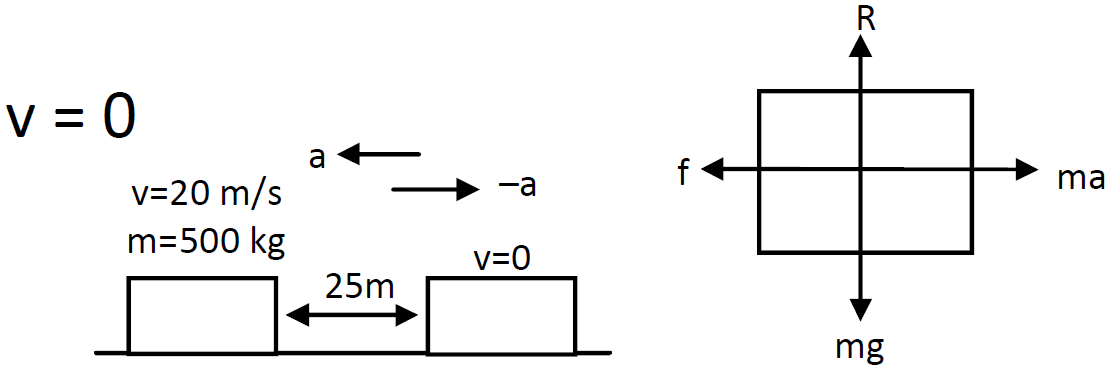
Find the average frictional force needed to stop a car weighing 500kg in a distance of 25m if the initial speed is 72km/ h.
Answer

m = 500kg, s = 25m, u = 72km/ h = 20 m/ s,
$\text{a}=\frac{\text{v}^2-\text{u}^2}{2\text{s}}$
$\Rightarrow\frac{400}{50}=8\text{m}/\text{sec}^2$
Frictional force F = ma = 500 × 8 = 4000N
View full question & answer
Question 42 Marks
A small heavy block is attached to the lower end of a light rod of length l which can be rotated about its clamped upper end. What minimum horizontal velocity should the block be given so that it moves in a complete vertical circle?
Answer

Let the velocity of the body at A is ‘V’ for minimum velocity given at A velocity of the body at point B is zero.
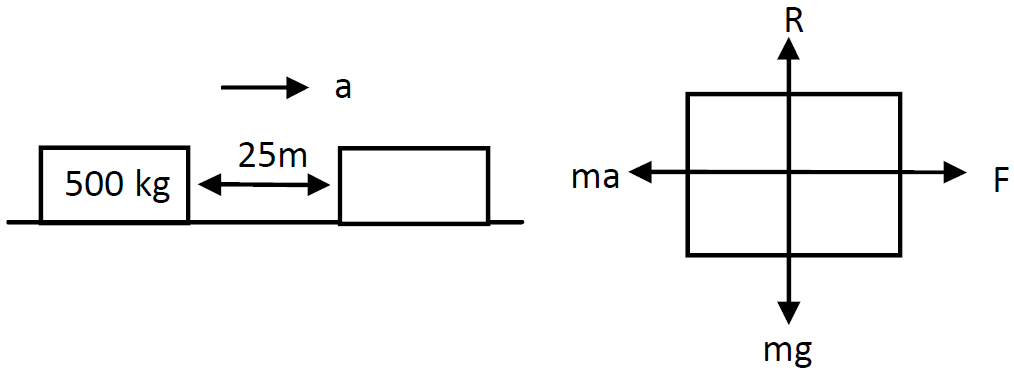
Applying law of conservation of energy at A & B.
$\frac{1}{2}\text{mv}^2=\text{mg}(2\ell)$
$\Rightarrow\text{v}=\sqrt{(4\text{g}\ell)}=2\sqrt{\text{g}\ell}$
View full question & answer
Question 52 Marks
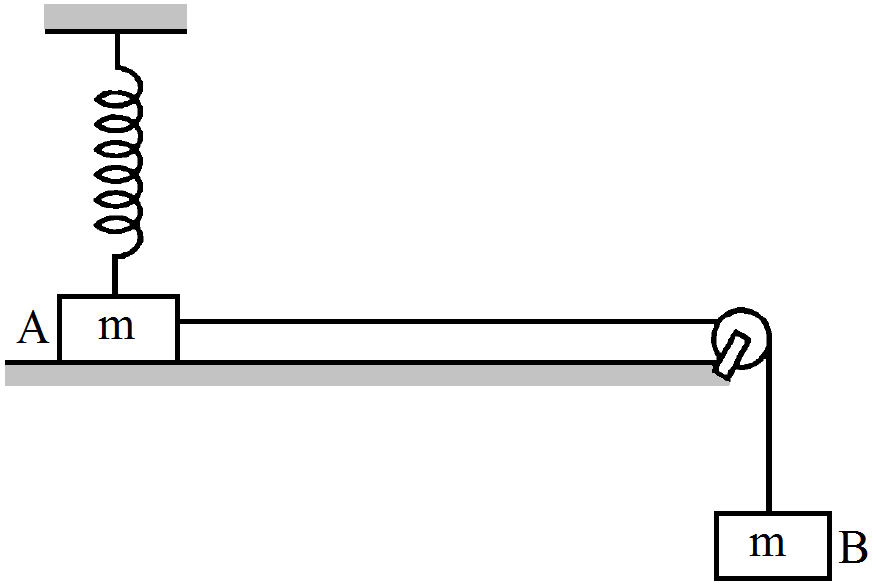
Find the average force needed to accelerate a car weighing 500kg from rest to 72km/h in a distance of 25m.
Answer

m = 500kg, u = 0, v = 72km/h = 20m/s
$\text{a}=\frac{\text{v}^2-\text{u}^2}{2\text{s}}$
$\Rightarrow\frac{400}{50}=8\text{m}/\text{sec}^2$
force needed to accelerate the car F = ma = 500 × 8 = 4000N
View full question & answer
Question 62 Marks
A block of mass 5.0kg slides down an incline of inclination 30° and length 10m. Find the work done by the force of gravity.
Answer

$\text{m} = 5\text{kg}$
$\theta=30^\circ$
$\text{S} = 10\text{m}$
$\text{F} = \text{mg}$
So, work done by the force of gravity
$\omega=\text{mgh}$
$= 5\times9.8\times5 = 245\text{J}$
View full question & answer
Question 72 Marks
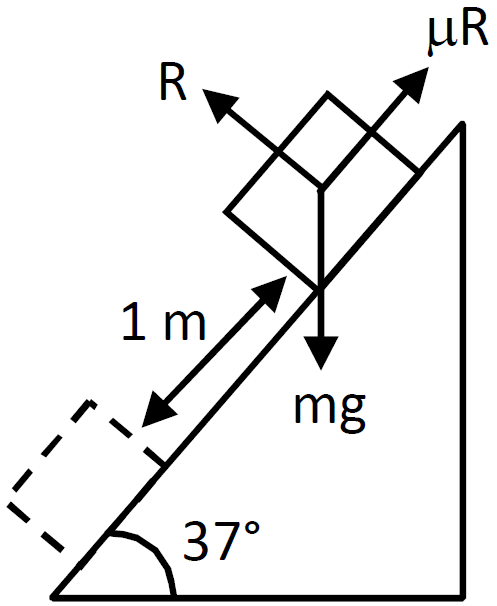
A block of mass 250g slides down an incline of inclination 37° with a uniform speed. Find the work done against the friction as the block slides through 1.0m.
Answer

$\text{m}_\text{b}=250\text{g}=.250\text{kg}$
$\theta=37^\circ,\text{S}=1\text{m}.$
Frictional force $\text{f}=\mu\text{R}$
$\text{mg}\sin\theta=\mu\text{R}\ \dots(1)$
$\text{mg}\cos\theta \dots(2)$
so, work done against $\mu\text{R}=\mu\text{RS}\cos0^\circ=\text{mg}\sin\theta$
$\text{S}=0.250\times9.8\times0.60\times1=1.5\text{J}$
View full question & answer
Question 82 Marks
A projectile is fired from the top of a 40m high cliff with an initial speed of 50m/s at an unknown angle. Find its speed when it hits the ground.
Answer
h = 40m, u = 50m/sec Let the speed be ‘v’ when it strikes the ground. Applying law of conservation of energy,$\text{mgh}+\frac{1}{2}\text{mu}^2+\frac{1}{2}\text{mv}^2$
$\Rightarrow10\times40+\frac{1}{2}\times2500=\frac{1}{2}\text{v}^2$
$\Rightarrow\text{v}^2=3300$
$\Rightarrow\text{v}=57.4\text{m}/\text{sec}\approx58\text{m}/\text{sec}$
View full question & answer
Question 92 Marks
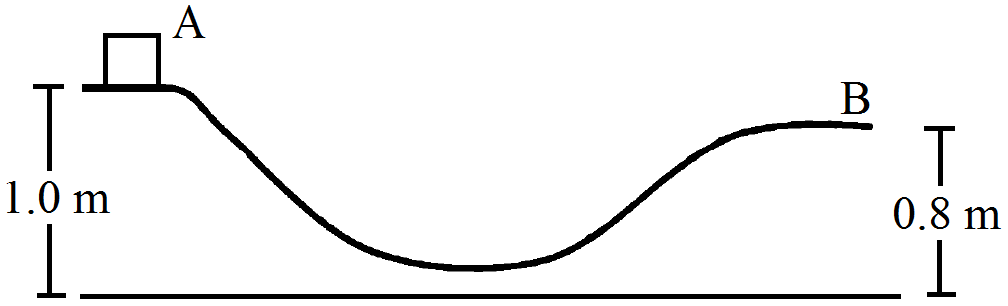
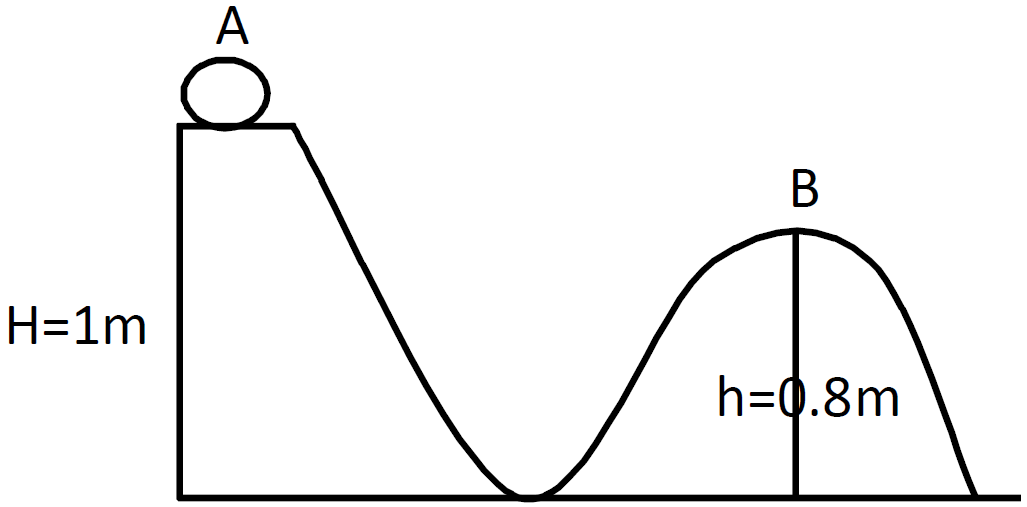
A block of mass 1kg is placed at the point A of a rough track shown in figure. If slightly pushed towards right, it stops at the point B of the track. Calculate the work done by the frictional force on the block during its transit from A to B.
Answer


Given, $m = 1kg, H = 1m, h = 0.8m$
Here, work done by friction = change in P.E. [as the body comes to rest]
$⇒ W_f= mgh - mgH$
$= mg(h - H)$
$= 1 × 10(0.8 - 1)$
$= -2J$
View full question & answer
Question 102 Marks
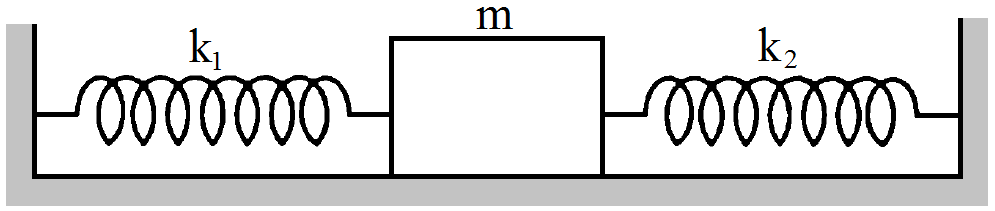
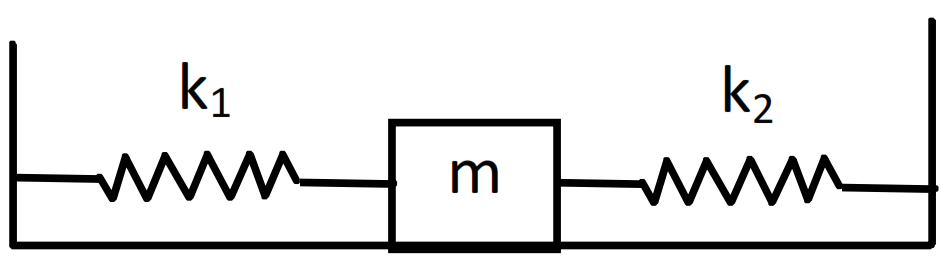
A block of mass $m$ is attached to two unstretched springs of spring constants $k_1$ and $k_2$ as shown in figure. The block is displaced towards right through a distance $x$ and is released. Find the speed of the block as it passes through the mean position shown.
Answer

The body is displaced x towards right.
Let the velocity of the body be v at its mean position.
Applying law of conservation of energy.
$\frac{1}{2}\text{mv}^2=\frac{1}{2}\text{k}_1\text{x}^2+\frac{1}{2}\text{k}_2\text{x}^2$
$\Rightarrow\text{mv}^2=\text{x}^2(\text{k}_1+\text{k}_2)$
$\Rightarrow\text{v}^2=\frac{\text{x}^2(\text{k}_1+\text{k}_2)}{\text{m}}$
$\Rightarrow\text{v}=\text{x}\sqrt{\frac{\text{k}_1+\text{k}_2}{\text{m}}}$
View full question & answer
Question 112 Marks
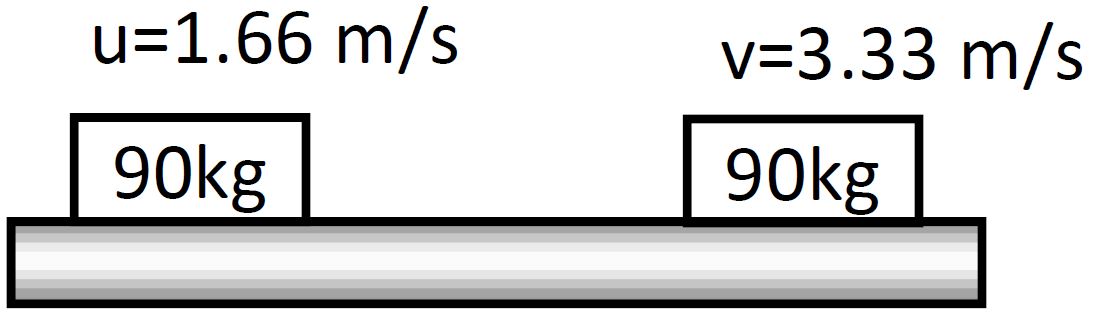
The mass of cyclist together with the bike is 90kg. Calculate the increase in kinetic energy if the speed increases from 6.0km/h to 12km/h.
Answer


$M = m_c+ m_b= 90kg$
$u = 6.0\ km/h = 1.666\ m/sec$
$ν = 12\ km/h = 3.333\ m/sec$
Increase in K.E.
$=\frac{1}{2}\text{Mv}^2-\frac{1}{2}\text{mu}^2$
$=\frac{1}{2}90\times(3.333)^2-\frac{1}{2}90\times(1.66)^2$
$=499.4-124.6$
$=374.8\approx375\text{J}$
View full question & answer
Question 122 Marks
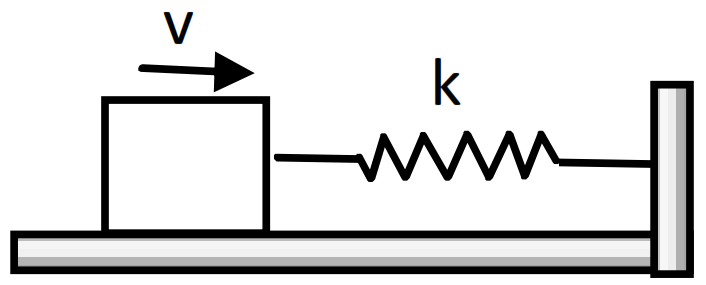
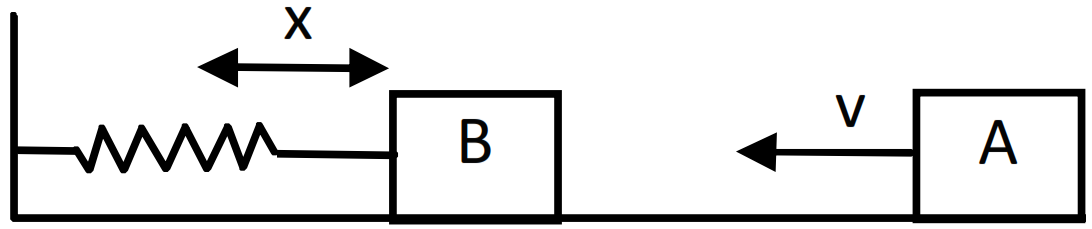
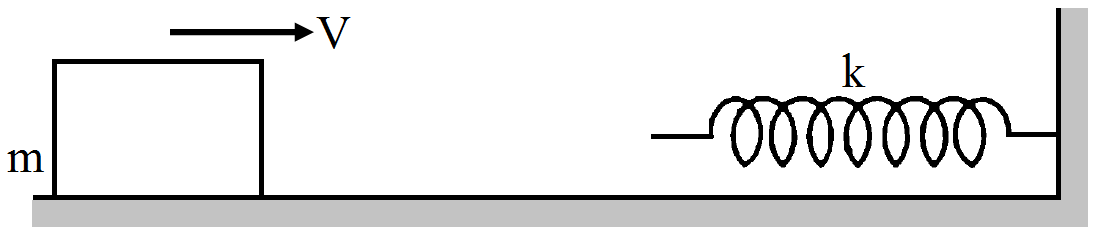
A block of massip, sliding on a smooth horizontal surface with a velocity $\vec{\text{v}}$ meets a long horizontal spring fixed at one end and having spring constant k as shown in figure. Find the maximum compression of tin spring. Will the velocity of the block be the same $\vec{\text{v}}$ when it comes back to the original position shown?
Answer

Let the compression be x.
According to law of conservation of energy,
$\frac{1}{2}\text{mv}^2=\frac{1}{2}\text{k}\text{x}^2$
$\Rightarrow\text{x}^2=\frac{\text{mv}^2}{\text{k}}$
$\Rightarrow\text{x}=\text{v}\sqrt{\Big({\frac{\text{m}}{\text{k}}\Big)}}$
No. It will be in the opposite direction and magnitude will be less due to loss in spring.
View full question & answer
Question 132 Marks
In a factory it is desired to lift 2000kg of metal through a distance of 12m in 1 minute. Find the minimum horsepower of the engine to be used.
Answer

m = 2000kg, s = 12m, t = 1min = 60sec
So, work $\text{W}=\text{F}\cos\theta=\text{mgs}\cos0^\circ$ $[\theta=0^\circ,$ for minimum work$]$
$=2000\times10\times12=240000\text{J}$
So, power $\text{p}=\frac{\text{W}}{\text{t}}=\frac{240000}{60}=4000\text{watt}$
h.p $=\frac{4000}{746}=5.3\text{hp}$
View full question & answer
Question 142 Marks
One person says that the potential energy of a particular book kept in an almirah is 20J and the other says it is 30J. Is one of them necessarily wrong?
Answer
No, both are correct. We measure potential energy from a reference level chosen by the observer. Therefore, in this case, both observers are measuring the potential energy from different reference levels.
View full question & answer
Question 152 Marks
A man moves on a straight horizontal road with a block of mass 2kg in his hand. If he covers a distance of 40m with an acceleration of $0.5m/s^2$, find the work done by the man on the block during the motion.
Answer


$m_b= 2\ kg, s = 40\ m, a = 0.5\ m/sec^2$
So, force applied by the man on the box
$F = m_ba = 2 × (0.5) = 1\ N$
$\omega=\text{FS}=1\times40=40\text{J}$
View full question & answer
Question 162 Marks
The 200m free style women's swimming gold medal at Seol Olympic 1988 went to Heike Friendrich of East Germany when she set a new Olympic record of 1 minute and 57.56 seconds. Assume that she covered most of the distance with a uniform speed and had to exert 460W to maintain her speed. Calculate the average force of resistance offered by the water during the swim.
Answer
t = 1min. 57.56sec = 11.56sec, p= 400W, s =200m$\text{p}=\frac{\text{w}}{\text{t}},$ Work W = pt = 460 × 117.56J
Again, $\text{W}=\text{FS}=\frac{460\times117.56}{200}$$=270.3\text{N}\approx270\text{N}$
View full question & answer
Question 172 Marks
A water pump lifts water from a level 10m below the ground. Water is pumped at a rate of 30kg/ minute with negligible velocity. Calculate the minimum horsepower the engine should have to do this.
Answer
h = 10m Flow rate $=\frac{\text{m}}{\text{t}}$$=30\text{kg}/\text{min}=0.5\text{kg}/\text{sec}$
power $\text{P}=\frac{\text{mgh}}{\text{t}}$$=(0.5)\times9.8\times10=49\text{W}$
So, horse power (h.p) $=\frac{\text{p}}{746}=\frac{49}{746}=6.6\times10^{-2}\text{hp}$
View full question & answer
Question 182 Marks
A person is painting his house walls. He stands on a ladder with a bucket containing paint in one hand and a brush in other. Suddenly the bucket slips from his hand and falls down on the floor. If the bucket with the paint had a mass of 6.0kg and was at a height of 2.0m at the time it slipped, how much gravitational potential energy is lost together with the paint?
Answer
m = 6kg, h = 2m P.E. at a height ‘2m’ = mgh = 6 × (9.8) × 2 = 117.6J P.E. at floor = 0 Loss in P.E. = 117.6 - 0$=177.6\ \text{J}\approx118\text{J}$
View full question & answer
Question 192 Marks
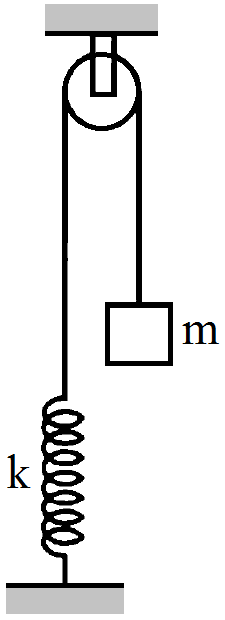
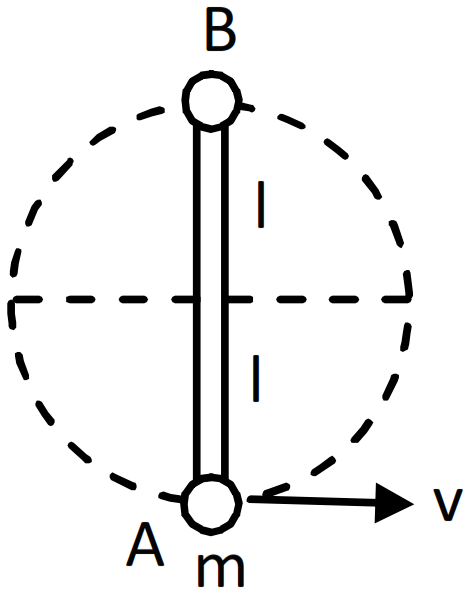
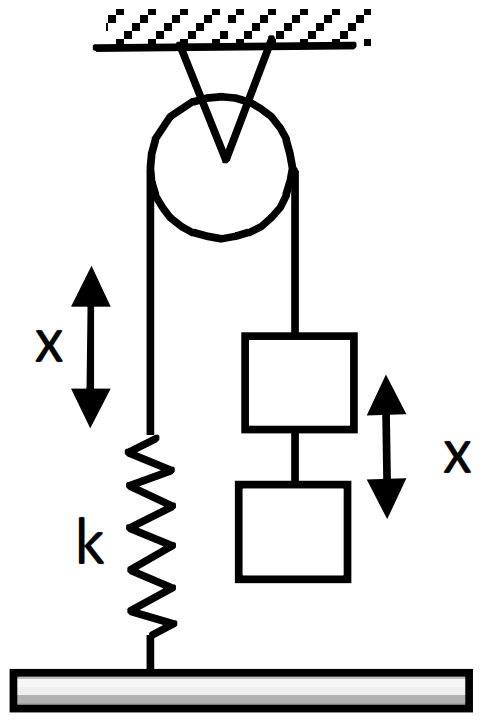
Consider the situation shown in figure. Initially the spring is unstretched when the system is released from rest. Assuming no friction in the pulley, find the maximum elongation of the spring.
Answer
Mass of the body = m Let the elongation be x So, $\frac{1}{2}\text{kx}^2=\text{mgx}$$\Rightarrow\text{x}=2\text{mg}/\text{k}$
View full question & answer
Question 202 Marks
An unruly demonstrator lifts a stone of mass 200g from the ground and throws it at his opponent. At the time of projection, the stone is 150cm above the ground and has a speed of 3.00m/s. Calculate the work done by the demonstrator during the process. If it takes one second for the demonstrator to lift the stone and throw, what horsepower does he use?
Answer
m = 200g = 0.2kg, h = 150cm = 1.5m, v = 3m/sec, t = 1sec Total work done $=\frac{1}{2}\text{mv}^2+\text{mgh}$$=\Big(\frac{1}{2}\Big)\times(0.2)\times9+(0.2)\times(9.8)\times(1.5)=3.84\text{J}$
h.p. used $=\frac{3.84}{746}=5.14\times10^{-3}$
View full question & answer
Question 212 Marks
A force F = a + bx acts on a particle in the x-direction, where a and b are constants. Find the work done by this force during a displacement from x = 0 to x = d.
Answer
Given that F= a + bx Where a and b are constants. So, work done by this force during this force during the displacement x = 0 and x = d is given by,$\text{W}=\int\limits_0^\text{d}\text{Fdx}$
$\text{W}=\int\limits_0^\text{d}\text{(a+bx)dx}$
$=\Big[\text{ax}+\Big(\frac{\text{bx}^2}{2}\Big)\Big]_0^\text{d}$
$=\Big[\text{a}+\frac{1}{2}\text{bd}\Big]\text{d}$
View full question & answer
Question 222 Marks
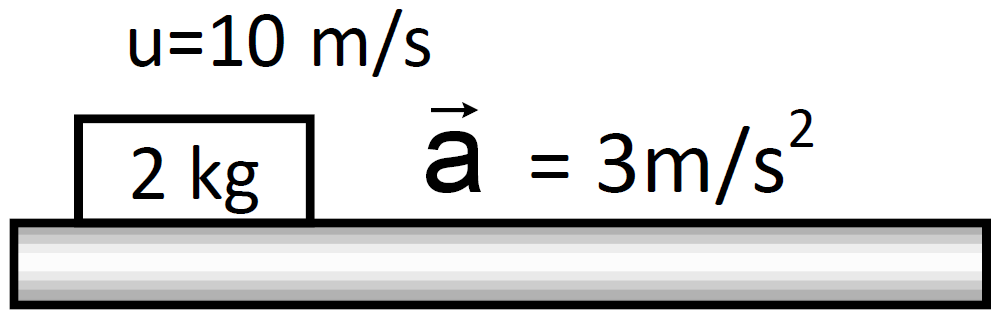
A block of mass 2.00kg moving at a speed of 10.0m/s accelerates at $3.00m/s^2$ for 5.00s. Compute its final kinetic energy.
Answer


$M_b= 2kg$
$u = 10m/s$
$a = 3m/s^2$
$t = 5s$
$ν = u + at$
$= 10 + 3 × 5 = 25m/s$
$\therefore$ Final $\text{K.E.}=\frac{1}{2}\text{mv}^2$
$=\frac{1}{2}\times2\times625=625\text{J}$
View full question & answer
Question 232 Marks
The magnetic force on a charged particle is always perpendicular to its velocity. Can the magnetic force change the velocity of the particle? Speed of the particle?
Answer
The magnetic force on a charged particle is always perpendicular to its velocity. Therefore, the work done by the magnetic force on the charged particle is zero. Here, the kinetic energy and speed of the particle remain unaffected, while the velocity changes due to the change in direction of its motion.
View full question & answer
Question 242 Marks
A particle moves from a point $\vec{\text{r}}_1=(2\text{m})\vec{\text{i}}+(3\text{m})\vec{\text{j}}$ to another point $\vec{\text{r}}_2=(3\text{m})\vec{\text{i}}+(2\text{m})\vec{\text{j}}$ during which a certain force $\vec{\text{F}}=(5\text{N})\vec{\text{i}}+(5\text{N})\vec{\text{j}}$ acts on it. Find the work done by the force on the particle during the displacement.
Answer
Given,$\vec{\text{r}}_1=2\hat{\text{i}}+3\hat{\text{j}}$
$\vec{\text{r}}_2=3\hat{\text{i}}+2\hat{\text{j}}$
So, displacement vector is given by,$\vec{\text{r}}=\vec{\text{r}}_1-\vec{\text{r}}_2$
$\Rightarrow\vec{\text{r}}=\Big(3\hat{\text{i}}+2\hat{\text{j}}\Big)-\Big(2\hat{\text{i}}+3\hat{\text{j}}\Big)$
$=\hat{\text{i}}-\hat{\text{j}}$
So, work done $=\vec{\text{F}}\times\vec{\text{S}}$$=5\times1+5(-1)=0$
View full question & answer
Question 252 Marks
A book is lifted from the floor and is kept in an almirah. One person says that the potential energy of the book is increased by 20J and the other says it is increased by 30J. Is one of them necessarily wrong?
Answer
Yes, one of them is necessarily wrong. We measure potential energy from a reference level chosen by the observer. However, the change in potential energy of a body does not depend on the level of reference.
View full question & answer
Question 262 Marks
A block of mass m moving at a speed v compresses a spring through a distance x before its speed is halved. Find the spring constant of the spring.
Answer

Let the velocity of the body at A be v
So, the velocity of the body at B is $\frac{\text{v}}{2}$
Energy at point A = Energy at point B
So, $\frac{1}{2}\text{mv}_\text{A}^2=\frac{1}{2}\text{mv}_\text{B}^2-\frac{1}{2}\text{kx}^{2+}$
$\Rightarrow\frac{1}{2}\text{kx}^2=\frac{1}{2}\text{mv}_\text{A}^2-\frac{1}{2}\text{mv}_\text{B}^2$
$\Rightarrow\text{kx}^2=\text{m}\Big(\text{v}_\text{A}^{2+-}\text{v}_\text{B}^2\Big)$
$\Rightarrow\text{kx}^2=\text{m}\Big(\text{v}^2-\frac{\text{v}^2}{4}\Big)$
$\Rightarrow\text{k}=\frac{3\text{m}\text{v}^2}{4\text{x}^2}$
View full question & answer
Question 272 Marks
A car weighing 1400kg is moving at a speed of 54km/h up a hill when the motor stops. If it is just able to reach the destination which is at a height of 10m above the point, calculate the work done against friction (negative of the work done by the friction).
Answer


m = 1400kg, v = 54km/h = 15m/sec, h = 10m
Work done = Total K.E. - Total P.E.
$=0+\frac{1}{2}\text{mv}^2-\text{mgh}$
$=\frac{1}{2}\times1400\times(15)^2-1400\times9.8\times10$
$=157500-137200$
$=20300$
So, work done against friction, $W_t= 20300J$
View full question & answer