Questions

Answer the following (4 mark each) :

🎯

Test yourself on this topic

5 questions · timed · auto-graded

Question 14 Marks
One day Raman and Sheela decided to record how they spent their day.
Raman recorded his daily routine in the table below.
ActivitesNo. of Hours ( Image = 1 hour)
Time spent sleepingImage
Time in schoolImage
Time spent studyingImage
Time spent eating and playingImage
Other activitiesImage
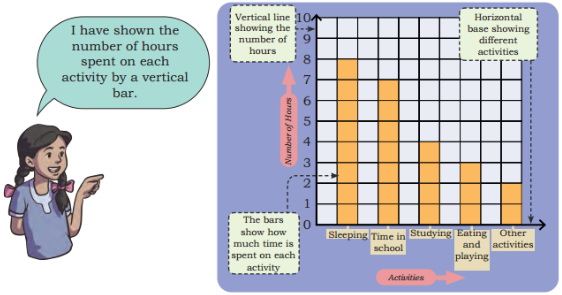
Sheela recorded her routine in the following manner.
Image
Observe Raman’s and Sheela’s routines and answer the following questions.
Q.1. Whose daily routine shows more time spent on sleeping?
Q.2. Who spends more hours in the school?
Q.3. How many more hours does Sheela spend studying compared to Raman?
Q.4. Is there any activity on which they spend the same amount of time? If yes, name the activity.
Answer
1. Raman spent 9 hours on sleeping and Sheela spent 8 hours on sleeping.
So, Raman’s daily routine shows more time spent on sleeping.
2. Raman spends 6 hours in school and Sheela spends 7 hours in school.
So, Sheela spends more hours in school.
3. Sheela spends 4 hours and Raman spends 2 hours in studying.
Difference = 4 - 2 = 2 hours
Sheela spends 2 more hours studying compared to Raman.
4. No, there is no activity on which they spend the same amount of time.

View full question & answer
Question 24 Marks
Deepti noted down the number of two-wheelers passing her house in one hour on three different days.
She used one icon to show 3 two-wheelers.
Image
DayNumber of Two-wheelers
MondayImage
WednesdayImage
FridayImage
Observe the pictograph and answer the following questions.
Q.1. Which day had the most two-wheelers passing her house?
Q.2. How many total two-wheelers did she record over three days?
Q.3. How many fewer two-wheelers were seen on Wednesday than on Monday?
Q.4. How many more two-wheelers were seen on Friday than on Wednesday?
Answer
1. Friday has the most symbols, so on Friday most two-wheelers passed her house.
2. Two-wheeler recorded on Monday = 8 × 3 = 24 two-wheelers
Two-wheeler recorded on Wednesday = 4 × 3 = 12 two-wheelers
Two-wheeler recorded on Friday = 12 × 3 = 36 two-wheelers
Total two-wheelers Deepti recorded over three days = 24 + 12 + 36 = 72 two-wheelers
3. On Monday Deepti saw 24 two-wheelers
On Wednesday Deepti saw 12 two-wheelers
Difference = 24 – 12 = 12 two-wheelers
∴ 12 fewer two-wheelers ware seen on Wednesday than on Monday.
4. On Wednesday Deepti saw 12 two-wheelsrs.
On Friday Deepti saw 36 two-wheelers.
Difference = 36 – 12 = 24 two-wheelers.
24 more two wheelers were seen on Friday than on Wednesday.
View full question & answer
Question 34 Marks
Joseph Uncle takes stock of the play items (toys, board games, and sports items) in his store a week before the summer break. He tries to record the items in his shop using a pictograph. He notices that there are too many items of each kind in his shop and it is not easy to make a picture for every item
Image
Dipesh, one of his helpers, suggested using one picture (icon) for every 5 items of each kind.
Image
His pictograph is shown below.
Name of the ItemNumber of Items
ToysImage
Board gamesImage
Sports itemsImage
Dipesh used a scale while recording the items in the pictograph. A scale helps record a large number of things using fewer icons.
Now, answer the following questions based on the above pictograph.
Q.1. How many toys does Joseph Uncle have?
Q.2. How many board games does Joseph Uncle have?
Q.3. How many total play items does Joseph Uncle have?
Q.4. Is there any other scale that you can use to make the pictograph?
Answer
1. Joseph Uncle has 8 × 5 = 40 toys
2. Joseph Uncle has 10 × 5 = 50 board games.
3. Joseph Uncle has 12 × 5 = 60 sports items.
Thus, total play items Joseph Uncle has = 40 + 50 + 60 = 150.
4. Yes, we can use another scale to make the pictograph simpler.
View full question & answer
Question 44 Marks
Answer
No. of hours spent watching TVNo. of children
$\frac{1}{2}$ hour9
1 hour13
$1 \frac{1}{2}$ hour7
2 hours3
More than 2 hours3
1. Number of children who watch TV for more than half an hour = 13 + 7 + 3 + 3 = 26 children.
2. Number of children who watch TV for less than two hours = 9 + 13 + 7 = 29 children.
3. Number of children who watch TV for more than two hours is 3.
4. Given statement is false, since only 3 children watch TV for two hours, but 9 children watch TV for half an hour.
Answer the following (4 mark each) : - MATHS STD 5 Questions - Vidyadip