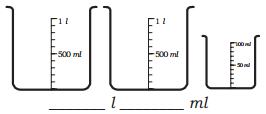
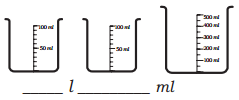
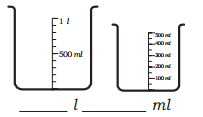
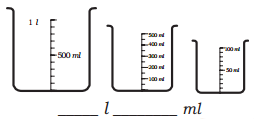
In a factory, 8 l 400 ml of oil needs to be equally poured into 7 containers for storage. How much oil will each container hold?
Answer
8 l 400 ml – 8000 ml + 400 ml = 8400 ml Now, $\frac{8400}{7}$ = 1,200 = 1000 + 200 So, 8 l 400 ml + 1 = 11 200 ml Therefore, each container will hold 1 l 200 ml oil.
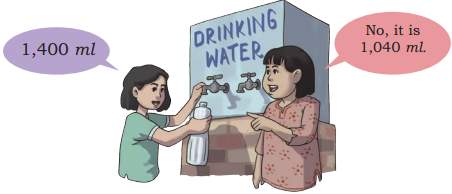
Mary and Daisy filled their bottle with 11 400 ml of water. They wondered about the capacity of the bottle in ml. How much is it? Who do you think is correct and why?
Answer
1 1 = 1000 ml 11 400 ml = 1000 ml + 400 ml = 1400 ml Therefore, Mary is correct.
A bucket can hold a maximum of 20 ml of water. Is this statement correct? Which unit should be used in such a situation?
Answer
The statement is incorrect. We should use litres instead of ml in this situation because ml is a very small unit in the context of capacity of a bucket.
You must have seen tea being prepared at your home. How much water and milk do we need to make 2 cups of tea? (a) Do we need 11 of water to make 2 cups of tea? (b) Is 500 ml of water enough for 2 cups of tea?
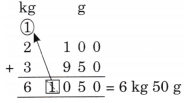
Aarav is helping his grandfather at the fruit stall. He lifts two baskets of apples weighing 2 kg 100 g and 3 kg 950 g. What is the total weight of apples he lifted?
Answer
Therefore, the total weight of the apples Aarav lifted is 6 kg 50 g.
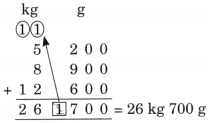
A restaurant owner uses 5 kg 200 g, 8 kg 900 g, and 12 kg 600 g of onions over 3 days. What is the total weight of onions used by the restaurant owner in 3 days?
Answer
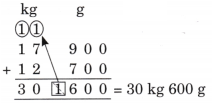
= 26 kg 700 g So, the total weight of the onions used by the restaurant owner in 3 days is 26 kg 700 g.
A vendor has 25 $l$ of milk. He sells it in packets of 500 ml each. (a) How many packets can he make? (b) If each packet is sold at ₹ 20, how much money will he earn in total?