Questions

Answer the following (4 mark each) :

🎯

Test yourself on this topic

11 questions · timed · auto-graded

Question 14 Marks
VehicleNo. of VehiclesQuantity of Fuel in Each Vehicle (in litres)Total Quantity of Fuel (in litres)
Truck3500
Bus6300
Car1050
Auto Rickshaw128
Two­ wheeler255
Q.1. How much more fuel is bought for buses than for trucks?
Q.2. What is the total quantity of fuel filled from the petrol pump on that day?
Answer
VehicleNo. of VehiclesQuantity of Fuel in Each Vehicle (in litres)Total Quantity of Fuel (in litres)
Truck35003 × 500 = 1,500
Bus63006 × 300 = 1,800
Car105010 × 50 = 500
Auto Rickshaw12812 × 8 = 96
Two­ wheeler25525 × 5 = 125
1. Fuel bought for buses = 1,800 l
Fuel bought for trucks = 1,500 l
Difference = 1,800 – 1,500 = 300
300 l more fuel is bought for buses than for trucks.
2. The total quantity of fuel filled from the petrol pump on that day is:
1,500 l + 1.800 l + 500 l + 96 l + 125 l
= 4,021 l
View full question & answer
Question 24 Marks
Nitesh is a scrap dealer. How much would he have paid for
Image
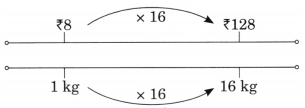
(а) 16 kg of old newspaper, if he paid ₹ 8 for every 1 kg of newspaper?
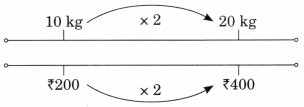
(b) 20 kg iron, if he paid ₹ 200 for every 10 kg of iron?
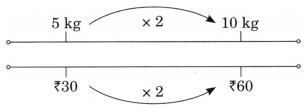
(c) 10 kg plastic, if he paid ₹ 30 for 5 kg of plastic?
Answer
(а) 1 kg × 16 = 16 kg
₹ 8 × 16 = ₹ 128
Nitesh would have paid ₹ 128.
Image
(b) 10 kg × 2 = 20 kg
₹ 200 × 2 = ₹ 400
Nitesh would have paid ₹ 400.
Image
(c) 15 kg × 2 = 10 kg
₹ 30 × 2 = ₹ 60
Nitesh would have paid ₹ 60.
Image
View full question & answer
Question 34 Marks
The cost of some grocery items is given in the following table. Find the total cost of each item.
ItemWeightCost of 1 kgTotal cost
Rice12 kg 500 g₹ 60
Flour7 kg 250 g₹ 40
Sugar5 kg₹ 45
Chana dal3 kg 600 g₹ 70
Besan4 kg₹ 60
Jaggery1 kg 400 g₹ 50
Answer
Rice: Cost of 12 kg = 12 × ₹ 60 = ₹ 720
Cost of lkg (1,000 g) = ₹ 60
Cost of 500 g = ₹ 30
Therefore, cost of 12 kg 500 g = ₹ 720 + ₹ 30
= ₹ 750
Flour: Cost of 7 kg = 7 × ₹ 40 = ₹ 280
Cost of 1 kg (250 g + 250 g + 250 g + 250 g)
= ₹ 40 (10 + 10 + 10 + 10)
Cost of 250 g = ₹ 10
Therefore, cost of 7 kg 250 g = ₹ 280 + ₹ 10
= ₹ 290
Sugar: Cost of 5 kg = 5 × ₹ 45 = ₹ 225
Chana dal: Cost of 3 kg = 3 × ₹ 70 = ₹ 210
Cost of 1 kg (1000 g) = ₹ 70
Cost of 100 g = ₹ 7
Cost of 600 g = 6 × ₹ 7 = ₹ 42
Therefore, cost of 3 kg 600 g = ₹ 210 + ₹ 42
= ₹ 252
Besan: Cost of 4 kg = 4 × ₹ 60 = ₹ 240
Jaggery: Cost of 1 kg (1000 g) = ₹ 50
Cost of 100 g = ₹ 5
Cost of 400 g = 4 ×₹ 5 = ₹ 20
Cost of 1 kg 400 g = ₹ 50 + ₹ 20 = ₹ 70
Hence, the complete table is:
ItemWeightCost of 1 kgTotal cost
Rice12 kg 500 g₹ 60₹ 750
Flour7 kg 250 g₹ 40₹ 290
Sugar5 kg₹ 45₹ 225
Chana dal3 kg 600 g₹ 70₹ 252
Besan4 kg₹ 60₹ 240
Jaggery1 kg 400 g₹ 50₹ 70
View full question & answer
Question 44 Marks
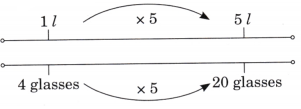
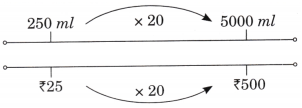
A juice vendor has a 5 l container of orange juice. Each glass has a capacity 250 ml.
(a) How many full glasses can he serve before the container becomes empty?
(b) If he has already served 10 glasses, how much juice is left?
(c) If 250 ml of juice is sold at `25, how much will he earn by selling 5 l juice?
View full question & answer
Question 54 Marks
Khayal chacha delivers the following amounts of milk each week to different families.
FamilyMilk Delivered in a Week in lQuantity in ml
Arora’s8 
Nair’s14 
Shrivastava’s 12,000
Das’s 20,000
Rao’s 25,000
Answer
FamilyMilk Delivered in a Week in lQuantity in ml
Arora’s88,000
Nair’s1414,000
Shrivastava’s1212,000
Das’s2020,000
Rao’s2525,000
View full question & answer
Question 64 Marks
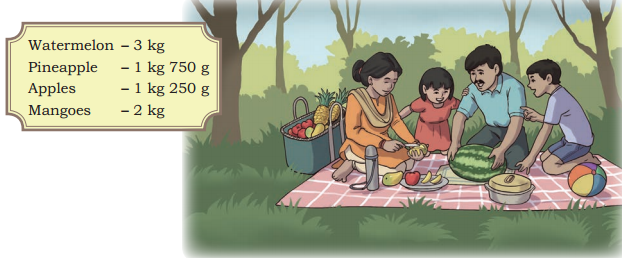
Harpreet’s family planned a picnic over the weekend. Her mother and father packed different food items to take along. The following is the list of fruits they carried.
Image
Among the fruits they carried, which one has the
(a) highest weight?
(b) least weight?
(c) Arrange the items in descending order of their weight.
Answer
(a) Weight of the watermelon = 3 kg = 3,000 g
Weight of the pineapple = 1 kg 750 g
= 1,750 g
Weight of the apples = 1 kg 250 g
= 1,250 g
Weight of the mangoes = 2 kg = 2,000 g
Among these weights, 3,000g is the highest, which is the weight of the watermelon.
Therefore, among the fruits they carried, watermelon has the highest weight.
(b) Among the given weights, 1,250g is the least, which is the weight of the apples. Therefore, among the fruits they carried, apples have the least weight.
(c) The decreasing order of weights is:
3,0 g > 2,000 g > 1,750 g > 1,250 g
Therefore, the items in decreasing order of their weights are: Watermelon, Mangoes, Pineapple, Apples.
View full question & answer
Question 74 Marks
Mr. Singh owns a petrol pump. He records the details of the sales of petrol in a day.
VehicleNo. of VehiclesQuantity of Fuel in Each Vehicle (in litres)Total Quantity of Fuel (in litres)
Truck4400
Bus7350
Car1245
Auto Rickshaw1510
Two-Wheeler206
Q.1. For which vehicle maximum quantity is of fuel is bought?
Q.2. How much fuel was bought for trucks and buses together?
Q.3. Find the difference between the fuel bought for cars and auto rickshaws.
Q.4. How much fuel was bought in total for all vehicles?
Answer
1. Bus
2. 4,050 $l$
3. 390 $l$
4. 4,920 $l$
View full question & answer
Question 84 Marks
Ramu milkman delivers the following amounts of milk each week to different families. Complete the table by converting litres into millilitres and millilitres into liters.
FamilyMilk delivered in a week in litresQuantity in ml
(a)Sharma's10
(b)Verma's15
(c)Gupta's 18,000
(d)Mehta's 22,000
(e)Kapoor's25
Answer
1. (a) 10,000
(b) 15,000
(c) 18
(d) 22
(e) 25,000
View full question & answer
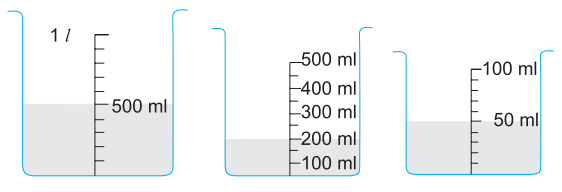
Question 94 Marks
Answer
1. (a) 750 ml
(b) 950 ml
2. 750; 750; 1,500; 1,500
3. 600; 600; 1,200; 1; 200
4. 1,500; 1; 500
View full question & answer
Question 104 Marks
The cost of some fruits is given in the table. Find the total cost of each item.
ItemsWeightCost of 1 kgTotal Cost
(a) Mangoes6 kg 500 g₹ 80
(b) Apples8 kg 250 g₹100
(c) Oranges4 kg 750 g₹ 60
(d) Bananas3 kg 250 g₹ 40
Answer
1. (a) ₹ 520
(b) ₹ 825
(c) ₹ 285
(d) ₹ 130
View full question & answer
Answer the following (4 mark each) : - MATHS STD 5 Questions - Vidyadip