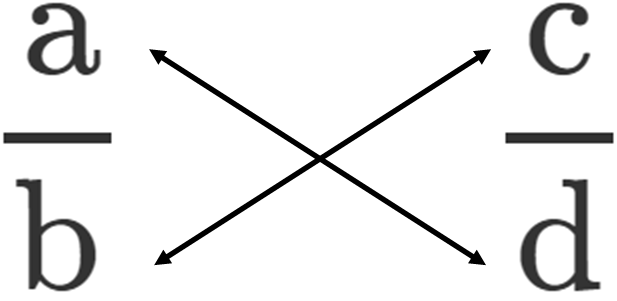
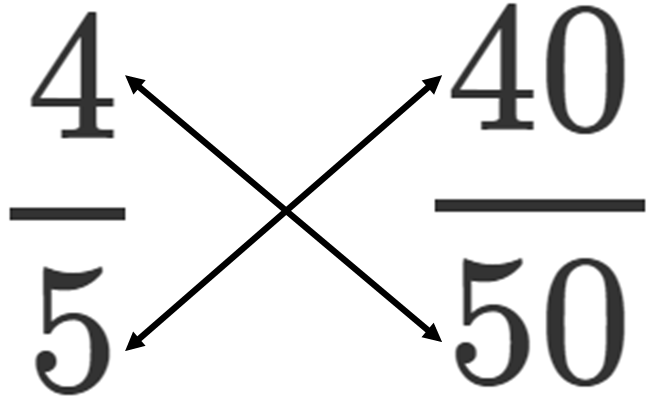
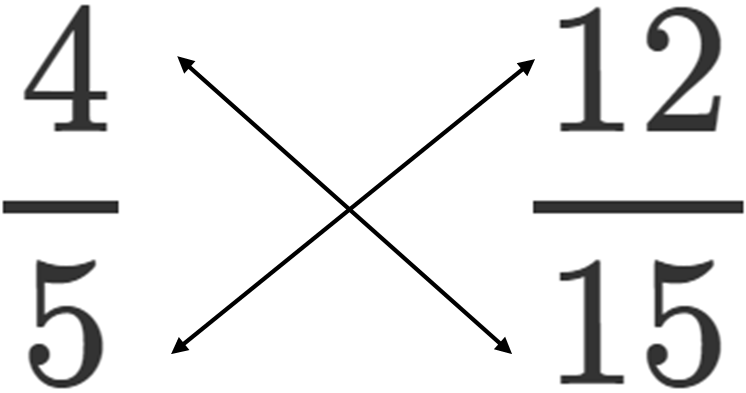
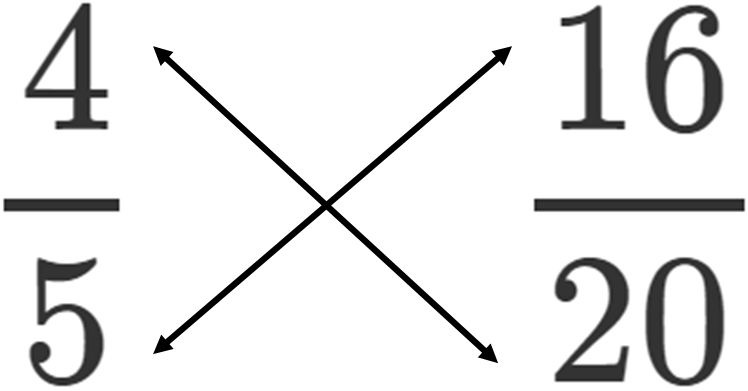
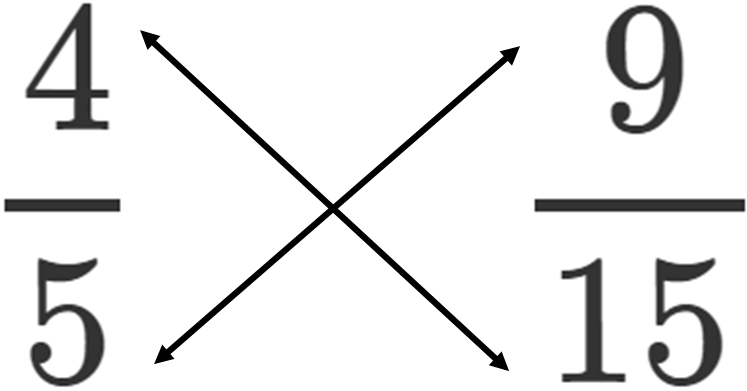
MCQ 11 Mark
The proper fraction of $5\frac{4}{9}$ is:
- ✓
$\frac{49}{9}$
- B
$\frac{47}{9}$
- C
$\frac{45}{9}$
- D
$\frac{43}{9}$
AnswerCorrect option: A. $\frac{49}{9}$
View full question & answer→MCQ 21 Mark
Mark $(\checkmark)$ against the correct answer in the following:
$\frac{5}{6}+\frac{2}{3}-\frac{4}{9}=\ ?$
- A
$1\frac{1}{3}$
- B
$1\frac{1}{6}$
- C
$1\frac{1}{9}$
- ✓
$1\frac{1}{18}$
AnswerCorrect option: D. $1\frac{1}{18}$
$\begin{array}{c|c}3&3,6,9\\\hline2&1,2,3\\\hline3&1,1,3\\\hline&1,1,1\end{array}$
$\frac{5}{6}+\frac{2}{3}-\frac{4}{9}$
$L.C.M.$ of $3, 6$ and $9 = (2 \times 3 \times 3) = 18$
$=\frac{(15+12-8)}{18}$
$\Big(\frac{18}{6}=3,3\times5=15\Big)$
$\Big(\frac{18}{3}=6,6\times2=12\Big)$
and $\Big(\frac{18}{9}=2,2\times4=8\Big)$
$=\frac{(27-8)}{18}$
$=\frac{19}{18}$
$=1\frac{1}{18}$
View full question & answer→MCQ 31 Mark
Write down $9275$ meters in km, as a decimal fraction.
- A
$927.5 \ KM.$
- B
$92.75 \ KM.$
- C
$10.275 \ KM.$
- ✓
$9.275 \ KM.$
AnswerCorrect option: D. $9.275 \ KM.$
$9275$ Meters in km, as decimal fraction$=\frac{9275}{1000} \ \text{KM} =9.275 \ \text{KM}$
View full question & answer→MCQ 41 Mark
Which of the following is not a proper fraction?
- A
$\dfrac{2}{3}$
- B
$\dfrac{3}{4}$
- C
$\dfrac{5}{7}$
- ✓
$\dfrac{6}{5}$
AnswerCorrect option: D. $\dfrac{6}{5}$
In $\dfrac{6}{5}$, the numerator $6$ is greater than the denominator $5.$
Therefore, $\dfrac{6}{5}$ is not a proper fraction.
View full question & answer→MCQ 51 Mark
Mark the correct alternative of the following:
Which of the following is a proper fraction?
- ✓
$\frac{3}{5}$
- B
$\frac{5}{3}$
- C
$1\frac{2}{3}$
- D
AnswerCorrect option: A. $\frac{3}{5}$
A fraction whose numerator is less than the denominator is called a proper fraction.
Here, $\frac{3}{5}$ is a proper fraction.
Hence, the correct option is $(a).$
View full question & answer→MCQ 61 Mark
Reciprocal of $2\frac{1}{4}$
- A
$-\frac{9}{4}$
- B
$-\frac{4}{9}$
- C
$\frac{9}{4}$
- ✓
$\frac{4}{9}$
AnswerCorrect option: D. $\frac{4}{9}$
since it is a mixed fraction.. it can be written as $\frac{9}{4}..$. then the reciprocal of $\frac{9}{4}$ is $\frac{4}{9}..$
View full question & answer→MCQ 71 Mark
$0.7499$ lies between:
- A
$0.7$ and $0.74$
- B
$0.75$ and $0.79$
- ✓
$0.749$ and $0.75$
- D
$0.74992$ and $0.75$
AnswerCorrect option: C. $0.749$ and $0.75$
Since, $0.7499$ is greater than $0.749$ and less than $0.75$. Therefore, $0.7499$ lies between $0.749$ and $0.75.$
$0.749 < 0.7499 < 0.75$
View full question & answer→MCQ 81 Mark
The following question is based on simple arithmetic principles. Find the right answer from the given alternatives. $\frac{26}{4}+\frac{14}{3}=?$
- A
$11.0$
- B
$10\frac{1}{6}$
- ✓
$11\frac{1}{6}$
- D
$12\frac{1}{5}$
AnswerCorrect option: C. $11\frac{1}{6}$
$\frac{26}{4}+\frac{14}{3}$
$=\frac{78+56}{12}=\frac{134}{12}=11\frac{2}{12}=11\frac{1}{6}$
View full question & answer→MCQ 91 Mark
A number with decimal point followed by $1$ or more digits is called:
AnswerIn decimal system, the number after the decimal point is called the decimal number.
View full question & answer→MCQ 101 Mark
Mark $(\checkmark)$ against the correct answer in the following: A fraction equivalent to $\frac{3}{5}$ is:
AnswerCorrect option: C. $\frac{3\times2}{5\times2}$
$\frac{3\times2}{5\times2}$
View full question & answer→MCQ 111 Mark
Mark $(\checkmark)$ against the correct answer in the following:
Which of the following is a proper fraction?
- ✓
$\frac{7}{8}$
- B
$1\frac{7}{8}$
- C
$\frac{8}{7}$
- D
AnswerCorrect option: A. $\frac{7}{8}$
In a proper fraction, the numerator is less than the denominator.
View full question & answer→MCQ 121 Mark
Which of the following is not a proper fraction?
- A
$\cfrac {2}{3}$
- B
$\cfrac {3}{4}$
- C
$\cfrac {5}{7}$
- ✓
$\cfrac {6}{5}$
AnswerCorrect option: D. $\cfrac {6}{5}$
Fractions that are greater than $00$ but less than $1$ are called proper fractions.
In proper fractions, the numerator is less than the denominator.
When a fraction has a numerator that is greater than or equal to the denominator, then the fraction is an improper fraction.
An improper fraction is always $1$ or greater than $1.$
Now looking at options
$\cfrac {2}{3} = .666 < 1$
$\cfrac {3}{4} = .75 < 1$
$\cfrac {5}{7} = .71 < 1$
$\cfrac {6}{5}= 1.2 < 1$
So $\cfrac {6}{5}$ is Not a Proper fraction.
View full question & answer→MCQ 131 Mark
Which fraction is equal to $4.4?$
- A
$\displaystyle{\frac{4}{10}}$
- ✓
$\displaystyle{\frac{44}{10}}$
- C
$\displaystyle{\frac{4}{100}}$
- D
$\displaystyle{\frac{44}{100}}$
AnswerCorrect option: B. $\displaystyle{\frac{44}{10}}$
The first decimal digit from the decimal point is the tenth.
$4.4$ has $4$ on the ones, after decimal point on the tenths is $4$ tenths.
$4.4$ is the sum of $4$ and$\displaystyle{\frac{4}{10}}$ or $\displaystyle{\frac{4}{10}}$.
So option $B$ is the correct answer.
View full question & answer→MCQ 141 Mark
Which of the following are simple fraction(s)?
- ✓
$\dfrac{5}{6}$
- B
$\dfrac{-3}{8}$
- C
$\dfrac{4}{-9}$
- D
AnswerCorrect option: A. $\dfrac{5}{6}$
$\dfrac{5}{6}$
View full question & answer→MCQ 151 Mark
$3\frac{1}{2}\text{m}$ of cloth $Rs. 168$, find the cost of $4\frac{1}{3}\text{m}$ of the same cloth.
- A
$Rs. 168$
- B
$Rs. 108$
- C
$Rs. 268$
- ✓
$Rs. 208$
AnswerCorrect option: D. $Rs. 208$
Given, $3\frac{1}{2}\text{m}$ of cloth cost $Rs. 168.$
Then $4\frac{1}{3}\text{m}$ of cloth cost Rs. $\frac{168\times\frac{13}{3}}{\frac{7}{2}}=208.$
View full question & answer→MCQ 161 Mark
Which of the following are not proper fraction?
- ✓
$\frac{5}{4}$
- B
$\frac{2}{3}$
- C
$\frac{5}{9}$
- D
$\frac{6}{8}$
AnswerCorrect option: A. $\frac{5}{4}$
Since, numerator > denominator, $\frac{5}{4}$ is not a proper fraction.
View full question & answer→MCQ 171 Mark
Mark the correct alternative of the following:
If $\frac{45}{60}$ is equivalent to $\frac{3}{\text{x}},$ then $x =$
Answer$\frac{45}{60}=\frac{3}{\text{x}}$
On cross-multiplying, we get:
$45\times\text{x}=3\times60$
$\Rightarrow\text{x}=\frac{3\times60}{45}$
$\Rightarrow\text{x}=\frac{180}{45}$
On dividing the numerator & denominator by the $HCF$ of $180$ & $45$, we get:
$\Rightarrow\text{x}=\frac{180\div45}{45\div45}$
$\text{x}=4$
View full question & answer→MCQ 181 Mark
The improper fraction is:
- A
$\dfrac { 12 }{ 15 }$
- B
$\dfrac { 13 }{ 17 }$
- C
$\dfrac { 16 }{ 21 }$
- ✓
$\dfrac { 25 }{ 11 }$
AnswerCorrect option: D. $\dfrac { 25 }{ 11 }$
$\dfrac { 25 }{ 11 }$
View full question & answer→MCQ 191 Mark
Write $\dfrac{3}{13}$ in decimal form and say what kind of decimal expansion it has.
- A
$0.230769$ Terminating and non repeating.
- ✓
$0.230769$ Non terminating and repeating.
- C
$0.230769$ Non terminating and non repeating.
- D
$0.230769$ Terminating and repeating.
AnswerCorrect option: B. $0.230769$ Non terminating and repeating.
Given,$ \frac{3}{13}$If we divide $3$ by $13$ we get $0.230769$ which is repeating and non-terminating.
View full question & answer→MCQ 201 Mark
Which of the following are not proper fraction?
- ✓
$\frac {5}{4}$
- B
$\frac {2}{3}$
- C
$\frac {5}{9}$
- D
$\frac {6}{8}$
AnswerCorrect option: A. $\frac {5}{4}$
Since, numerator > denominator, $\frac {5}{4}$ is not a proper fraction.
View full question & answer→MCQ 211 Mark
Which of the following is a proper fraction?
- A
$\frac{5}{3}$
- B
- C
$1\dfrac{2}{5}$
- ✓
AnswerIf the numerator is less than the denominator then the fraction is called as proper fraction.
Hence none of these are proper fractions.
View full question & answer→MCQ 221 Mark
Example for an improper fraction from the given options is:
- A
$\frac{25}{26}$
- B
$\frac{12}{13}$
- ✓
$\frac{15}{14}$
- D
$\frac{19}{20}$
AnswerCorrect option: C. $\frac{15}{14}$
In an improper fraction, the numerator is greater than the denominator.
Of the given fractions, $\frac{15}{14}$ has numerator greater than the denominator.
Hence, $\frac{15}{14}$ is a proper fraction.
View full question & answer→MCQ 231 Mark
Convert into decimal: $\displaystyle \frac{75.814}{1000}$ =____________
- ✓
$75.814$
- B
$7.5814$
- C
$758.14$
- D
$758140$
AnswerCorrect option: A. $75.814$
$\displaystyle \frac{75.814}{1000}$ in decimal is $75.814$
View full question & answer→MCQ 241 Mark
The smallest possible decimal fraction upto three decimal places is:
- A
$0.101$
- B
$0.111$
- ✓
$0.001$
- D
$0.011$
AnswerCorrect option: C. $0.001$
The smallest possible decimal fraction upto three decimal places $=\dfrac{1}{1000}=.001$
View full question & answer→MCQ 251 Mark
The improper fraction of $\displaystyle 2\frac { 1 }{ 2 }$ is:
AnswerCorrect option: A. $\displaystyle \frac { 5 }{ 2 }$
Improper fraction of
$2\cfrac{1}{2}= \cfrac{2 \times 2 + 1}{2}$
$= \cfrac{4 + 1}{2}$
$=\cfrac{5}{2}$
View full question & answer→MCQ 261 Mark
Shabana has to stitch $35$ dresses. So, ar she has stitched $21$ dresses. What fraction of dresses has she stitched?
- A
$\dfrac{7}{9}$
- ✓
$\dfrac{3}{5}$
- C
$\dfrac{6}{5}$
- D
$\dfrac{3}{7}$
AnswerCorrect option: B. $\dfrac{3}{5}$
Number of dresses she had to stiches $= 35$
Number of dresses she has finished $= 21$
$\therefore$ Fraction of dresses she has finished = $\dfrac{21}{35} =\dfrac{3}{5}$
View full question & answer→MCQ 271 Mark
$\frac{1.5}{0.2 \ + \text{ x} },= 5$ then $x =$
- A
$-3.7$
- ✓
$0.1$
- C
$0.3$
- D
$0.5$
Answer$\frac{1.5}{0.2 \ + \text{ x} } = 5$
cross multiplying$\Rightarrow 5 \times (0.2 + x) = 1.5$
$\Rightarrow 5 \times 0.2 + 5x = 1.5$
$\Rightarrow 1 \times 5x = 1.5$
$\Rightarrow 5x = 1.5 - 1 = 0.5$
$\Rightarrow 5x = 0.5$
$\Rightarrow x = 0.1$
View full question & answer→MCQ 281 Mark
Out of these which are proper fractional numbers?
- A
$\displaystyle\frac{3}{2}$
- ✓
$\displaystyle\frac{2}{5}$
- C
$\displaystyle\frac1{7}$
- D
$\displaystyle\frac{8}{3}$
AnswerCorrect option: B. $\displaystyle\frac{2}{5}$
Proper fractions are the one whose numerator is less than the denominator
In $\dfrac{3}{2}$ and $ \dfrac{8}{3},$ the numerator is greater than the denominatorSo, they are not proper fractionsWhereas in $\dfrac{2}{5}$ and $\dfrac{1}{7}$ the numerator is less than the denominatorThus, they are proper fractions.Hence, $\dfrac{2}{5}$ and $\dfrac{1}{7}$are proper fractional numbers.
View full question & answer→MCQ 291 Mark
Which one of the following is not equivalent to $0.000000375?$
AnswerCorrect option: B. $3 \dfrac{3}{4} \times 10^{-7}$
$0.000000375=375\times { 10 }^{ -9 }=3.75\times { 10 }^{ -7 }$
$=\cfrac { 375 }{ 100 } \times { 10 }^{ -7 }$
$=\cfrac { 15 }{ 4 } \times { 10 }^{ -7 }=3\cfrac { 3 }{ 4 } \times 10^7.$
View full question & answer→MCQ 301 Mark
Mark the correct alternative of the following:
A fraction equivalent to $\frac{30}{45}$ is:
- A
$\frac{3}{4}$
- B
$\frac{3}{2}$
- ✓
$\frac{2}{3}$
- D
AnswerCorrect option: C. $\frac{2}{3}$
Fraction equivalent to a given fraction can be obtained by multiplying or dividing its numerator and denominator by a non-zero number.
Therefore, the fraction equivalent to $\frac{30}{45}$ is $\frac{30\div15}{45\div15}=\frac{2}{3}.$
Hence, the correct option is $(c).$
View full question & answer→MCQ 311 Mark
Which of the following is a proper fraction?
- ✓
$\frac{7}{8}$
- B
$1\dfrac{7}{8}$
- C
$\frac{8}{7}$
- D
AnswerCorrect option: A. $\frac{7}{8}$
If the numerator is less than the denominator then the fraction is called as proper fraction.
Hence,$\frac{7}{8}$ is a proper fraction.
View full question & answer→MCQ 321 Mark
Mark $(\checkmark)$ against the correct answer in the following:
$\frac{5}{8}+\frac{1}{8}=\ ?$
- A
$\frac{3}{8}$
- ✓
$\frac{3}{4}$
- C
$6$
- D
AnswerCorrect option: B. $\frac{3}{4}$
$\text{Addition of like fractions} =\frac{\text{Sum of the numerators}}{\text{ Common denominator}}$
$=\frac{5}{8}+\frac{1}{8}$
$=\frac{(5+1)}{8}$
$=\frac{6}{8}$
$=\frac{3}{4}$
View full question & answer→MCQ 331 Mark
Mark the correct alternative of the following:
$\frac{34}{13}$ is an example of:
AnswerA fraction whose numerator is less than the denominator is called a proper fraction, otherwise it is called an improper fraction.
Here, $\frac{34}{13}$ is an example of an improper fraction.
Hence, the correct option is $(b).$
View full question & answer→MCQ 341 Mark
AnswerCorrect option: A. $\dfrac { 232 } { 990 }$
$\dfrac{{232}}{{990}}$ is equal to $0.234$
View full question & answer→MCQ 351 Mark
- A
$\frac{12}{100}$
- B
$\frac{12}{10}$
- C
$\frac{2}{1000}$
- ✓
$\frac{12}{1000}$
AnswerCorrect option: D. $\frac{12}{1000}$
$\frac{12}{1000}$
View full question & answer→MCQ 361 Mark
Solve : $2\frac{5}{7}\text{%}$ of $280 {\text{cm}}.$
- A
$2.80\ cm$
- B
$80\ cm$
- ✓
$7.6\ cm$
- D
$280\ cm$
AnswerCorrect option: C. $7.6\ cm$
$\Rightarrow2\frac{5}{7}\text{%} $ of $280$
$=\frac{19}{7}\text{%}$ of $280$
$=\frac{19}{7}\times\frac{280}{100}$
$=19\times\frac{4}{10}$
$\frac{76}{10}=7.6$
So $2\frac{5}{7}\text{%}$ of $280\text{cm}$ is $7.6\text{cm}.$
View full question & answer→MCQ 371 Mark
Which of the following is/are improper fraction $(s)?$
AnswerCorrect option: A. $\frac{21}{20}$
Here, Numerator > denominator only in option $A.$
View full question & answer→MCQ 381 Mark
Mark $(\checkmark)$ against the correct answer in the following:
The largest of the fractions $\frac{6}{11},\frac{7}{11},\frac{8}{11},\frac{9}{11}$ is:
- ✓
$\frac{6}{1 1}$
- B
$\frac{7}{1 1}$
- C
$\frac{8}{1 1}$
- D
$\frac{9}{11}$
AnswerCorrect option: A. $\frac{6}{1 1}$
Among like fractions, the fraction with the smallest numerator is the smallest.
View full question & answer→MCQ 391 Mark
Product of $\frac{11}{12}\times\frac{16}{4}\times\frac{9}{16}$ is equal to
- ✓
$2\frac{1}{16}$
- B
$\frac{3}{4}$
- C
$\frac{2}{8}$
- D
$\frac{9}{6}$
AnswerCorrect option: A. $2\frac{1}{16}$
Given, $\frac{11}{12}\times\frac{16}{4}\times\frac{9}{16}=\frac{11}{12}\times4\times\frac{9}{16}$
$\rightarrow\frac{11}{3}\times\frac{9}{16}$
$\rightarrow11\times\frac{3}{16}=\frac{33}{16}=2\frac{1} {16}$
View full question & answer→MCQ 401 Mark
Example of proper fraction from the given options is _____.
- ✓
$\displaystyle \frac{5}{7}$
- B
$\displaystyle \frac{4}{3}$
- C
$\displaystyle \frac{16}{15}$
- D
$\displaystyle \frac{22}{21}$
AnswerCorrect option: A. $\displaystyle \frac{5}{7}$
In a proper fraction, the numerator is smaller than the denominator. Of the given fractions, $\displaystyle \frac{5}{7}$ has numerator smaller than the denominator.
Hence, $\displaystyle \frac{5}{7}$ is a proper fraction.
View full question & answer→MCQ 411 Mark
Mark $(\checkmark)$ against the correct answer in the following:
Which is greater: $3\frac{1}{3}$ or $\frac{33}{10}$?
- ✓
$3\frac{1}{3}$
- B
$\frac{33}{10}$
- C
AnswerCorrect option: A. $3\frac{1}{3}$
Let us compare $3\frac{1}{3}$ and $\frac{33}{10}$
or $\frac{10}{3}$ and $\frac{33}{10}$
$10 \times 10 = 100$ and $3 \times 33 = 99$
Clearly,$ 100 > 99$
Therefore, $\frac{10}{3}<\frac{33}{10}$
or $3\frac{1}{3}<\frac{33}{10}$
View full question & answer→MCQ 421 Mark
Mark $(\checkmark)$ against the correct answer in the following
Which of the following are like fractions?
- A
$\frac{2}{3},\frac{3}{4},\frac{4}{5},\frac{5}{6}$
- B
$\frac{2}{5},\frac{2}{7},\frac{2}{9},\frac{2}{11}$
- ✓
$\frac{1}{8},\frac{3}{8},\frac{5}{8},\frac{7}{8}$
- D
AnswerCorrect option: C. $\frac{1}{8},\frac{3}{8},\frac{5}{8},\frac{7}{8}$
Like fractions have same the denominator.
View full question & answer→MCQ 431 Mark
A badminton player won $6$ games and lost $4$. The fraction of the games he won is:
- A
$\frac{6}{4}$
- B
$\frac{4}{6}$
- ✓
$\frac{6}{10}$
- D
$\frac{5}{10}$
AnswerCorrect option: C. $\frac{6}{10}$
Games won $= 6$
Total Games $= 6 + 4 = 10$
$\therefore$ required fraction $\frac{6}{10}$
View full question & answer→MCQ 441 Mark
Every fraction can be represented as:
AnswerAccording to number system , every fraction in $\frac{p}{q} $ form can be converted into decimal number. and vice versa.
View full question & answer→MCQ 451 Mark
In improper fraction, the numeratoris always _____ the denominator.
AnswerIn an improper fraction, the numerator is always greater than the denominator.
Eg $ \displaystyle \frac{9}{5},\displaystyle \frac{5}{3}.$
View full question & answer→MCQ 461 Mark
Mark the correct alternative of the following:
Which of the following is an improper fraction?
- A
$\frac{1}{2}$
- B
$\frac{3}{7}$
- ✓
$\frac{7}{3}$
- D
$\frac{3}{15}$
AnswerCorrect option: C. $\frac{7}{3}$
$\frac{7}{3},$ because in an improper fraction, the numerator is more than the denominator.
View full question & answer→MCQ 471 Mark
The vulgar fraction of $0.231$ can be expressed as ____________.
- A
$\displaystyle\frac{229}{990}$
- B
$\displaystyle\frac{229}{900}$
- ✓
$\displaystyle\frac{231}{1000}$
- D
$\displaystyle\frac{231}{999}$
AnswerCorrect option: C. $\displaystyle\frac{231}{1000}$
$0.231=\dfrac{0.231}{1}$Multiplying numerator and denominator by $100.\dfrac{231}{1000}$ Hence.
View full question & answer→MCQ 481 Mark
Convert it into decimal $\frac {3} {10}$ ____
AnswerConverting fraction to decimal = $\frac{3}{10} = 0.3$
View full question & answer→MCQ 491 Mark
Mixed fraction of $\dfrac {39}{12}$ is:
- A
$3\dfrac {1}{12}$
- B
$3\dfrac {2}{12}$
- ✓
$3\dfrac {3}{12}$
- D
$2\dfrac {14}{12}$
AnswerCorrect option: C. $3\dfrac {3}{12}$
A Mixed Fraction is a whole number and a proper fraction combined.
Divide the numerator by the denominator.
Write down the whole number answerThen write down any remainder above the denominator.
$\dfrac{39}{12}=\dfrac{36}{12}+\dfrac{3}{12}$
$=3+\dfrac{3}{12}=3\dfrac{3}{12}$
View full question & answer→MCQ 501 Mark
- ✓
$-0.5$
- B
$-0.008$
- C
$5.08$
- D
$5.8$
AnswerCorrect option: A. $-0.5$
View full question & answer→MCQ 511 Mark
The two consecutive integers between which the fraction $\frac57$ lies are:
- A
$5$ and $6.$
- ✓
$0$ and $1.$
- C
$5$ and $7.$
- D
$6$ and $7.$
AnswerCorrect option: B. $0$ and $1.$
We know that, if the numerator is less than the denominator, then the value of fraction is less than $1.$
Hence, the fraction $\frac57$ lies between $0$ and $1.$
View full question & answer→MCQ 521 Mark
$1\frac{3}{4}$ is a ____ fraction.
Answer$1\frac{3}{4}$ is a mixed fraction as:
$1+\frac{3}{4}=1\frac{3}{4}$
View full question & answer→MCQ 531 Mark
Choose the fraction which is equivalent to $\frac{15}{20}.$
- A
$\frac{12}{15}$
- B
$\frac{51}{12}$
- C
$\frac{4}{3}$
- ✓
$\frac{12}{16}$
AnswerCorrect option: D. $\frac{12}{16}$
$\frac{15}{20}$ can be written in the simplest form $\frac{4}{3}.$
Now, look at the options, then option $D$ can also be written in the simplest form $\frac{4}{3}.$
That means option $D$ is equivalent to $\frac{15}{20}.$
View full question & answer→MCQ 541 Mark
The vulgar fraction of $0.231$ can be expressed as ____________.
- A
$\frac{229}{990}$
- B
$\frac{229}{900}$
- ✓
$\frac{231}{1000}$
- D
$\frac{231}{999}$
AnswerCorrect option: C. $\frac{231}{1000}$
$0.231=\frac{0.231}{1}$ Multiplying numerator and denominator by $100.\frac{231}{1000}$Hence.
View full question & answer→MCQ 551 Mark
Product of $\displaystyle \frac{11}{12} \times \displaystyle \frac{16}{4} \times \displaystyle \frac{9}{16}$ is equal to:
- ✓
$\displaystyle 2\frac{1}{16}$
- B
$\displaystyle \frac{3}{4}$
- C
$\displaystyle \frac{2}{8}$
- D
$\displaystyle \frac{9}{6}$
AnswerCorrect option: A. $\displaystyle 2\frac{1}{16}$
Given, $\displaystyle \frac{11}{12} \times \displaystyle \frac{16}{4} \times \displaystyle \frac{9}{16}$
$=\frac{11}{12} \times 4 \times \frac{9}{16}$
$\rightarrow \displaystyle \frac{11}{3} \times \frac{9}{16}$
$\rightarrow \displaystyle 11 \times \frac{3}{16} = \frac{33}{16} = 2 \frac{1}{16}$
View full question & answer→MCQ 561 Mark
Which of the following is an improper fraction?
- ✓
$\dfrac{15}{1}$
- B
$\dfrac{1}{3}$
- C
$\dfrac{2}{3}$
- D
AnswerCorrect option: A. $\dfrac{15}{1}$
$\dfrac{15}{1}$
View full question & answer→MCQ 571 Mark
The proper fraction of $6\frac { 1 }{ 5 }$ is.
AnswerCorrect option: A. $\displaystyle \frac { 31 }{ 5 }$
Proper fraction of $6\cfrac{1}{5}= \cfrac{5 \times 6 + 1}{5} = \cfrac{30 + 1}{5} = \cfrac{31}{5}$
View full question & answer→MCQ 581 Mark
Mark $(\checkmark)$ against the correct answer in the following:
If $\frac{3}{4}$ is equivalent to $\frac{\text{x}}{20}$ then the value of $x$ is:
Answer$\Big(\frac{3}{4}=\frac{\text{x}}{20}\Big)$
We have,
$20 = 4 \times 5$
So, we have to multiply the numerator by $5.$
Therefore, $x = 3 \times 5 = 15$
View full question & answer→MCQ 591 Mark
Example for a proper fraction is:
- A
$\frac{28}{13}$
- ✓
$\frac{11}{23}$
- C
$\frac{16}{9}$
- D
$\frac{14}{3}$
AnswerCorrect option: B. $\frac{11}{23}$
A proper fraction is a fraction where the numerator (the top number) is less than the denominator (the bottom number).
In given options $\frac{11}{23}$ is proper fraction.
View full question & answer→MCQ 601 Mark
The decimal $0.238$ is equal to the fraction:
- ✓
$\frac{119}{500}$
- B
$\frac{238}{25}$
- C
$\frac{119}{25}$
- D
$\frac{119}{50}$
AnswerCorrect option: A. $\frac{119}{500}$
We know that a decimal can be converted into a fraction by taking the numerator as the number obtained by removing the decimal point from the given decimal and taking the denominator as the number obtained by inserting as many zeroes with $1$ as there are number of places in the decimal part.
Finally, converting the obtained fraction in its lowest form by dividing numerator and denominator by their $HCF.$
$0.238=\frac{238}{1000}=\frac{238\div2}{1000\div2}=\frac{119}{500}[\because$ $HCF$ of $238$ and $1000$ is $2]$
View full question & answer→MCQ 611 Mark
he lowest form of $\frac {20}{50}$ is ..........
- A
$ \frac {1}{5}$
- B
$ \frac {1}{2}$
- ✓
$ \frac {2}{5}$
- D
$ \frac {10}{25}$
AnswerCorrect option: C. $ \frac {2}{5}$
Given, $\frac{20}{50}$ To obtain the lowest form of given fraction, divide it by $10.$
Then the lowest form of $\frac {20}{50}$ is $ \frac{2}{5}$
View full question & answer→MCQ 621 Mark
Which of the following is a proper fraction?
- ✓
$\frac{7}{8}$
- B
$1\frac{7}{8}$
- C
$\frac{8}{7}$
- D
$\text{None of these}$
AnswerCorrect option: A. $\frac{7}{8}$
If the numerator is less than the denominator then the fraction is called as proper fraction.
Hence, $\frac{7}{8}$ is a proper fraction.
View full question & answer→MCQ 631 Mark
Mark the correct alternative of the following:
If $\frac{\text{a}}{\text{b}}=\frac{4}{3},$ then the value of $\frac{6\text{a}+4\text{b}}{6\text{a}-5\text{b}}$ is:
Answer$\frac{\text{a}}{\text{b}}=\frac{4}{3}$
$\Rightarrow\text{a}=\frac{4\text{b}}{3}$
On putting the value of $\text{a}=\frac{4\text{b}}{3}$ in $\frac{6\text{a}+\text{4b}}{6\text{a}-5\text{b}},$ we get:
$\frac{6\text{a}+4\text{b}}{6\text{a}-5\text{b}}=\frac{6\Big(\frac{4\text{b}}{3}\Big)+4\text{b}}{6\Big(\frac{4\text{b}}{3}\Big)-5\text{b}}=\frac{\frac{24\text{b}}{3}+4\text{b}}{\frac{24\text{b}}{3}-5\text{b}}$
$LCM$ of $3$ and $1$ is $3$.
$\frac{\frac{24\text{b}}{3}+\frac{4\text{b}\times3}{1\times3}}{\frac{24\text{b}}{3}-\frac{5\text{b}\times3}{1\times3}}=\frac{\frac{24\text{b}}{3}+\frac{12\text{b}}{3}}{\frac{24\text{b}}{3}-\frac{15\text{b}}{3}}$
$=\frac{\frac{24\text{b}+12\text{b}}{3}}{\frac{24\text{b}-15\text{b}}{3}}$
$=\frac{\frac{36\text{b}}{3}}{\frac{9\text{b}}{3}}$
$=\frac{36}{9}$
On dividing the numerator & denominator by the $HCF$ of $36$ & $9$, we get:
$\frac{36\div9}{9\div9}=4$
View full question & answer→MCQ 641 Mark
Mark the correct alternative of the following:
The smallest of the fractions $\frac{3}{5},\frac{2}{3},\frac{5}{6},\frac{7}{10}$ is:
- A
$\frac{2}{3}$
- ✓
$\frac{3}{5}$
- C
$\frac{5}{6}$
- D
$\frac{7}{10}$
AnswerCorrect option: B. $\frac{3}{5}$
Fractions can be compared by converting them into like fractions and then arranging them in ascending or descending order.
$\frac{3}{5}=\frac{3}{5}\times\frac{6}{6}=\frac{18}{30}$
$\frac{2}{3}=\frac{2}{3}\times\frac{10}{10}=\frac{20}{30}$
$\frac{5}{6}=\frac{5}{6}\times\frac{5}{5}=\frac{25}{30}$
$\frac{7}{10}=\frac{7}{10}\times\frac{3}{3}=\frac{21}{30}$
We know,
$18 < 20 < 21 < 25$
$\Rightarrow\frac{18}{30}<\frac{20}{30}<\frac{21}{30}<\frac{25}{30}$
$\Rightarrow\frac{3}{5}<\frac{2}{3}<\frac{7}{10}<\frac{5}{6}$
$\therefore$ the smallest fraction is $\frac{3}{5}.$
Hence, the correct option is $(b).$
View full question & answer→MCQ 651 Mark
$13.572$ correct to the tenths place is:
- A
$10$
- B
$13.57$
- C
$14.5$
- ✓
$13.6$
AnswerCorrect option: D. $13.6$
For rounding off to tenths place, we look at the hundredths place.
Here, the digit at hundredths place is $7$ which is greater than $5.$
So, the digit at the tenths place $(5)$ will be increased by $1$ and digits at the hundredths and thousandths place will be written as equal to zero.
Hence, rounding off $13.572$ to nearest tenths, we get $13.6.$
View full question & answer→MCQ 661 Mark
Which of the following fractions is the smallest?
- A
$\frac78$
- B
$\frac98$
- ✓
$\frac38$
- D
$\frac58$
AnswerCorrect option: C. $\frac38$
Since, for comparing fractions with same denominators, fraction with smaller numerator is
$\therefore\frac38<\frac58<\frac78<\frac98$
Hence, $\frac38$ is the smallest fraction.
View full question & answer→MCQ 671 Mark
Which of the following statements is $CORRECT?$
- A
$14$ tenths $4$ thousandths $= 0.144$
- B
$2$ tenths $13$ hundredths $= 0.213$
- C
$4$ hundredths $2$ tenths $= 0.024$
- ✓
$7$ tenths $17$ hundredths $= 0.87$
AnswerCorrect option: D. $7$ tenths $17$ hundredths $= 0.87$
Let us check with all options:
$(A) 14$ tenths $4$ thousandths $=\frac{14}{10}+\frac{4}{1000}=1.4+0.004=1.404.$
$(B) 2$ tenths $13$ hundredths $=\frac{2}{10}+\frac{13}{10}=0.33.$
$(C) 4$ hundredths $2$ tenths $=\frac{4}{100}+\frac{2}{10}=0.24.$
$(D) 7$ tenths $17$ hundredths $=\frac{7}{10}+\frac{17}{100}=0.87.$ Hence, it is correct.
View full question & answer→MCQ 681 Mark
Simplifying the fraction $\frac{\dfrac{6}{5}}{\dfrac{4}{5}}$ gives.
- A
$ \frac{1}{2}$
- ✓
$ \frac{3}{2}$
- C
$22$
- D
$11$
AnswerCorrect option: B. $ \frac{3}{2}$
$\displaystyle \frac{\dfrac{6}{5}}{\dfrac{4}{5}} = \frac{6}{5}\times \frac{5}{4} = \frac{6}{4}=\frac{3}{2}$
View full question & answer→MCQ 691 Mark
Example of proper fraction from the given options is _____
- ✓
$\frac{5}{7}$
- B
$\frac{4}{3}$
- C
$\frac{16}{15}$
- D
$\frac{22}{21}$
AnswerCorrect option: A. $\frac{5}{7}$
In a proper fraction, the numerator is smaller than the denominator.
Of the given fractions, $\frac{5}{7}$ has numerator smaller than the denominator.
View full question & answer→MCQ 701 Mark
Mark the correct alternative of the following:
A fraction equivalent to $\frac{8}{12}$ is:
- A
$\frac{8+4}{12+4}$
- ✓
$\frac{8\div4}{12\div4}$
- C
$\frac{8-4}{12-4}$
- D
AnswerCorrect option: B. $\frac{8\div4}{12\div4}$
Fraction equivalent to a given fraction can be obtained by multiplying or dividing its numerator and denominator by a non-zero number.
Therefore, the fraction equivalent to $\frac{8}{12}$ is $\frac{8-4}{12-4}.$
Hence, the correct option is $(b).$
View full question & answer→MCQ 711 Mark
Mark the correct alternative of the following:
If $\frac{5}{12}$ is equivalent of $\frac{\text{x}}{3},$ then $x =$
- ✓
$\frac{5}{4}$
- B
$\frac{4}{5}$
- C
$\frac{5}{3}$
- D
$\frac{3}{5}$
AnswerCorrect option: A. $\frac{5}{4}$
$\frac{5}{12}=\frac{\text{x}}{3}$
On cross-multiplying, we get:
$5\times3=\text{x}\times12$
$\Rightarrow\text{x}=\frac{5\times3}{12}$
$\Rightarrow\text{x}=\frac{15}{12}$
$\text{x}=\frac{5}{4}$
View full question & answer→MCQ 721 Mark
Which of the following is not a proper fraction?
- A
$\displaystyle \frac{2}{3}$
- B
$\displaystyle \frac{3}{4}$
- C
$\displaystyle \frac{5}{7}$
- ✓
$\displaystyle \frac{6}{5}$
AnswerCorrect option: D. $\displaystyle \frac{6}{5}$
Proper fraction is a fraction that is less than one, with the numerator less than the denominator.
View full question & answer→MCQ 731 Mark
Mark the correct alternative of the following:
A fraction equivalent to $\frac{2}{3}$ is:
AnswerCorrect option: C. $\frac{2\times5}{3\times5}$
Fraction equivalent to a given fraction can be obtained by multiplying or dividing its numerator and denominator by a non-zero number.
Therefore, the fraction equivalent to $\frac{2}{3}$ is $\frac{2\times5}{3\times5}.$
Hence, the correct option is $(c).$
View full question & answer→MCQ 741 Mark
Which of the following is not a proper fraction?
- A
$\frac{2}{3}$
- B
$\frac{3}{4}$
- C
$\frac{5}{7}$
- ✓
$\frac{6}{5}$
AnswerCorrect option: D. $\frac{6}{5}$
Proper fraction is a fraction that is less than one, with the numerator less than the denominator.
View full question & answer→MCQ 751 Mark
Mark the correct alternative of the following:
Which of the following fractions is the smallest?
$\frac{1}{2},\frac{3}{7},\frac{3}{5},\frac{4}{9}$
- A
$\frac{4}{9}$
- B
$\frac{3}{5}$
- ✓
$\frac{3}{7}$
- D
$\frac{1}{2}$
AnswerCorrect option: C. $\frac{3}{7}$
The $LCM$ of numerators is $12$, so we can convert each fraction into an equivalent fraction with numerator $12.$
$\frac{1}{2}=\frac{1}{2}\times\frac{12}{12}=\frac{12}{24}$
$\frac{3}{7}=\frac{3}{7}\times\frac{4}{4}=\frac{12}{28}$
$\frac{3}{5}=\frac{3}{5}\times\frac{4}{4}=\frac{12}{20}$
$\frac{4}{9}=\frac{4}{9}\times\frac{3}{3}=\frac{12}{27}$
When numerator is the same, the fraction with greater denominator is the smallest.
Thus, $\frac{3}{7}$ is the smallest fraction.
View full question & answer→MCQ 761 Mark
Mark $(\checkmark)$ against the correct answer in the following:
$\frac{5}{8}-\frac{1}{8}=\ ?$
- A
$\frac{1}{4}$
- ✓
$\frac{1}{2}$
- C
$\frac{1}{16}$
- D
AnswerCorrect option: B. $\frac{1}{2}$
$=\frac{5}{8}-\frac{1}{8}$
$=\frac{(5-1)}{8}$
$=\frac{4}{8}$
$=\frac{1}{2}$
View full question & answer→MCQ 771 Mark
Write the fraction in which?
$1.$ Numerator $= 5$ and denominator $= 13$
$2.$ Denominator $= 23$ and numerator $= 17$
- A
$\text{(i) }\dfrac{23}{17},\text{(ii) }\dfrac{5}{13}$
- ✓
$\text{(i)}\dfrac{5}{13},\text{(ii) }\dfrac{17}{23}$
- C
$\text{(i) }\dfrac{17}{23},\text{(ii) }\dfrac{5}{13}$
- D
$\text{(i) }\dfrac{13}{5},\text{(ii) }\dfrac{23}{17}$
AnswerCorrect option: B. $\text{(i)}\dfrac{5}{13},\text{(ii) }\dfrac{17}{23}$
$\text{(i)}\dfrac{5}{13},\text{(ii) }\dfrac{17}{23}$
View full question & answer→MCQ 781 Mark
Convert into Improper fraction: $\displaystyle 2\frac { 3 }{ 7 }$
AnswerCorrect option: A. $\displaystyle \frac { 17 }{ 7 }$
Improper fraction of
$2\cfrac{3}{7}= \cfrac{7 \times 2 + 3}{7}$
$= \cfrac{14 + 3}{7}= \cfrac{17}{7}$
View full question & answer→MCQ 791 Mark
Mark $(\checkmark)$ against the correct answer in the following
$\frac{24}{11}$ is an example of:
AnswerIn an improper fraction, the numerator is greater than the denominator.
View full question & answer→MCQ 801 Mark
Write down $9275$ meters in km, as a decimal fraction.
- A
$927.5\ Km$
- B
$92.75\ Km$
- C
$10.275\ Km$
- ✓
$9.275\ Km$
AnswerCorrect option: D. $9.275\ Km$
$9275$ meters in km, as decimal fraction
$=\frac{9275}{1000}\text{km}=9.275\text{km}$
View full question & answer→MCQ 811 Mark
The proper fraction of $6\frac{1}{5}$ is:
- ✓
$\frac{31}{5}$
- B
$\frac{29}{5}$
- C
$\frac{28}{5}$
- D
$\frac{6}{5}$
AnswerCorrect option: A. $\frac{31}{5}$
Proper fraction of
$6\frac{1}{5}=\frac{5\times6+1}{5}=\frac{30+1}{5}=\frac{31}{5}$
View full question & answer→MCQ 821 Mark
Mark the correct alternative of the following:
A fraction equivalent to $\frac{3}{5}$ is:
AnswerCorrect option: C. $\frac{3\times2}{5\times2}$
On dividing the numerator & denominator by $2$, we get $\frac{3}{5}.$
View full question & answer→MCQ 831 Mark
Which of the following is improper fraction?
- A
$\dfrac{1}{3}$
- ✓
$\dfrac{4}{3}$
- C
$\dfrac{3}{5}$
- D
AnswerCorrect option: B. $\dfrac{4}{3}$
$\dfrac{4}{3}$
View full question & answer→MCQ 841 Mark
Which of the following is an improper fraction?
AnswerCorrect option: A. $\frac{15}{1}$
Since numerator $>$ denominator only in option $A$. Therefore, it is correct.
View full question & answer→MCQ 851 Mark
Mark $(\checkmark)$ against the correct answer in the following
The largest of the fractions $\frac{2}{3},\frac{5}{9},\frac{1}{2}$ and $\frac{7}{12}$ is:
- ✓
$\frac{2}{3}$
- B
$\frac{5}{9}$
- C
$\frac{7}{12}$
- D
$\frac{1}{2}$
AnswerCorrect option: A. $\frac{2}{3}$
$L.C.M.$ of $3, 9, 2$ and $12 = ( 2 \times 2 \times 3 \times 3) = 36$
Now, we have:
$\frac{2}{3}=\frac{2\times12}{3\times12}=\frac{24}{36}$
$\frac{5}{9}=\frac{5\times4}{9\times4}=\frac{20}{36}$
$\frac{1}{2}=\frac{1\times18}{2\times18}=\frac{18}{36}$
$\frac{7}{12}=\frac{7\times3}{12\times3}=\frac{21}{36}$
Hence, $\frac{24}{36}=\frac{2}{3}$ is the largest fraction.
View full question & answer→MCQ 861 Mark
Example for an improper fraction from the given options is:
- A
$\dfrac {25}{26}$
- B
$\dfrac {12}{13}$
- ✓
$\dfrac {15}{14}$
- D
$\dfrac {19}{20}$
AnswerCorrect option: C. $\dfrac {15}{14}$
In an improper fraction, the numerator is greater than the denominator.
Of the given fractions, $\dfrac {15}{14}$ has numerator greater than the denominator.
Hence, $\dfrac {15}{14}$ is a proper fraction.
View full question & answer→MCQ 871 Mark
Which of these are improper fractional numbers?
- A
$\frac{2}{7}$
- B
$\frac{7}{11}$
- ✓
$\frac{13}{2}$
- D
$\frac{7}{8}$
AnswerCorrect option: C. $\frac{13}{2}$
Improper fractions are the one who numerator is more than the denominator
In $ \frac{13}{2}$ and $ \frac{7}{3}, $ the numerator is greater than the denominator
So, they are not proper fractions Whereas in $\frac{2}{7}$ and $\frac{7}{11},$ the numerator is less than the denominator
Thus, they are proper fractions.
Hence, $\frac{13}{2}$ and $\frac{7}{3} $ are improper fractional numbers.
View full question & answer→MCQ 881 Mark
$1\frac{3}{4}$ is a ____ fraction.
Answer$1\frac{3}{4}$ is a mixed fraction as:
$1\dfrac{3}{4}=1\dfrac{3}{4}$
View full question & answer→MCQ 891 Mark
Mark $(\checkmark)$ against the correct answer in the following:
Which of the following are like fractions?
- A
$\frac{2}{5},\frac{2}{7},\frac{2}{9},\frac{2}{11}$
- B
$\frac{2}{3},\frac{3}{4},\frac{4}{5},\frac{5}{6}$
- ✓
$\frac{1}{8},\frac{3}{8},\frac{5}{8},\frac{7}{8}$
- D
AnswerCorrect option: C. $\frac{1}{8},\frac{3}{8},\frac{5}{8},\frac{7}{8}$
(Fractions having the same denominator are called like fractions.)
View full question & answer→MCQ 901 Mark
$\frac{1.5}{0.2+\text{x}}=5,$ then $x =$
- A
$-3.7$
- ✓
$0.1$
- C
$0.3$
- D
$0.5$
AnswerGiven that
$\frac{1.5}{0.2+\text{x}}=5$
cross multiplying
$\Rightarrow 5 \times (0.2 + x) = 1.5$
$\Rightarrow 5 \times 0.2 + 5x = 1.5$
$\Rightarrow 1 + 5x = 1.5$
$\Rightarrow 5x = 1.5 − 1 = 0.5$
$\Rightarrow 5x = 0.5$
$\Rightarrow x = 0.1$
View full question & answer→MCQ 911 Mark
What percent of $8.25m$ is $75\ cm?$
- A
$\frac{150}{11}\text{%}$
- B
$\frac{75}{11}\text{%}$
- C
$\frac{80}{11}\text{%}$
- ✓
$\frac{100}{11}\text{%}$
AnswerCorrect option: D. $\frac{100}{11}\text{%}$
We know that $1\ m = 100\ cm \ 8.25\ m = 825\ cm$ as per problem,
$\frac{75}{825}\times100=\frac{7500}{825}=\frac{1500}{165}=\frac{100}{11}$
Therefore $75\ cm$ is $\frac { 100 }{ 11 }\text{%} $ of $8.25m$
View full question & answer→MCQ 921 Mark
Which of these are improper fractional numbers?
- A
$\displaystyle\frac{2}{7}$
- B
$\displaystyle\frac{7}{11}$
- ✓
$\displaystyle\frac{13}{2}$
- D
$\displaystyle\frac{7}8$
AnswerCorrect option: C. $\displaystyle\frac{13}{2}$
Improper fractions are the one who numerator is more than the denominator
In $\displaystyle\frac{13}{2}$ and $\dfrac{7}{3}$, the numerator is greater than the denominator So, they are not proper fractions Whereas in $\dfrac{2}{7}$and $\dfrac{7}{11}$, the numerator is less than the denominatorThus, they are proper fractions.Hence, $\dfrac{13}{2}$ and $\dfrac{7}{3}$ are improper fractional numbers.
View full question & answer→MCQ 931 Mark
- A
$0.2$ and $0.3$
- ✓
$0.02$ and $0.03$
- C
$0.03$ and $0.029$
- D
$0.026$ and $0.024$
AnswerCorrect option: B. $0.02$ and $0.03$
Since, $0.023$ is greater than $0.02$ and less than $0.03.$
Therefore, $0.023$ lies between $0.02$ and $0.03.$
$0.02 < 0.023 < 0.03$
View full question & answer→MCQ 941 Mark
The fraction which is not equal to $\frac45$ is:
- A
$\frac{ 40}{ 50}$
- B
$\frac{ 12}{ 15}$
- C
$\frac{16}{ 20}$
- ✓
$\frac{9}{ 15}$
View full question & answer→MCQ 951 Mark
Which of the following is/are simple fraction $(s)?$
- A
$\frac{20.5}{100}$
- B
$\frac{14.7}{100}$
- C
$0.58$
- ✓
$\frac{3}{7}$
AnswerCorrect option: D. $\frac{3}{7}$
$\frac{3}{7}$ is a simple fraction because both numerator and denominator are integers.
View full question & answer→MCQ 961 Mark
Mark the correct alternative of the following:
Which of the following fractions is the smallest?
$\frac{5}{9},\frac{4}{9},\frac{2}{9},\frac{11}{9}$
- A
$\frac{11}{9}$
- B
$\frac{4}{9}$
- C
$\frac{5}{9}$
- ✓
$\frac{2}{9}$
AnswerCorrect option: D. $\frac{2}{9}$
$2 < 4 < 5 < 11$
$\Rightarrow\frac{2}{9}<\frac{4}{9}<\frac{5}{9}<\frac{11}{9}$
$\therefore$ the smallest fraction is $\frac{2}{9}.$
Hence, the correct option is $(d).$
View full question & answer→MCQ 971 Mark
In which of the following pairs of numbers it is true that their sum is $11$ times their product?
- A
$1,\frac{1}{11}$
- ✓
$1,\frac{1}{10}$
- C
$1,\frac{1}{12}$
- D
$1,10$
AnswerCorrect option: B. $1,\frac{1}{10}$
This happens in only option
$\text{B}1+\frac{1}{10}=\frac{11}{10}=11\times1\times\frac{1}{10}$
View full question & answer→MCQ 981 Mark
What is $6050.287$ rounded to the nearest tenths?
- A
$6050$
- B
$6100$
- C
$6050.29$
- ✓
$6050.3$
AnswerCorrect option: D. $6050.3$
To round to the nearest tenth, write down the number with a decimal point, and find the tenths place directly to the right of the decimal.
Then, to the right of the tenths place, look at the number in the hundredths place.
In $6050.287$ the number in the hundredths is $.2.$
So, $6050.287$ rounded to the nearest tenths will be $6050.3$
View full question & answer→MCQ 991 Mark
Which of the following represents the division problem using two other symbols?
- A
$63\times7=9;63-7=9$
- B
$\frac{7}{9}=63;\frac{9}{63)7}$
- C
$\frac{7}{63}=9;\frac{7}{63)9}$
- ✓
$\frac{63}{7}=9;\frac{9}{7)63}$
AnswerCorrect option: D. $\frac{63}{7}=9;\frac{9}{7)63}$
A proper or improper fraction which is completely divisible denotes the denominator is the divider and the numerator is the divident.
The quotient is the answer of that division. We see that option $D$ is the only option that shows this relationship through two different symbols.
View full question & answer→MCQ 1001 Mark
- ✓
$\frac{18}{1000}$
- B
$\frac{18}{10}$
- C
$\frac{18}{100}$
- D
$\frac{2}{1000}$
AnswerCorrect option: A. $\frac{18}{1000}$
$\frac{18}{1000}$
View full question & answer→MCQ 1011 Mark
Identify proper fractions from the following.
AnswerCorrect option: D. $\text{All of the above}$
Numerator $<$ Denominator in all $4$ cases.
View full question & answer→MCQ 1021 Mark
Mark $(\checkmark)$ against the correct answer in the following:
Which of the following is a proper fraction?
- A
$\frac{5}{3}$
- B
$5$
- C
$1\frac{2}{5}$
- ✓
AnswerIn a proper fraction, the numerator is less than the denominator.
View full question & answer→MCQ 1031 Mark
On subtracting $\frac{5}{9}$ from $\frac{19}{9},$ the result is:
- A
$\frac{24}{9}$
- ✓
$\frac{14}{9}$
- C
$\frac{14}{18}$
- D
$\frac{14}{0}$
AnswerCorrect option: B. $\frac{14}{9}$
Since, fractions with same denominators can be subtracted by simply subtracting the numerators and writing the common denominator as it is.
$\frac{19}{9}-\frac59=\frac{19-5}9{}=\frac{14}{9}$
View full question & answer→MCQ 1041 Mark
Mark $(\checkmark)$ against the correct answer in the following:
A fraction equivalent to $\frac{24}{36}$ is:
- A
$\frac{3}{4}$
- ✓
$\frac{2}{3}$
- C
$\frac{8}{9}$
- D
AnswerCorrect option: B. $\frac{2}{3}$
Factors of $24$ are $1, 2, 3, 4, 6, 8, 12, 24.$
Factors of $36$ are $1, 2, 3, 4, 6, 9, 12, 18, 36.$
Common factors of $24$ and $36$ are $1, 2, 3, 4, 6, 12.$
$H.C.F. = 12$
Dividing both the numerator and the denominator by $12:$
$\frac{24}{36}$
$=\frac{24\div12}{36\div12}$
$=\frac{2}{3}$
View full question & answer→MCQ 1051 Mark
Solve : $2 \dfrac{5}{7}\% $ of $280\ cm.$
- A
$2.80\ cm.$
- B
$80\ cm.$
- ✓
$7.6\ cm.$
- D
$280\ cm.$
AnswerCorrect option: C. $7.6\ cm.$
$\Rightarrow2\dfrac { 5 }{ 7 } \%$ of $280$
$=\dfrac { 19 }{ 7 }\% \%$ of $280$
$=\dfrac{19}{7}\times \dfrac{280}{100}$
$=19\times \dfrac{4}{10}$
$=\dfrac{76}{10}=7.6$
So $2\dfrac { 5 }{ 7 }$ of $280\ cm$ is $7.67.6\ cm$
View full question & answer→MCQ 1061 Mark
A number with decimal point followed by $1$ or more digits is called:
AnswerIn decimal system, the number after the decimal point is called the decimal number.
View full question & answer→MCQ 1071 Mark
A badminton player won $6$ games and lost $4$.The fraction of the games he won is:
- A
$\displaystyle \frac{6}{4}$
- B
$\displaystyle \frac{4}{6}$
- ✓
$\displaystyle \frac{6}{10}$
- D
$\displaystyle \frac{5}{10}$
AnswerCorrect option: C. $\displaystyle \frac{6}{10}$
Games won $= 6$
Total Games $= 6 + 4 = 10$
$\therefore$ required fraction = $\displaystyle \frac{6}{10}$
View full question & answer→MCQ 1081 Mark
In which of the following pairs of numbers it is true that their sum is $11$ times their product?
- A
$1, \dfrac{1}{11}$
- ✓
${1}, \dfrac {1}{10}$
- C
$1, \dfrac{1}{12}$
- D
AnswerCorrect option: B. ${1}, \dfrac {1}{10}$
This happens in only option $\text{B1}+\frac{1}{10}= \frac{11}{10}= 11\times 1\times \frac { 1 }{ 10 }$
View full question & answer→MCQ 1091 Mark
Improper fraction of $12\dfrac {1}{6}$ is:
- A
$\dfrac {72}{6}$
- ✓
$\dfrac {73}{6}$
- C
$\dfrac {108}{6}$
- D
$\dfrac {85}{6}$
AnswerCorrect option: B. $\dfrac {73}{6}$
$\frac{\text{W N } \times \text{ D + N}}{\text{D}}$
$\dfrac {12\times 6+1}{6}$
$=\dfrac {72+1}{6}$
$=\dfrac {73}{6}$
View full question & answer→MCQ 1101 Mark
Example for an improper fraction is:
- A
$\frac{25}{26}$
- B
$\frac{12}{13}$
- ✓
$\frac{15}{14}$
- D
$\frac{19}{20}$
AnswerCorrect option: C. $\frac{15}{14}$
An improper fraction is a fraction that has a larger number on the top than on the bottom.
The number on the top of the fraction is a numerator and the number on the bottom is a denominator.
Therefore, an improper fraction has a greater numerator than the denominator.
The only option with the numerator greater than the denominator is option $C$ $\frac{15}{14}$
View full question & answer→MCQ 1111 Mark
Mark the correct alternative of the following:
If $\frac{11}{7}=\frac{77}{\text{x}},$ then $x =$
- ✓
$28$
- B
$\frac{77}{28}$
- C
$44$
- D
$308$
Answer$\frac{11}{7}=\frac{77}{\text{x}}$
On cross-multiplying, we get:
$11\times\text{x}=77\times4$
$\Rightarrow\text{x}=\frac{77\times4}{11}$
$\Rightarrow\text{x}=\frac{7\times11\times4}{11}$
$\text{x}=28$
View full question & answer→MCQ 1121 Mark
Shabana has to stitch $35$ dresses. So, ar she has stitched $21$ dresses.
What fraction of dresses has she stitched ?
- A
$\frac{7}{9}$
- ✓
$\frac{3}{9}$
- C
$\frac{6}{5}$
- D
$\frac{3}{7}$
AnswerCorrect option: B. $\frac{3}{9}$
Number of dresses she had to stiches $= 35$
Number of dresses she has finished $= 21$
$\therefore$ Fraction of dresses she has finished $=\frac{21}{35}=\frac{3}{5}$
View full question & answer→MCQ 1131 Mark
$3\frac{1}{2}\text{m}$ Of cloth $Rs.168$, find the cost of $4\frac{1}{3}\text{m}$ of the same cloth.
- A
$Rs. 68$
- B
$Rs. 108$
- C
$Rs. 268$
- ✓
$Rs. 208$
AnswerCorrect option: D. $Rs. 208$
Given, $3\frac{1}{2}\text{m}$ of cloth cost $Rs. 168Rs.168.$
Then $4\frac{1}{3}\text{m}$ of cloth cost
$Rs. \dfrac{168\times \dfrac{13}{3}}{\dfrac{7}{2}}=208.$
View full question & answer→MCQ 1141 Mark
Expression of $0.23$ in terms of vulgar fraction is:
- A
$\frac{7}{30}$
- ✓
$\frac{23}{100}$
- C
$\frac{23}{90}$
- D
$\frac{7}{90}$
AnswerCorrect option: B. $\frac{23}{100}$
View full question & answer→MCQ 1151 Mark
By how much is $\frac{3^\text{th}}{4}$ of $568$ lesser than $\frac{7^\text{th}}{8}$ of $1008.$
Answer$1008\times\frac{7}{8}-568\times\frac{3}{4}$
$=126\times7-142\times3$
$=882-426$
$=456$
View full question & answer→MCQ 1161 Mark
In a unit fraction, the numerator is ________
AnswerA unit fraction is a rational number written as a fraction in which numerator is $11$ and denominator is a positive integer.
Example:
$\dfrac{1}{2},\dfrac{1}{3},\dfrac{1}{5}$ etc.
View full question & answer→MCQ 1171 Mark
Example for an improper Fraction is -
- A
$\displaystyle \frac { 35 }{ 36 }$
- ✓
$\displaystyle \frac { 20 }{ 10 }$
- C
$\displaystyle \frac { 12 }{ 14 }$
- D
$\displaystyle \frac { 17 }{ 20 }$
AnswerCorrect option: B. $\displaystyle \frac { 20 }{ 10 }$
If denominator is less than the Numerator in a fraction, then it is termed as improper fraction.
View full question & answer→MCQ 1181 Mark
$36.2 =$ ____
- A
$\displaystyle \frac{362} {10}$
- ✓
$\displaystyle 36\frac{2} {10}$
- C
$\displaystyle \frac{360} {100}$
- D
$\displaystyle \frac{36} {10}$
AnswerCorrect option: B. $\displaystyle 36\frac{2} {10}$
$\displaystyle 36.2 \Rightarrow 36 + 0.2\ = \frac {362}{10} = 36 \frac{2}{10}.$
View full question & answer→MCQ 1191 Mark
Which of the following is/are simple fraction $(s)?$
AnswerCorrect option: A. $\frac{5}{6}$
Simple fractions are those fractions which contain integers in both, numerator and denominator.
Here all the options contain integers.
Therefore they are all simple fractions.
View full question & answer→MCQ 1201 Mark
Which of the following decimals is the greatest?
- A
$0.182$
- B
$0.0925$
- ✓
$0.29$
- D
$0.038$
AnswerCorrect option: C. $0.29$
Here, whole part of all numbers are same and tenths part of $0.0925$ and $0.038$ are same
i.e. $0$ and tenths part of $0.182 =\frac{1}{10}$
and tenths part of $0.29 =\frac{2}{10}$
Hence, $0.29$ is the greatest.
View full question & answer→MCQ 1211 Mark
Which of the following is a proper fraction?
- ✓
$\frac{1}{2}$
- B
$4\frac{3}{2}$
- C
$\frac{9}{4}$
- D
$\text{None of these}$
AnswerCorrect option: A. $\frac{1}{2}$
Here, numerator < denominator only in option $A.$
View full question & answer→MCQ 1221 Mark
- ✓
$\frac{232}{990}$
- B
$\frac{232}{9990}$
- C
$\frac{232}{900}$
- D
$\frac{232}{9909}$
AnswerCorrect option: A. $\frac{232}{990}$
$\frac{232}{990}$ is equal to $0.234.$
View full question & answer→MCQ 1231 Mark
Which of the following is not an improperfraction?
- A
$\displaystyle\frac{4}{3}$
- B
$\displaystyle\frac{3}{2}$
- C
$\displaystyle\frac{5}{3}$
- ✓
$\displaystyle\frac{7}{11}$
AnswerCorrect option: D. $\displaystyle\frac{7}{11}$
$\displaystyle\frac{7}{11}$ is not an improper fraction because the numerator is smaller than the denominator.
In Improper fraction, the Numerator is always larger than the denominator.
View full question & answer→MCQ 1241 Mark
Which number should come in place of □?
$\frac{1}{7}+\frac{2}{7}+\frac{\Box}{7}=1\frac{3}{7}$
AnswerLet the blank part be $x$ Therefore,
$\frac{1}{7}+\frac{2}{7}+\frac{\text{x}}{7}=1\frac{3}{7}\Rightarrow\frac{3+\text{x}}{7}=\frac{10}{7}$
$\Rightarrow3+\text{x}=10$
$\Rightarrow\text{x}=10-3=7$
View full question & answer→MCQ 1251 Mark
Convert it into decimal: $\frac{3}{10}$ = ..........
AnswerConverting fraction to decimal $= \frac{3}{10}= 0.3$
View full question & answer→MCQ 1261 Mark
Simplifying the fraction $\frac{\frac{6}{5}}{\frac{4}{5}}$ gives:
- A
$\frac{1}{2}$
- ✓
$\frac{3}{2}$
- C
$2$
- D
$1$
AnswerCorrect option: B. $\frac{3}{2}$
$\frac{\frac{6}{5}}{\frac{4}{5}}=\frac{6}{5}\times\frac{5}{4}\times\frac{6}{4}=\frac{3}{2}.$
View full question & answer→MCQ 1271 Mark
Mark the correct alternative of the following:
The correct fraction in the box $\Box$ is:
$\Box-\frac{5}{8}=\frac{1}{4}$
- A
$\frac{6}{8}$
- ✓
$\frac{7}{8}$
- C
$\frac{1}{2}$
- D
AnswerCorrect option: B. $\frac{7}{8}$
$\Box-\frac{5}{8}=\frac{1}{4}$
$\Rightarrow\Box=\frac{1}{4}+\frac{5}{8}$
$LCM$ of $4$ and $8$ is $8.$
$\Rightarrow\Box=\frac{1\times2}{4\times2}+\frac{5\times1}{8\times1}$
$\Rightarrow\Box=\frac{2}{8}+\frac{5}{8}$
$\Rightarrow\Box=\frac{2+5}{8}$
$\Box=\frac{7}{8}$
View full question & answer→MCQ 1281 Mark
Mark the correct alternative of the following:
$\frac{1}{2\frac{1}{3}}+\frac{1}{1\frac{3}{4}}$ is equal to:
- A
$\frac{7}{14}$
- B
$\frac{12}{49}$
- C
$4\frac{1}{2}$
- ✓
Answer$\frac{1}{2\frac{1}{3}}+\frac{1}{1\frac{3}{4}}=\frac{1}{\frac{2\times3+1}{3}}+\frac{1}{\frac{1\times4+3}{4}}$
$=\frac{1}{\frac{7}{3}}+\frac{1}{\frac{7}{4}}$
$=\frac{3}{7}+\frac{4}{7}$
$=\frac{3+4}{7}$
$=\frac{7}{7}=1$
View full question & answer→MCQ 1291 Mark
Expression of $0.23$ in terms of vulgar fraction (a fraction expressed by a numerator and denominator) is:
- A
$\frac {7}{30}$
- ✓
$\frac {23}{100}$
- C
$\frac {23}{90}$
- D
$\frac {7}{90}$
AnswerCorrect option: B. $\frac {23}{100}$
Vulgar fraction is a fraction expressed by numerator and denominator, and not in form of decimal.The given number is in decimal form: $0.23$ Here, the decimal point is before two digits. So, in order to obtain vulgar fraction, we need to multiply both the numerator and denominator by $100.$
$\displaystyle \frac{0.23}{1}\, =\, \frac{0.23 \times 100}{1 \times 100}\, =\, \frac{23}{100}$
View full question & answer→MCQ 1301 Mark
- A
$\dfrac {4}{100}$
- ✓
$\dfrac {4}{1000}$
- C
$\dfrac {04}{10}$
- D
$\dfrac {4}{10}$
AnswerCorrect option: B. $\dfrac {4}{1000}$
$0.004 =\dfrac{0.004}{1}$ Here, we have three numbers after decimal point. So, we multiply by both numerator and denominator by 1000.
$=\dfrac{0.004\times 1000}{1\times 1000}$
$=\dfrac{4}{1000}$
$\therefore\text{Fraction for 0.004 is } \dfrac{4}{1000}$
View full question & answer→MCQ 1311 Mark
To express a terminating decimal as a common fraction, we express the decimal as a common fraction with a power of $10$ in the______
AnswerWhen the prime factorization of the denominator of a fraction has only factors of $2$ and factors of $5$, then the number is a terminating decimal. If there are prime factors in the denominator other than $2$ or $5$, then the decimals repeat.
Therefore, $C$ is the correct answer.
View full question & answer→MCQ 1321 Mark
Answer from the given alternatives. $\displaystyle\frac{26}{4}+\frac{14}{3}$?
- A
$11.0$
- B
$\displaystyle 10\frac{1}{6}$
- ✓
$\displaystyle 11\frac{1}{6}$
- D
$\displaystyle 12\frac{1}{5}$
AnswerCorrect option: C. $\displaystyle 11\frac{1}{6}$
$\displaystyle\frac{26}{4}+\frac{14}{3} $
$= \dfrac{78+56}{12}=\dfrac{134}{12}$
$=11\dfrac{2}{12}=11\dfrac{1}{6}$
View full question & answer→MCQ 1331 Mark
$\frac{11}7$ can be expressed in the form:
- A
$7\frac14$
- B
$4\frac17$
- ✓
$1\frac47$
- D
$11\frac17$
AnswerCorrect option: C. $1\frac47$
We have, improper fraction $=\frac{11}7$
Now,
$\text { 7)11(1 }$
$ \frac{7}{4}$
$\therefore\frac{11}{7}=1\frac47$
Note: In order ot express an improper fraction as a mixed fraction, we first devide the numerator by denominator and obtain the quotient and remainder and then we write the mixed fraction as, $\text{Quotient}\ \frac{\text{Remainder}}{\text{Denominator}}$
View full question & answer→MCQ 1341 Mark
- A
$\dfrac {12}{100}$
- B
$\dfrac {12}{10}$
- C
$\dfrac {2}{1000}$
- ✓
$\dfrac {12}{1000}$
AnswerCorrect option: D. $\dfrac {12}{1000}$
The first decimal digit from the decimal point is the tenth, the second decimal digit from the decimal point is the hundredth and the third decimal digit from the decimal point is the thousandths digit.
Read the whole set of three decimal digits as a number, and say, "tenths ", "hundredths" and “thousandths.” $0.012$ has $0$ tenths, $1$ hundredth, and $2$ thousandths. While $0.012$ is the sum of $\frac{0}{10}$, $\frac{1}{100}$, and $\frac{2}{1000}$, it is also $\frac{12}{1000}$.
View full question & answer→MCQ 1351 Mark
Which of the following is not in the lowest form?
- A
$\frac75$
- ✓
$\frac{15}{20}$
- C
$\frac{13}{33}$
- D
$\frac{27}{28}$
AnswerCorrect option: B. $\frac{15}{20}$
We know that, a fraction is in its lowest form, if the $HCF$ of their numerator and denominator is $1$. Now,
$a.\ \frac{7}{5}$
Since, $HCF$ of $7$ and $5$ is $1$. So it is in its lowest form.
$b.\ \frac{15}{20}$
Since, $HCF$ of $15$ and $20$ is $5$. So it is not in its lowest form.
$c.\ \frac{13}{33}$
Since, $HCF$ of $13$ and $33$ is $1$. So, irt is in its lowest form.
$d.\ \frac{27}{28}$
Since, $HCF$ of $27$ and $28$ is $1$. So, it is in its lowest form.
View full question & answer→MCQ 1361 Mark
Mark $(\checkmark)$ against the correct answer in the following:
The smallest of the fractions $\frac{3}{5},\frac{2}{3},\frac{5}{6},\frac{7}{10}$ is:
- A
$\frac{2}{3}$
- B
$\frac{7}{10}$
- ✓
$\frac{3}{5}$
- D
$\frac{5}{6}$
AnswerCorrect option: C. $\frac{3}{5}$
$\begin{array}{c|c}2&5,3,6,10\\\hline5&5,3,3,5\ \\\hline3&1,3,3,1\ \\\hline&1,1,1,1\ \end{array}$
$L.C.M$. of $5, 3, 6$ and $10 = (2 \times 3 \times 5) = 30$
Thus, we have:
$\frac{3}{5}=\frac{3\times6}{5\times6}=\frac{18}{30}$
$\frac{2}{3}=\frac{2\times10}{3\times10}=\frac{20}{30}$
$\frac{5}{6}=\frac{5\times5}{6\times5}=\frac{25}{30}$
$\frac{7}{10}=\frac{7\times3}{10\times3}=\frac{21}{30}$
Therefore, The smallest fraction $=\frac{18}{30}=\frac{3}{5}$
View full question & answer→MCQ 1371 Mark
Identify proper fractions from the following:
- A
$\dfrac {3}{8}$
- B
$\dfrac {1}{4}$
- C
$\dfrac {14}{15}$
- ✓
View full question & answer→MCQ 1381 Mark
Expression of $0.23$ in terms of vulgar fraction is:
- A
$\frac{7}{300}$
- ✓
$\frac{23}{100}$
- C
$\frac{23}{90}$
- D
$\frac{7}{90}$
AnswerCorrect option: B. $\frac{23}{100}$
Dividing $23$ by $100$ will give the answer $0.23$
View full question & answer→MCQ 1391 Mark
Expression of $0.23$ in terms of vulgar fraction is:
- A
$\displaystyle \frac{7}{300}$
- ✓
$\displaystyle \frac{23}{100}$
- C
$\displaystyle \frac{23}{90}$
- D
$\displaystyle \frac{7}{90}$
AnswerCorrect option: B. $\displaystyle \frac{23}{100}$
Dividing $23$ by $100$ will give the answer $0.23$
View full question & answer→MCQ 1401 Mark
- A
$\displaystyle \frac { 17 }{2}$
- ✓
$\displaystyle \frac { 2 }{7}$
- C
- D
$\displaystyle \frac { 2 }{17}$
AnswerCorrect option: B. $\displaystyle \frac { 2 }{7}$
$\displaystyle \frac { 2 }{7}$
View full question & answer→MCQ 1411 Mark
Decimal form of $\frac{9}{1000}$ is:
- A
$0.9$
- B
$1000.9$
- ✓
$0.009$
- D
$0.09$
AnswerCorrect option: C. $0.009$
To write it as a decimal we divide the numerator from the denominator.
$9/1000 = 0.009$
So, $0.009$ is the decimal representation for $9/1000.$
View full question & answer→MCQ 1421 Mark
Mark the correct alternative of the following:
If $\frac{45}{60}$ is equivalent to $\frac{3}{\text{x}},$ then the value of $x$ is:
Answer$\frac{45}{60}=\frac{3}{\text{x}}$
$\Rightarrow\frac{45\div15}{60\div15}=\frac{3}{\text{x}}$
$\Rightarrow\frac{3}{4}=\frac{3}{\text{x}}$
$\text{x}=4$
View full question & answer→MCQ 1431 Mark
Expression of $0.23$ in terms of vulgar fraction is:
- A
$\displaystyle\frac{7}{30}$
- ✓
$\displaystyle\frac{23}{100}$
- C
$\displaystyle\frac{23}{90}$
- D
$\displaystyle\frac{7}{90}$
AnswerCorrect option: B. $\displaystyle\frac{23}{100}$
$0.23 = \displaystyle\frac{23}{100}$
View full question & answer→MCQ 1441 Mark
Which one is the example of improper fraction from the given options?
- A
$\frac{2}{3}$
- B
$\frac{1}{2}$
- ✓
$\frac{23}{22}$
- D
$\frac{11}{15}$
AnswerCorrect option: C. $\frac{23}{22}$
In an improper fraction, the numerator is greater than the denominator.
Of the given fractions, $\frac{23}{22}$ has numerator greater than the denominator.
Hence, $\frac{23}{22}$ is an improper fraction
View full question & answer→MCQ 1451 Mark
If $\frac{5}8=\frac{20}{\text{p}},$ then value of $p$ is:
AnswerGiven, $\frac{5}{8}=\frac{20}{\text{p}}$
We know that, if two fractions $\frac{\text{a}}{\text{b}}$ and $\frac{\text{c}}{\text{d}}$ are equvalent.
Then, $\text{a}\times\text{d}=\text{b}\times\text{c}$
$\Rightarrow5\times\text{p}=8\times20$
$\Rightarrow\text{p}=\frac{8\times20}{5}$
$\Rightarrow\text{p}=\frac{160}{5}=32$
Hence, the value of $p$ is $32.$
View full question & answer→MCQ 1461 Mark
Mark $(\checkmark)$ against the correct answer in the following:
$4\frac{3}{5}=\ ?$
- A
$\frac{17}{5}$
- B
$\frac{23}{5}$
- ✓
$\frac{17}{3}$
- D
AnswerCorrect option: C. $\frac{17}{3}$
$\frac{23}{5}$
View full question & answer→MCQ 1471 Mark
- A
$-0.5$
- ✓
$-0.008$
- C
$5.08$
- D
$5.8$
AnswerCorrect option: B. $-0.008$
$\cfrac { -1 }{ 2 } =-0.5$
View full question & answer→MCQ 1481 Mark
By how much is ${\dfrac{3}{4}^{\text{th}}}$of 568 lesser than ${\dfrac{7}{8}^\text{th}}$ of $1008.$
Answer$1008\times \dfrac{7}{8}-568\times \dfrac{3}{4}$
$126 \times 7 - 142 \times 3$
$= 882 - 426$
$= 456$
View full question & answer→MCQ 1491 Mark
Which of the following is not an improper fraction?
- A
$\displaystyle \frac{4}{3}$
- B
$\displaystyle \frac{3}{2}$
- C
$\displaystyle \frac{5}{3}$
- ✓
$\displaystyle \frac{7}{11}$
AnswerCorrect option: D. $\displaystyle \frac{7}{11}$
$\displaystyle \frac{7}{11}$
View full question & answer→MCQ 1501 Mark
- ✓
$\displaystyle \frac{18} {1000}$
- B
$\displaystyle \frac{18} {10}$
- C
$\displaystyle \frac{18} {100}$
- D
$\displaystyle\frac {2} {1000}$
AnswerCorrect option: A. $\displaystyle \frac{18} {1000}$
$\displaystyle \frac{18} {1000}$
View full question & answer→MCQ 1511 Mark
Which fraction is equal to $4.4 ?$
- A
$\frac{4}{10}$
- ✓
$\frac{44}{10}$
- C
$\frac{4}{100}$
- D
$\frac{44}{100}$
AnswerCorrect option: B. $\frac{44}{10}$
The first decimal digit from the decimal point is the tenth.
$4.4$ has $4$ on the ones, after decimal point on the tenths is $4$ tenths.
$4.4$ is the sum of $4$ and $\frac{4}{10}$or $\frac{44}{10}.$
View full question & answer→MCQ 1521 Mark
Reciprocal of $\displaystyle 2\frac { 1 }{ 4 }$
- A
$\displaystyle- \frac { 9 }{ 4 }$
- B
$\displaystyle -\frac { 4 }{ 9 }$
- C
$\displaystyle \frac { 9 }{ 4 }$
- ✓
$\displaystyle \frac { 4 }{ 9 }$
AnswerCorrect option: D. $\displaystyle \frac { 4 }{ 9 }$
Since it is a mixed fraction..it can be written as $\displaystyle \frac { 9 }{ 4 }$ then the reciprocal of $\displaystyle \frac { 9 }{ 4 }$ is $\displaystyle \frac { 4 }{ 9 }$
View full question & answer→MCQ 1531 Mark
A proper fraction with denominator $10$ is:
- A
$\dfrac{8}{7}$
- B
$\dfrac{4}{7}$
- ✓
$\dfrac{6}{10}$
- D
$\dfrac{11}{7}$
AnswerCorrect option: C. $\dfrac{6}{10}$
We have, $\dfrac{3}{5}$
$\therefore \dfrac{3}{5}= \dfrac{3}{5}\times \dfrac{2}{2}=\dfrac{6}{10}$
View full question & answer→MCQ 1541 Mark
Mark the correct alternative of the following:
Which of the following fractions is the greatest of all?
$\frac{7}{8},\frac{6}{7},\frac{4}{5},\frac{5}{6}$
- A
$\frac{6}{7}$
- B
$\frac{4}{5}$
- C
$\frac{5}{6}$
- ✓
$\frac{7}{8}$
AnswerCorrect option: D. $\frac{7}{8}$
The $LCM$ of $8, 7, 6$ and $5$ is $840$, so we can convert each fraction into an equivalent fraction with denominator $840.$
$\frac{7}{8}=\frac{7}{8}\times\frac{105}{105}=\frac{735}{840}$
$\frac{6}{7}=\frac{6}{7}\times\frac{120}{120}=\frac{720}{840}$
$\frac{4}{5}=\frac{4}{5}\times\frac{168}{168}=\frac{672}{840}$
$\frac{5}{6}=\frac{5}{6}\times\frac{140}{140}=\frac{700}{840}$
When denominator is the same, the fraction with the largest numerator is the greatest.
Thus, $\frac{7}{8}$ is the greatest fraction among all.
View full question & answer→MCQ 1551 Mark
A fraction with denominator $3$ , which is less than $1$ is:
- A
$\frac{4}{3}$
- ✓
$\frac{2}{3}$
- C
$1 \frac{2}{3}$
- D
AnswerCorrect option: B. $\frac{2}{3}$
Clearly from question denominator $= 3$ numerator $= 2$ Fraction = $\frac{2}{3}$
View full question & answer→MCQ 1561 Mark
Mark the correct alternative of the following:
Which of the following are like fractions?
- A
$\frac{3}{5},\frac{3}{7},\frac{3}{11},\frac{3}{16}$
- ✓
$\frac{5}{11},\frac{7}{11},\frac{15}{11},\frac{2}{11}$
- C
$\frac{2}{3},\frac{3}{4},\frac{4}{5},\frac{6}{7}$
- D
AnswerCorrect option: B. $\frac{5}{11},\frac{7}{11},\frac{15}{11},\frac{2}{11}$
Because like fractions are the fractions with the same denominator.
View full question & answer→MCQ 1571 Mark
$15.8 - 6.73$ is equal to:
- A
$8.07$
- ✓
$9.07$
- C
$9.13$
- D
$9.25$
AnswerCorrect option: B. $9.07$
Converting the given decimals to like decimals, we have $15.80$ and $6.73.$
$\ \ 15.80\\ \underline{-\ 6.73\ \ }\\ \underline{\ \ \ \ \ 9.07\ \ }$
Note: Decimals having the same number of digits on the right of the decimal point are known as like decimals.
View full question & answer→MCQ 1581 Mark
- A
$\frac{362}{10}$
- ✓
$36\frac{2}{10}$
- C
$\frac{360}{2}$
- D
$\frac{36}{10}$
AnswerCorrect option: B. $36\frac{2}{10}$
$36.2<\text{br}>\Rightarrow36+0.2=\frac{362}{10}=36\frac{2}{10}$
View full question & answer→MCQ 1591 Mark
Mark $(\checkmark)$ against the correct answer in the following:
A fraction equivalent to $\frac{8}{2}$ is:
- A
$\frac{8+4}{12+4}$
- B
$\frac{8-4}{12-4}$
- ✓
$\frac{8\div4}{12\div4}$
- D
AnswerCorrect option: C. $\frac{8\div4}{12\div4}$
$\frac{8\div4}{12\div4}$
View full question & answer→MCQ 1601 Mark
Which one of the following is the greatest?
- A
$\displaystyle \sqrt{15}-\sqrt{13}$
- B
$\displaystyle \sqrt{13}-\sqrt{11}$
- C
$\displaystyle \sqrt{11}-\sqrt{9}$
- ✓
$\displaystyle \sqrt{9}-\sqrt{7}$
AnswerCorrect option: D. $\displaystyle \sqrt{9}-\sqrt{7}$
$\displaystyle \sqrt{9}-\sqrt{7}$
View full question & answer→MCQ 1611 Mark
Which of the following is simple fraction$(s)?$
- A
$\dfrac{20.5}{100}$
- B
$\dfrac{14.7}{100}$
- C
- ✓
$\dfrac{3}{7}$
AnswerCorrect option: D. $\dfrac{3}{7}$
$\dfrac{3}{7}$ is a simple fraction because both numerator and denominator are integers.
View full question & answer→MCQ 1621 Mark
Mixed fraction of $\frac{39}{12}$ is:
- A
$3\frac{1}{12}$
- B
$3\frac{2}{12}$
- ✓
$3\frac{3}{12}$
- D
$2\frac{14}{12}$
AnswerCorrect option: C. $3\frac{3}{12}$
$3\frac{3}{12}$
View full question & answer→MCQ 1631 Mark
Out of these which are proper fractional numbers?
- A
$\frac{3}{2}$
- ✓
$\frac{2}{5}$
- C
$\frac{1}{7}$
- D
$\frac{8}{3}$
AnswerCorrect option: B. $\frac{2}{5}$
Proper fractions are the one whose numerator is less than the denominator
In $\frac{3}{2} $ and $\frac{8}{3},$ the numerator is greater than the denominator
So, they are not proper fractions Whereas in $\frac{2}{5}$ and $ \frac{1}{7},$ the numerator is less than the denominator
Thus, they are proper fractions.Hence, $\frac{2}{5}$ and $ \frac{1}{7} $ are proper fractional numbers.
View full question & answer→MCQ 1641 Mark
Which of the following is not a proper fraction?
- A
$\frac{2}{3}$
- B
$\frac{3}{4}$
- C
$\frac{5}{7}$
- ✓
$\frac{6}{5}$
AnswerCorrect option: D. $\frac{6}{5}$
In $\frac{6}{5},$ the numerator 6 is greater than the denominator $5.$
Therefore, $\frac{6}{5} $ is not a proper fraction.
View full question & answer→MCQ 1651 Mark
Fraction for $0.004$ is:
- A
$\frac{4}{100}$
- ✓
$\frac{4}{1000}$
- C
$\frac{04}{10}$
- D
$\frac{4}{10}$
AnswerCorrect option: B. $\frac{4}{1000}$
$0.004\frac{0.004}{1}$ Here, we have three numbers after decimal point.
So, we multiply by both numerator and denominator by $1000.$
$=\frac{0.004\times1000}{1\times1000}$
$=\frac{4}{1000}$
$\therefore $ Fraction for $0.0040.004$ is $\frac{4}{1000}$
View full question & answer→MCQ 1661 Mark
Equivalent fraction of $\dfrac {9}{11}$ is:
- A
$\dfrac {99}{88}$
- ✓
$\dfrac {234}{286}$
- C
$\dfrac {72}{77}$
- D
AnswerCorrect option: B. $\dfrac {234}{286}$
To get the Equivalent fraction of $\dfrac {9}{11}$ we will multiply numerator and denominator by $26.$
$\dfrac{9}{11} \times \dfrac{26}{26} =\dfrac{234}{286}$
View full question & answer→MCQ 1671 Mark
Which of the following is not equal to the others?
- A
$\frac68$
- B
$\frac{12}{16}$
- ✓
$\frac{15}{25}$
- D
$\frac{18}{24}$
AnswerCorrect option: C. $\frac{15}{25}$
In order to find which of the given fraction is not equal to others, we will convert each of the given fraction in its lowest form. Now,
$a.\ \frac68=\frac{6\div2}{8\div2}=\frac34[\because$ $HCF$ of $6$ and $8$ is $2]$
$b.\ \frac{12}{16}=\frac{12\div4}{16\div4}=\frac34[\because \text{HCF}$ of $12$ and $16$ is $4]$
$c.\ \frac{15}{25}=\frac{15\div5}{25\div5}=\frac35[\because \text{HCF}$ of $15$ and $25$ is $5]$
$d.\ \frac{18}{24}=\frac{18\div6}{24\div6}=\frac34[\because \text{HCF}$ of $18$ and $24$ is $6]$
View full question & answer→MCQ 1681 Mark
Which of the following decimals is the smallest?
- A
$0.27$
- B
$1.5$
- ✓
$0.082$
- D
$0.103$
AnswerCorrect option: C. $0.082$
Here, whole part of numbers $0.27, 0.082$ and $0.103$ are same and is less than $1.5.$
Now, we will compare the tenths part of $0.27, 0.082$ and $0.103.$
Tenths part of $0.27 = \frac{2}{10}$
Tenths part of $0.082 = \frac{0}{10}$ and tenths part of $0.103 =\frac{1}{10}$
Clearly, tenths part of $0.082$ is smallest.
Hence, $0.082$ is the smallest decimal.
View full question & answer→MCQ 1691 Mark
A proper fraction with denominator $10$ is:
- A
$\frac{8}{7}$
- B
$\frac{4}{7}$
- ✓
$\frac{6}{10}$
- D
$\frac{11}{7}$
AnswerCorrect option: C. $\frac{6}{10}$
We have, $\frac{3}{5}$
$\therefore\frac{3}{5}=\frac{3}{5}\times\frac{2}{2}=\frac{6}{10}$
View full question & answer→MCQ 1701 Mark
Equivalent fraction of $\frac{9}{12}$ is:
- A
$\frac{99}{88}$
- ✓
$\frac{234}{286}$
- C
$\frac{72}{77}$
- D
$\text{None of these}$
AnswerCorrect option: B. $\frac{234}{286}$
To get the Equivalent fraction of $\frac{9}{11}$ we will multiply numerator and denominator by $26.$
$\frac{9}{11}\times\frac{26}{26}=\frac{234}{286}$
View full question & answer→MCQ 1711 Mark
Which of the following is not a proper fraction?
- A
$\frac{1}{2}$
- B
$\frac{1}{4}$
- C
$\frac{3}{8}$
- ✓
$\text{None of these}$
AnswerCorrect option: D. $\text{None of these}$
Since numerator < denominator in all three options, All three are proper fractions.
View full question & answer→MCQ 1721 Mark
Mark $(\checkmark)$ against the correct answer in the following:
The largest of the fractions $\frac{3}{4},\frac{5}{6},\frac{7}{12},\frac{2}{3}$ is:
- A
$\frac{2}{3}$
- B
$\frac{3}{4}$
- C
$\frac{5}{6}$
- ✓
$\frac{7}{12}$
AnswerCorrect option: D. $\frac{7}{12}$
$\begin{array}{c|c}2&4,6,12,3\\\hline2&2,3,6,3\ \ \\\hline3&1,3,3,3\ \ \\\hline&1,1,1,1\ \ \end{array}$
$L.C.M.$ of $4, 6, 12$ and $3 = (2 \times 2 \times 3) = 12$
Thus, we have:
$\frac{3}{4}=\frac{3\times3}{4\times3}=\frac{9}{12}$
$\frac{5}{6}=\frac{5\times2}{6\times2}=\frac{10}{12}$
$\frac{7}{12}=\frac{7\times1}{12\times1}=\frac{7}{12}$
$\frac{2}{3}=\frac{2\times4}{3\times4}=\frac{8}{12}$
Clearly, $\frac{7}{12}$ is the smallest fraction.
View full question & answer→MCQ 1731 Mark
The improper fraction is:
- A
$\frac{12}{15}$
- B
$\frac{13}{17}$
- C
$\frac{16}{21}$
- ✓
$\frac{25}{11}$
AnswerCorrect option: D. $\frac{25}{11}$
A fraction in which the numerator is greater than the denominator is an improper fraction.
$1.\ \frac{12}{15}$: Here $12 < 15 \Rightarrow $ Numerator $<$ Denominator. Hence it is not an improper fraction.
$2.\ \frac{13}{17}$ : Here $13 < 17 \Rightarrow $ Numerator $<$ Denominator. Hence it is not an improper fraction.
$3.\ \frac{16}{21}$ : Here $16 < 21 \Rightarrow $ Numerator $<$ Denominator. Hence it is not an improper fraction.
$4.\ \frac{25}{11}$ : Here $25 > 11 \Rightarrow $ Numerator $>$ Denominator. Hence it is an improper fraction.
View full question & answer→MCQ 1741 Mark
Mark $(\checkmark)$ against the correct answer in the following
$?-\frac{8}{21}=\frac{8}{21}$
- A
$0$
- B
$1$
- C
$\frac{21}{8}$
- ✓
$\frac{16}{21}$
AnswerCorrect option: D. $\frac{16}{21}$
$?-\frac{8}{21}=\frac{8}{21}$
$?=\frac{8}{21}+\frac{8}{21}$
$?=\frac{16}{21}$
View full question & answer→MCQ 1751 Mark
Mark $(\checkmark)$ against the correct answer in the following:
If $\frac{45}{60}$ is equivalent to $\frac{\text{3}}{\text{x}}$ then the value of $x$ is:
Answer$\Big(\frac{45}{60}=\frac{\text{3}}{\text{x}}\Big)$
Now,
$3=\frac{45}{15}$
So, we have to multiply the denominator by $15$
Therefore, $\text{x}=\frac{60}{15}$
$\text{x}=4$
View full question & answer→MCQ 1761 Mark
Which one of the following is not equivalent to $0.000000375?$
AnswerCorrect option: B. $3\frac{3}{4}\times10^{-7}$
$0.000000375=375\times10^{-9}=3.75\times10^{-7}$ $=\frac{375}{100}\times10^{-7}=\frac{15}{4}\times10^{-7}=3\frac{3}{4}\times10^{-7}$
View full question & answer→MCQ 1771 Mark
The mixed fraction $5\frac47$ can be expressed as:
- A
$\frac{33}7$
- ✓
$\frac{39}7{}$
- C
$\frac{33}4{}$
- D
$\frac{39}{4}$
AnswerCorrect option: B. $\frac{39}7{}$
We hve, mixed fraction $=5\frac47$
Converting mixed fraction into improper fraction by using that formula, mixed fraction = Improper fraction
$=\Big(\frac{\text{Whole number}\times\text{Denominator}+\text{Numerator}}{\text{Denominator}}\Big)$
$=\frac{5\times7+4}{7}=\frac{39}{7}$
View full question & answer→MCQ 1781 Mark
Decimal form of $\dfrac {9}{1000 }$ is:
- A
$0.9$
- B
$1000.9$
- ✓
$0.009$
- D
$0.09$
AnswerCorrect option: C. $0.009$
To write it as a decimal we divide the numerator from the denominator.
$\dfrac {9}{1000 } = 0.009$
So, $0.009$ is the decimal representation for $\dfrac {9}{1000 }$.
View full question & answer→MCQ 1791 Mark
What is $6050.287$ rounded to the nearest tenths?
- A
$6050$
- B
$6100$
- C
$6050.29$
- ✓
$6050.3$
AnswerCorrect option: D. $6050.3$
To round to the nearest tenth, write down the number with a decimal point, and find the tenths place directly to the right of the decimal.
Then, to the right of the tenths place, look at the number in the hundredths place.
In $6050.287$ the number in the hundredths is $2.$
So, $6050.287$ rounded to the nearest tenths will be $6050.3$
View full question & answer→MCQ 1801 Mark
Mark the correct alternative of the following:
What is the value of $\frac{\text{a}+\text{b}}{\text{a}-\text{b}},$ if $\frac{\text{a}}{\text{b}}=4?$
- A
$\frac{3}{5}$
- ✓
$\frac{5}{3}$
- C
$\frac{4}{5}$
- D
$\frac{5}{4}$
AnswerCorrect option: B. $\frac{5}{3}$
$\frac{\text{a}}{\text{b}}=4$
$\Rightarrow\text{a}=4\text{b}$
On putting the value of a in $\frac{\text{a}+\text{b}}{\text{a}-\text{b}},$ we get:
$\frac{\text{a}+\text{b}}{\text{a}-\text{b}}=\frac{4\text{b}+\text{b}}{4\text{b}-\text{b}}=\frac{5\text{b}}{3\text{b}}$
On dividing the numerator & denominator by b, we get $\frac{5}{3}.$
View full question & answer→MCQ 1811 Mark
Choose the fraction which is equivalent to $\frac{15}{20}.$
- A
$\displaystyle \frac{12}{15}$
- B
$\displaystyle \frac{51}{12}$
- C
$\displaystyle \frac{4}{3}$
- ✓
$\displaystyle \frac{12}{16}$
AnswerCorrect option: D. $\displaystyle \frac{12}{16}$
$\dfrac{15}{20}$ Can be written in the simplest form $\dfrac{3}{4}.$
Now, look at the options, then option $D$ can also be written in the simplest form $\dfrac{3}{4}.$
That means option $D$ is equivalent to $\dfrac{15}{20}$.
View full question & answer→MCQ 1821 Mark
The proper fraction of $5\frac { 4 }{ 9 }$ is.
AnswerCorrect option: A. $\displaystyle \frac { 49 }{ 9 }$
Proper fractionof $5\cfrac{4}{9}= \cfrac{9 \times 5 + 4}{9}= \cfrac{45 + 4}{9} = \cfrac{49}{9}$
View full question & answer→MCQ 1831 Mark
Sum of $\frac{4}{17}$ and $\frac{15}{17}$ is:
- ✓
$\frac{19}{17}$
- B
$\frac{11}{17}$
- C
$\frac{19}{34}$
- D
$\frac{2}{17}$
AnswerCorrect option: A. $\frac{19}{17}$
Since, fractions with same denominators can be added by simply adding the numerators and writing the common denominator as it is.
$\frac{4}{17}+\frac{15}{17}=\frac{4+15}{17}=\frac{19}{17}$
View full question & answer→MCQ 1841 Mark
What is the multiplication of the numbers $1\frac{1}{3}\times3\frac{1}{4}\times\frac{7}{8}?$
- A
$3\frac{18}{24}$
- B
$2\frac{19}{24}$
- ✓
$3\frac{19}{24}$
- D
$2\frac{18}{24}$
AnswerCorrect option: C. $3\frac{19}{24}$
Given, $1,\frac{1}{3}\times3\frac{1}{4}\times\frac{7}{8}$
$=\frac{4}{3}\times\frac{13}{4}\times\frac{7}{8}$
$=\frac{13}{3}\times\frac{7}{8}$
$=\frac{91}{24}$
$=3\frac{19}{24}$
View full question & answer→MCQ 1851 Mark
Use the digits $11, 9, 7$ to form the smallest and the largest mixed number.
Then find their sum giving your answer as a mixed number.
- A
$18\frac{8}{9}$
- ✓
$20\frac{8}{77}$
- C
$18\frac{42}{99}$
- D
$19\frac{52}{77}$
AnswerCorrect option: B. $20\frac{8}{77}$
Largest mixed number using these digits will be $11\frac{9}{7}$
Smallest mixed number will be $7\frac{9}{11}$
Their sum $=11\frac{9}{7}+7\frac{9}{11}=\frac{86}{7}+\frac{86}{11}$
$=\frac{11\times86+7\times86}{77}$
$=\frac{1548}{77}$
$=20\frac{8}{77}$
View full question & answer→MCQ 1861 Mark
What percent of $8.25m$ is $75\ cm?$
- A
$\displaystyle\frac{150}{11}\%$
- B
$\displaystyle\frac{75}{11}\%$
- C
$\displaystyle\frac{80}{11}\%$
- ✓
$\displaystyle\frac{100}{11}\%$
AnswerCorrect option: D. $\displaystyle\frac{100}{11}\%$
We know that $1m = 100cm 8.25m = 825cm$ as per problem, $\frac { 75 }{ 825 } \times 100=\frac { 7500 }{ 825 } =\frac { 1500 }{ 165 } =\frac { 100 }{ 11 }$
Therefore $75\ cm\ \frac { 100 }{ 11 }\%$ of $8.25m.$
View full question & answer→MCQ 1871 Mark
Example for a proper fraction is:
- A
$\dfrac {28}{13}$
- ✓
$\dfrac {11}{23}$
- C
$\dfrac {16}{9}$
- D
$\dfrac {14}{3}$
AnswerCorrect option: B. $\dfrac {11}{23}$
A proper fraction is a fraction where the numerator (the top number) is less than the denominator (the bottom number).
In given options $\dfrac {11}{23}$ is proper fraction.
View full question & answer→MCQ 1881 Mark
Example for an improper fraction is:
- A
$\dfrac {25}{26}$
- B
$\dfrac {12}{13}$
- ✓
$\dfrac {15}{14}$
- D
$\dfrac {19}{20}$
AnswerCorrect option: C. $\dfrac {15}{14}$
$\dfrac {15}{14}$
View full question & answer→MCQ 1891 Mark
Mark the correct alternative of the following:
If $\frac{1}{3}+\frac{1}{2}+\frac{1}{\text{x}}=4,$ then $x = ?$
- A
$\frac{5}{18}$
- ✓
$\frac{6}{19}$
- C
$\frac{18}{5}$
- D
$\frac{24}{11}$
AnswerCorrect option: B. $\frac{6}{19}$
$\frac{1}{3}+\frac{1}{2}+\frac{1}{\text{x}}=4$
$\Rightarrow\frac{1}{\text{x}}=4-\frac{1}{3}-\frac{1}{2}$
$\Rightarrow\frac{1}{\text{x}}=\frac{4\times6}{1\times6}-\frac{1\times2}{3\times2}-\frac{1\times3}{2\times3}$
$\Rightarrow\frac{1}{\text{x}}=\frac{24}{6}-\frac{2}{6}-\frac{3}{6}$
$\Rightarrow\frac{1}{\text{x}}=\frac{24-2-3}{6}$
$\Rightarrow\frac{1}{\text{x}}=\frac{19}{6}$
$\text{x}=\frac{6}{19}$
View full question & answer→MCQ 1901 Mark
Expression of $0.23$ in terms of vulgar fraction (a fraction expressed by a numerator and denominator) is:
- A
$\frac{7}{30}$
- ✓
$\frac{23}{100}$
- C
$\frac{23}{90}$
- D
$\frac{7}{90}$
AnswerCorrect option: B. $\frac{23}{100}$
Vulgar fraction is a fraction expressed by numerator and denominator, and not in form of decimal.
The given number is in decimal form: $0.23$ Here, the decimal point is before two digits.
So, in order to obtain vulgar fraction, we need to multiply both the numerator and denominator by $100.$
$\frac{0.23}{1}=\frac{0.23\times100}{1\times100}=\frac{23}{100}$
View full question & answer→MCQ 1911 Mark
Which of the following statements is?
- A
$14$ Tenths $4$ thousandths $= 0.144$
- B
$2$ Tenths $13$ hundredths $= 0.213$
- C
$4$ Hundredths $2$ tenths $= 0.024$
- ✓
$7$ Tenths $17$ hundredths $= 0.87$
AnswerCorrect option: D. $7$ Tenths $17$ hundredths $= 0.87$
Let us check with all options:
$a.\ 14$ Tenths $4$ thousandths = $\frac{14}{10}+\frac{4}{1000}=1.4+0.004=1.404$
$b.\ 2$ Tenths $13$ hundredths $\frac{2}{10}+\frac{13}{100}=0.33$
$c.\ 4$ Hundredths $2$ tenths$=\frac{4}{100}+\frac{2}{10}=0.24$
$d.\ 7$ Tenths $17$ hundredths $=\frac{7}{10}+\frac{17}{100}=0.87$
View full question & answer→MCQ 1921 Mark
Which of the following is not an improper fraction?
- A
$\dfrac{4}{3}$
- B
$\dfrac{3}{2}$
- C
$\dfrac{5}{3}$
- ✓
$\dfrac{7}{11}$
AnswerCorrect option: D. $\dfrac{7}{11}$
In improper fractions, the Numerator is always greater than the denominator.In $\dfrac{7}{11}$, the numerator $7$ is smaller than the denominator $11.$
Therefore, $\dfrac{7}{11}$ is not an improper fraction.
View full question & answer→MCQ 1931 Mark
Improper fraction of $12\frac{1}{6}$ is:
- A
$\frac{72}{6}$
- ✓
$\frac{73}{6}$
- C
$\frac{108}{6}$
- D
$\frac{85}{6}$
AnswerCorrect option: B. $\frac{73}{6}$
$\frac{\text{WN}\times\text{D}+\text{N}}{\text{D}}$
$\frac{12\times6+1}{6}=\frac{72+1}{6}=\frac{73}{6}$
View full question & answer→MCQ 1941 Mark
Which of the following is not a proper fraction?
- A
$\frac{2}{3}$
- B
$\frac{3}{4}$
- C
$\frac{5}{7}$
- ✓
$\frac{6}{5}$
AnswerCorrect option: D. $\frac{6}{5}$
Fractions that are greater than $0$ but less than $1$ are called proper fractions.
In proper fractions, the numerator is less than the denominator.
When a fraction has a numerator that is greater than or equal to the denominator, then the fraction is an improper fraction.
An improper fraction is always $1$ or greater than $1.$
Now looking at options
$\frac{2}{3}=.666<1$
$\frac{3}{4}=.75<1$
$\frac{5}{7}=71<1$
$\frac{6}{5}=1.2>1$
So $\frac{6}{5}$ is Not a Proper fraction.
View full question & answer→MCQ 1951 Mark
Improper fraction of $12\displaystyle \frac {1}{6}$ is:
- A
$\displaystyle \frac {72}{6}$
- ✓
$\displaystyle \frac {73}{6}$
- C
$\displaystyle \frac {108}{6}$
- D
$\displaystyle \frac {85}{6}$
AnswerCorrect option: B. $\displaystyle \frac {73}{6}$
$12\dfrac16=\dfrac {12\times6+1}{6}$
$=\dfrac {73}{6}$
View full question & answer→MCQ 1961 Mark
Two sevenths = ...........
- A
$\frac{17}{2}$
- ✓
$\frac{2}{7}$
- C
$\text{One}$
- D
$\frac{2}{17}$
AnswerCorrect option: B. $\frac{2}{7}$
Two sevenths $\frac{2}{7}$
View full question & answer→MCQ 1971 Mark
Which one is the example of improper fraction from the given options?
- A
$\displaystyle \frac{2}{3}$
- B
$\displaystyle \frac{1}{2}$
- ✓
$\displaystyle \frac{23}{22}$
- D
$\displaystyle \frac{11}{15}$
AnswerCorrect option: C. $\displaystyle \frac{23}{22}$
In an improper fraction, the numerator is greater than the denominator. Of the given fractions, $\displaystyle \frac {23}{22}$ has numerator greater than the denominator.
View full question & answer→MCQ 1981 Mark
$0.07 + 0.008$ is equal to:
- A
$0.15$
- B
$0.015$
- ✓
$0.078$
- D
$0.78$
AnswerCorrect option: C. $0.078$
Converting the given decimals to like decimals, we have $0.070$ and $0.008.$
$\ \ \ \ 0.070\\\underline{+\ 0.008\ \ }\\\underline{\ \ \ \ 0.078\ \ }$
Note: Decimals having the same number of digits on the right of the decimal point are known as like decimals.
View full question & answer→MCQ 1991 Mark
Which of the following is not an improper fraction?
- A
$\frac{4}{3}$
- B
$\frac{3}{2}$
- C
$\frac{5}{3}$
- ✓
$\frac{7}{11}$
AnswerCorrect option: D. $\frac{7}{11}$
Proper fraction is a fraction that is less than one, with the numerator less than the denominator.
View full question & answer→MCQ 2001 Mark
Mark $(\checkmark)$ against the correct answer in the following
$\frac{3}{8}$ is an example of:
AnswerIn a proper fraction, the numerator is less than the denominator.
View full question & answer→MCQ 2011 Mark
To express a terminating decimal as a common fraction, we express the decimal as a common fraction with a power of $10$ in the .........
AnswerWhen the prime factorization of the denominator of a fraction has only factors of $2$ and factors of $5$, then the number is a terminating decimal.
If there are prime factors in the denominator other than $2$ or $5,$ then the decimals repeat.
View full question & answer→MCQ 2021 Mark
Which of the following is improper fraction(s)?
- ✓
$\dfrac{21}{20}$
- B
$\dfrac{23}{24}$
- C
$\dfrac{14}{15}$
- D
AnswerCorrect option: A. $\dfrac{21}{20}$
$\dfrac{21}{20}$
View full question & answer→MCQ 2031 Mark
A fraction with denominator $3,$ which is less than $1$ is:
- A
$\frac{4}{3}$
- ✓
$\frac{2}{3}$
- C
$1\frac{2}{3}$
- D
$\text{None}$
AnswerCorrect option: B. $\frac{2}{3}$
Clearly from question denominator $= 3$ numerator $= 2$ Fraction $=\frac{2}{3}$
View full question & answer→MCQ 2041 Mark
Example for an improper Fraction is:
- A
$\frac{35}{36}$
- ✓
$\frac{20}{10}$
- C
$\frac{12}{14}$
- D
$\frac{17}{20}$
AnswerCorrect option: B. $\frac{20}{10}$
If denominator is less than the Numerator in a fraction, then it is termed as improper fraction.
View full question & answer→MCQ 2051 Mark
Mark $(\checkmark)$ against the correct answer in the following
$\frac{3}{8}$ and $\frac{5}{12}$ on comparison give:
- A
$\frac{3}{8}>\frac{5}{12}$
- ✓
$\frac{3}{8}<\frac{5}{12}$
- C
$\frac{3}{8}=\frac{5}{12}$
- D
AnswerCorrect option: B. $\frac{3}{8}<\frac{5}{12}$
Considering $\frac{3}{8}$and $\frac{5}{12}$
On cross multiplying, we get:
$3 \times 12 = 36$ and $8 \times 5 = 40$
Clearly, $36 < 40$
$\therefore\frac{3}{8}<\frac{5}{12}$
View full question & answer→MCQ 2061 Mark
Mark the correct alternative of the following:
The fraction to be added to $6\frac{7}{15}$ to get $8\frac{1}{5}$ is equal to:
- A
$\frac{11}{15}$
- ✓
$1\frac{11}{15}$
- C
$\frac{44}{3}$
- D
$\frac{3}{44}$
AnswerCorrect option: B. $1\frac{11}{15}$
Let the fraction to be added is $x.$
$6\frac{7}{15}+\text{x}=8\frac{1}{5}$
$\Rightarrow\frac{6\times15+7}{15}+\text{x}=\frac{8\times5+1}{5}$
$\Rightarrow\frac{97}{15}+\text{x}=\frac{41}{5}$
$\Rightarrow\text{x}=\frac{41}{5}-\frac{97}{15}$
$\Rightarrow\text{x}=\frac{41\times3}{5\times3}-\frac{97\times1}{15\times1}$
$\Rightarrow\text{x}=\frac{123}{15}-\frac{97}{15}$
$\Rightarrow\text{x}=\frac{123-97}{15}$
$\Rightarrow\text{x}=\frac{26}{15}$
$\Rightarrow\text{x}=\frac{15+11}{15}$
$\Rightarrow\text{x}=\frac{15}{15}+\frac{11}{15}$
$\Rightarrow\text{x}=1+\frac{11}{15}$
$\text{x}=1\frac{11}{15}$
View full question & answer→MCQ 2071 Mark
The smallest possible decimal fraction upto three decimal places is:
- A
$0.101$
- B
$0.111$
- ✓
$0.001$
- D
$0.011$
AnswerCorrect option: C. $0.001$
The smallest possible decimal fraction upto three decimal places $=\frac{1}{1000}=.001.$
View full question & answer→MCQ 2081 Mark
Convert into decimal: $\frac{75814}{1000}$ = .........
- ✓
$75.814$
- B
$7.5814$
- C
$758.14$
- D
$758140$
AnswerCorrect option: A. $75.814$
$\frac{75814}{1000}$ in decimal is $75.814.$
View full question & answer→MCQ 2091 Mark
Which of the following fractions is the greatest?
- A
$\frac57$
- ✓
$\frac56$
- C
$\frac59$
- D
$\frac58$
AnswerCorrect option: B. $\frac56$
In order to find the greatest fraction among the above given fractions, we will convert all the fractions to an equivalent fraction with denominator equal to the $LCM$ of their denominator.
$\begin{array}{c|c} 2&7,6,9,8\\\hline2&7,3,7,4\\\hline2&7,3,9,2\\\hline 3&7,3,9,1\\\hline3&7,1,3,1\\\hline7&7,1,1,1\\\hline&1,1,1,1\end{array}$
So, $LCM$ of denominator i.e. $LCM$ of $7, 6, 9$ and $8 = 2 \times 2 \times 2 \times 3 \times 3 \times 7 = 504$
Now, we converty the givn fraction to equivalent fractions with denominator $504.$
$\frac{5\times72}{7\times72}=\frac{360}{504},\frac{5\times84}{6\times84}=\frac{420}{504}$
$\frac{5\times56}{9\times56}=\frac{280}{504},\frac{5\times63}{8\times63}=\frac{315}{504}$
Clearly, $\frac{420}{504},$ i.e. $\frac56$ is greatest.
View full question & answer→MCQ 2101 Mark
If $\frac{1}{\text{k}}=\frac{1 }{3}+\frac{1}{4}$ then the value of $K$ is:
- ✓
$1\frac{5}{7}$
- B
$2\frac{5}{7}$
- C
$3\frac{5}{7}$
- D
$4\frac{5}{12}$
AnswerCorrect option: A. $1\frac{5}{7}$
$\frac{1}{\text{k}}=\frac{1 }{3}+\frac{1}{4}$ Multiply by $k$
$\therefore1=\frac{\text{k}}{3}+\frac{\text{k}}{4}\Rightarrow12=4\text{k}+3\text{k}$
$\Rightarrow7\text{k}=12\Rightarrow\text{k}=1\frac{5}{7}$
View full question & answer→MCQ 2111 Mark
Every fraction can be represented as:
AnswerAccording to number system, every fraction in p/q form can be converted into decimal number. and vice versa.
View full question & answer→MCQ 2121 Mark
Mark the correct alternative of the following:
If $\frac{1}{5}-\frac{1}{6}=\frac{4}{\text{x}},$ then $x =$
- A
$-120$
- B
$-100$
- C
$100$
- ✓
$120$
Answer$\frac{1}{5}-\frac{1}{6}=\frac{4}{\text{x}}$
$\Rightarrow\frac{1\times6}{5\times6}-\frac{1\times5}{6\times5}=\frac{4}{\text{x}}$
$\Rightarrow\frac{6}{30}-\frac{5}{30}=\frac{4}{\text{x}}$
$\Rightarrow\frac{6-5}{30}=\frac{4}{\text{x}}$
$\Rightarrow\frac{1}{30}=\frac{4}{\text{x}}$
$\Rightarrow1\times\text{x}=4\times30$
$\text{x}=120$
View full question & answer→MCQ 2131 Mark
Which of the following is a proper fraction?
- A
$1\frac{1}{3}$
- B
$\frac{5}{4}$
- ✓
$\frac{2}{3}$
- D
$\text{None of these}$
AnswerCorrect option: C. $\frac{2}{3}$
Since numerator $<$ denominator, therefore $\frac{2}{3}$ is a proper fraction.
View full question & answer→MCQ 2141 Mark
When $\frac14$ is written with denominator as $12$, its numerator is:
AnswerGiven, fraction $=\frac14$
In order to make the denominator as $12$, we will multiply the denominator by $3$ and we will also multiply the numerator by $3$, to make it an equivalent fraction.
$\frac14=\frac{1\times3}{4\times3}=\frac{3}{12}$
Hence, when denominator of $\frac14$ is $12,$ then its numerator will be $3.$
View full question & answer→MCQ 2151 Mark
Convert into Improper fraction: $2\frac{3}{7}$
- ✓
$\frac{17}{7}$
- B
$\frac{15}{7}$
- C
$\frac{13}{7}$
- D
$\frac{11}{7}$
AnswerCorrect option: A. $\frac{17}{7}$
Improper fraction of $2\frac{3}{7}=\frac{7\times2+3}{7}=\frac{14+3}{7}=\frac{17}{7}$
View full question & answer→MCQ 2161 Mark
Which of the following is not an improperfraction?
- A
$\frac{4}{3}$
- B
$\frac{3}{2}$
- C
$\frac{5}{3}$
- ✓
$\frac{7}{11}$
AnswerCorrect option: D. $\frac{7}{11}$
$\frac { 7 }{ 11 }$ is not an improper fraction because the numerator is smaller than the denominator.
In Improper fraction, the Numerator is always larger than the denominator.
View full question & answer→MCQ 2171 Mark
The sum $^\text{n}\text{C}_0+^\text{n}\text{C}_1+^\text{n}\text{C}_2+.....+^\text{n}\text{C}_\text{n}$ is equal to
AnswerCorrect option: A. $\frac{2.4.6......2\text{n}}{\text{n!}}$
We know, $\text{(x+a)}^\text{n}=\text{nc}_0\text{x}^\text{n}+\text{nc}_1\text{x}^\text{n-1}\text{a}+\text{nc}_2\text{x}^\text{n-2}\text{a}^2+.....+\text{nc}_\text{n}\text{a}^\text{n}$
Let $x = 1, a = 1$, then,
$2^\text{n}=\text{nc}_0+\text{nc}_2+.....+\text{nc}_\text{n}$
$\text{nc}_0+\text{nc}_1+\text{nc}_2+....+\text{nc}_\text{n}=2^\text{n}$
$=\frac{2.1\times2.2\times2.3....\times2.\text{n}}{1\times2\times3...\times\text{n}}=\frac{2.4.6....2\text{n}}{\text{n!}}$
View full question & answer→MCQ 2181 Mark
The improper fraction of $2\frac{1}{2}$ is:
- ✓
$\frac{5}{2}$
- B
$\frac{1}{2}$
- C
$\frac{3}{2}$
- D
$\frac{7}{2}$
AnswerCorrect option: A. $\frac{5}{2}$
Improper fraction of $2\frac{1}{2}=\frac{2\times2+1}{2}=\frac{4+1}{2}=\frac{5}{2}$
View full question & answer→MCQ 2191 Mark
Mark $(\checkmark)$ against the correct answer in the following:
The largest of the fractions $\frac{4}{5},\frac{4}{7},\frac{4}{9},\frac{4}{11}$ is:
- A
$\frac{4}{1 1}$
- ✓
$\frac{4}{5}$
- C
$\frac{4}{7}$
- D
$\frac{4}{9}$
AnswerCorrect option: B. $\frac{4}{5}$
Among the given fractions with the same numerator, the one with the smallest denominator is the greatest.
View full question & answer→MCQ 2201 Mark
Mark the correct alternative of the following:
A fraction equivalent to $\frac{45}{105}$ is:
- ✓
$\frac{6}{14}$
- B
$\frac{4}{7}$
- C
$\frac{5}{7}$
- D
$\frac{7}{5}$
AnswerCorrect option: A. $\frac{6}{14}$
$\frac{45}{105}$
On dividing the numerator & denominator by the $HCF$ of $45$ & $105$, we get:
$\frac{45\div15}{105\div15}=\frac{3}{7}$
$\frac{3}{7}\times\frac{2}{2}=\frac{6}{14}$
View full question & answer→MCQ 2211 Mark
Which of the following is a proper fraction?
- A
$\frac{5}{3}$
- B
$5$
- C
$1\frac{2}{5}$
- ✓
$\text{None of these }$
AnswerCorrect option: D. $\text{None of these }$
If the numerator is less than the denominator then the fraction is called as proper fraction.
Hence none of these are proper fractions.
View full question & answer→MCQ 2221 Mark
In improper fraction, the numeratoris always _____ the denominator.
AnswerIn an improper fraction, the numerator is always greater than the denominator.
Eg $\frac{9}{5},\frac{5}{3}$
View full question & answer→MCQ 2231 Mark
Write the fraction in which:
$i.$ Numerator $= 5$ and denominator $= 13$
$ii.$ Denominator $= 23$ and numerator $= 17$
- A
$(\text{i})\ \frac{23}{17},\ (\text{ii})\ \frac{5}{13}$
- B
$(\text{i})\ \frac{5}{13},\ (\text{ii})\ \frac{17}{23}$
- ✓
$(\text{i})\ \frac{17}{23},\ (\text{ii})\ \frac{5}{13}$
- D
$(\text{i})\ \frac{13}{5},\ (\text{ii})\ \frac{23}{17}$
AnswerCorrect option: C. $(\text{i})\ \frac{17}{23},\ (\text{ii})\ \frac{5}{13}$
$(\text{i})\ \frac{5}{13},\ (\text{ii})\ \frac{17}{23}$
View full question & answer→MCQ 2241 Mark
Write $\frac{3}{13}$ in decimal form and say what kind of decimal expansion it has.
- A
$0.230769$, terminating and non repeating
- ✓
$0.230769$, non terminating and repeating
- C
$0.230769$, non terminating and non repeating
- D
$0.230769$, terminating and repeatin
AnswerCorrect option: B. $0.230769$, non terminating and repeating
Given, $\frac{3}{13}$ If we divide $3$ by $13$ we get $0.230769$ which is repeating and non - terminating
View full question & answer→MCQ 2251 Mark
The lowest form of $\frac {20}{50}$ is _______.
- A
$\displaystyle \frac {1}{5}$
- B
$\displaystyle \frac {1}{2}$
- ✓
$\displaystyle \frac {2}{5}$
- D
$\displaystyle \frac {10}{25}$
AnswerCorrect option: C. $\displaystyle \frac {2}{5}$
Given, $\frac{20}{50}$ To obtain the lowest form of given fraction, divide it by $10$ Then the lowest form of $ \frac {20}{50}$ is $\frac{2}{5}$
View full question & answer→MCQ 2261 Mark
Mark $(\checkmark)$ against the correct answer in the following:
$\frac{34}{7}=\ ?$
- A
$3\frac{4}{7}$
- B
$7\frac{3}{4}$
- ✓
$4\frac{6}{7}$
- D
AnswerCorrect option: C. $4\frac{6}{7}$
On dividing $34$ by $7,$
Quotient $= 4$
Remainder $= 6$
$\frac{34}{7}=4+\frac{6}{7}$
$=4\frac{6}{7}$
View full question & answer→MCQ 2271 Mark
Mark the correct alternative of the following:
$\frac{1}{3}+\text{x}=3,$ then $x =$
- A
$\frac{7}{3}$
- B
$\frac{2}{3}$
- C
$\frac{4}{3}$
- ✓
$\frac{8}{3}$
AnswerCorrect option: D. $\frac{8}{3}$
$\frac{1}{3}+\text{x}=3$
$\Rightarrow\frac{1}{3}+\text{x}-\frac{1}{3}=3-\frac{1}{3}$
$\Rightarrow\text{x}=3-\frac{1}{3}$
$\Rightarrow\text{x}=\frac{3\times3}{1\times3}-\frac{1}{3}$
$\Rightarrow\text{x}=\frac{9}{3}-\frac{1}{3}$
$\Rightarrow\text{x}=\frac{9-1}{3}$
$\text{x}=\frac{8}{3}$
View full question & answer→MCQ 2281 Mark
Which of the following is improper fraction?
AnswerCorrect option: B. $\frac{4}{3}$
A fraction in which the numerator is greater than the denominator is called an improper fraction.
$\therefore\frac{4}{3}$ is correct.
View full question & answer→MCQ 2291 Mark
Improper fraction of $\displaystyle 12\tfrac{1}{6}$ is:
- A
$\displaystyle \frac{72}{6}$
- ✓
$\displaystyle \frac{73}{6}$
- C
$\displaystyle \frac{108}{6}$
- D
$\displaystyle \frac{85}{6}$
AnswerCorrect option: B. $\displaystyle \frac{73}{6}$
$\frac{\text{W N } \times \text{ D + N}}{\text{D}}$
$\displaystyle \frac{12\times 6+1}{6}= \frac{72+1}{6}$
$= \frac{73}{6}$
View full question & answer→MCQ 2301 Mark
Mark the correct alternative of the following:
If $\frac{1}{4}$ is equivalent to $\frac{\text{x}}{28},$ then the value of $x$ is:
Answer$\frac{1}{4}=\frac{\text{x}}{28}$
$\Rightarrow\frac{1\times7}{4\times7}=\frac{\text{x}}{28}$
$\Rightarrow\frac{7}{28}=\frac{\text{x}}{28}$
$\text{x}=7$
View full question & answer→MCQ 2311 Mark
Mark the correct alternative of the following:
$\frac{5}{8}+\frac{3}{4}-\frac{7}{12}$ is equal to:
- A
$\frac{15}{24}$
- B
$\frac{17}{24}$
- ✓
$\frac{19}{24}$
- D
$\frac{21}{24}$
AnswerCorrect option: C. $\frac{19}{24}$
$\frac{5}{8}+\frac{3}{4}-\frac{7}{12}$
$LCM$ of $8, 4$ and $12$ is $24.$
$\Rightarrow\frac{5\times3}{8\times3}+\frac{3\times6}{4\times6}-\frac{7\times2}{12\times2}$
$\Rightarrow\frac{15}{24}+\frac{18}{24}-\frac{14}{24}$
$\Rightarrow\frac{15+18-14}{24}=\frac{19}{24}$
View full question & answer→