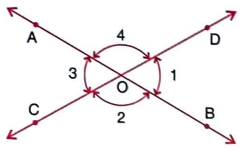
In Fig., write another name for: (i) $\angle 1$ (ii) $\angle 2$ (iii) $\angle 3$ (iv) $\angle 4$
Answer
(i) $\angle B O D$ or $\angle D O B$ (ii) $\angle B O C$ or $\angle C O B$ (iii) $\angle C O A$ or $\angle A O C$ (iv) $\angle A O D$ or $\angle D O A$
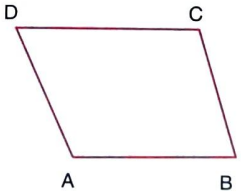
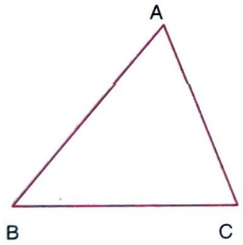
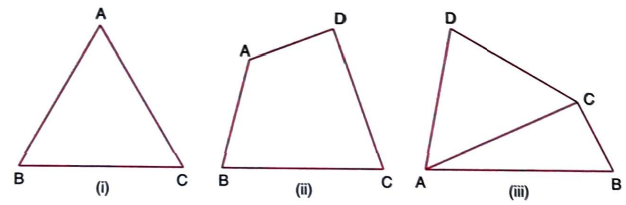
How many angles are formed in the figures (i), (ii) and (iii)? Name them.
Answer
(i) Three: $\angle A B C, \angle A C B, \angle B A C$ (ii) Four: $\angle A B C, \angle B C D, \angle C D A, \angle D A B$ (iii) Eight: $\angle A B C, \angle B C D, \angle C D A, \angle D A B, \angle C A B, \angle C A D, \angle B C A, \angle A C D$
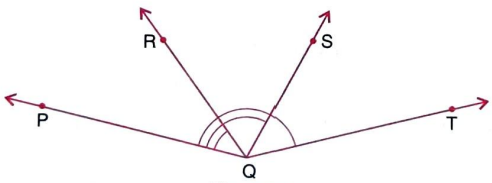
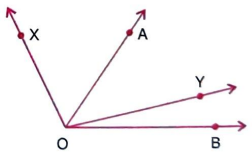
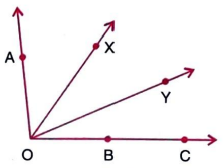
Which angle is greater: $\angle XOY$ or $\angle A O B$ ? Give reasons. $\begin{array}{l}\text {[HINT: } \angle XOY =\angle XOA +\angle A O Y \\ \angle A O B=\angle B O Y+\angle A O Y \\ \therefore \angle XOY -\angle A O B=[\angle X O A+\angle A O Y]-[\angle B O Y+\angle A O Y]\\ =\angle X O A-\angle B O Y\end{array}$ We observe that $\angle X O A>\angle B O Y$ $ \therefore \angle X O A-\angle B O Y>0 \Rightarrow \angle X O Y-\angle A O B>0 \Rightarrow \angle X O Y>\angle A O B] $
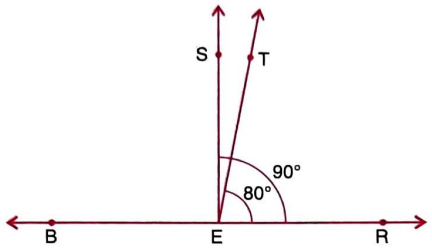
In Fig., determine which angle is greater and why? (i) $\angle A O B$ or $\angle X O Y$ (ii) $\angle A O B$ or $\angle X O B$ (iii) $\angle X O B$ or $\angle X O C$
Answer
(i) $\angle A O B$ (ii) $\angle A O B$ (iii) $\angle XOB =\angle XOC$
Mark any three points on a paper that are not on one line. Label them $A, B, C$. Draw all possible lines going through pairs of these points. How many lines do you get? Name them. How many angles can you name using $A, B, C$ ? Write them down, and mark each of them.
Answer
3 lines, $A B, B C, A C$. Three angles, $\angle A B C, \angle A C B, \angle B C A$.
Mark three non-collinear points $A, B$ and $C$ in your note book. Draw lines through these points taking two at a time. Name these lines. How many such different lines can be drawn?
Lines $p, q$ and $r$ are concurrent. Also lines $p, s$ and $t$ are concurrent. Is it always true that the lines $q, r$ and $s$ will be concurrent? Is it always true for lines $q, r$ and $t$ ?
Lines $p, q$ and $r$ are concurrent. Also, lines $p, r$ and $s$ are concurrent. Draw a figure and state whether lines $p, q, r$ and $s$ are concurrent or not.
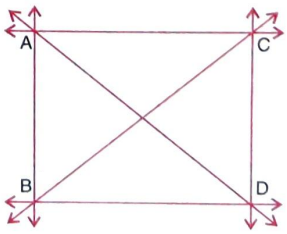
Mark four points $A, B, C$ and $D$ in your notebook such that no three of them are collinear. Draw all the lines which join them in pairs as shown in Fig. (i) How many such lines can be drawn? (ii) Write the names of these lines. (iii) Name the lines which are concurrent at $A$.
Answer
(i) $\operatorname{six}$ (ii) $A B, B C, C D, A D, B D, A C$ (iii) $A C, A B, A D$