On a squared paper, draw (i) a rectangle, (ii) a triangle (iii) any irregular closed figure. Find the approximate area of each by counting the number of squares complete, more than half and exactly half.
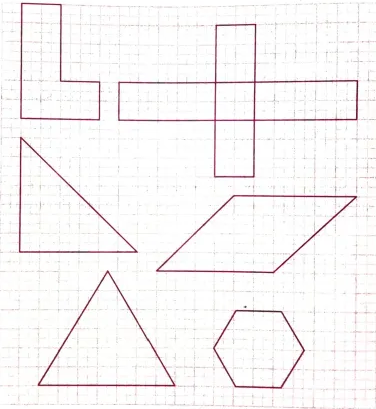
The following figures are drawn on a squared paper. Count the number of squares enclosed by each figure and find its area, taking the area of each square as 1 cm².
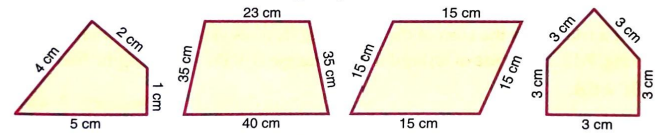
Find the missing terms: (i) Perimeter of a rectangle = 14 cm; breadth = 2 cm; length = ? (ii) Perimeter of a square = 20 cm; length of a side = ? (iii) Perimeter of a rectangle = 12 m; length = 3 m, breadth = ? (iv) Perimeter of a triangle = 55 cm; lengths of two sides 20 cm and 14 cm; length of third side = ?
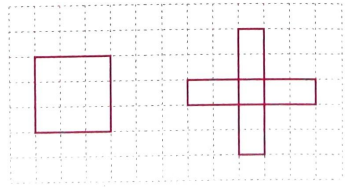
Avneet buys 9 square paving slabs, each with a side of $\frac{1}{2} m$. He lays them in the form of a square. (i) What is the perimeter of his arrangement? (ii) Shari does not like his arrangement. She gets him to lay them out like a cross. What is the perimeter of her arrangement? (iii) Which has greater perimeter? (iv) Avneet wonders, if there is a way of getting an even greater perimeter. Can you find a wal of doing this? (The paving slabs must meet along complete edges they cannot be broken!
To fix fence wires in a garden, 70 m long and 50 m wide, Arvind bought metal pipes for posts. He fixed a post every 5 metres apart. Each post was 2 m long. What is total length of the pipes he bought for the posts?
A wire of length 20 m is to be folded in the form of a rectangle. How many rectangles can be formed by folding the wire if the sides are positive integers in metres?
A piece of string is 36 cm long. What will be the length of each side, if is used to form: (i) a square (ii) an equilateral triangle (iii) a regular hexagon