Question 13 Marks
For the following pairs of numbers, verify the property:
Product of the number = Product of their $H.C.F$ and $L.C.M$
$87,145$
AnswerGiven numbers are $87$ and $145.$
Prime factorization of $87 = 3 \times 29$
Prime factorization of $145 = 5 \times 29$
$HCF$ of 87 and $145 = 29$
$LCM$ of $87$ and $145 = 3 \times 5 \times 29 = 435$
Product of the given number $= 87 \times 145 = 12615$
Product of their $HCF$ and $LCM = 29 \times 435 = 12615$
Therefore, Product of the number = Product of their $HCF$ and $LCM$ (Verified)
View full question & answer→Question 23 Marks
Show that the following pairs are co-prime:$ 875,1859$
AnswerWe know that two numbers are co-primes if their $HCF$ is $1. 875$ and $1859$ Here, dividend $= 1859$ and divisor $= 875$ 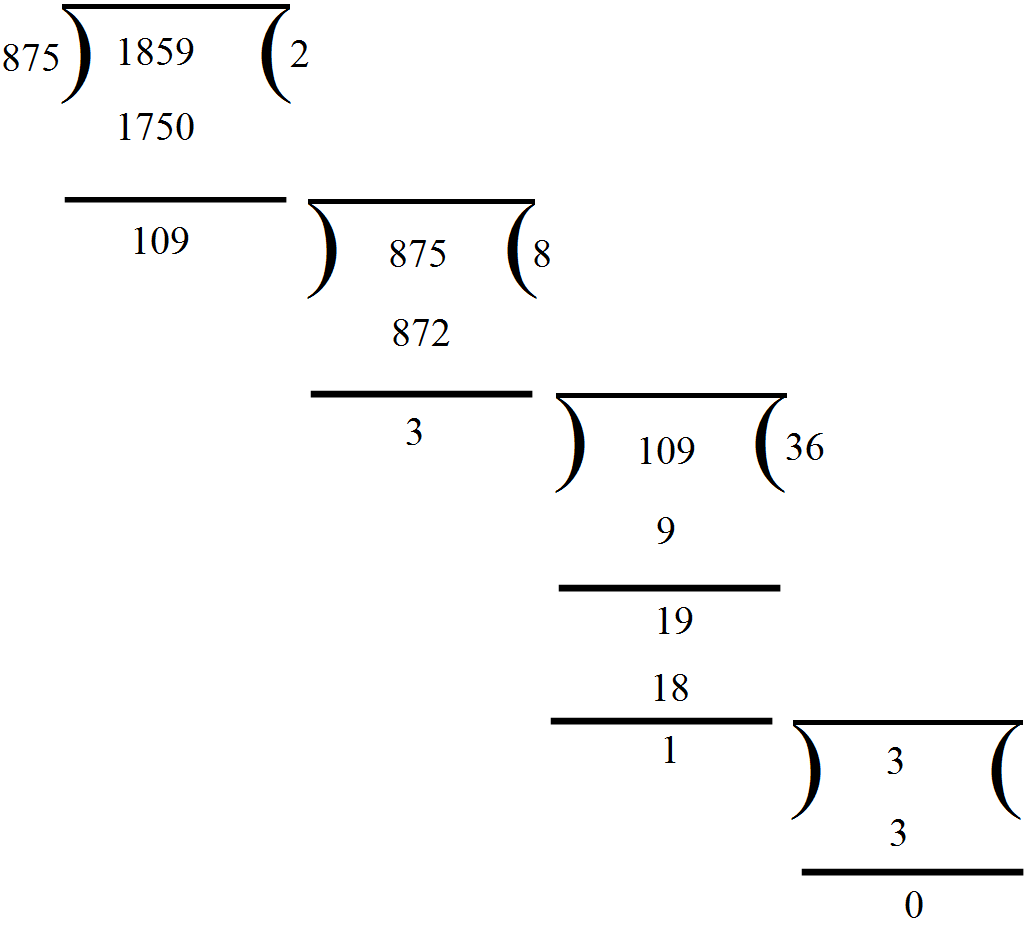
Clearly, the last divisor is $1$. Hence, the given numbers are co-prime. View full question & answer→Question 33 Marks
A merchant has $120$ litres of oil of one kind, $180$ liters of another kind and $240$ litres of third kind. He wants to sell the oil by filling the three kinds of oil in tins of equal capacity. What should be the greatest capacity of such a tin?
AnswerThe maximum capacity of the required tin is the $HCF$ of the three quantities of oil.
Prime factorization of $120 = 2 \times 2 \times 2 \times 3 \times 5$
Prime factorization of $180 = 2 \times 2 \times 3 \times 3 \times 5$
Prime factorization of $240 = 2 \times 2 \times 2 \times 2 \times 3 \times 5$
Therefore,$ HCF$ of $120, 180,$ and $240 = 2 \times 2 \times 3 \times 5 = 60$
Hence, the required greatest capacity of the tin must be $60$ liters.
View full question & answer→Question 43 Marks
In the following numbers. replace * by the smallest number to make it divisible by $11:$
$9 \times 8071$
AnswerRule: A number is divisible by $11$ if the difference of the sums of the alternate digits is either $0$ or a multiple of $11$.$9 \times 8071$
Sum of the digits at the odd places $= 9 + 8 + 7 = 24$
Sum of the digits at the even places= missing number $+ 0 + 1$
$=$ missing number $+ 1$ Difference
$= 24 - [$missing number $+ 1] = 23 -$ missing number
According to rule, $23 -$ missing number $= 22$
[Because $22$ is a multiple of $11$ and the missing number is a single digit]
Thus, missing number $= 1$
Hence, the smallest required number is $1.$
View full question & answer→Question 53 Marks
During a sale, colour pencils were being sold in packs of $24$ each and crayons in packs of $32$ each. If you want full packs of both and the same number of pencils and crayons, how many each would you need to buy?
AnswerTo find the required number of pencils and crayons, we need to find the $LCM$ of $24$ and $32.$
Prime factorization of $24 = 2 \times 2 \times 2 \times 3$
Prime factorization of $32 = 2 \times 2 \times 2 \times 2 \times 2$
Required $LCM$ of $24$ and $32 =2 \times 2 \times 2 \times 2 \times 3 = 96$
Thus, number of pencils and crayons needed to be bought is $96$ each,
i.e. $96 ÷ 24 = 4$ packs of color pencils and $96 ÷ 32 = 3$ packs of crayons.
View full question & answer→Question 63 Marks
Determine the longest tape which can be used to measure exactly the lengths $7m, 3m$ $85\ cm$ and $12m$ $95\ cm.$
AnswerGiven: Length of the first tape $= 7m = 700\ cm$
Length of the second tape $= 3m$ $85\ cm = 385\ cm$
Length of the third tape $= 12m$ $95\ cm = 1,295\ cm$
The length of the longest tape will be the $HCF$ of $700, 385,$ and $1,295.$
Prime factorization of $700 = 2 \times 2 \times 5 \times 5 \times 7$
Prime factorization of $385 = 5 \times 7 \times 11$
Prime factorization of $1,295 = 5 \times 7 \times 37$
$I-ICF$ of $700, 385,$ and $1,295 = 5 \times 7 = 35$
Required length of the longest tape $= 35\ cm$
View full question & answer→Question 73 Marks
Define a perfect number. Write two perfect numbers.
AnswerA perfect number is a positive number that equals the sum of its divisors, excluding itself.
Divisors of $6 = 1, 2, 3$
Divisors of $28 = 1, 2, 4, 7, 14, 28$
In $6$, the sum of divisors except itself, $1 + 2 + 3$ is $6.$
In $28$, the sum of divisors except itself, $1 + 2 + 4 + 7 + 14$ is $28.$
Two perfect numbers are $6$ and $28.$
View full question & answer→Question 83 Marks
Can two numbers have $12$ as their $HCF$ and $512$ as their $LCM$? Justify your answer.
Answer$HCF$ of two numbers is a factor of the $LCM$ of those numbers Thu,
we cannot have two numbers whose $HCF$ is $12$ and $LCM$ is $512$.
Because, when we divide $512$ by $12$, we get a remainder of $42.68$
Thus, $12$ is not a factor of $512$.
Hence, we cannot have two numbers of whose $HCF$ is $12$ and $LCM$ is $512.$
View full question & answer→Question 93 Marks
For the following pairs of numbers, verify the property: Product of the number = Product of their $H.C.F$ and $L.C.M$ $117,221$
AnswerGiven numbers are $117$ and $221$.
Prime factorization of $117 = 3 \times 3 \times 13$
Prime factorization of $221 = 13 \times 17$
$HCF$ of $117$ and $221 = 13$
$LCM$ of $117$ and $221 = 3 \times 3 \times 13 \times 17 = 1, 989$
Product of the given number $= 117 \times 221 = 12, 857$
Product of their $HCF$ and $LCM = 13 \times 1,989 = 12,857$
Therefore, Product of the number = Product of their $HCF$ and $LCM$ (verified)
View full question & answer→Question 103 Marks
The $L.C.M$ and $H.C.F$ of two numbers are $180$ and $6$ respectively. If ones of the numbers is $30$, find the other number.
AnswerGiven: $HCF$ of two numbers $= 6$
$LCM$ of two numbers $= 180$
One of the given number $= 30$
Product of the two numbers = Product of their $HCF$ and $LCM$
Therefore, $30 x$ other number $= 6 \times 180$ Other number $= 6 \times 18030 = 36$
Thus, the required number is $36.$
View full question & answer→Question 113 Marks
Find the greatest number that can divide $101$ and $115$ leaving remainders $5$ and $7$ respectively.
AnswerFirst we will subtract $5$ and $7$ from $101$ and $115$ respectively.
Now, we have $101 - 5 = 96$ and $115 − 7 = 108$
$96=2 \times 2 \times 2 \times 2 \times 2 \times 3=2^5 \times 3^1$
$108=2 \times 2 \times 3 \times 3 \times 3=2^2 \times 3^3$
$HCF$ of $96$ and $108=2^2 \times 3^1=12$
Hence, the greatest number that can divide $101$ and $115$ leaving remainders $5$ and $7$ respectively is $12$.
View full question & answer→Question 123 Marks
What is the $H.C.F$ of two consecutive numbers?
AnswerThe $HCF$ of two consecutive numbers is $1$.
Example: $D = 4$ and $d= 5$ are two consecutive numbers.
Here, we have dividend $= 5$ and divisor $= 4$
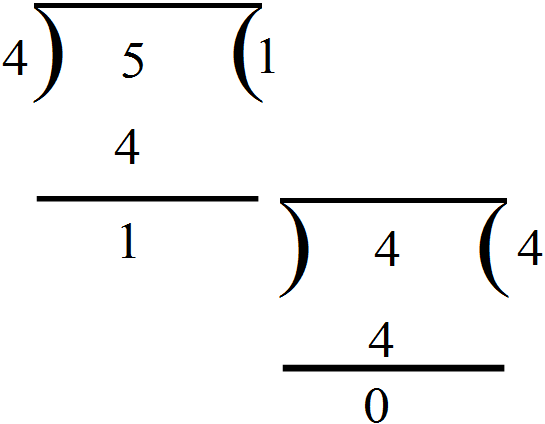
Clearly, the last divisor is $1$. Hence, $HCF$ of $4$ and $5$ is $1$. View full question & answer→Question 133 Marks
Find the greatest number which divides $285$ and $1249$ leaving remainders $9$ and $7$ respectively.
AnswerWe have to find the greatest number which divides $(285 - 9)$ and $(1,249 - 7)$ exactly.
The required number will be given by the $HCF$ of $276$ and $1242.$
Resolving $276$ and $1242$ into prime factors,
we have: $276 =2 \times 2 \times 3 \times 23$
$1242 =2 \times 3 \times 3 \times 3 \times 23$
$HCF$ of $276$ and $1242$ is $2 \times 3 \times 23 = 138.$
View full question & answer→Question 143 Marks
Find the prime factors of $1729$. Arrange the factors in ascending order, and find the relation between two consecutive prime factors.
AnswerThe given number is $1729$. We have:
|
$7$
|
$1729$
|
|
$13$
|
$247$
|
|
$19$
|
$19$
|
Thus, the number $1729$ can be expressed in the form of its prime factors ass $7 \times 13 \times 19$.
Relation between its two consecutive prime factors:
The consecutive prime factors of the given number are $7, 13$ and $19$.
Clearly, $13 - 7 = 6$ and $19 - 13 =6$
Here, in two consecutive prime factors, the latter is $6$ more than the previous one. View full question & answer→Question 153 Marks
A school bus picking up children in a colony of flats stops at every sixth block of flats. Another school bus starting from the same place stops at every eighth blocks of flats. Which is the first bus stop at which both of them will stop?
AnswerFirst bus stop at which both the buses will stop together $= LCM$ of $6th$ block and $8th$ block Prime factorization of $6 = 2 \times 3$ Prime factorization of $8 = 2 \times 2 \times 2$ Therefore, Required $LCM = 2 \times 2 \times 2 \times 3 = 24$
Hence, the first bus stop at which both the buses will stop together will be at the $24th$ block.
View full question & answer→Question 163 Marks
What is the smallest number that both $33$ and $39$ divide leaving remainders of $5$?
AnswerWe have to find prime factorization of $33$ and $39.$
Prime factorization of $33 = 3 \times 11$
Prime factorization of $39 = 3 \times 13$
Therefore, Required $LCM = 3 \times 11 \times 13 = 429$
Thus, $429$ is the smallest number exactly divisible by $33$ and $39.$
To get the remainder as $5$: Smallest number $= 429 + 5 = 434$
Thus, the required number is $434.$
View full question & answer→Question 173 Marks
Find the greatest number which divides $615$ and $963$, leaving the remainder $6$ in each case.
AnswerFirst we subtract the required remainder from $615$ and $963$. Thus, we will get $609$ and $957.$
$609=3 \times 7 \times 29=3^1 \times 7^1 \times 29^1$
$165=3 \times 11 \times 29=3^1 \times 11^1$
$HCF$ $=3^1 \times 29^1=87$
Hence, the greatest number which divides $615$ and $963$, leaving the remainder $6$ in each case is $87$.
View full question & answer→Question 183 Marks
In a morning walk three persons step off together. Their steps measure $80\ cm, 85\ cm,$ and $90\ cm$ respectively. What is the minimum distance each should walk so that he can cover the distance in complete steps?
AnswerWe have to find the $LCM$ of $80\ cm, 85\ cm,$ and $90\ cm$.
Prime factorization of $80 = 2 \times 2 \times 2 \times 2 \times 5$
Prime factorization of $85 = 5 \times 17$
Prime factorization of $90 = 2 \times 3 \times 3 \times 5$
Therefore, Required $LCM = 2 \times 2 \times 2 \times 2 \times 3 \times 3 \times 5 \times 17 = 12,240$
Therefore, Required minimum distance $= LCM$ of $80\ cm, 85\ cm,$ and $90\ cm = 12,240\ cm = 122m 40\ cm ($since $1m =100\ cm)$
View full question & answer→Question 193 Marks
The $HCF$ of two numbers is $4$ and their $LCM$ is $400$. How many pairs of values can the numbers assume?
Answer$HCF$ of two numbers is $4$ So, the numbers can be $4a$ and $4b$.
Now, $4a \times 4b = 4 \times 400 \Rightarrow ab = 100$
So, we can get the pairs $a = 25$ and $b = 4 a = 4$ and $b = 25$
Thus, the numbers are $4 \times 25 = 100$ and $4 \times 4 = 16$.
Also, we can get the other pair $4 \times 1 = 4$ and $400.$
Hence, there are two pairs.
View full question & answer→Question 203 Marks
Find the least number that is divisible by all the numbers between $1$ and $10$ (both inclusive).
AnswerTo find the required least number, we have to find the $LCM$ of the numbers from $1$ to $10$.
We know that $2, 3, 5,$ and $7$ are prime number.
Prime factorization of $4 = 2 \times 2$
Prime factorization of $6 = 2 \times 3$
Prime factorization of $8= 2 \times 2 \times 2$
Prime factorization of $9 = 3 \times 3$
Prime factorization of $10 = 2 \times 5$
Therefore, Required least number $= 2 \times 2 \times 2 \times 3 \times 3 \times 5 \times 7 = 2,520$
View full question & answer→Question 213 Marks
For the following pairs of numbers, verify the property: Product of the number = Product of their $H.C.F$ and $L.C.M\ 25,65$
AnswerGiven numbers are $25$ and $65$
Prime factorization of $25 = 5 \times 5$
Prime factorization of $65 = 5 \times 13$
$ HCF$ of $25$ and $65 = 5$
$LCM$ of $25$ and $65= 5 \times 5 \times 13 = 325$
Product of the given numbers $= 25 \times 65 = 1,625$
Product of their $HCF$ and $LCM = 5 \times 325 = 1,625$
Therefore, Product of the number = Product of their $HCF$ and $LCM$ (Verified)
View full question & answer→Question 223 Marks
Find the least $5$-digit number which is exactly divisible by $20, 25$ and $30.$
Answer$20=1 \times 2 \times 2 \times 5=2^2 \times 5^1$
$25=1 \times 5 \times 5 \times 31=5^2$
$30=1 \times 2 \times 3 \times 5=2^1 \times 3^1 \times 5^1$
$LCM$ of $20, 25$ and $30=2^2 \times 3^1 \times 5^2=300$
Least five digit number is $10000$
Now, if we divide $10000$ by $60$, we will get $33.33$ as quotient.
The integer just greater than $33.33$ is $34$
$\therefore$ Required number $= 300 \times 34 = 10200$
Hence, the least $5$-digit number which is exactly divisible by $20, 25, 30$ is $10200.$
View full question & answer→Question 233 Marks
The length, breadth and height of a room are $1050 \ cm, 750 \ cm$ and $425 \ cm$ respectively. Find the length of the longest tape which can measure the three dimensions of the room exactly.
Answer$1050=1 \times 2 \times 3 \times 5 \times 5 \times 7=2^1 \times 3^1 \times 5^2 \times 7^1$
$750=1 \times 2 \times 3 \times 5 \times 5 \times 5=2^1 \times 3^1 \times 5^3$
$425=1 \times 5 \times 5 \times 17=5^2 \times 17^1$
$30=1 \times 2 \times 3 \times 5=2^1 \times 3^1 \times 5^1$
$HCF$ of $1050, 750,$ and $425 = 5^2= 25$
Hence, the length of the longest tape which can measure the three dimensions of the room exactly is $25\ cm$
View full question & answer→Question 243 Marks
Show that the following pairs are co-prime: $59,97$
AnswerWe know that two numbers are co-primes if their $HCF$ is $1. 59$ and $97$
Here, dividend $= 97$ and divisor $= 59$
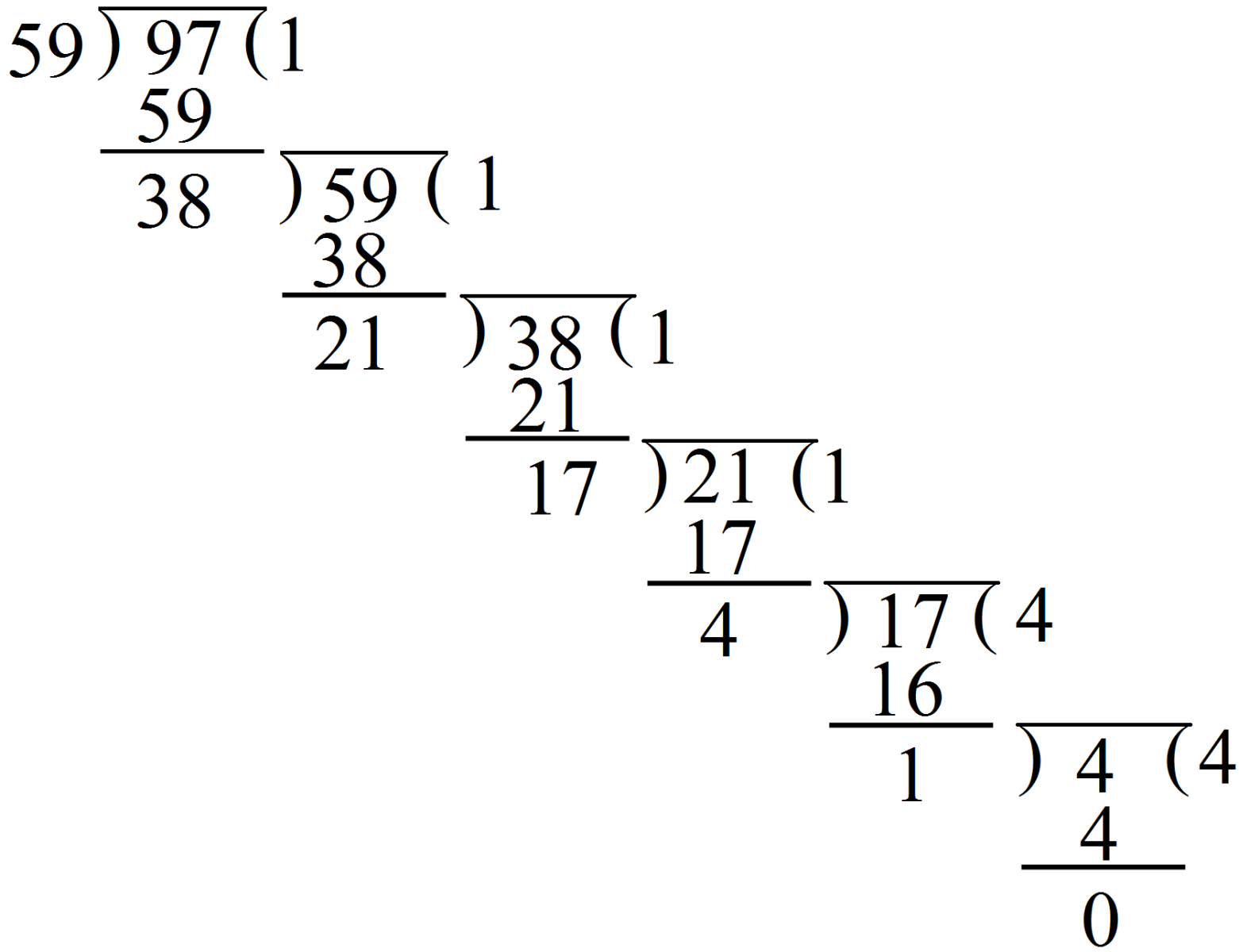
Clearly, the last divisor is $1$.
Hence, the given numbers are co-primes.
View full question & answer→Question 253 Marks
Three tankers contain $403$ liters, $434$ liters and $465$ liters of diesel respectively. Find the maximum capacity of a container that can measure the diesel of three containers exact number of times.
AnswerThe maximum capacity of three containers is equal to the $HCF$ of $403, 434$ and $465.$
$403=1 \times 13 \times 31=13^1 \times 31^1$
$434=1 \times 2 \times 7 \times 31=2^1 \times 7^1 \times 31^1$
$465=1 \times 3 \times 5 \times 31=3^1 \times 5^1 \times 31^1$
$HCF$ of $403, 434$ and $465=31^1=31$
Hence, the maximum capacity of a container that can measure the diesel of three containers exact number of times is $31$ liters.
View full question & answer→Question 263 Marks
Find the largest number which $615$ and $963$ leaving remainder $6$ in each case.
AnswerWe have to find the largest number which divides $(615 - 6)$ and $(963 - 6)$ exactly.
Therefore, the required number $= HCF$ of $609$ and $957$ Resolving $609$ and $957$ into prime factors,
we have: $609 = 3 \times 7 \times 29 957 = 3 \times 11 \times 29$
Therefore, $HCF$ of $609$ and $957$ $= 29 \times 3 = 87$
Hence, the required largest number is $87.$
View full question & answer→Question 273 Marks
The $H.C.F$ of two numbers is $16$ and their product is $3072$. Find their $L.C.M.$
AnswerGiven: $HCF$ of two numbers $= 16$
Product of these two numbers $= 3,072$
Product of the two numbers = Product of their $HCF$ and $LCM$
Therefore, $3,072 = 16 \times LCM$
$LCM = 307216 = 192$
Thus, the required $LCM$ is $192.$
View full question & answer→Question 283 Marks
In the following numbers. replace * by the smallest number to make it divisible by $11: 467 \times 91$
AnswerRule: A number is divisible by $11$ if the difference of the sums of the alternate digits is either $0$ or a multiple of $11$.
$467 \times 91$ Sum of the digits at the odd places $= 4 + 7 + 9 = 20$
Sum of the digits at the even places $= 6 +$ missing number$ + 1 $
$=$ missing number $+ 7$ Difference
$= 20 -$ [missing number $+ 7]$
$= 13 -$ missing number According to rule, $13 -$ missing number $= 11$ [Because the missing number is a single digit]
Thus, missing number $= 2$ Hence, the smallest required number is $2$.
View full question & answer→Question 293 Marks
Reduce the following fractions to the lowest terms:
$\frac{196}{481}$
Answer$\frac{196}{481}$
For reducing the given fraction to the lowest terms, we have to divide its numerator and denominator by their $HCF.$
Now, we have to find the $HCF$ of $296$ and $481.$
Prime factorization of $296 = 2 \times 2 \times 2 \times 37$
Prime factorization of $481 = 13 \times 37$
Therefore, $HCF$ of $296$ and $481 = 37$
Now, $296 + 37481 + 37 = 813$
Hence, $813$ is the required fraction.
View full question & answer→Question 303 Marks
Two brands of chocolates are available in packs of $24$ and $15$ respectively. If i need to buy an equal number of chocolates of both kinds, what is the least number of boxes of each kind i would need to buy?
AnswerLet the brand $‘A’$ contain $24$ chocolates in one packet and brand $‘B’$ contain $14$ chocolates in one packet.
Equal number of chocolates of each kind can be found out by taking $LCM$ of the number of chocolates in each packet.
Therefore, $LCM$ of $15$ and $24$ is:
$\begin{array}{c|c} 2 & 15, 24 \\ \hline 2 & 15,12 \\ \hline2&15,6\\ \hline3&15,3\\ \hline5&5,1\\ \hline&1,1 \end{array}$
Required $LCM = 2 \times 2 \times 2 \times 3 \times 5 =120$
Therefore, minimum $12o$ chocolates of each kind should be purchased.
Number of boxes of brand $‘A’$ which needs to be purchased $= 120 ÷ 24 = 5$
Number of boxes of brand $‘B’$ which needs to be purchased $= 120 ÷ 15 = 8$
View full question & answer→Question 313 Marks
For the following pairs of numbers, verify the property: Product of the number = Product of their $H.C.F$ and $L.C.M$ $490,1155$
AnswerGiven numbers are $490$ and $1155.$
Prime factorization of $490 = 2 \times 5 \times 7 \times 7$
Prime factorization of $1155 = 3 \times 5 \times 7 \times 11$
$HCF$ of $490$ and $1155 = 35$
$LCM$ of $490$ and $1155 = 2 \times 3 \times 3 \times 5 \times 7 \times 7 \times 11 = 16710$
Product of the given number $= 490 \times 1155 = 5,65,950$
Product of their $HCF$ and $LCM = 35 \times 16,170 = 5,65,950$
Therefore, Product of the number = Product of their $HCF$ and $LCM$ (Verified)
View full question & answer→Question 323 Marks
For the following pairs of numbers, verify the property:
Product of the number = Product of their $H.C.F$ and $L.C.M$
$35,40$
AnswerGiven numbers are $35$ and $40.$
Prime factorization of $35 = 5 \times 7$
Prime factorization of $40 = 2 \times 2 \times 2 \times 5$
$HCF$ of $35$ and $40 = 5$
$LCM$ of $35$ and $40 = 2 \times 2 \times 2 \times 5 \times 7 = 280$
Product of the given number $= 35 \times 40 = 1400$
Product of their $HCF$ and $LCM = 5 \times 280 = 1400$
Therefore, Product of the number = Product of their $HCF$ and $LCM$ (Verified)
View full question & answer→Question 333 Marks
Find the least three digit number which when divided by $20, 30, 40$ and $50$ leaves remainder $10$ in each case.
Answer$ 20=1 \times 2 \times 2 \times 5=2^2 \times 5^1 $
$ 30=1 \times 2 \times 3 \times 5=2^1 \times 3^1 \times 5^1 $
$ 40=1 \times 2 \times 2 \times 2 \times 5=2^3 \times 5^1 $
$ 50=1 \times 2 \times 5 \times 5=2^1 \times 5^2$
$LCM$ of $20,30,40$ and $50=2^3 \times 3^1 \times 5^2=600$
$\therefore$ Required number $= 600 + 10 = 610$. Hence, the least three digit number which when divided by $20, 30, 40$ and $50$ leaves remainder $10$ in each case is $610.$
View full question & answer→Question 343 Marks
The $H.C.F$ of two numbers is $145$, their $L.C.M$ is $2175$. If one number is $725$, find the other.
Answer$HCF$ of two numbers $= 145$ $LCM$ of two numbers $= 2,175$ One of the given numbers $= 725$
Product of the given two numbers = Product of their $LCM$ and $HCF$
Therefore, $725 x$ other number $= 145 × 2,175$ Other number $= 145 × 2175725 = 435$
Thus, the required number is $435.$
View full question & answer→Question 353 Marks
Find the smallest number which leaves remainders $8$ and $12$ when divided by $28$ and $32$ respectively.
AnswerFirst, we have to find the $LCM$ of $28$ and $32$.
Prime factorization of $28 = 2 \times 2 \times 7$
Prime factorization of $32 = 2 \times 2 \times 2 \times 2 \times 2$
Therefore, Required $LCM = 2 \times 2 \times 2 \times 2 \times 2 \times 7 = 224$
It is given that when we divide the number by $28$, the remainder is $8$ and when we divide the number by $32,$ the remainder is $12.$
We observe: $28 - 8 = 20 32 - 12 = 20$ Therefore, Required number $= 224 - 20 = 204$
View full question & answer→Question 363 Marks
Reduce the following fractions to the lowest terms: $\frac{161}{207}$
Answer$\frac{161}{207}$ For reducing the given fraction to the lowest terms,
we have to divide its numerator and denominator by their $HCF$.
Now, we have to find the $HCF$ of $161$ and $207$.
Prime factorization of $161 = 7 \times 23$
Prime factorization of $207 = 3 \times 3 \times 23$
Therefore, $HCF$ of $161$ and $207 = 23$ Now, $161 + 23207 + 23 = 79$
Hence, $79$ is the required fraction.
View full question & answer→Question 373 Marks
Telegraph poles occur at equal distances of $220 m$ along a road and heaps of stones are put at equal distances of $300 m$ along the same road. The first heap is at the foot of the first pole. How far from it along the road is the next heap which lies at the foot of a pole?
AnswerWe have to find the $LCM$ of $220 m$ and $300 m$.
Prime factorization of $220 = 2 \times 2 \times 5 \times 11$
Prime factorization of $300 = 2 \times 2 \times 3 \times 5 \times 5$
Therefore, Required $LCM = 2 \times 2 \times 3 \times 5 \times 5 \times 11 = 3,300$
Hence, $3,300$ m far is the next heap that lies at the foot of a pole.
View full question & answer→Question 383 Marks
If $x$ is prime, $y$ is a composite number such that $x + y = 240$ and their $LCM$ is $4199$. Find $x$ and $y.$
AnswerWe know that the $LCM$ of a prime number and a composite number is equal to their product.
So, $xy = 4199$
Now, $x + y = 240$
$\Rightarrow y = 240 - x $
Substituting the value of $y$ in $xy = 4199$, we will get
$x( 240 - x) = 4199$
$ \Rightarrow 240 x-x^2=4199 $
$ \Rightarrow x^2-240 x+4199=0 $
$ \Rightarrow x^2-19 x-221 x+4199=0 $
$\Rightarrow x(x - 19) - 221(x - 19) = 0$
$\Rightarrow (x - 19)(x - 221) = 0$
$\Rightarrow (x - 19) = 0 $or $(x - 221) = 0$
$\Rightarrow x = 19, 221$
$\therefore$ $x = 19$ and $y = 221$ or $x = 221$ and $y = 19$
View full question & answer→Question 393 Marks
AnswerMultiple:When a number $‘a’$ is multiplied by another number $‘b’$, the product is the multiple of both the numbers $‘a’$ and $‘b’.$
Examples of multiples:
$6$ is a multiple of $2$ because $2 \times 3 = 6$
$8$ is a multiple of $4$ because $4 \times 2 = 8$
$12$ is a multiple of $6$ because $6 \times 2 = 12$
$21$ is a multiple of $7$ because $7 \times 3 = 21$
View full question & answer→Question 403 Marks
Find the smallest $5$-digit number which is exactly divisible by $20, 25, 30.$
Answer$ 20=1 \times 2 \times 2 \times 5=2^2 \times 5^1 $
$ 25=1 \times 5 \times 5 \times 31=5^2 $
$ 30=1 \times 2 \times 3 \times 5=2^1 \times 3^1 \times 5^1$
$LCM$ of $20,25$ and $30=2^2 \times 3^1 \times 5^2=300$
Smallest five digit number is $10000$
Now, if we divide $10000$ by $60$, we will get $33.33$ as quotient.
The integer just greater than $33.33$ is $34$
$\therefore$ Required number $= 300 \times 34 = 10200$
Hence, the smallest $5$-digit number which is exactly divisible by $20, 25, 30$ is $10200.$
View full question & answer→Question 413 Marks
What is the largest number that divides $626,3127$ and $15628$ and leaves remainders of $1,2$ and $3$ respectively?
AnswerWe have to find the largest number which divides $(626 - 1), (3,127 - 2),$ and $(15,628 - 3)$ exactly.
The required number will be given by the $HCF$ of $625, 3,125$ and $15,625.$
Resolving $625, 3125,$ and $15625$ into prime factors,
we have: $625 = 5 \times 5 \times 5 \times 5 3,$
$125 = 5 \times 5 \times 5 \times 5 \times 5$
$15, 625 = 5 \times 5 \times 5 \times 5 \times 5 \times 5$
Therefore, $HCF$ of $625, 3125$ and $15625 = 5 × 5 × 5 × 5 = 625$
Hence, the required largest number is $625.$
View full question & answer→Question 423 Marks
$105$ goats, $140$ donkeys and $175$ cows have to be taken across a river. There is only one boat which will have to make many trips in order to do so. The lazy boatman has his own conditions for transporting them. He insists that he will take the same number of animals in every trip and they have to be of the same kind. He will naturally like to take the largest possible number each time. Can you tell how many animals went in each trip.
AnswerWe have to find the largest possible number of animals.
Thus, we will have to find the $HCF$ of $105, 140,$ and $175.$
Prime factorization of $105 = 3 \times 5 \times 7$
Prime factorization of $140 = 2 \times 2 \times 5 \times 7$
Prime factorization of $175 = 5 \times 5 \times 7$
Required $HCF = 5 \times 7 = 35$
Hence, $35$ animals went in each trip.
View full question & answer→Question 433 Marks
Find the largest number that divides $59$ and $54$ leaving remainders $3$ and $5$ respectively
AnswerFirst we will subtract $3$ and $5$ from $59$ and $54$ recpectively.
Now, we have $59 - 3 = 56$ and $54 - 5 = 49$
$ 56=2 \times 2 \times 2 \times 7=2^3 \times 7^1 $
$ 49=7 \times 7=7^2 $
$HCF$ of $56$ and $49 = 7^1= 7$
Hence, the largest number that divides $59$ and $54$ leaving remainders $3$ and $5$ respectively is $7.$
View full question & answer→Question 443 Marks
What is the smallest number which when divided by $24, 36$ and $54$ gives a remainder of $5$ each time?
AnswerWe have to find prime factorization of 24, 36, and 54.
Prime factorization of $24 = 2 \times 2 \times 2 \times 3$
Prime factorization of $36 = 2 \times 2 \times 3 \times 3$
Prime factorization of $54 = 2 \times 3 \times 3 \times 3$
Therefore, Required $LCM=2 \times 2 \times 2 \times 3 \times 3 \times 3 = 216$
Thus, $216$ is the smallest number exactly divisible by $24, 36,$ and $54.$
To get the remainder as 5: Smallest number $= 216 + 5 = 221$ Thus, the required number is $221.$
View full question & answer→Question 453 Marks
In the following numbers. replace $*$ by the smallest number to make it divisible by $11: 86 * 72$
AnswerRule: $A$ number is divisible by $11$ if the difference of the sums of the alternate digits is either $0$ or a multiple of $11.$
$86 \times 72$ Sum of the digits at the odd places $= 8 +$ missing number $+ 2$
$=$ missing number $+ 10$ Sum of the digits at the even places
$= 6 + 7 = 13$ Difference
$= [$missing number $+ 10 ] - 13$
$=$ Missing number $– 3$
According to the rule, missing number $- 3 = 0$ [Because the missing number is a single digit]
Thus, missing number $= 3$ Hence, the smallest required number is $3.$
View full question & answer→Question 463 Marks
A number is divisible by both $7$ and $16$. By which other number will that number be always divisible?
AnswerSince the number is divisible by $7$ and $16,$ they are the factors of that number.
So, the number will be divisible by the common factor of$ 7$ and $16.$
The factors of $7$ are $1$ and $7$.
The factors of $16$ are $1, 2, 4, 8,$ and $16$.
Therefore, the common factor of $7$ and $16$ is $1$ and the number is divisible by $1.$
View full question & answer→Question 473 Marks
Show that the following pairs are co-prime:
$288,1375$
AnswerWe know that two numbers are co-primes if their $HCF$ is $1.$
$288$ and $1375$
Here, dividend = 288 and divisor = 1375
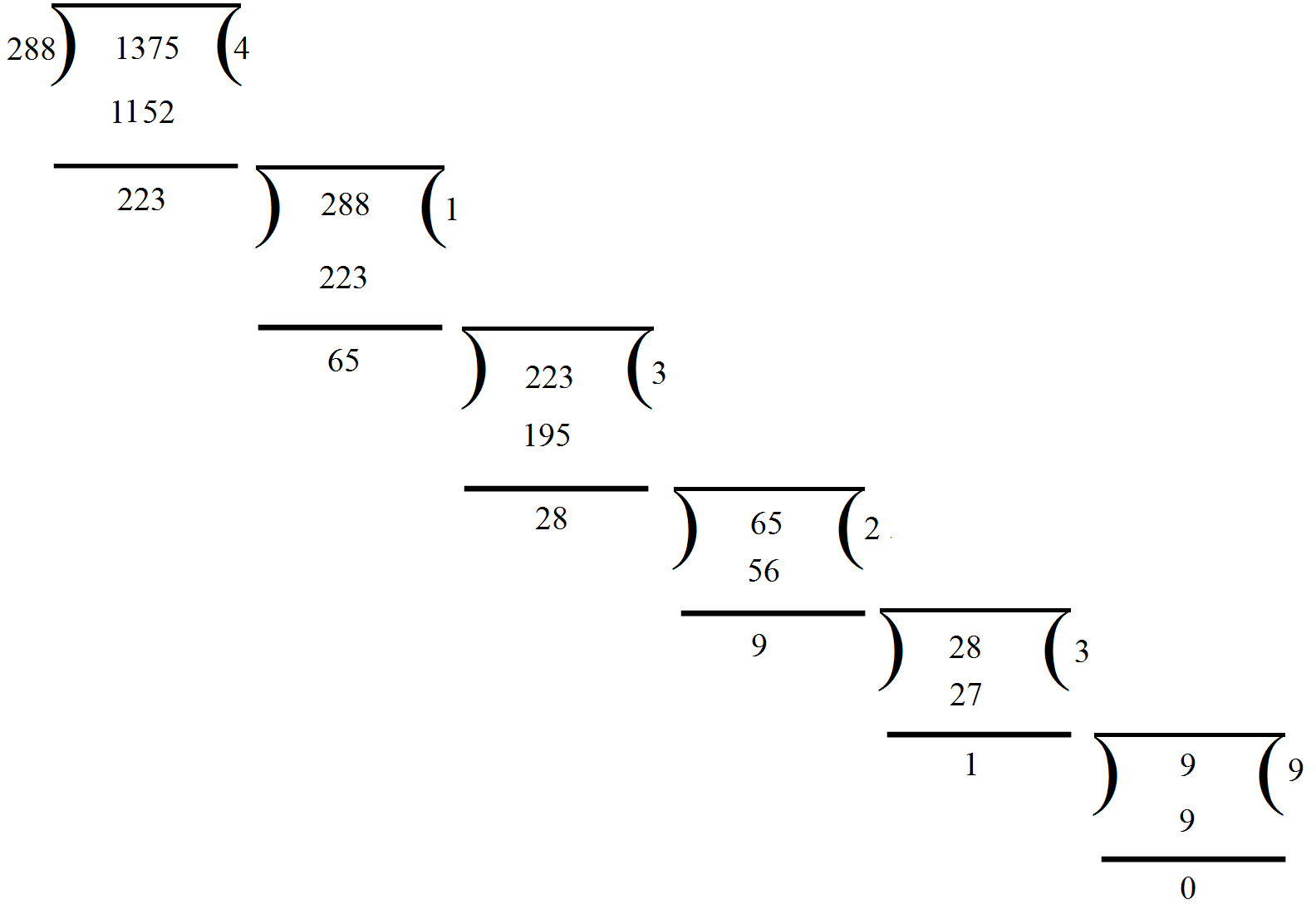
Clearly, the last divisor is $1.$
Hence, the given numbers are co-prime. View full question & answer→Question 483 Marks
Find the least number of five digits which is exactly divisible by each of $8, 12, 18, 40$ and $45$
Answer$ 2 \times 2 \times 3=2^2 \times 3^1 $
$ 18=1 \times 2 \times 3 \times 3=2^1 \times 3^2$
$ 40=1 \times 2 \times 2 \times 2 \times 5=2^3 \times 5^1 $
$ 45=1 \times 3 \times 3 \times 5=3^2 \times 5^1$
$LCM$ of $8,12,18,40$ and $45=2^3 \times 3^2 \times 5^1=360$
Smallest five digit number is $10000$
Now, if we divide $10000$ by $360,$ we will get $27.78$ as quotient.
The integer just greater than $27.78$ is $28$
$\therefore$ Required number $= 360 \times 28 = 10080$
Hence, the least number of five digits which is exactly divisible by each of $8, 12, 18, 40$ and $45$ is $10080.$
View full question & answer→Question 493 Marks
What is the smallest number that, when divide by $35, 56$ and $91$ leaves remainders of $7$ in each case?
AnswerWe have to find the prime factorization of $35, 56,$ and $91$.
Prime factorization of $35 = 5 \times 7$
Prime factorization of $56 = 2 \times 2 \times 2 \times 7$
Prime factorization of $91 = 7 \times 13$
Therefore, Required $LCM = 2 \times 2 \times 2 \times 5 \times 7 \times 13 = 3,640$
Thus, $3,640$ is the smallest number exactly divisible by $35, 56,$ and $91.$
To get the remainder as $7:$ Smallest number $= 3,640 + 7 = 3,647$
Thus, the required number is $3,647.$
View full question & answer→Question 503 Marks
In a school there are two sections - section $A$ and section $B$ of Class $VI$. There are $32$ students in section $A$ and $36$ in section $B$. Determine the minimum number of books required for their class library so that they can be distributed equally among students of section $A$ or section $B.$
AnswerWe have to find the $LCM$ of $32$ and $36$.
Prime factorization of $32 = 2 \times 2 \times 2 \times 2 \times 2$
Prime factorization of $36 = 2 \times 2 \times 3 \times 3$
Required $LCM = 2 \times 2 \times 2 \times 2 \times 2 \times 3 \times 3 = 288$
Therefore, Minimum number of books required $= LCM$ of $32$ and $36 = 288$ books
View full question & answer→Question 513 Marks
AnswerFactor:A factor of a number is an exact divisor of that number.
For example, $4$ exactly divide $32$. Therefore, $4$ is a factor of $32.$
Examples of factors are:
$2$ and $3$ are factors of $6$ because $2 \times 3 = 6$
$2$ and $4$ are factors of $8$ because $2 \times 4 = 8$
$3$ and $4$ are factors of $12$ because $3 \times 4 = 12$
$3$ and $5$ are factors of $15$ because $3 \times 5 = 15$
View full question & answer→Question 523 Marks
A rectangular courtyard is $20m$ $16\ cm$ long and $15m$ $60\ cm$ broad. It is to be paved with square stones of the same size. Find the least possible number of such stones.
AnswerLength of the rectangular courtyard $= 20m$
$16\ cm = 2,016\ cm$
Breadth of the rectangular courtyard $= 15m$
$60\ cm = 1,560\ cm$
Least possible side of the square stones used to pave the rectangular courtyard
$= HCF$ of $(2,016$ and $1,560)$
Prime factorization of $2,016 =2 \times 2 \times 2 \times 2 \times 2 \times 3 \times 3 \times 7$
Prime factorization of $1,560 = 2 \times 2 \times 2 \times 3 \times 5 \times 13$
$HCF$ of $(2,016, 1,560) = 2 \times 2 \times 2 \times 3= 24$
Least possible side of square stones used to pave the rectangular courtyard is $24 \ cm.$
Number of square stones used to pave the rectangular courtyard
= Area of rectangular courtyard Area of square stone $= 2016\ cm \times 1560\ cm (24\ cm) 2 = 5460$
Thus, the least number of square stones used to pave the rectangular courtyard is $5,460.$
View full question & answer→Question 533 Marks
The length, breadth and height of a room are $8m$ $25\ cm, 6m$ $75\ cm$ and $4m$ $50\ cm$, respectively. Determine the longest rod which can measure the three dimensions if the room exactly.
AnswerLength of the room $= 8m$ $25\ cm = 825\ cm$
Breadth of the room $= 6m$ $75\ cm = 675\ cm$
Height of the room $= 4m$ $50\ cm = 450\ cm$
The longest rod will be given by the $HCF$ of $825, 675$ and $450.$
Prime factorization of $825 = 3 \times 5 \times 5 \times 11$
Prime factorization of $675 = 3 \times 3 \times 3 \times 5 \times 5$
Prime factorization of $450 = 2 \times 3 \times 3 \times 5 \times 5$
Therefore, $HCF$ of $825, 675$ and $450 = 3 \times 5 \times 5 = 75$
Thus, the required length of the longest rod is $75\ cm.$
View full question & answer→Question 543 Marks
Find the greatest number of four digits which is exactly divisible by each of $8, 12, 18$ and $30.$
Answer$ 8=1 \times 2 \times 2 \times 2=2^3 $
$ 12=1 \times 2 \times 2 \times 3=2^2 \times 3^1$
$ 18=1 \times 2 \times 3 \times 3=2^1 \times 3^2 $
$ 30=1 \times 2 \times 3 \times 5=2^1 \times 3^1 \times 5^1$
$LCM$ of $8,12,18$, and $30=2^3 \times 3^2 \times 5^1=360$
Largest $4$-digit number is $9999$
Now, if we divide $9999$ by $360$, we will get $27.78$ as quotient.
The integer just less than $27.78$ is $27$
$\therefore$ Required number $= 360 \times 27 = 9720$
Hence, the greatest number of four digits which is exactly divisible by each of $8, 12, 18$ and $30$ is $9720$.
View full question & answer→