Questions · Page 3 of 4

M.C.Q. [1 Marks Each]

MCQ 1011 Mark
To draw an angle of $150^\circ $ using a pair of compass and ruler _______.
  • Bisect angle between $120^\circ $ and $180^\circ $
  • B
    Bisect angle between $60^\circ $ and $120^\circ $
  • C
    Bisect angle between $0^\circ $ and $160^\circ $
  • D
    None of these
Answer
Correct option: A.
Bisect angle between $120^\circ $ and $180^\circ $
View full question & answer
MCQ 1021 Mark
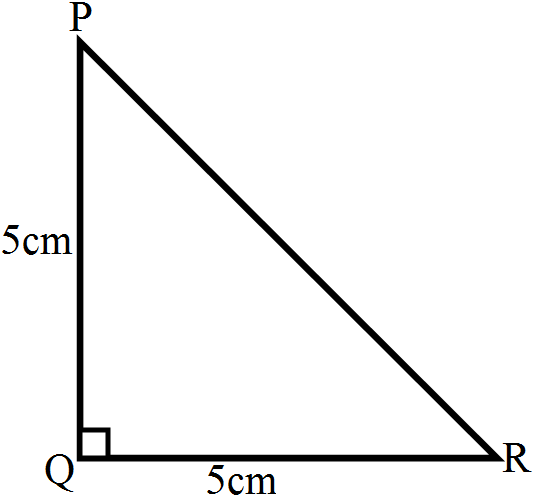
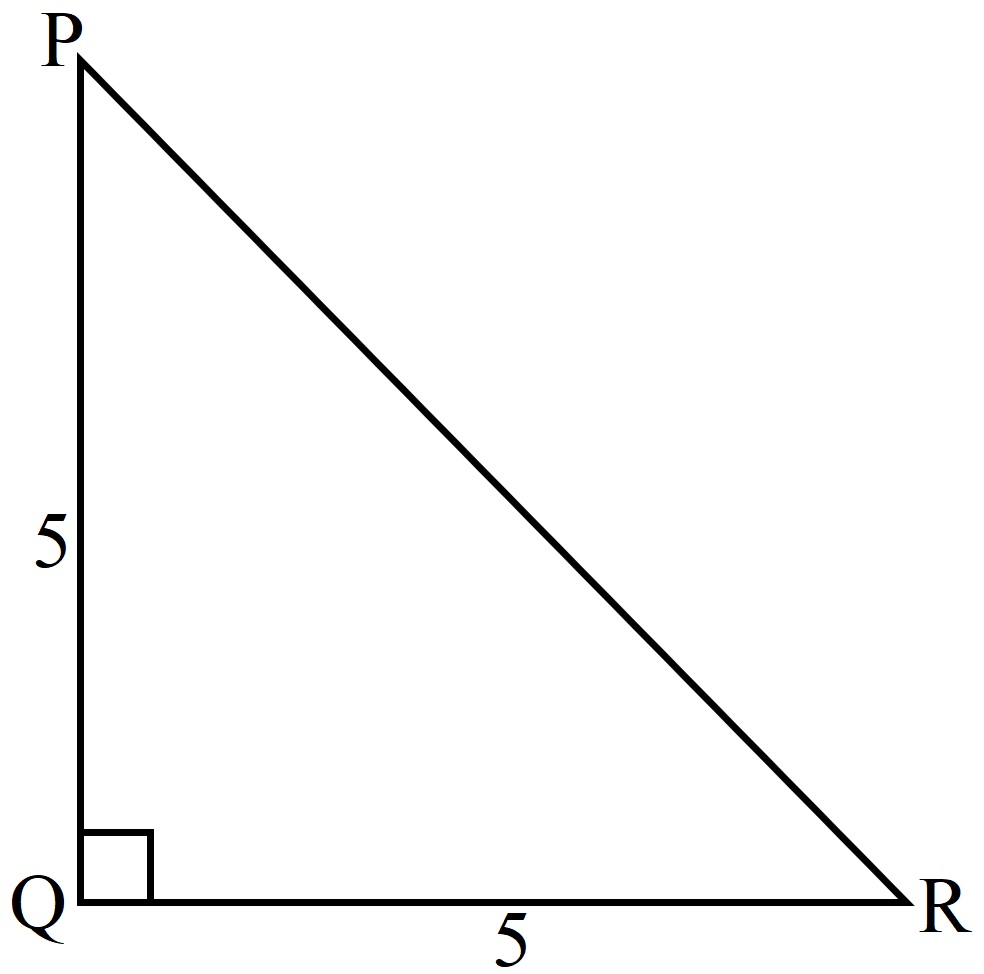
In Fig. ${\text{PQ}}\perp{\text{RQ}}$, $PQ = 5\ cm$ and $QR = 5\ cm$. Then$ \triangle{\text{PQR}}$ is:
  • A
    a right triangle but not isosceles
  • an isosceles right triangle
  • C
    isosceles but not a right triangle
  • D
    neither isosceles nor right triangle
Answer
Correct option: B.
an isosceles right triangle
View full question & answer
MCQ 1031 Mark
A line segment $\overline{\text{PQ}}=8.2\text{cm}$ is bisected at $O$, then length of $\overline{\text{PO}}$ is _______.
  • A
    $4.2\ cm$
  • B
    $4\ cm$
  • $4.1\ cm$
  • D
    $16.4\ cm$
Answer
Correct option: C.
$4.1\ cm$

Length of $PO$ $=\big(\frac{8.2}{2}\big)$ $cm = 4.1 \ cm$

View full question & answer
MCQ 1041 Mark
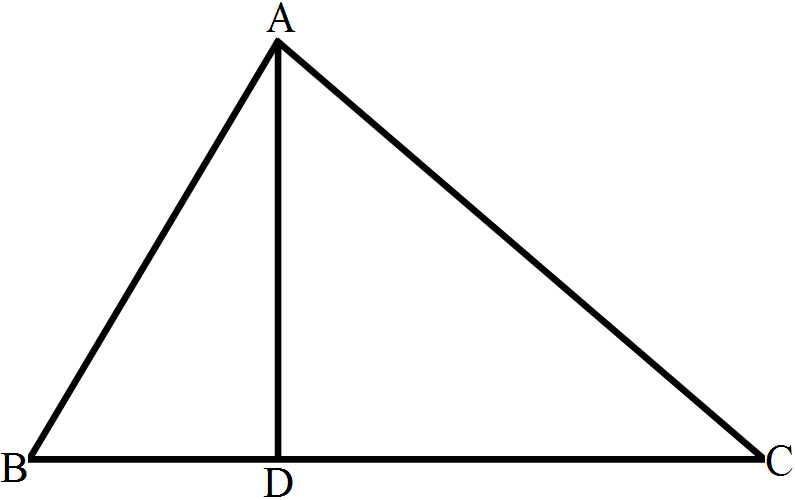
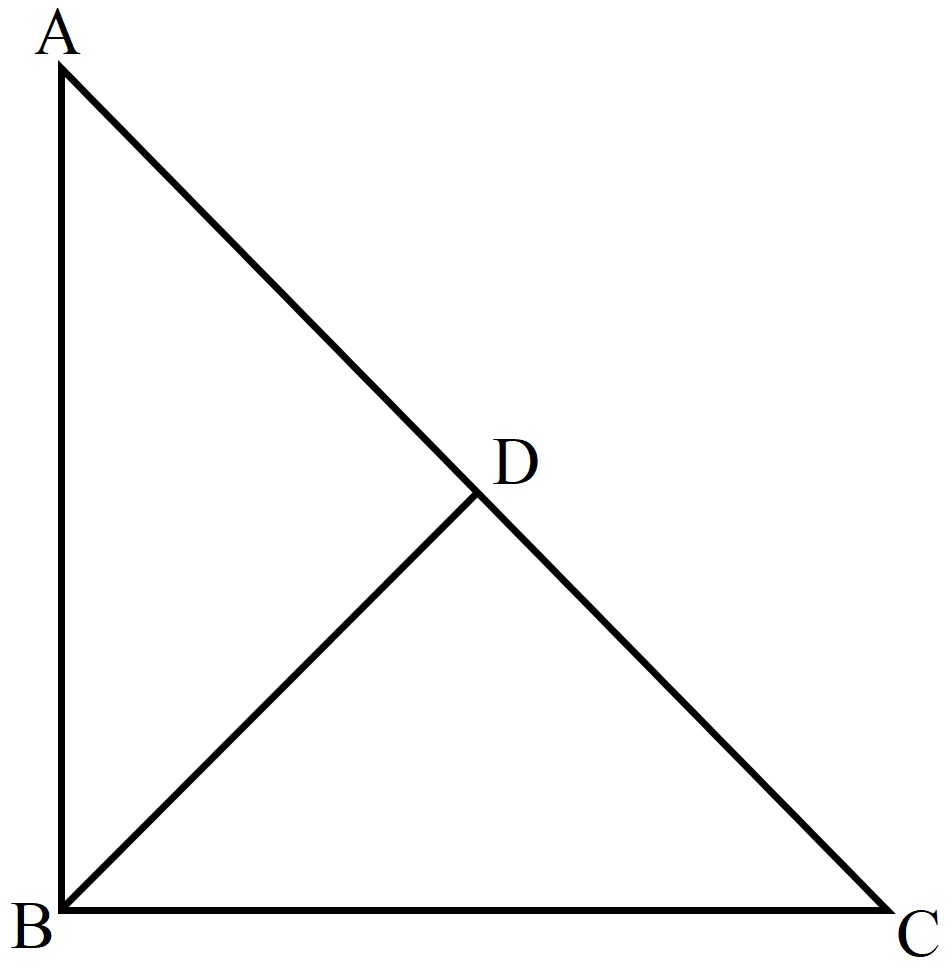
In Fig. $\angle\text{BAC}-90^\circ$ and $\text{AD}\perp\text{BC}.$
The number of right triangles in the figure is:
  • A
    $1$
  • B
    $2$
  • $3$
  • D
    $4$
Answer
Correct option: C.
$3$
A triangle, in which one angle is equal to $90^\circ $, is called a right angled triangle. Since, $\angle\text{BAC}=90^\circ$
$ABAC$ is a right angled triangle.
Also, $\angle\text{ADB}=\angle\text{ADC}=90^\circ$ $[AD$ Perpendicular to $BC]$
$A ADB$ and $A ADC$ are also right angled triangles.
Hence, there are $3$ right angled triangles.
View full question & answer
MCQ 1051 Mark
Which among the following is sufficient to construct a triangle?
  • The lengths of the three sides
  • B
    The perimeter of the triangle
  • C
    The measures of three angles
  • D
    The names of three vertices.
Answer
Correct option: A.
The lengths of the three sides
View full question & answer
MCQ 1061 Mark
The second step in the process is:
  • A
    $1$
  • $2$
  • C
    $4$
  • D
    $5$
Answer
Correct option: B.
$2$
Correct sequence is: step
$1.$ Draw a ray $BC.$
$2.$ Place the pointed end of the compass on $B$ and draw a semi $-$ circular arc with arbitrary radius and name its intersection with the ray $BC$ as $D$.
$3.$ From $D$ mark a point $E$ on the arc with the same radius.
$4.$ From point $E$, mark a point $F$ on the same arc with same radius.
$5.$ Join $B − F$ and extend it to obtain ray $BA$ So the second step is $2$
View full question & answer
MCQ 1071 Mark
An angle $\angle{\text{XYZ}}=75^\circ $ is bisected by an angular bisector $\overrightarrow{\text{YU}}.$Then what is the measure of $\angle{\text{UYZ}}$?
  • A
    $37^\circ $
  • $37.5^\circ $
  • C
    $47.5^\circ $
  • D
    $47^\circ $
Answer
Correct option: B.
$37.5^\circ $
$37.5^\circ $
View full question & answer
MCQ 1081 Mark
A line segment $ \overline{\text{IP}}$is bisected at $T$. Which of the following equals $\overline{\text{IT}}$?
  • $\overline{\text{IP}}$
  • B
    $\overline{\text{TP}}$
  • C
    $\overline{\text{TC}}$
  • D
    $\overline{\text{IQ}}$
Answer
Correct option: A.
$\overline{\text{IP}}$
$\overline{\text{TP}}$
View full question & answer
MCQ 1091 Mark
In Fig. if point $A$ is shifted to point $B$ along the ray $PX$ such that $PB = 2PA$, then the measure of $\angle\text{BPY}$ is:
  • A
    Greater than $45^\circ $
  • $45^\circ $
  • C
    Less than $45^\circ $
  • D
    $90^\circ $
Answer
Correct option: B.
$45^\circ $
There will be no change in the measure of $\angle\text{BPY}$
View full question & answer
MCQ 1101 Mark
Identify the instruments used to bisect a given line segment.
  • A
    A scale and a protractor
  • Scale and compasses
  • C
    Scale and setsquares
  • D
    A scale
Answer
Correct option: B.
Scale and compasses
Scale and compasses
View full question & answer
MCQ 1121 Mark
Identify the one with no definite length.
  • $\overleftrightarrow{\text{AB}}$
  • B
    $\overline{\text{PQ}}$
  • C
    $-\text{XYZ}$
  • D
    $\overline{\text{MN}}$
Answer
Correct option: A.
$\overleftrightarrow{\text{AB}}$
$\overleftrightarrow{\text{AB}}$ has no definite length.
View full question & answer
MCQ 1131 Mark
The point $M$ on $\overleftrightarrow{\text{AB}}$ is such that $\overline{\text{AM}}=\overline{\text{MB}}$ Which of the following is a false statement?
  • A
    $M$ is the mid-point of $\overleftrightarrow{\text{AB}}$.
  • B
    $\overline{\text{AM}}=\frac{1}{2}\overline{\text{AB}}$
  • $\overline{\text{MB}}=2\overline{\text{AB}}$
  • D
    The point $M$ bisects $AB$.
Answer
Correct option: C.
$\overline{\text{MB}}=2\overline{\text{AB}}$
$M$ is a point on $\overleftrightarrow{\text{AB}}$ such that $\overline{\text{AM}}=\overline{\text{MB}}$ Then $M$ is the midpoint of $\overleftrightarrow{\text{AB}}$, $\overline{\text{AM}}=\frac{1}{2}\overline{\text{AB}}$ and $\overrightarrow{\text{M}}$ bisects $\overleftrightarrow{\text{AB}}$ are true.
Hence the only false statement is $\overline{\text{MB}}=2\overline{\text{AB}}$
View full question & answer
MCQ 1141 Mark
Identify the false statement.
  • A
    A triangle with three equal sides is called an equilateral triangle.
  • B
    A triangle with a right angle is called a right angled triangle.
  • A triangle with two equal sides is called a scalene triangle.
  • D
    A right angled triangle has two acute angles and a right angle.
Answer
Correct option: C.
A triangle with two equal sides is called a scalene triangle.
In $[c],$ such a $\triangle\text{le}$ is called isosceles $\triangle\text{le}$
View full question & answer
MCQ 1151 Mark
Number of perpendicular bisectors for a line segment is
  • A
    Three
  • B
    Five
  • One
  • D
    Infinite
Answer
Correct option: C.
One
One
View full question & answer
MCQ 1161 Mark
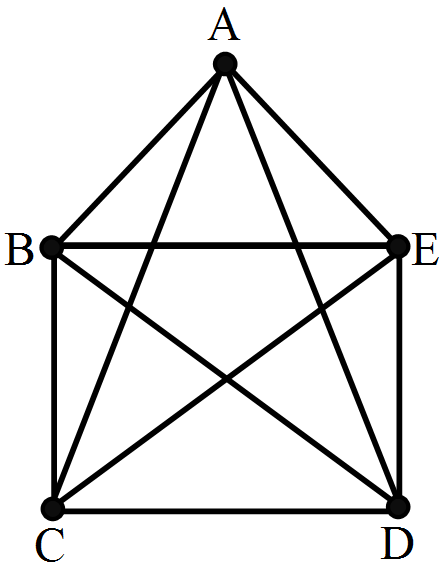
Number of lines passing through five points such that no three of them are collinear is:
  • $10$
  • B
    $5$
  • C
    $20$
  • D
    $8$
Answer
Correct option: A.
$10$
Let $A, B, C, D$ and $E$ be five points such that no three of them are $4$ collinear.
Lines passing through these five points are $AB, BC, CD, DE, EA, BA, BD, CE, AC$ and $AD$.

Hence, the number of lines is $10$.
Note: Three or more points are said to be collinear, if they lie on a single straight line.
View full question & answer
MCQ 1171 Mark
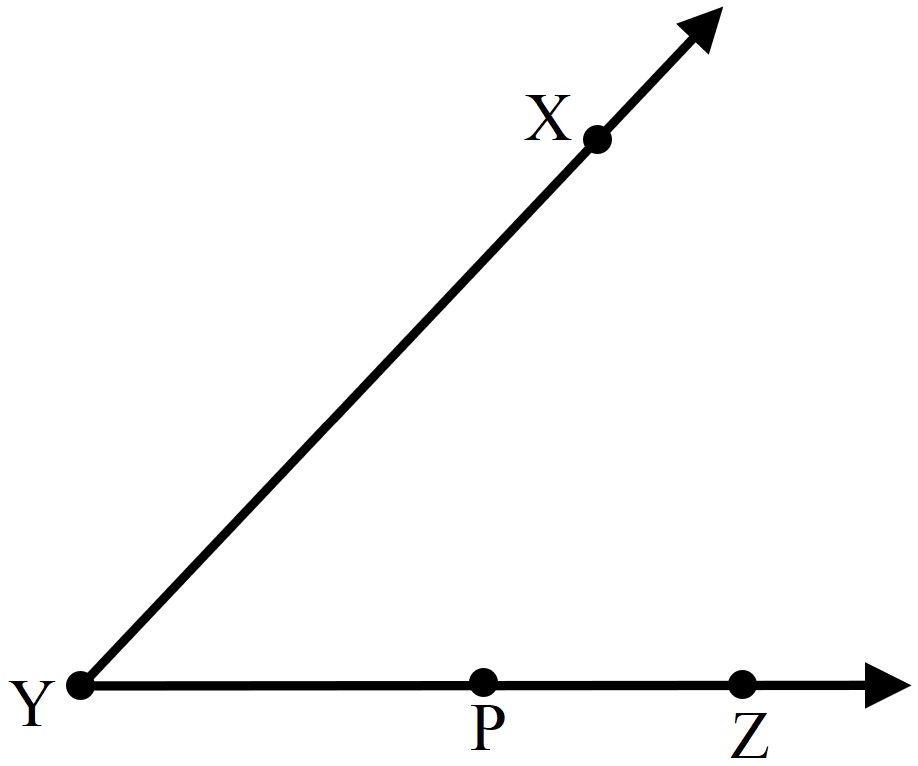
In Fig.$ −DXYZ$ cannot be written as:
  • A
    $\angle{\text{Y}}$
  • $\angle{\text{ZXY}}$
  • C
    $\angle{\text{ZYX}}$
  • D
    $\angle{\text{XYP}}$
Answer
Correct option: B.
$\angle{\text{ZXY}}$
View full question & answer
MCQ 1181 Mark
The steps of construction of an $\angle\text{AOB}=45^\circ$ is given in jumbled order below:
$1.$ Place compass on intersection point.
$2.$ Place ruler on start point and where arc intersects perpendicular line.
$3.$ Adjust compass width to reach start point.
$4.$ Construct a perpendicular line.
$5.$ Draw $45$ degree line.
$6.$ Draw an arc that intersects perpendicular line.
$7.$ The third step in process is:
  • A
    $2$
  • B
    $3$
  • $4$
  • D
    $5$
Answer
Correct option: C.
$4$
Correct sequence is:
$1.$ Construct a perpendicular line.
$2.$ Draw an arc that intersect the perpendicular line.
$3.$ Adjust the compass width to reach the start point.
$4.$ Place compass on intersection point.
$5.$ Place ruler on start point and where the arc intersects the perpendicular line.
$6.$ Draw $45$ degree line.
View full question & answer
MCQ 1191 Mark
In which of the following cases can a triangle be constructed?
  • A
    Measures of three sides are given.
  • B
    Measures of two sides and an included angle are given.
  • C
    Measures of two angles and the side between them are given.
  • All the above.
Answer
Correct option: D.
All the above.
All the above.
View full question & answer
MCQ 1201 Mark
If a bicycle wheel has $48$ spokes, then the angle between a pair of two consecutive spokes is:
  • A
    $\Big(5\frac{1}{2}\Big)$
  • $\Big(7\frac{1}{2}\Big)$
  • C
    $\Big(\frac{2}{11}\Big)$
  • D
    $\Big(\frac{2}{15}\Big)$
Answer
Correct option: B.
$\Big(7\frac{1}{2}\Big)$
Given, number of spokes$ = 48$ A complete angle $= 360^\circ .$
Angle between a pair of two consecutive spokes = Complete angle,
Number of spokes $48.2$
View full question & answer
MCQ 1211 Mark
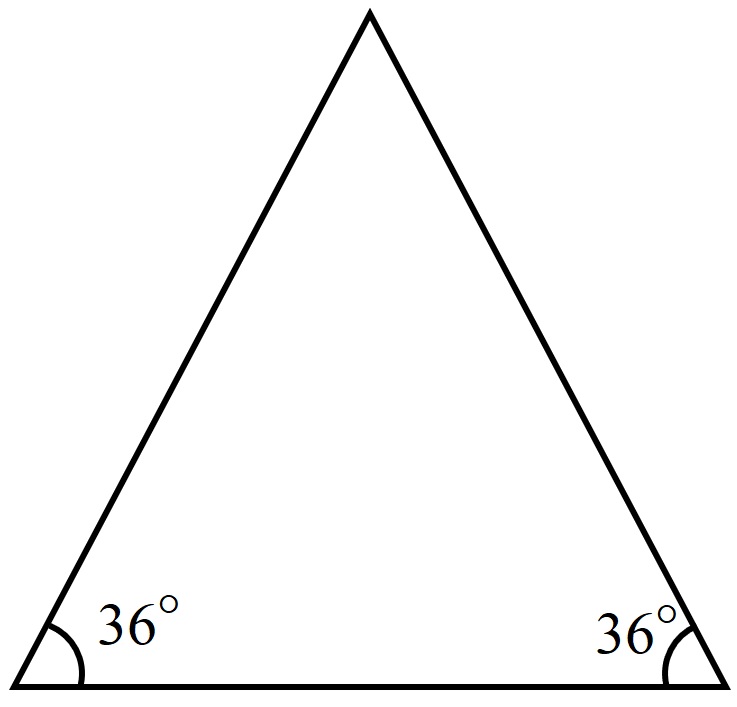
Which of the following best describes the given triangle.
  • A
    Isosceles acute triangle
  • B
    Isosceles right triangle
  • C
    Equilateral obtuse triangle
  • Isosceles obtuse triangle
Answer
Correct option: D.
Isosceles obtuse triangle
Isosceles obtuse triangle.
View full question & answer
MCQ 1221 Mark
Identify the uses of a ruler.
  • A
    To draw a line segment of a given length
  • B
    To draw a copy of a given segment.
  • C
    To draw a diameter of a circle.
  • All the above.
Answer
Correct option: D.
All the above.

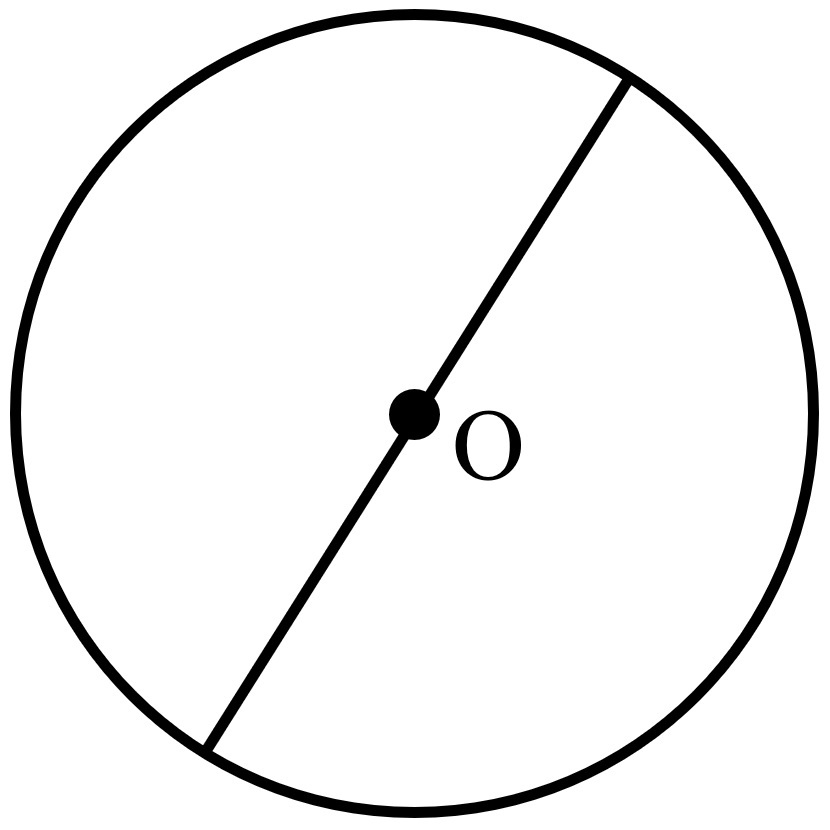
A ruler is used to draw a line segment of a given length, to draw the copy of a given segment, and to draw a diameter of a circle.
Thus, all the given options are correct.

View full question & answer
MCQ 1231 Mark
In order to duplicate agiven angle, which of the following instruments can be used?
  • Compass
  • B
    Set Square
  • C
    Protractor
  • D
    Divider
Answer
Correct option: A.
Compass

A Compass can be used to make the duplicate of any angle. A protractor can also be used
to duplicate angles but only of integral values.So option A is correct.

View full question & answer
MCQ 1241 Mark
$\overrightarrow{\text{XY}}$ bisects $\angle{\text{AXB}}.$ If $\angle{\text{YXB}}=37.5,$ what is the measure of $\angle{\text{AXB}}$?
  • A
    $37.5^\circ $
  • B
    $74^\circ $
  • C
    $64^\circ $
  • $75^\circ $
Answer
Correct option: D.
$75^\circ $
$75^\circ $
View full question & answer
MCQ 1251 Mark
If sum of two angles of a triangle is $60^\circ.$ Then, the measure of third angle of a triangle is:
  • A
    $60^\circ$
  • B
    $90^\circ$
  • $120^\circ$
  • D
    $180^\circ$
Answer
Correct option: C.
$120^\circ$
Let the angles be $x, y$ and $z$ Sum of two angles $= x + y$
Given $x + y = 60^\circ$
Using angle sum property $x + y + z = 180^\circ 60^\circ + z = 180 z = 120^\circ$
View full question & answer
MCQ 1261 Mark
Angles to be bisected to obtain an angle of $90^\circ $ are:
  • A
    $60^\circ $
  • $60^\circ $ and $120^\circ $
  • C
    $120^\circ $ and $180^\circ $

  • D
    $0^\circ $ and $60^\circ $
Answer
Correct option: B.
$60^\circ $ and $120^\circ $
Angles to be bisected to obtain an angle of $90^\circ$ are $60^\circ$ and $120^\circ $ as it exactly lies between
these two angles. $\frac{60^\circ + 120^\circ}{2}$
$= 90^\circ $ Hence, option $B$.
View full question & answer
MCQ 1271 Mark
If two lines have only one point in common, what are they called?
  • A
    Parallel lines
  • Intersecting lines
  • C
    Perpendicular lines
  • D
    Transversal
Answer
Correct option: B.
Intersecting lines
Intersecting lines have only one point in common.
View full question & answer
MCQ 1281 Mark
Arrange the given steps in $CORRECT$ order of constructing a perpendicular using ruler and compases. Steps of construction:
$1.$ With $A$ and $B$ as centres and a radius greater than $AP$ construct two arcs, which cut each other at $Q$.
$2.$ Join $PQ$. Then $\overline{\text{PQ}}$ is perpendicular to $l$. We write $0$ $\overline{\text{PQ}}\perp\text{l}$
$3.$ With $P$ as centre and a convenient radius, construct an arc intersecting the line l at two points $A$ and $B$.
$4.$ Given a point $P$ on a line $l$
  • $4 - 3 - 1 - 2$
  • B
    $3 - 4 - 2 - 1$
  • C
    $4 - 1 - 3 - 2$
  • D
    $1 - 2 - 3 - 4$
Answer
Correct option: A.
$4 - 3 - 1 - 2$
$4 - 3 - 1 - 2$
View full question & answer
MCQ 1301 Mark
In Fig. $\text{PQ}\perp\text{RQ},\text{PQ}=5\text{cm}$ and $\text{QR}=5\text{cm}.$ Then $\triangle\text{PQR}$ is:
  • A
    A right triangle but not isosceles.
  • An isosceles right triangle.
  • C
    Isosceles but not a right triangle.
  • D
    Neither isosceles nor right triangle.
Answer
Correct option: B.
An isosceles right triangle.
Since, $PQ$ Perpendicular to $RQ$,
So, $\triangle\text{PQR}=90^\circ$
$\therefore\triangle\text{PQR}$ is right angled triangle.
Also, in $\triangle\text{PQR},$
$\text{PQ}=\text{QR}$
$\triangle\text{PQR}$ is an isosceles triangle.
Hence, $\triangle\text{PQR}$ is an isosceles right angled triangle.
View full question & answer
MCQ 1311 Mark
In Fig. $AB = BC$ and $AD = BD = DC$. The number of isosceles triangles in the figure is:
  • A
    $1$
  • B
    $2$
  • $3$
  • D
    $4$
Answer
Correct option: C.
$3$
$3$
View full question & answer
MCQ 1331 Mark
Anitha's maths book has the figure given. Which instrument $(s)$ did she use to draw the figure?
  • The compasses and a ruler
  • B
    Only compasses
  • C
    Only ruler
  • D
    Cannot be said.
Answer
Correct option: A.
The compasses and a ruler
View full question & answer
MCQ 1341 Mark
$ABC$ is a triangle. The bisectors of theinternal angle $\angle B$ and external angle $\angle C$ intersect at $D$. if $\angle BDC = 60^\circ$ then $\angle A$ is
  • A
    $120^\circ$
  • B
    $180^\circ$
  • $60^\circ$
  • D
    $150^\circ$
Answer
Correct option: C.
$60^\circ$
Consider $△ABC$ Let $BC$ be extended to $E$ Since Angular bisectors Meet at $D \angle ABD = \angle DBC ⋯ (1)$
$\angle ACD =\angle DCE ⋯ (2)$
Consider $△DBC$ By External sum property $\angle DCE = \angle BDC + \angle DBC $
$⟹ 2 \angle DCE = 2(60^\circ ) + 2 \angle DBC $
$⟹ \angle ACE = 120^\circ +\angle ABC $
By external sum property of
$△ABC \angle ACE = \angle BAC + \angle ABC$
$⟹ \angle A = 60^\circ$
View full question & answer
MCQ 1351 Mark
Draw perpendicular to the line of length $99\ cm$ so that the perpendicular divides the line in the ratio $1:21:2$. Then length of the line on the left will be:
  • $3 \ cm$
  • B
    $4 \ cm$
  • C
    $5 \ cm$
  • D
    $6 \ cm$
Answer
Correct option: A.
$3 \ cm$
Draw a line say $B$ of length $9 \ cm$ using a ruleNow we have to divide the line in $1:2.$
Let the length of left part be $x$ then length of right part is$2\text{x}\Rightarrow{\text{x + 2x =9}}\Rightarrow{\text{3x = 9}}\Rightarrow{\text{x = }}\frac{9}{3}=3$$cm$
So, the lenght of left part is $3 \ cm$ So, option $A$ is correct.
View full question & answer
MCQ 1361 Mark
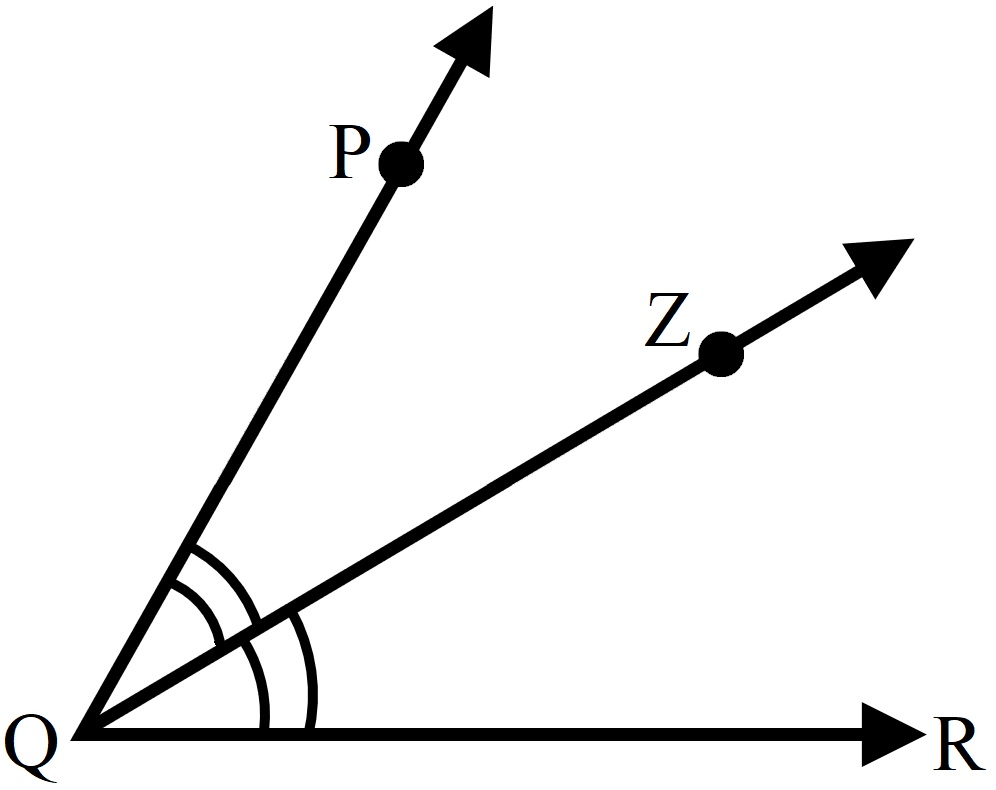
$\overrightarrow{\text{QZ}}$ is the bisector of $\angle{\text{PQZ}}=\angle{\text{PQR}}$ Which of the following is true?
  • A
    $\angle{\text{PQZ}}=\angle{\text{PQR}}$
  • B
    $\angle{\text{PQZ}}=\angle{\text{ZQR}}$
  • C
    $\angle{\text{PQZ}}=\frac{1}{2}\angle{\text{ZQR}}$
  • $\text{Both [b] and [c]}  $
Answer
Correct option: D.
$\text{Both [b] and [c]}  $
$\overrightarrow{\text{QZ}}$ bisects $\angle{\text{PQZ}}$ (Given) )

Thus. $\angle{\text{PQZ}}=\angle{\text{ZQR}}=\frac{1}{2}\angle{\text{PQR}}$
View full question & answer
MCQ 1371 Mark
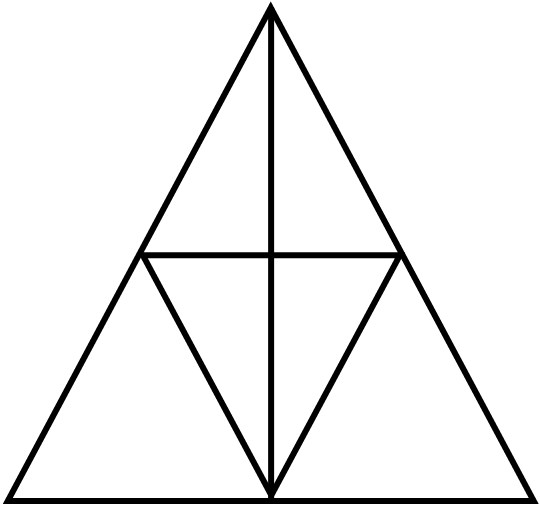
The number of triangles in Fig. is:
  • A
    $10$
  • B
    $12$
  • $13$
  • D
    $14$
Answer
Correct option: C.
$13$

By observing the figure, we can say that, number of triangles is $13$.

View full question & answer
MCQ 1381 Mark
The steps to construct a line perpendicular to $XY$ and passing through $P$ is given in random order :
$1.$ Move the set square along $XY$ so the other short side touches Point $P$.
$2.$ Use the edge of the set square to draw a line through Point $P$.
$3.$ Draw a line $XY$ and mark point $P$.
$4.$ Place one short side of the set square on the line $XY$.
Which of the following will be the fourth step:
 
  • A
    $1$
  • $2$
  • C
    $3$
  • D
    $4$
Answer
Correct option: B.
$2$
 
$1.$ Draw a line $XY$ and mark a point $P$ on it.
$2.$ Place one short side of the set square on the line $XY$.
$3.$ Move the set square along $XY$ so the other short side touches point $P.$
$4.$ Use the edge of the set square to draw a line through point $P.$
So $2$. is the fourth step.Option $B$ is correct.
 
View full question & answer
MCQ 1391 Mark
Which of the following is an angle that can be constructed using compasses and a ruler?
  • A
    $20^\circ $
  • B
    $80^\circ $
  • $60^\circ $
  • D
    $110^\circ $
Answer
Correct option: C.
$60^\circ $
$60^\circ $
View full question & answer
MCQ 1401 Mark
Which of the following can be drawn on a piece of paper?
  • A
    A line
  • A line segment
  • C
    A ray
  • D
    A plane
Answer
Correct option: B.
A line segment
A line segment can be drawn on a paper.
View full question & answer
MCQ 1411 Mark
To construct a perpendicular to a line $(L)$ from a point $(P)$ outside the line, steps are given in jumbled form. Identify the second step from the following.
$1.$ Draw line $PQ.$
$2.$ Draw a line $L$ and consider point $P$ outside the line.
$3.$ Take $P$ as a center, draw $2$ arcs on line L and name it as points $A$ and $B$ respectively.
$4.$ Taking $A$ and $B$ as a center one by one and keeping the same distance in compass,
draw the arcs on other side of the plane.The point where these arcs intersect name that point as $Q$.
  • A
    $4$
  • $3$
  • C
    $2$
  • D
    $1$
Answer
Correct option: B.
$3$
 
The correct sequence is:
$a.\ $Draw a line $L$ and consider a point $P$ outside the line.
$b.\ $Take $P$ as center and draw two arcs on line $L$ ans name the points $A$ and $B$ respectively.
$c.\ $Taking $A$ and $B$ as centres one by one and keeping the same distance in compass, draw the arcs on other side of the plane .The point where these arcs intersect name that as $Q$.
$d.\ $Draw line $PQ$ So the second
Option $B$ is correct.
 
View full question & answer
MCQ 1421 Mark
A perpendicular is drawn to a line segment $\overline{\text{NM}}$ at $N$ using a protractor and a point $P$ is marked on it. Which of the following is true?
  • A
    $\overline{\text{MP}}\perp\overline{\text{NP}}$
  • B
    $\overline{\text{MN}}\perp\overline{\text{MP}}$
  • C
    ${\text{M}\perp{P}}$
  • $\overline{\text{NM}}\perp\overline{\text{NP}}$
Answer
Correct option: D.
$\overline{\text{NM}}\perp\overline{\text{NP}}$
View full question & answer
MCQ 1441 Mark
Which type of triangle is in the classification based on angles only?
  • A
    An equilateral triangle
  • B
    A scalene triangle
  • A right angled triangle
  • D
    An isosceles triangle
Answer
Correct option: C.
A right angled triangle
View full question & answer
MCQ 1451 Mark
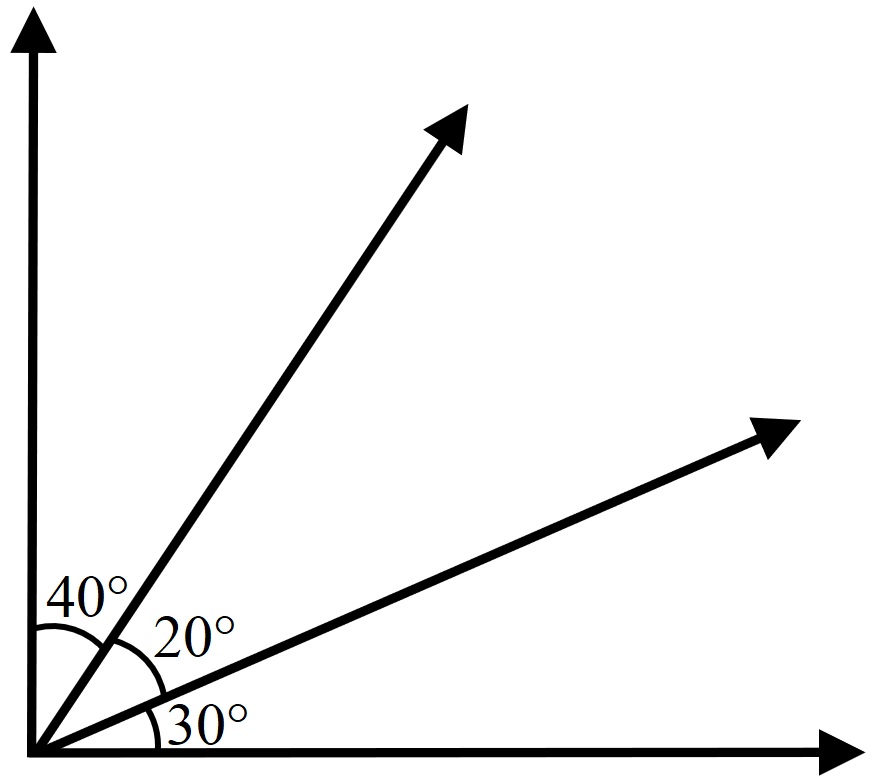
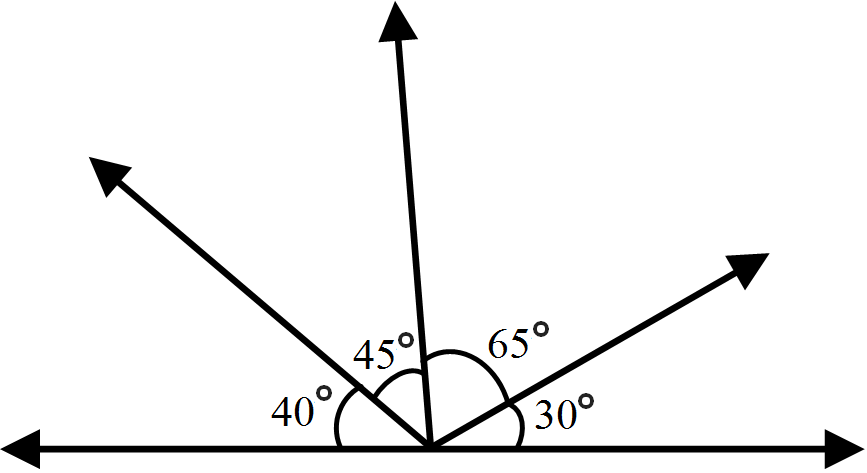
The number of obtuse angles in Fig. is:
  • A
    $2$
  • B
    $3$
  • $4$
  • D
    $5$
Answer
Correct option: C.
$4$
There are $4$ obtuse angles.
$1.\ 30^\circ + 65^\circ = 95^\circ $
$2.\ 30^\circ + 65^\circ + 45^\circ = 140^\circ $
$3.\ 65^\circ + 45^\circ = 110^\circ $
$4.\ 65^\circ + 45^\circ + 40^\circ = 150^\circ [$van obtuse angle is more than $90^\circ $ but less than $180^\circ ]$
View full question & answer
MCQ 1461 Mark
The steps to construct a line perpendicular to $XY$ and passing through $P$ is given in random order :
$1.$ Move the set square along $XY$ so the other short side touches Point $P$
$2.$ Use the edge of the set square to draw a line through Point $P$.
$3.$ Draw a line $XY$ and mark point $P$.
$4.$ Place one short side of the set square on the line $XY$.
Which of the following will be the second step:
  • A
    $1$
  • B
    $2$
  • $3$
  • D
    $4$
Answer
Correct option: C.
$3$
Draw a line $XY$ and mark a point $P$ on it.
Place one short side of the set square on the line $XY.$
Move the set square along $XY$ so the other short side touches point $P$.
Use the edge of the set square to draw a line through point $P$.
So $3$. is the first step.Option $C$ is correct.
View full question & answer
MCQ 1471 Mark
If a quadrilateral with two pairs of adjacent sides equal but opposite sides are not equal then it is called.
  • A
    parallelogram
  • square
  • C
    rectangle
  • D
    kite
Answer
Correct option: B.
square
square
View full question & answer
MCQ 1481 Mark
Identify the instruments used to bisect a given line segment.
  • A
    A scale and a protractor
  • Scale and compasses
  • C
    Scale and setsquares
  • D
    A scale
Answer
Correct option: B.
Scale and compasses
Scale and compasses
View full question & answer
MCQ 1491 Mark
An angle of $15^\circ $ is drawn using a pair of compasses and a ruler. How is it done?
  • A
    Bisecting $60^\circ $ angle.
  • B
    Bisecting $60^\circ $ and $120^\circ $ angles.
  • Bisecting $60^\circ $ and then bisecting it again.
  • D
    Bisecting a $60^\circ $ and $180^\circ $ angles.
Answer
Correct option: C.
Bisecting $60^\circ $ and then bisecting it again.
View full question & answer
MCQ 1501 Mark
How do you draw a $90^\circ $ angle?
  • By drawing a perpendicular to a line from a point lying on it.
  • B
    By bisecting a $120^\circ $ angle.
  • C
    By bisecting a $60^\circ $ angle.
  • D
    By drawing multiples of $45^\circ $ angle.
Answer
Correct option: A.
By drawing a perpendicular to a line from a point lying on it.
View full question & answer
M.C.Q. [1 Marks Each] - Page 3 - MATHS STD 6 Questions - Vidyadip