Questions

2 Marks Questions

Take a timed test

27 questions · self-marked practice — reveal the answer and mark yourself.

Question 12 Marks
Write two numbers whose product is 10000. The two numbers should not have 0 as the units digit.
Answer
We need to write factors of 10000.
10000= 10 × 10 × 10 × 10
= 2 × 5 × 2 × 5 × 2 × 5 × 2 × 5
So, 2 × 2 × 2 × 2 = 16 and 5 × 5 × 5 × 5 = 625.
Hence, 16 and 625 are the two numbers whose product is 10000.
View full question & answer
Question 22 Marks
The teacher asked if 14560 is divisible by all of 2, 4, 5, 8 and 10. Guna checked for divisibility of 14560 by only two of these numbers and then declared that it was also divisible by all of them. What could those two numbers be?
Answer
If a number is divisible by 8, it will automatically be divisible by 4.
If a number is divisible by 10, it is also divisible by 2 and 5. Therefore, checking divisibility by 8 and 10 confirms divisibility by all other numbers (2, 4, 5).
Thus, the pair of numbers that Guna could check to determine that 14560 is divisible by all of 2, 4, 5, 8, and 10 is: 8 and 5.
View full question & answer
Question 32 Marks
Explore and find out if each statement is always true, sometimes true or never true. You can give e×amples to support your reasoning.
(a) Sum of two even numbers gives a multiple of 4.
(b) Sum of two odd numbers gives a multiple of 4.
Answer
(a) Sometimes true. Sum of any two even numbers is not always divisible by 4. For e×ample, 6 + 4 = 10 which is not divisible by 4 whereas 2+2 = 4 which is divisible of 4.
(b) Sometimes true. Sum of two odd numbers can indeed be even but not necessarily a multiple of 4. For e×ample, 1 + 5 = 6 which is not a multiple of 4 whereas 1+3 = 4, which is a multiple of 4. Similarly 7 + 5 = 12, which is a multiple of 4.
View full question & answer
Question 42 Marks
2024 is a leap year (as February has 29 days). Leap years occur in the years that are multiples of 4, e×cept for those years that are evenly divisible by 100 but not 400.
(a) From the year you were born till now, which years were leap years?
(b) From the year 2024 till 2099, how many leap years are there?
Answer
(i) Let the year you were born be 2010.
2010 (not divisible by 4) 
2011 (not divisible by 4) 
2012 (divisible by 4) 
2013 (not divisible by 4) 
2014 (not divisible by 4) 
2015 (not divisible by 4) 
2016 (divisible by 4) 
2017 (not divisible by 4) 
2018 (not divisible by 4) 
2019 (not divisible by 4) 
2020 (divisible by 4) 
2021 (not divisible by 4) 
2022 (not divisible by 4) 
2023 (not divisible by 4) 
2024 (divisible by 4)
Thus, the years that were leap years are 2012, 2016, 2020 and 2024.
(ii) Since, leap years occur in the years that are multiples of 4, except for those years that are evenly divisible by 100 but not 400. Therefore, the leap years from 2024 till 2099 are 2024, 2028, 2032, 2036, 2040, 2044, 2048, 2052, 2056, 2060, 2064, 2068, 2072, 2076, 2080, 2084, 2088, 2092 and 2096.
Hence, there are 19 leap years from the year 2024 till 2099.
View full question & answer
Question 52 Marks
What is the smallest number whose prime factorization has:
(a) three different prime numbers?
(b) four different prime numbers?
Answer
(a) The smallest prime numbers are 2, 3, and 5. To find the smallest number with these primes as factors, multiply them together:
2 × 3 × 5 = 30
So, the smallest number whose prime factorization has three different prime numbers is 30.
(b) The smallest four prime numbers are 2, 3, 5, and 7. To find the smallest number with these primes as factors, multiply them together:
2 × 3 × 5 × 7 = 210
Thus, the smallest number whose prime factorization has four different prime numbers is 210.
View full question & answer
Question 62 Marks
Find three prime numbers, all less than 30, whose product is 1955.
Answer
The prime factorization of 1955:
1955 = 5 × 17 × 23
All the factors are prime numbers and are less than 30.
Hence, the three prime numbers whose product is 1955 are 5, 17, and 23.
View full question & answer
Question 72 Marks
The prime factorization of a number has one 2, two 3s, and one 11. What is the number?
Answer
To find the number, we multiply these prime factors together:
2 × 3 × 3 × 11 = 198
Thus, the number is 198.
View full question & answer
Question 82 Marks
Observe that 3 is a prime number, and 2 × 3 + 1 = 7 is also a prime. Are there other primes for which doubling and adding 1 gives another prime? Find at least five such examples.
Answer
The five prime numbers for which doubling and adding 1 gives another prime are:
• 2 (since 2 × 2 + 1 = 5)
• 3 (since 2 × 3 + 1 = 7)
• 5 (since 2 × 5 + 1 = 11)
• 11 (since 2 × 11 + 1 = 23)
• 23 (since 2 × 23 + 1 = 47)
View full question & answer
Question 92 Marks
How many three-digit prime numbers can you make using each of 2, 4 and 5 once?
Answer
2, 4 and 5 cannot form a single prime number.
Because, when its units digit is 2 or 4 it is divided by 2, and when units digits is 5 it is divided by 5 so that’s why 2, 4 and 5 cannot form a prime number.
View full question & answer
Question 102 Marks
Which of the following numbers is the product of exactly three distinct prime numbers:
45, 60, 91, 105, 330?
Answer
Here, 45 = 3 × 3 × 5 (2 distinct primes)
60 = 2 × 2 × 3 × 5(3 distinct primes)
91 = 7 × 13 (2 distinct primes)
105 = 3 × 5 × 7 (3 distinct primes)
330 = 2 × 3 × 5 × 11 (4 distinct primes)
Number 105 is the product of exactly three distinct prime numbers i.e. 3 × 5 × 7.
View full question & answer
Question 112 Marks
We see that 2 is a prime and also an even number. Is there any other even prime?
Answer
No, 2 is the only even prime number. Since 2 is the only even number that meets the criteria of a prime number (its only divisors are 1 and 2), it is the only even prime number. All other even numbers are divisible by 2 and at least one other number, so they are not prime.
View full question & answer
Question 122 Marks
Are there an equal number of primes occurring in every row in the table on the previous page (See NCERT Textbook, Page 113)? Which decades have the least number of primes? Which have the most number of primes?
Answer
There is not an equal number of primes in every row. The number of primes varies between rows. The decade 90-99 has the least number of primes with only 1 prime (97).
The decades 0-9 and 10-19 have the greatest number of primes, each with 4 primes.
View full question & answer
Question 132 Marks
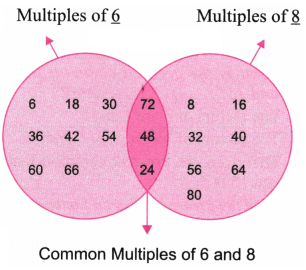
In the diagram below, Guna has erased all the numbers except the common multiples. Find out what those numbers could be and fill in the missing numbers in the empty regions.
Answer
Multiples of 6 Multiples of 8
Image
Here 6 could also be replaced by 3.
As 24, 48, 72, are also common multiples of 3 and 8.

View full question & answer
Question 142 Marks
In the treasure hunting game, Grumpy has kept treasures on 28 and 70. What jump sizes will land on both the numbers?
Answer
Factors of 28 = 1, 2, 4, 7, 14, 28
Factors of 70 = 1,2, 5, 7, 10, 14, 35, 70
Common factors are 1, 2, 7 and 14
Hence jump sizes which will land at both 28 and 70 are 1, 2, 7 and 14.
View full question & answer
Question 152 Marks
Anshu and his friends play the 'idli-vada' game with two numbers, which are both smaller than 10. The first time anybody says 'idli-vada' is after the number 50. What could the two numbers be which are assigned ‘idli’and ‘vada’?
Answer
If ‘idli-vada’ is said after number 50 it means that the least common multiple (LCM) of the two numbers must be slightly greater than 50. The LCM of 6 and 9 is 54,’.which is the first common multiple after 50, making 6 and 9 the possible numbers. Hence the two numbers could be 6 and 9.
View full question & answer
Question 162 Marks
Find any three numbers that are multiples of 25 but not multiples of 50.
Answer
Numbers that are multiples of 25 are 25, 50, 75, 100, 125, 150, 175, …
Numbers that are multiples of 50 are 50, 100, 150, 200, 250,300,…
Hence, the numbers that are multiples of 25 but not multiples of 50 are 25, 75, 125, 175,…
View full question & answer
Question 172 Marks
A number for which the sum of all its factors is equal to twice the number is called a perfect number. The number 28 is a perfect number. Its factors are 1, 2, 4, 7, 14 and 28. Their sum is 56 which is twice 28. Find a perfect number between 1 and 10.
Answer
The only perfect number between 1 and 10 is 6.
• Proper divisors are 1, 2, 3, 6
• Sum of proper divisors: 1 + 2 + 3 + 6 = 12
• 12 is twice of 6, hence 6 is a perfect number.
View full question & answer
Question 182 Marks
Who am I?
(a) I am a number less than 40. One of my factors is 7. The sum of my digits is 8.
(b) I am a number less than 100. Two of my factors are 3 and 5. One of my digits is l more than the other.
Answer
(a) 7 is the common factors of 7, 14, 21,28, 35, which are less than 40. And there is one number which have digit sum of 8, is 35 = (3 + 5) = 8.
So, I am 35.
(b) Common factors of 3 and 5 are 15, 30, 45, 60, 75,90, (which are less than 100). And there is one number which one of digit is 1 more than the other that is 45. So, I am 45.
View full question & answer
Question 192 Marks
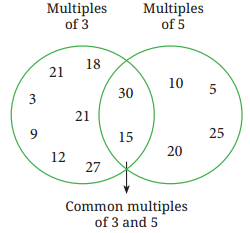
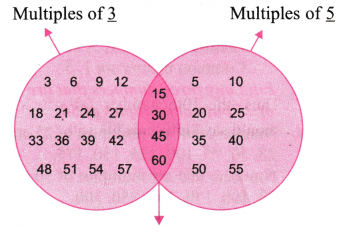
Is this figure somehow related to the ‘idli- vada’ game? (Hint: Imagine playing the game till 30. Draw the figure if the game is played till 60.)
Image
Answer
Yes, this figure is related to the ‘idli-vada’ game. Figure below for game played till 60.
Image
View full question & answer
Question 202 Marks
At what number is ‘idli-vada’ said for the 10th time?
Answer
To determine the 10th occurrence of “idli- vada”; we need to identify the numbers that are multiples of both 3 and 5.
The numbers for which “idli-vada” is said are the multiples of 15.
This sequence is: 15, 30, 45, 60, 75, 90, 105, 120, 135, 150,…
Thus, the 10th number for which players should say “idli-vada” is 150.
View full question & answer
Question 212 Marks
Find numbers between 330 and 340 that are divisible by 4. Also, find numbers between 1730 and 1740, and 2Q30 and 2040, that are divisible by 4. What do you observe?
Answer
The numbers between 330 and 340 that are divisible by 4 are 332, 336, and 340. The numbers between 1730 and 1740 that are divisible by 4 are 1732, 1736, and 1740. The numbers between 2030 and 2040 that are divisible by 4 are 2032, 2036, and 2040.
View full question & answer
Question 222 Marks
Find the common factors of:
(a) 20 and 28
(b) 35 and 50
(0 4, 8 and 12
(d) 5, 15 and 25
Answer
(a) Factors of 20 are 1, 2, 4, 5, 10, 20 Factors of 28 are 1, 2, 4, 7, 14, 28 Common factors are 1, 2, 4
(b) Factors of 35 are 1, 5, 7, 35 Factors of 50 are 1, 2,’5, 10, 25, 50 Common factors are 1,5
(c) Factors of 4 are 1, 2, 4 Factors of 8 are 1, 2, 4, 8 Factors of 12 are 1, 2, 3, 4, 6, 12 Common factors are 1, 2, 4
(d) Factors of 5 are 1, 5 Factors of 15 are 1, 3, 5, 15 Factors of 25 are 1, 5, 25 Common factors are 1,5.
View full question & answer
Question 232 Marks
What if the game was played till 900? How would your answers change?
Answer
There are 300 multiples of 3 between 1 and 900 and there are 180 multiples of 5 between 1 and 900. There are 60 multiples of 15 between 1 and 900.
(a) “idli” is said: 300 times (including the times “idli-vada” is said).
(b) “vada” is said: 180 times (including the times “idli-vada” is said).
(c) “idli-vada” is said: 60 times.
View full question & answer
Question 242 Marks
Check whether the numbers are divisibility by 4:
(i) 23408
(ii) 100246
Answer
(i) Given number is 23408
Here last 2 digits of 23408 is 08.
it is divisible by 4. $\left(\because \frac{8}{2}=2\right)$
Hence 23408 is divisible by 4.

(ii) Given number is 100246
Now last 2 digits of 100246 is 46 which is not divisible by 4.
Hence 100246 is not divisible by 4.
View full question & answer
Question 252 Marks
Which of the following is a prime number?
(a) 23
(b) 18
(c) 25
(d) 15
Answer
(a) 23 = 1 × 23
Hence, 23 is a prime number.

(b) Since 18 = 1 × 18 or 6 × 3
Hence, 18 is not a prime number.

(c) Since 25 = 1 × 25 or 5× 5
Hence, 25 is not a prime number.

(d) Since 15 = 1 × 15 or 3 × 5
Hence, 15 is not a prime number.
Hence, the option (a) is correct.
View full question & answer
Question 262 Marks
Find the common factors of:
(a) 4, 8 and 12
(b) 5,15 and 25
Answer
(a) Given numbers are: 4, 8 and 12
Factors of 4 are 1,2, 4
Factors of 8 are 1, 2, 4, 8
Factors of 12 are 1, 2, 3, 4, 6, 12
Therefore, the common factors of 4, 8 and 12 are 1,2, and 4.

(b) Given numbers are: 5, 15 and 25
Factors of 5 are 1, 5
Factors of 15 are 1, 3, 5, 15
Factors of 25 are 1, 5, 25
Therefore, the common factors of 5, 15, and 25 are 1 and 5.
View full question & answer
Question 272 Marks
What is the difference between Factors and Multiples?
Answer
The major differences between factors and multiples are provided below:
FactorsMultiples
A factor of a number is defined as an exact divisor of the given number.A multiple of a number is defined as a number that is obtained by multiplying it by a natural number.
For example, the factors of 20 are 1, 2, 4, 5, 10, and 20.For example, the multiples of 20 are 20, 40, 60, 80, 100, etc.
View full question & answer