Questions

3 Marks Question

Take a timed test

14 questions · self-marked practice — reveal the answer and mark yourself.

Question 13 Marks
Find the remainders obtained when each of the following numbers are divided by
(i) 10
(ii) 5
(iii) 2.
78, 99, 173, 572, 980, 1111, 2345
Answer
Here we have to divide 78 by 10, 5 and 2 then
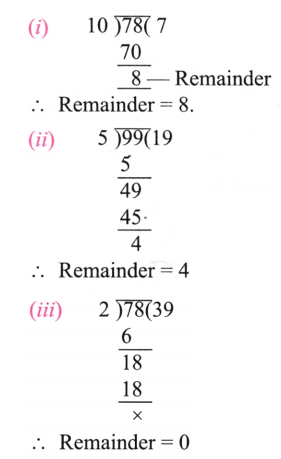
Image

Now do yourself:
99/10: Remainder = 9, 99/5: Remainder = 4, 99/2: Remainder = 1
173/10: Remainder = 3, 173/5: Remainder = 3, 173/2: Remainder = 1
572/10: Remainder = 2, 572/5: Remainder = 2, 572/2: Remainder = 0
980/10: Remainder = 0,980/5: Remainder = 0, 980/2: Remainder = 0
1111/10: Remainder= 1,1111/5: Remainder= 1, 1111/2: Remainder = 1
2345/10: Remainder 5,2345/5: Remainder = 0, 2345/2: Remainder = 1
View full question & answer
Question 23 Marks
Is the first number divisible by the second? Use prime factorization.
(a) 225 and 27
(b) 96 and 24
(c) 343 and 17
(d) 999 and 99
Answer
(a) Prime Factors of 225 and 27:
225 = 3 × 3 × 5 × 5 and 27 = 3 × 3 × 3
Since 225 contains 3 × 3 and does not have enough factors of 3 to match 3 × 3 × 3, 225 does not have sufficient factors to be divisible by 27.
Therefore, 225 is not divisible by 27.
(b) Prime Factors of 96 and 24:
96 = 2 × 2 × 2 × 2 × 2 × 3 and 24 = 2 × 2 × 2 × 3.
Since 96 includes the required factors to match those in 24, it is divisible by 24.
(c) Prime Factors of 343 and 17:
343 = 7 × 7 × 7 and 17 = 1 × 17
Since the prime factorization of 343 contains the prime factor 7 and not 17, 343 is not divisible by 17.
Thus, 343 is not divisible by 17.
(d) Prime Factors of 999 and 99: t
999 = 3 × 3 × 3 × 37 and 99 = 3 × 3 × 11
Since 999 does not include the factor 11 required for 99, 999 is not divisible by 99.
View full question & answer
Question 33 Marks
Are the following pairs of numbers co-prime? Guess first and then use prime factorization to verify your answer.
(a) 30 and 45
(b) 57 and 85
(c) 121 and 1331
(d) 343 and 216
Answer
(a) Factors of 30 and 45:
30 = 2 × 3 × 5,
45 = 3 × 3 × 5
Common factors: 3 × 5 = 15, hence 30 and 45 are not a pair of co-prime numbers.
(b) Factors of 57 and 85:
57 = 3 × 19,
85 = 5 × 17
No common factors other than 1, hence 57 and 85 are a pair of co-prime numbers.
(c) Factors of 121 and 1331:
121 = 11 × 11,
1331 = 11 × 11 × 11
Common factors: 11 × 11 = 121, hence 121 and 1331 are not a pair of co-prime numbers.
(d) Factors of 343 and 216:
343 = 7 × 7 × 7,
216 = 2 × 2 × 2 × 3 × 3 × 3
No common factors other than 1, hence 343 and 216 are a pair of co-prime numbers.
View full question & answer
Question 43 Marks
Find the prime factorization of these numbers without multiplying first.
(a) 56 × 25
(b) 108 × 75
(c) 1000 × 81
Answer
(a) Prime factors of 56 = 2 × 2 × 2 × 7
Prime factors of 25 = 5 × 5
Combined prime factorization of 56 × 25 = 2 × 2 × 2 × 7 × 5 × 5
(b) Prime factors of 108 = 2 × 2× 2 × 3 × 3
Prime factors of 75 = 3 × 5 × 5
Combined prime factorization of 108 × 75 = 2 × 2 × 3 × 3 × 3 × 3 × 5 × 5
(c) Prime factors of 1000 = 2 × 2 × 2 × 5 × 5 × 5
Prime factors of 81 = 3 × 3 × 3 × 3
Combined prime factorization of 1000 × 81 = 2 × 2 × 2 × 5 × 5 × 5 × 3 ×3 × 3 × 3
View full question & answer
Question 53 Marks
Find the smallest number that is a multiple of all the numbers from 1 to 10.
Answer
To find the smallest number that is divisible by all the numbers from 1 to 10 (both inclusive), let us first find the LCM of all the numbers between 1 and 10 (both inclusive)
we have
1 = 1
2 = 2
3 = 3
4 = 2 × 2
5 = 5
6 = 2 × 3
7 = 7
8 = 2 × 2 × 2
9 = 3 × 3
10 = 2 × 5
$\therefore$ LCM = Product of the highest power of the prime factors including other factors = 2 × 2 × 2 × 3 × 3 × 5 × 7
= 8 ×9 × 5 × 7 = 2520
The smallest number that is a multiple of all the numbers from 1 to 10 is 2520
View full question & answer
Question 63 Marks
Find the smallest number that is a multiple of all the numbers from 1 to 10 except for 7.
Answer
To find smallest number that is a multiple of all the numbers between 1 and 10 (both inclusive), let us first find the LCM of all the numbers between 1 and 10 except 7.
Here, 1 = 1
2 = 2
3 = 3
4 = 2 × 2
5 = 5
6 = 2 × 3
8 = 2 × 2 × 2
9 = 3 × 3
10 = 2 × 5
$\therefore$ LCM = Product of the highest power of the prime factors including other factors
= 2 × 2 × 2 × 3 × 3 × 5
= 360
Hence, the smallest number that is a multiple of all the numbers from 1 to 10 except for 7 is 360.
View full question & answer
Question 73 Marks
If the game is played for the numbers from 1 till 90, find out:
(a) How many times would the children say ‘idli ’ (including the times they say ‘idli- vada’)?
(b) How many times would the children say ‘vada ’ (including the times they say ‘idli-vada’)?
(c) How many times would the children say ‘idli-vada ’?
Answer
(a) Idli is said for multiples of 3. Between 1 and 90 the multiples of 3 are 3, 6, 9, 12, 15, 18, ...... 90.
There are 30 such numbers.
Hence the children would say idli 30 times.
(b) Vada is said for multiples of 5. Between 1 and 90 the multiples of 5 are 5, 10,15, 20, 25,…
There are 18 such numbers.
(c) Idli-Vada is said for multiples of both 3 and 5, which is multiple of 15. Between 1 and 90, there are 15, 30,45,60,75,90. There are 6 such numbers.
View full question & answer
Question 83 Marks
Consider these statements:
(a) Only the last two digits matter when deciding if a given number is divisible by 4.
(b) If the number formed by the last two digits is divisible by 4, then the original number is divisible by 4.
(c) If the original number is divisible by 4, then the number formed by the last two digits is divisible by 4.
Do you agree? Why or why not?
Answer
(a) Yes, that’s correct. When determining if a number is divisible by 4, only the last two digits of the number matter. This is because 100 is divisible by 4, so the divisibility rule for 4 focuses on whether the number formed by the last two digits is divisible by 4.
(b) Yes, that’s correct. If the number formed by the last two digits of a given number is divisible by 4, then the original number is also divisible by 4.
(c) Yes, that’s correct. If the original number is divisible by 4, the last two digits of the number will indeed be divisible by 4.
View full question & answer
Question 93 Marks
Which of the following pairs of numbers are co-prime?
(a) 18 and 35
(b) 15 and 37
(c) 30 and 415
Answer
(a) Here factors of 18 = 1 × 2 × 3 × 3 and factors of 35 = 1 × 5 × 7
No common factor other than 1.
Hence 18 and 35 are co-prime numbers.
(b) We have factors of 15 = 1 × 3 × 5 and factors of 37 = 1 × 37
No common factor other than 1.
Hence 15 and 37 are co-prime numbers.
(c) Given numbers are 30 and 415 Here factors of 30 = 1 × 2 × 3 × 5 and factors of 415 = 5 × 83
Clearly 5 is a common factor of 30 and 415.
Hence 30 and 415 are not co-prime numbers.
View full question & answer
Question 103 Marks
What jump size can reach both 15 and 30? There are multiple jump sizes possible. Try to find them all. f
Answer
To find the jump sizes that allow Jumpy to land on both 15 and 30, you need to determine the common factors of these two numbers. Here’s how you can find these common jump sizes:
Factors of 15:
• 15 can be factored into: 15 = 3 × 5
• The factors of 15 are: 1, 3, 5, 15
Factors of 30:
• 30 can be factored into: 30 = 2 × 3 × 5
• The factors of 30 are: 1, 2, 3, 5, 6, 10, 15, 30
The common factors between these two lists are: 1, 3, 5, 15. So, the jump sizes that will allow Jumpy to land on both 15 and 30 are the common factors of 15 and 30.
Therefore, the jump sizes that will enable Jumpy to land on both 15 and 30 are: 1, 3, 5, 15
View full question & answer
Question 113 Marks
In each of the following numbers without doing actual division, determine Whether the first number is divisible by the second number:
(i) 3409122;6
(ii) 11309634; 8
(iii) 3501804; 4
Answer
(i) Let’s determine if 3409122 is divisible by 6.
The divisibility rule for 6 combines the rules for 2 and 3.
Here 3409122 is even number because its last digit is 2.
Hence given number is divisible by 2.

Also the sum of its digits is
3 + 4 + 0 + 9 + 1 + 2 + 2 = 21
which is divisible by 3.
Thus given number is also divisible by 3.
Hence 3409122 is also divisible by 6.

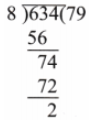
(ii) Given number is 11309634
Here last 3 digits of 11309634 is 634
Now
Image
which is not divisible by 8.
Hence 11309634 is not divisible by 8.

(iii) Given number is 3501804
and last 2 digits of 3501804 is 04.
It is divisible by 4.
Hence 3501804 is divisible by 4.
View full question & answer
Question 123 Marks
Find the prime factorization of the following numbers:
(i) 18
(ii) 39
(iii) 385
(iv) 45
(v) 52
(vi) 64
(vii) 390
(viii) 2520
(ix) 1210
(x) 1260
(xi) 1024
(xii) 2520
Answer
(i) 18 = 1 × 2 × 3 × 3
(ii) 39 = 1 × 3 × 13
(iii) 385 = 1 × 5 × 7 × 11
(iv) 45 = 1 × 3 × 3 × 5
(v) 52 = 1 × 2 × 2 × 13
(vi) 64 = 2 × 2 × 2 × 2 × 2 × 2
(vii) 390 = 2 × 3 × 5 × 13
(viii) 2520 = 1 × 2 × 2 × 2 × 3 × 3 × 5 × 7
(ix) 1210 = 2 × 5 × 11 × 11
(x) 1260 = 1 × 2 × 2 × 3 × 3 × 5 × 7
(xi) 1024 = 1 × 2 × 2 × 2 × 2 × 2 × 2 × 2 × 2 × 2 × 2
(xii) 2520 = 1 × 2 × 2 × 2 × 3 × 3 × 5 × 7
View full question & answer
Question 133 Marks
Check if the given pair of numbers are co-primes:
(i) 15 and 38
(ii) 25 and 26
(iii) 12 and 18
Answer
(i) Here factors of 15 are 1, 3, 5, 15 and factors of 38 are 1,2, 19, 38
$\therefore$ HCF of 15 and 38
= common factors of 15 and 38 = 1
Since HCF of 15 and 38 is 1.
Hence 15 and 38 are co-primes.

(ii) Here factors of 25 are 1, 5, 25 and factors of 26 are 1,2, 13, 26
$\therefore$ common factors of 25 and 26 = 1
Since HCF of 25 and 26 is 1.
Hence 25 and 26 are co-primes.

Here factors of 12 are: 1, 2, 3, 4, 6, 12 and factors of 18 are: 1, 2, 3, 6, 9, 18
$\therefore$ HCF of 12 and 18
= common factors of 12 and 18 = 1,2 and 3
Since 1,2 and 3 are factors of 12 and 18.
Hence they are not co-primes.
View full question & answer
Question 143 Marks
Check whether or not the following are composite numbers
(i) 98
(ii) 47
(iii) 35
(iv) 69
(v) 108
(vi) 19
(vii) 21
(viii) 103
Answer
(i) The factors of 98 are 1, 2, 7, 14, 49 and 98.
So, 98 is a composite number.

(ii) The factors of 47 are 1 and 47.
So, 47 is not a composite number. It is a prime number.

(iii) The factors of 35 are 1, 5, 7, 35.
So, 35 is a composite number.

(iv) The factors of 69 are 1, 3, 23, 69.
So, 69 is a composite number.

(v) The factors of 108 are 1,2, 3,4, 6, 9, 12, 18, 27,36, 54, and 108.
So, 108 is a composite number.

(vi) The factors of 19 are 1 and 19 So, 19 is not .a composite number.

(vii) The factors of 21 are 1, 3, 7, 21.
So, 21 is a composite number.

(viii) The factors of 103 are 1 and 103
So, 103 is not a composite number.
View full question & answer