Question 15 Marks
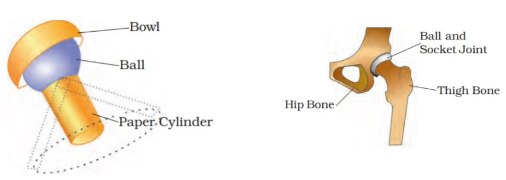
Describe the following experiment with Diagram: To understand the structure and function of a hinge joint by making a model.
Answer
View full question & answer→ Apparatus - Materials : Thro cardboards, pencil. Apparatus - Materials : Thro cardboards, pencil. Procedure:
$(1)$ Make a cylinder with cardboard.
(See fig.)
$(2)$ Attach a small pencil to the cylinder by piercing the cylinder at the center.
$(3)$ Make a hollow half cylinder from cardboard such that the rolled up cylinder can fit inside it easily.
$(4)$ The hollow half cylinder with the rolled-up cylinder sitting inside it, allows movement like a hinge.
$(5)$ Try to move rolled up cylinder. Observe how does it move. The cylinder can be moved in one direction only. It shows the movement of hinge joint. e.g. joints of elbow, knee, toes, jaw, etc.
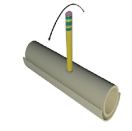
$(1)$ Make a cylinder with cardboard.
(See fig.)
$(2)$ Attach a small pencil to the cylinder by piercing the cylinder at the center.
$(3)$ Make a hollow half cylinder from cardboard such that the rolled up cylinder can fit inside it easily.
$(4)$ The hollow half cylinder with the rolled-up cylinder sitting inside it, allows movement like a hinge.
$(5)$ Try to move rolled up cylinder. Observe how does it move. The cylinder can be moved in one direction only. It shows the movement of hinge joint. e.g. joints of elbow, knee, toes, jaw, etc.