Questions

[5 Marks Each] QUE-ANS

🎯

Test yourself on this topic

12 questions · timed · auto-graded

Question 15 Marks
Describe the following  experiment with Diagram :To study the structure of ovary of a flower.
Answer
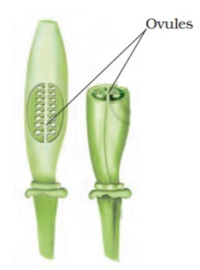
Apparatus — Materials: Two ovaries from different flowers, blade, magnifying glass, water. Procedure:
$(1)$ Ovary is the lowermost and swollen part of the pistil.
$(2)$ Take two ovaries from different flowers.
$(3)$ Take longitudal section of one of the ovaries and transversal section of the other as shown in the figure.
$(4)$ To prevent hem from drying, put a drop of water on each of the two pieces of the ovary, you have cut.
$(5)$ Observe the inner parts of the ovary using a lens. Observation: Small bead like structures called ovules are found inside the ovary.
View full question & answer
Question 25 Marks
Describe the following  experiment with Diagram :To demonstrate that the roots anchor plant firmly to the soil.
Answer

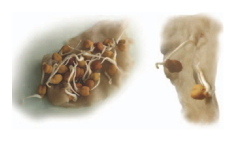
Apparatus — Materials: Seeds of gram and maize, cotton wool, two bowls
(katoris), water. Procedure:
$(1)$ Take two bowls.
$(2)$ Place balls of wet cotton wool in them.
$(3)$ Put $3$ or $4$ seeds of gram in one and maize in the other.
$(4)$ Keep the cotton wet by sprinkling water every day, until the sprouts have grown into young plants.
$(5)$ After a week try to separate the young plants from the cotton wool. Observe. Is it easy to separate the cotton wool from the roots? Observation : The roots are not easily separated from the cotton wool. Conclusion : The roots anchor the plant firmly to the soil.
View full question & answer
Question 35 Marks
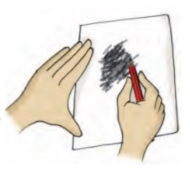
Describe the following  experiment with Diagram :To take the impression of a leaf.
Answer

Apparatus — Materials: Leaf, paper, pencil. Procedure:
$(1)$ Take a leaf.
$(2)$ Place the leaf under a white sheet of paper.
$(3)$ Hold the leaf and the paper properly as shown in the figure.
$(4)$ Hold your pencil tip sideways and rub it on the portion of the paper with the leaf below it. Note down your observation. Observation: An impression of the leaf is obtained on the paper.
View full question & answer
Question 45 Marks
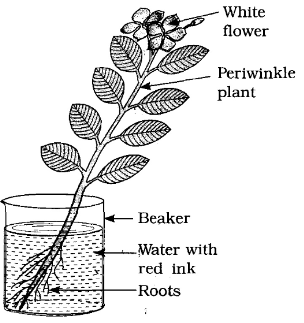
With the help of an experiment prove that roots absorb water and minerals from the soil.
Answer

To prove that roots absorb water and minerals from the soil. Apparatus - Materials: Uprooted plant with white flowers and the roots still attached to it, beaker, red ink, water. procedure:
$(1)$ Take an uprooted plant that has white flower on it.
$(2)$ Wash the mud particles that are stuck to the roots.
$(3)$ Take some water in a beaker and add some red ink to it so that the water turns red.
$(4)$ Place the plant in the beaker with its roots immersed.
$(5)$ Observe the changes carefully on the next day. Observation The stem, flower and leaves of the plants turn red. Conclusion : Roots absorb water and minerals from the soil.
View full question & answer
Question 55 Marks
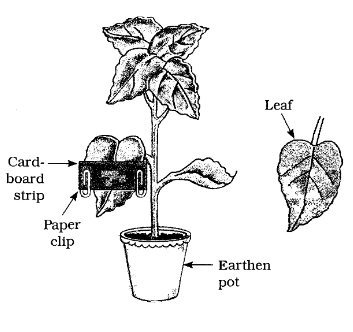
With the help of an experiment prove that sunlight is essential for photosynthesis.
Answer

To prove that sunlight is essential for photosynthesis. Apparatus — Materials: Potted plant with big leaves, two thin cardboard strips, paper clip, beaker, alcohol, iodine solution, water. Procedure:
$(1)$ Take a potted plant and keep it in dark for two days so that the starch gets used up.
$(2)$ Take two rectangular thin cardboard strips and fix it on a leaf with the help of paper clips as shown in the figure.
$(3)$ Place the pot in sunlight for a day.
$(4)$ Next day pluck the leaf and remove the cardboard strips.
$(5)$ First wash the leaf with hot water and then wash it with alcohol to remove its green colour.
$(6)$ Now, pour drops of, iodine solution on the leaf and observe it carefully. Observation: When iodine solution is poured on the leaf, it turns brown except the part which was covered with cardboard strips. Conclusion: Sunlight is essential for photosynthesis.
View full question & answer
Question 65 Marks
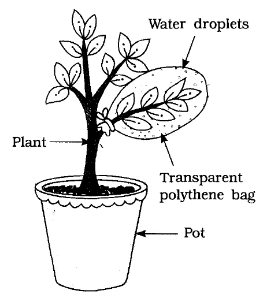
With the help of an experiment prove that plants give off water in the form of water vapour in the process of transpiration.
Answer

 To prove that plants give off water in the form of water vapour in the process of transpiration. Apparatus - Materials :Potted plant, transparent polythene bags, string. To prove that plants give off water in the form of water vapour in the process of transpiration. Apparatus - Materials :Potted plant, transparent polythene bags, string. Procedure:
$(1)$ Take a well-watered healthy potted plant.
$(2)$ Enclose a leafy branch of the plant in a polythene bag and tie up its mouth with string.
$(3)$ Let the pot remain under the sun for some time.
$(4)$ Observe the inner surface of the bag after some hours. Observation: Water droplets are observed on the inner surface of the polythene bag. Conclusion: It proves that plants give off water in the form of water vapour in the process of transpiration.
View full question & answer
Question 75 Marks
Describe with the help of an experiment that stem conducts water and dissolved minerals from the roots to other parts of a plant.
Answer
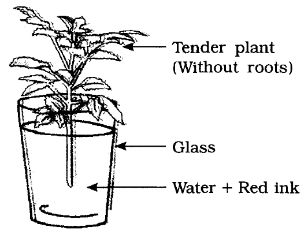
Apparatus — Materials :Tender plant, glass, blade, water, red ink.

To prove that stem conducts water and dissolved minerals from the roots to other parts of a plant. Procedure:
$(1)$ Pour water to fill one-third of the glass.
$(2)$ Add a few drops of red ink to the water.
$(3)$ Cut the base of the stem of the herb and put it in the glass containing red water.
$(4)$ Observe different parts of the plant the next day. Observation :The .stem and the branches of the herb turn red. Conclusion :The stem of the plant conducts water and dissolved minerals.
View full question & answer
Question 85 Marks
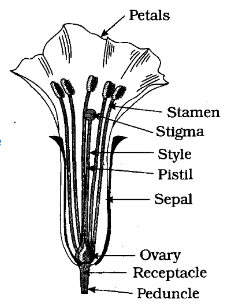
Draw a labelled diagram of dhatura flower (moonflower) and write a short note ofl its parts.
Answer

Different parts of dhatura flower (moonflower) arid their information is given below: 
$1.$ Sepal : The outer parts of a flower that have leaf like structure is called sepal. These sepals form the outer whorl that encloses the petals and is known as calyx.  Function: It protects the flower in budding stage. 
$2.$ Petals : The coloured leaves that are arranged inside the sepals are called petals. These are generally arranged in circles and their collection is known as corolla. Petals are generally bright coloured and have a fragrance. Function : They attract birds and insects to the flower for pollination to take place. 
$3.$ Stamen : It is situated inside the petals. It is the male reproductive part of the flower. It is made up of two parts anther and filament. Function : Stamen produces pollen grains in anther. 
$4.$ Pistil : The innermost part of a flower is called pistil. It is the female reproductive part of a flower.
Function : It receives the pollen during fertilization.
View full question & answer
Question 95 Marks
Describe the following  experiment with Diagram : To show that roots are essential for the healthy growth of a plant.
Answer
Apparatus — Materials: Two pots, two plants, soil, khurpi (for digging), blade, water. Procedure:
$(1)$ Select two plants of the same kind from an open ground and dig them out.
$(2)$ Plant one of the them in the soil in pot $A$ [Fig. $(a)$].
$(3)$ Cut off the roots from the other plant and plant it in the soil in pot $B$ [Fig. $(b)$].
$(4)$ Water them regularly. Observe the plants after a week. Observation:
$(1)$ The plant with roots grows properly and is healthy.
$(2)$ The plant without roots wilts. Conclusion: Roots are essential for the healthy growth of a plant.
View full question & answer
Question 105 Marks
Describe the following  experiment with Diagram : : To check the presence of starch in leaves.
Answer
Apparatus — Materials: Leaf, spirit, beaker, test tube, Bunsen burner, water, plate, iodine solution. Procedure:
$(1)$ Put the leaf in a test tube.
$(2)$ Pour spirit in the test tube to completely cover the leaf.
$(3)$ Put the test tube in a beaker half filled with water.
$(4)$ Heat the beaker till all the green colour from the leaf comes out into the spirit in the test tube.
$(5)$ Take out the leaf carefully and wash it in water.
$(6)$ Put it on a plate and pour some iodine solution over it. Observe the effect of iodine on the leaf. Observation: The colour of the iodine solution turns brown black. Conclusion: Starch is present in the leaf of a plant.
View full question & answer
Question 115 Marks
Describe the following  experiment with Diagram :To understand that stem conducts water.
Answer
Plants can be classified into three types on the basis of their height: $1.$ Herb $2.$ Shrub $3.$ Tree
$1.$ Herb : Herbs have very soft, green and weak stem. Herbs are very small non-bushy plants. Their height is usually less than $1-1/2-$ metres. They don’t have many branches. Example of herbs — Basil, coriander, periwinkle, wheat, bajri, maize, etc.
$2.$ Shrub : A shrub is a woody plant which is smaller than a tree and has several main stems arising at or near the ground. Shrubs have hard stems in comparison to herbs and bear many branches. Example of shrubs — Rose, lemon plant, china rose, henna, pomegranate etc.
$3.$ Tree : Trees have single woody stem with many branches attached to it. Trees are very big plants with thick, hard and brown stem. The branches are generally attached to the upper part of the stem. Example of trees — Mango tree, banyan tree, coconut tree, asopalav, etc.
View full question & answer
Question 125 Marks
Write short note on Backbone
Answer
The backbone consists of $33$ bones. It is the main axis of our body and is made up of small bones combined together. These small bones are joined by cartilage due to which the backbone becomes flexible. If the backbone were stiff we couldn’t bend. Apart from this, the backbone also protects our spinal cord which is the main component of our spinal system. Its upper end is attached to the skull and provides support to the body.
View full question & answer
[5 Marks Each] QUE-ANS - Science STD 6 Questions - Vidyadip