Questions

[5 Marks Each] QUE-ANS

🎯

Test yourself on this topic

7 questions · timed · auto-graded

Question 15 Marks
Give points of differences: Shadow and Image.
Answer
  Shadow Image
$1$ A shadow ** formed when an opaque ****** ***** in *** path of light. An image is formed when light gets reflected by a mirror.
$2$ The ****** of a coloured object is black ** colour. The colour of *** image is same as that of the object.
View full question & answer
Question 25 Marks
Give points of differences: Transparent object and Opaque object.
Answer
 
  *********** object Opaque object
$1$ Light can **** ******* it easily. Light cannot pass through it.
$2$ It does not form shadow. It forms shadow.
$3$ Glass, water and air are examples ** *********** objects. Wood, **** and notebook are examples of opaque objects.
View full question & answer
Question 35 Marks
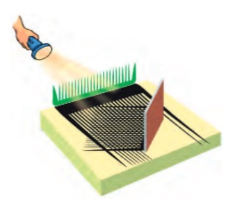
Describe the following  experiment with Diagram: To show that light travels along straight line and gets reflected from a mirror.
Answer
Apparatus — Materials : Thermocol sheet, comb, mirror, torch.

 Procedure: Procedure:
$(1)$ Take a large thermocol sheet.
$(2)$ Fix a comb on one side of the thermocol sheet such that its bristles remain upwards.
$(3)$ Fix a mirror on the other side of the thermocol sheet as shown in the figure.
$(4)$ Spread a dark coloured sheet of paper between the mirror and the comb.
$(5)$ Keep this in sunlight or send a beam of light from a torch through the comb. What pattern is seen between the comb and the mirror? Observation : A crisscross pattern of shadows is formed by the rays that pass through the comb bristles and the rays reflected by the mirror. Conclusion : This activity shows the manner in which light travels and gets reflected from a mirror.
View full question & answer
Question 45 Marks
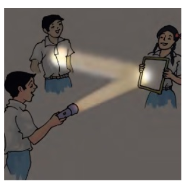
Describe the following  experiment with Diagram:  To show that a mirror changes the direction of light falling on it.
Answer
Apparatus — Materials : Torch, mirror. 

 Procedure Procedure
$(1)$ Ask one of your friends to hold a mirror in his / her hand at one corner of the dark room.
$(2)$ Stand at another corner with a torch in your hand.
$(3)$ Cover the glass of torch with your finers and switch it on.
$(4)$ Adjust your fingers with a small gap between them so that you can get a beam of light.
$(5)$ Direct the beam of the torch light onto the mirror that your friend is holding.
$(6)$ You see a patch of light on the other side. 
$(7)$ Now, adjust the direction of the torch so that the patch of light falls on another friend standing in the room. Observation : The light from the torch after reflection incident on friend.
View full question & answer
Question 55 Marks
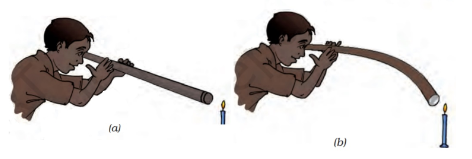
Describe the following  experiment with Diagram: To prove that light travels in a straight line.
Answer
Apparatus — Materials : A rubber tube that can be bent, candle. 
 Procedure
$(1)$ Light a candle and fix it on a table.
$(2)$ Standing at the other end of the room look at the candle through the tube.
$(3)$ Observe, if the candle is visible.
$(4)$ Now, bend the tube a little while you are looking at the candle. Observe, if the candle is visible now. Turn the tube a little to your right or left. Can you see the candle now? Observation : The candle is not visible when the rubber tube is bent. Conclusion : Light travels in a straight line.
View full question & answer
Question 65 Marks
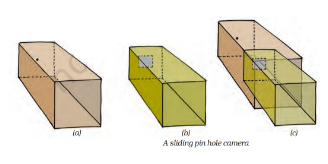
Describe the following  experiment with Diagram: To construct a pinhole camera and see the images of objects through it.
Answer
Apparatus — Materials : Two rectangular boxes having sizes slightly different from each other, tracing paper, black cloth.
Procedure
$(1)$ Take two boxes of cardboard so that one can slide into another with no gap in between them.
$(2)$ Cut open one side of each box.
$(3)$ On the opposite face of the larger box, make a small hole in the middle as shown in figure $(a)$.
$(4)$ In the smaller box, cut out a square from the middle with a side of about $5$ to $6 \ cm$.
$(5)$ Cover this open square in the box with tracing paper (translucent screen) as shown in figure $(b)$.
$(6)$ Slide the smaller box inside the larger one with the hole, in such a way that the side with the tracing paper is inside as shown in figure $(c)$.
$(7)$ Your pinhole camera is ready for use. Observing the images of objects using a pinhole camera:  
$(1)$ Holding the pinhole camera look through the open face of the smaller box.
$(2)$ You should use a piece of black cloth to cover your head and the pinhole camera.
$(3)$ Now, try to look at some distant objects like a tree or a building through the pinhole camera.
$(4)$ Move the smaller box forward or backward till you get a picture on the tracing paper pasted at the other end.
View full question & answer
Question 75 Marks
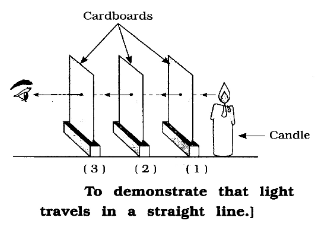
Describe an experiment to prove that light travels in a straight line.
Answer
Aim: To prove that light travels in a straight line.
 
 Apparatus — Materials: Three cardboards of equal dimensions, candle, thin rod. Method:
$(1)$ Take three cardboards of equal dimensions.
$(2)$ Place all the three cardboards on each other and pierce a hole through all of them with the help of the thin pointed rod.
$(3)$ Arrange all the three cardboards as shown in the figure.
$(4)$ Now pass the thin rod through the holes of the cardboards so that the holes remain in a line.
$(5)$ Now, place a burning candle on one side of the arrangement.
$(6)$ Try to see the candle flame from the opposite side of the arrangement (from the other side). Do you see the candle flame? 
$(7)$ Now, slightly shift any one of the cardboard and try to observe the candle flame again. Do you see the candle flame? Observation: When the holes of all the three cardboards are in the same line, the candle flame was visible. When one of the cardboards was shifted the candle flame was not visible. Conclusion: Light travels in a straight line.
View full question & answer
[5 Marks Each] QUE-ANS - Science STD 6 Questions - Vidyadip