Question 12 Marks
(i) Starting from $(-5) \times 4$, find $(-5) \times(-6)$.
(ii) Starting from $(-6) \times 3$, find $(-6) \times(-7)$.
Answer(i) We have, $(-5) \times 4=-(5 \times 4)=-20$
Similarly, multiply other integers with (-5), we get$\begin{array}{l}(-5) \times 3=-(5 \times 3)=-15,(-5) \times 2=-(5 \times 2)=-10 \\
(-5) \times 1=-(5 \times 1)=-5,(-5) \times 0=-(5 \times 0)=0 \\
\text { and }(-5) \times(-1)=5,(-5) \times(-2)=10, \\
(-5) \times(-3)=15,(-5) \times(-4)=20, \\
(-5) \times(-5)=25,(-5) \times(-6)=30,\end{array}$
Thus, $(-5) \times(-6)=30$
(ii) 42
View full question & answer→Question 22 Marks
Check if
$(-23) \times 20=23 \times(-20)$
AnswerWe have, $(-23) \times 20=23 \times(-20)$
$
\begin{aligned}
\text { LHS } & =-23 \times 20=-(23 \times 20)=-460 \\
\text { RHS } & =23 \times(-20)=-(23 \times 20)=-460 \\
\because \text { LHS } & =\text { RHS }
\end{aligned}
$
Therefore, $(-23) \times 20=23 \times(-20)$
View full question & answer→Question 32 Marks
Check if
$25 \times(-21)=(-25) \times 21$
AnswerWe have, $25 \times(-21)=-25 \times 21$
$
\begin{aligned}
\text { LHS } & =25 \times(-21)=-(25 \times 21)=-525 \\
\text { RHS } & =-25 \times 21=-(25 \times 21)=-525 \\
\because \text { LHS } & =\text { RHS }
\end{aligned}
$
Therefore, $25 \times(-21)=(-25) \times 21$
View full question & answer→Question 42 Marks
Is (i) $1 \div a=1$ ?
(ii) $a \div(-1)=-a$ ? for any integer $a$.
Take different values of a and check.
Answer(i) Let $a=5$, so $1 \div a=1 \div 5=\frac{1}{5} \neq 1$
So, first statement is not true.
(ii) Let $a=3$, so $a \div (-1)=3 \div (-1)=-(3 \div1)=-3$
So, $a \div (-1)=-a$ is true.
View full question & answer→Question 52 Marks
$\begin{array}{l}\text {(i) Is } 10 \times[6-(-2)]=10 \times 6-10 \times(-2) \text { ? }
\\ \text {(ii) Is }(-15) \times[(-7)-(-1)] =(-15) \times(-7)-(-15) \times(-1) \text { ? }\end{array}$
Answer(i) We have, $10 \times[6-(-2)]=10 \times 6-10 \times(-2)$
Distributive property in subtraction,
$\begin{array}{l}a \times(b-c)=(a \times b)-(a \times c) \\
\begin{aligned}
\therefore \text { LHS } & =10 \times[6-(-2)] \\
& =10 \times(6+2)=10 \times 8=80 \\
\text { and } RHS & =10 \times 6-10 \times(-2) \\
& =60+20=80
\end{aligned} \\
\because \text { LHS }=\text { RHS }\end{array}$
Hence, it is true.
(ii) Do same as part (i)
View full question & answer→Question 62 Marks
(i) Is $10 \times[6+(-2)]=10 \times 6+10 \times(-2)$ ?
(ii) Is $(-15) \times[(-7)+(-1)]=(-15) \times(-7)+(-15) \times(-1)$ ?
Answer(i) We have, $10 \times[6+(-2)]=10 \times 6+10 \times(-2)$
Distributive property in addition
$\begin{array}{l}
a \times(b+c)=a \times b+a \times c \\
\therefore \text { LHS }=10 \times[6+(-2)]=10 \times(4)=40 \\
\text { and } RHS=10 \times 6+10 \times(-2)=60-20=40 \\
\because \text { LHS }=\text { RHS }\end{array}$
Hence, it is true
(ii) Do same as part (i)
View full question & answer→Question 72 Marks
An elevator descends into a mine shaft at the rate of 6 m/min. If the descent start from 10 m above the ground level, how long will it take to reach -350 m?
AnswerGiven, present position of the elevator $=10 m$ above the ground level.
Distance to be moved by the elevator below the ground level $=350 m$
$\therefore$ Total distance moved by the elevator $=350+10=360 m$
Rate of descends $=6 m / min$
$\therefore$ Time taken $=\frac{\text { Total distance }}{\text { Rate of descends }}$
$=\frac{360}{6}=60 min$
View full question & answer→Question 82 Marks
Verify that $a÷(b+c) \neq(a÷b)+(a÷c)$ for each of the following values of $a, b$ and $c$.
(i) $a=12, b=-4, c=2$
(ii) $a=(-10), b=1, c=1$
Answer(i) Given, $a=12, b=-4$ and $c=2$
$
\therefore LHS=a \div(b+c)
$
On putting the values of $a, b$ and $c$, we get
$
\text { LHS }=12 \div(-4+2)=12 \div(-2)
$
$=-(12 \div2)=-6$
and RHS $=(a \div b)+(a \div c)$
$\begin{array}{l}=[12 \div(-4)]+(12 \div2) \\ =-(12 \div4)+6=-3+6=3\end{array}$
$
\begin{array}{l}
\because \quad \text { LHS } \neq \text { RHS } \\
\therefore a \div(b+c) \neq(a \div b)+(a \div c)
\end{array}
$
(ii) Do same as part (i)
View full question & answer→Question 92 Marks
Starting from $(-1) \times 5$, write various products showing same pattern to show $(- 1 ) \times(- 1 )= 1$.
AnswerWe have, $(-1) \times 5=-5$
Multiply -1 with other integers like $4,3,2,1,0$ and -1 , we get
$
\begin{array}{l}
(-1) \times 4=-4,(-1) \times 3=-3, \\
(-1) \times 2=-2,(-1) \times 1=-1, \\
(-1) \times 0=0,(-1) \times(-1)=1
\end{array}
$
Hence, $(-1) \times(-1)=1$
View full question & answer→Question 102 Marks
(i) For any integer $a$, what is $(-1) \times a$ equal to?
(ii) Determine the integer whose product with $(-1)$ is
(a) -22 $\quad$ (b) 37 $\quad$ (c) 0
Answer(i) For any integer $a$, we have $(-1) \times a=-a$
(ii) We know that the product of any integer and $(-1)$ is the additive inverse of integer.
(a) $(-1) \times 22=-22$
(b) $(-1) \times(-37)=37$
(c) $(-1) \times 0=0$
View full question & answer→Question 112 Marks
Verify the following.
(i) $18 \times[7+(-3)]=[18 \times 7]+[18 \times(-3)]$
(ii) $(-21) \times[(-4)+(-6)] =[(-21) \times(-4)]+[(-21) \times(-6)]$
Answer(i) We have, $18 \times[7+(-3)]=[18 \times 7]+[18 \times(-3)]$
$\begin{array}{l}\therefore \text { LHS }=18 \times[7+(-3)]=18 \times(7-3)=18 \times 4=72 \\
\text { and RHS }=[18 \times 7]+[18 \times(-3)] \\
=126+[(-54)] \\
=126-54=72 \\
\because \text { LHS }=\text { RHS } \\
\text { Hence, } 18 \times[7+(-3)]=[18 \times 7]+[18 \times(-3)]\end{array}$
(ii) Do same as part (i)
View full question & answer→Question 122 Marks
In a quiz, Team $A$ scored $-30,5,0$ and Team $B$ scored $20,0,-10$ in three successive rounds. Which team scored more? Can we say that we can add integer in any order?
AnswerTotal scores of Team $A=-30+5+0=-30+5=-25$
Total scores of Team $B=20+0+(-10)=20-10=10$
Hence, score of Team $B$ was more than Team $A$. Yes, we can add integer in any order.
View full question & answer→Question 132 Marks
Use the integers-2, 4, -5, -12, 20, -25 and 50 just one each in the wheel shown in figure to make the product 1200 along each line.

Question 142 Marks
Solve the following riddles.
(i) Minus of minus six
Minus minus-minus-seven
What do you get if this is added to
minus-minus-seven again?
(ii) Now add the value in riddle (a) to minus four and
then minus two you take away
Divide this by minus two
What is this value can you say?
(iii) Take the result of riddle (b) and subtract from it minus six
Multiply this by minus two
What will the answer be?
Question 152 Marks
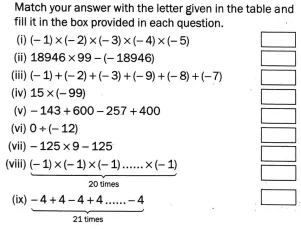
Answer(i) -120
(ii) 1894600
(iii) -30
(iv) -1485
(v) 600
(vi) 0
(vii) -1250
(viii) 1
(ix) -4
Name of the month SEPTEMBER
View full question & answer→Question 162 Marks
If $a^* b$ means $a \times b+2$ and $a \# b$ means $-a+b-(-3)$, then find the value of the following.
(i) $-4 ^* 3$
(ii) $(-3) ^*(-2)$
(iii) $(-7)$ # $(-3)$
(iv) $2 \# (-4)$
(v) $7 ^*(-5)$
(vi) $-7 * 2$ # $3$
Next, match these answers with suitable letters by looking at the table below and arrange them in increasing order of integers to decode the name of the Mathematician.| Integers | -9 | 14 | -3 | 4 | -10 | 8 | -33 | -21 | 7 | 18 |
| Letters | P | Y | C | T | U | I | E | G | L | D |
Answer(i) -10
(ii) 8
(iii) 7
(iv) -3
(v) -33
(vi) 18
Decoded name - EUCLID
View full question & answer→Question 172 Marks
Find the value of
(i) $26+[(-13) \div1]$
(ii) $[(-20)+5] \div[(-5)+2]$
(iii) $(46 \times 5 \times 0) \div4$
Answer(i) $26+[(-13) \div1]=26+(-13) \quad[\because(-a) \div1=(-a)]$
$=26-13=13$
(ii) $[(-20)+5] \div[(-5)+2]=[(-15)] \div[(-3)]$
$=\frac{-15}{-3}=\frac{15}{3}=5$
(iii) $(46 \times 5 \times 0) \div 4=0 \div 4 \quad[\because a \times 0=0]$
$=\frac{0}{4} \quad\left[\because \frac{0}{a}=0\right]=0$
View full question & answer→Question 182 Marks
Verify that $a \div(b+c) \neq(a \div b)+(a \div c)$ for each of the following values of $a, b$ and $c$.
(i) $a=24, b=-4, c=8$
(ii) $a=16, b=4, c=4$
Answer(i) $LHS =a \div(b+c)=24 \div(-4+8)=24 \div(4)=6$
$
\begin{aligned}
RHS & =(a \div b)+(a \div c)=[24 \div (-4)]+[24 \div8] \\
& =-(24 \div4)+(24 \div8)=-6+3=-3
\end{aligned}
$
$\because$ LHS $\neq$ RHS
Hence, $a \div(b+c) \neq(a \div b)+(a \div c)$
(ii)
$
\begin{array}{l}
LHS=a \div(b+c)=16 \div(4+4)=16 \div8=2 \\
RHS=(a \div b)+(a \div c)=(16 \div 4)+(16 \div 4)=4+4=8
\end{array}
$
$\because$ LHS $\neq$ RHS
Hence, $a\div(b+c) \neq(a \div b)+(a \div c)$
View full question & answer→Question 192 Marks
Find the value of
(i) $(25) \times 4+(-25) \times(-6)$
(ii) $-40 \times[136+(-36)]$
(iii) $-152 \times 97+152(-3)$
Answer(i) $(25) \times 4+(-25) \times(-6)$
$
\begin{array}{l}
=25 \times 4+25 \times 6 \quad[\because(-a) \times(-a)=a \times a] \\
=25 \times[4+6] \text { [using distributive property] } \\
=25 \times 10=250
\end{array}
$
(ii) $(-40) \times[136+(-36)]=(-40) \times(100)=-4000$
(iii) $-152 \times 97+152(-3)=152 \times(-97)+152 \times(-3)$ $[\because(-a) \times b=a \times(-b)]$
$=152 \times[(-97)+(-3)]$ [using distributive property]
$=152 \times[-100]=-15200$
View full question & answer→Question 202 Marks
Verify $(a \times b) \times c=a \times(b \times c)$ for the following values of $a, b$ and $c$.
(i) $a=12, b=13, c=19$
(ii) $a=-11, b=-12, c=-3$
Answer(i) Given, $a=12, b=13$ and $c=19$
On taking LHS,
$
(a \times b) \times c=(12 \times 13) \times 19=156 \times 19=2964
$
Now, on taking RHS,
$
a \times(b \times c)=12 \times(13 \times 19)=12 \times 247=2964
$
Hence, $(a \times b) \times c=a \times(b \times c)$
(ii) Given, $a=-11, b=-12$ and $c=-3$
On taking LHS,
$
\begin{aligned}
(a \times b) \times c & =[(-11) \times(-12)] \times(-3) \\
& =[(11 \times 12) \times(-3)]=132 \times(-3)=-396
\end{aligned}
$
Now, on taking RHS,
$
\begin{aligned}
a \times(b \times c) &=(-11) \times[(-12) \times(-3)] \\
& =(-11) \times[(12 \times 3)]=(-11) \times 36=-396
\end{aligned}
$
Hence, $(a \times b) \times c=a \times(b \times c)$
View full question & answer→Question 212 Marks
Verify $a+(b+c)=(a+b)+c$ for the following values of $a, b$ and $c$.
(i) $a=18, b=15, c=13$
(ii) $a=-31, b=51, c=89$
Answer(i) Given, $a=18, b=15$ and $c=13$
On taking LHS,
$
a+(b+c)=18+(15+13)=18+28=46
$
Now, on taking RHS,
$
\begin{array}{l}
(a+b)+c=(18+15)+13=33+13=46 \\
\text { Hence, } a+(b+c)=(a+b)+c
\end{array}
$
(ii) Given, $a=-31, b=51$ and $c=89$
On taking LHS,
$
a+(b+c)=-31+(51+89)=-31+140=109
$
Now, on taking RHS,
$
(a+b)+c=(-31+51)+89=20+89=109
$
Hence, $a+(b+c)=(a+b)+c$
View full question & answer→Question 222 Marks
Write a negative integer and a positive integer whose difference is +2 .
AnswerFor a negative integer and a positive integer whose difference is +2,
First integer $=1$ and second integer $=-1$
$
\therefore \quad 1-(-1)=1+1=2
$
View full question & answer→Question 232 Marks
Write down a pair of integers whose
(i) sum is $- 1 4$.
(ii) difference is $- 1 9$.
Answer(i) For a pair of integers, whose sum is -14 .
$
=(-21)+7=-14
$
(ii) For a pair of integers, whose difference is -19 .
$
=-12-7=-19
$
View full question & answer→