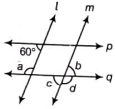
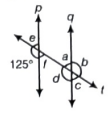
Try to identify a few transversals in your surroundings.
Answer
Examples of transversals from our surroundings are as follow: (i) A road crossing two or more roads. (ii) A railway line crossing several other lines. (iii) Grills of the window. (iv) A towel stand.
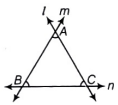
Find the measures of the angles made by the intersecting lines at the vertices of an equilateral triangle.
Answer
Let $\triangle A B C$ be an equilateral triangle. Since, all the angles of an equilateral triangle are equal. $ \therefore\angle A=\angle B=\angle C=x $ We know that sum of all the angles of a triangle is $180^{\circ}$. $ \begin{array}{rlrl} \therefore\angle A+\angle B+\angle C=180^{\circ} \\ \Rightarrow x+x+x=180^{\circ} \\ \Rightarrow 3 x=180^{\circ} \\ \Rightarrow x=\frac{180^{\circ}}{3}=60^{\circ} \end{array} $ Hence, $\angle A=\angle B=\angle C=60^{\circ}$
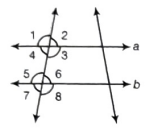
State the property that is used in each of the following statements. (i) If $a \| b$, then $\angle 1=\angle 5$. (ii) If $\angle 4=\angle 6$, then $a \| b$. (iii) If $\angle 4+\angle 5=180^{\circ}$, then $a \| b$.
Answer
(i) We have if $a \| b$, then $\angle1=\angle 5$. If a transversal intersects two parallel lines, then the corresponding angles are equal. $\therefore$ By corresponding angles property, it is true. (ii) We have if $\angle 4=\angle 6$, then $a \| b$. If a transversal intersects two parallel lines, then the alternate interior angles are equal. $\therefore$ By alternate interior angles property, it is true. (iii) We have if $\angle 4+\angle 5=180^{\circ}$, then $a \| b$. If a transversal intersects two parallel lines, then the interior angles on the same side of the transversal are supplementary.
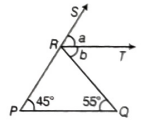
In the following figure, $P Q \| R T$. Find the value of $a+b$
Answer
Since, $P Q \| R T$ and $R Q$ is a transversal. $\angle R P Q$ and $\angle a$ are corresponding angles. $ \begin{aligned} \therefore\angle R P Q=\angle a\\ \Rightarrow\angle a =45^{\circ} \end{aligned} $ Also, $\angle b$ and $\angle R Q P$ are alternate angles. $ \therefore \angle b=55^{\circ} $ Hence, $\angle a+\angle b=45^{\circ}+55^{\circ}=100^{\circ}$
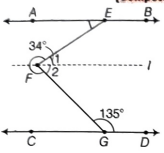
In the given figure, $A B \| C D$ Find the reflex of $\angle E F G$.
Answer
$\begin{array})\text{Given,}\angle 1 =34^{\circ}\\ \angle A E F=34^{\circ} & \text { [alternate angles] } \\ \because\angle F G D=135^{\circ} \\ \therefore \angle 2+135^{\circ}=180^{\circ} \end{array} $ [sum of pair of cointerior angles is $180^{\circ}$ ] $ \begin{array}{ll} \Rightarrow\angle 2=180^{\circ}-135^{\circ} \\ \Rightarrow \angle 2=45^{\circ} \end{array} $ $ \Rightarrow \angle1+\angle 2=34^{\circ}+45^{\circ}=79^{\circ} $ Reflex of $\angle E F G=360^{\circ}-79^{\circ}=281^{\circ}$ [since, reflex angle is less than $360^{\circ}$ and more than $180^{\circ}$]
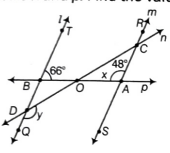
In the given figure, two parallel lines $l$ and $m$ are cut by two transversals $n$ and $p$. Find the value of $x$ and $y$.
Answer
Given, $l \| m, n$ and $p$ are transversals, $\angle T B O=66^{\circ}$. $ \begin{array}{lc} \therefore\angle T B O+\angle x=180^{\circ} \\ {\left[\because l \| m \text { and cointerior angles has a sum of } 180^{\circ}\right]} \\ \Rightarrow\angle x=180^{\circ}-66^{\circ}=114^{\circ} \\ \because \angle O C A=\angle B D O \end{array} $ [alternate angles formed by transversal $m$ are equal] $ \begin{array}{ll} \because \angle O C A=48^{\circ} \\ \text { So, } \angle B D O=48^{\circ} \text { [alternate interior angles] } \end{array} $ $ \because \angle B D O+\angle Q D O=180^{\circ}\text { [linear pair] } $ $ \Rightarrow 48^{\circ}+\angle y=180^{\circ} $ $ \Rightarrow \angle y=180^{\circ}-48^{\circ}=132^{\circ} $
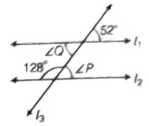
Since, lines $l_1$ and $l_2$ are parallel to each other, where $l_3$ is transversal. $\therefore \angle Q$ and $\angle 52^{\circ}$ are vertically opposite angles. So, $\angle Q=52^{\circ}$ Also, angles $128^{\circ}$ and $\angle P$ form a linear pair angles. So, $128^{\circ}+\angle P=180^{\circ}$ $ \Rightarrow \angle P=180^{\circ}-128^{\circ} \Rightarrow \angle P=52^{\circ} $
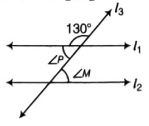
In the following figure, $I_1 \| I_2$. Find the value of $\angle M$.
Answer
Since, lines $l_1$ and $l_2$ are parallel to each other, where $l_3$ is transversal. $\therefore \angle P$ and $\angle 130^{\circ}$ form a linear pair angles. So, $ \angle P+130^{\circ}=180^{\circ}$ $ \Rightarrow \angle P=180^{\circ}-130^{\circ} \Rightarrow \angle P=50^{\circ} $ Also, $\angle P$ and $\angle M$ are alternate interior angles. $ \angle M=\angle P=50^{\circ} $
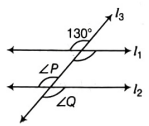
In the following figure, $I_1 \| I_2$. Find the value of $\angle P$ and $\angle Q$.
Answer
Since, lines $l_1$ and $l_2$ are parallel to each other, where $l_3$ is transversal. $\therefore \angle 130^{\circ}$ and $\angle P$ are corresponding angles. So, $ \angle P=130^{\circ}$ Also, $\angle P$ and $\angle Q$ are vertically opposite angles . So, $ \angle Q=\angle P=130^{\circ} \Rightarrow \angle Q=130^{\circ}$
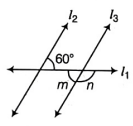
In the following figure, $I_2 \| I_3$. Find the value of $\angle m$ and $\angle n$.
Answer
Since, lines $I_2$ and $l_3$ are parallel to each other, where $l_1$ is transversal. $\therefore \angle 60^{\circ}$ and $m$ are alternate interior angles. So, $m=60^{\circ}$ Also, angles $m$ and $n$ form a linear pair angles. So, $m+n=180^{\circ} \Rightarrow 60^{\circ}+n=180^{\circ}$ $\Rightarrow n=180^{\circ}-60^{\circ}$ $\Rightarrow n=120^{\circ}$
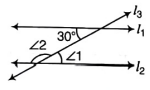
In the following figure, $I_1 \| I_2$. Find the value of $\angle 1$ and $\angle 2$ :
Answer
Since, line $l_1$ is parallel to the line $l_2$, where line $l_3$ is transversal and $\angle 30^{\circ}$ and $\angle 1$ are alternate interior angles. So, $ \angle 1=30^{\circ}$ Also, $\angle 1$ and $\angle 2$ form a linear pair angles. So, $\angle 1+\angle 2=180^{\circ} \Rightarrow 30^{\circ}+\angle 2=180^{\circ}$ $ \Rightarrow \angle 2=180^{\circ}-30^{\circ} \Rightarrow \angle 2=150^{\circ} $