Questions

1 Marks Question

Take a timed test

18 questions · self-marked practice — reveal the answer and mark yourself.

Question 11 Mark
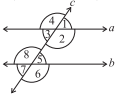
In the adjoining figure, the vertically opposite angles are:
Answer
From the given figure, we can easily see that
Pairs of vertically opposite angles are:
$\angle 1 $ and $ \angle 3$
$ \angle 2 $ and $ \angle 4$
$ \angle 5 $ and $ \angle 7$
$ \angle 6 $ and $ \angle 8$
View full question & answer
Question 21 Mark
In the adjoining figure, write the pairs of interior angles on the same side of the transversal.
Answer
From the given figure,
Pairs of alternate interior angles on the same side of the transversal are as follows:
$\angle 2$ and $\angle 5$
$\angle 3$ and $\angle 8$
View full question & answer
Question 31 Mark
In the adjoining figure,the pairs of alternate interior angles.
Answer
From the above given figure, we see that
the Pairs of alternate interior angles are:
$\angle 2$ and $ \angle 8$
$\angle 3$ and $ \angle 5$
View full question & answer
Question 41 Mark
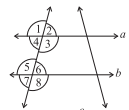
In the adjoining figure, identify the pairs of corresponding angles.
Answer
From the given figure, we can see that
Pairs of corresponding angles are as follows:
$​ \angle 1 $ and $ \angle ​5$
​$ \angle 2 $ and $ \angle ​6$
​$ \angle 3 $ and $ \angle ​7$
​$ \angle 4 $ and $ \angle ​8$
View full question & answer
Question 51 Mark
State the property that is used in the statement: If $\angle4 + \angle5 = 180^\circ $, then $a \| b.$
Answer
From the above-given figure, it is clear that,
$\angle 4 + \angle 5 = 180^{\circ}$
Because, we know that the interior angles on the same side of the transversal are supplementary.
View full question & answer
Question 61 Mark
State the property that is used in the statement: If $\angle 4 = \angle 6$, then $a \| b.$
Answer
From the above-given figure, it is clear that,
$\angle 4 = \angle 6$
This is because of the pair follows alternate interior angle property.
View full question & answer
Question 71 Mark
State the property that is used in the statement: If $a \| b$, then $\angle 1 = \angle 5$​​​​​​​
Answer
From the above-given figure, it is clear that,
$\angle 1 = \angle 5$
This is because a is parallel to b and $\angle 1$ and $\angle 5$ form a corresponding pair of angles.
Hence, these angles are equal due to the corresponding angle property.
View full question & answer
Question 81 Mark
Identify whether the pair of angles are complementary or supplementary: $112^\circ , 68^\circ $
Answer
Here, Sum of the measures of the given angles = $112^{\circ}+68^{\circ}=180^{\circ}$
As the sum of these angles is equal to $180^{\circ}$
Therefore,
These angles are supplementary angles.
View full question & answer
Question 91 Mark
Identify whether the pair of angles are complementary or supplementary: $65^\circ , 115^\circ $
Answer
Since, sum of the measures of the given angles = $115^{\circ}+65^{\circ}=180^{\circ}$
Therefore, These angles are supplementary angles.
View full question & answer
Question 101 Mark
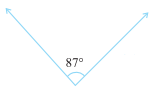
Find the supplement of angle:
Answer
We know that,
Sum of measures of supplementary angles is $180^{\circ}$
It is given in the question that,
One of the angle $=154^{\circ}$
Therefore, its supplement $=180^{\circ}-154^{\circ}=26^{\circ}$
View full question & answer
Question 111 Mark
Find the supplement of the angle:
Answer
We know that,
Sum of measures of supplementary angles is $180^{\circ}$
One of the angle $=87^{\circ}$
Therefore, its supplement $=180^{\circ}-87^{\circ}=93^{\circ}$
View full question & answer
Question 121 Mark
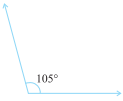
Find the supplement of angle:
Answer
We know that,
Sum of measures of supplementary angles is $180^{\circ}$
One of the angle $=105^{\circ}$
Therefore, its supplement $=180^{\circ}-105^{\circ}=75^{\circ}$
View full question & answer
Question 131 Mark
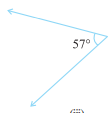
Find the complement of angle:
Answer
We know that,
Sum of measures of complementary angles is $90^{\circ}$
One of the angle $=57^{\circ}$
Therefore, its complement $=90^{\circ}-57^{\circ}=33^{\circ}$
View full question & answer
Question 141 Mark
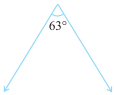
Find the complement of angle:
Answer
We know that,
Sum of measures of complementary angles is $90^{\circ}$
One of the angle $=63^{\circ}$
Therefore, its complement $=90^{\circ}-63^{\circ}=27^{\circ}$
View full question & answer
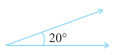
Question 151 Mark
Find the complement of angle:
Answer
We know that,
Sum of measures of complementary angles is $90^{\circ}$
One of the angles $=20^{\circ}$
Therefore, Complement $=90^{\circ}-20^{\circ}=70^{\circ}$
View full question & answer
Question 161 Mark
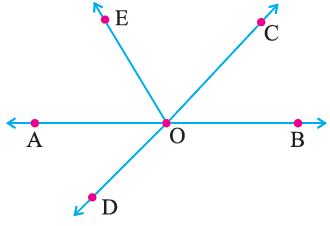
In the given figure identify
Two pairs of vertically opposite angles.
Answer
The two pairs of vertically opposite angles are:
$( \angle COB, \angle AOD)$, and $( \angle AOC, \angle BOD)$
View full question & answer
Question 171 Mark
In the given figure identify

Three linear pairs.
Answer
Three linear pairs of angles in the above figure are:
$(\angle AOE, \angle EOB), (\angle AOC, \angle COB), (\angle COB, \angle BOD)$
View full question & answer
Question 181 Mark
In the given figure identify Five pairs of adjacent angles.
Answer
Five pairs of adjacent angles in the above given figure are:
$(\angle AOE, \angle EOC), (\angle EOC, \angle COB), (\angle AOC, \angle COB), (\angle COB, \angle BOD), (\angle EOB, \angle BOD)$
View full question & answer