Question 13 Marks
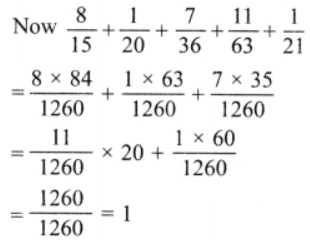
Here is a problem posed by the ancient Indian Mathematician Mahaviracharya (850 C.E.). Add together $\frac{8}{15}, \frac{1}{20}, \frac{7}{36}, \frac{11}{63}$ and $\frac{1}{21}$ What do you get? How can we find this sum efficiently?
Answer
View full question & answer→Here $\frac{8}{15}, \frac{1}{20}, \frac{7}{36}, \frac{11}{63}, \frac{1}{21}$
Now 15 = 3 × 5
20 = 2 × 2 × 5
36 = 2 × 2 × 3 × 3
63 = 3 × 3 × 7
21 = 3 × 7
LCM of denominators = 2 × 2 × 3 × 3 × 5 × 7
= 4 × 9 × 5 × 7
= 1260
Now 15 = 3 × 5
20 = 2 × 2 × 5
36 = 2 × 2 × 3 × 3
63 = 3 × 3 × 7
21 = 3 × 7
LCM of denominators = 2 × 2 × 3 × 3 × 5 × 7
= 4 × 9 × 5 × 7
= 1260