Questions

2 Marks Questions

🎯

Test yourself on this topic

32 questions · timed · auto-graded

Question 12 Marks
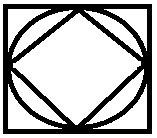
In the adjoining figure,
(i) which square has the larger perimeter?
(ii) which is larger, perimeter of smaller square or the circumference of the circle?
Image
Answer
(i) From the given figure, it is clear that outer square has the larger perimeter.
(ii) From the given figure, it is clear that circumference of the circle is larger than the perimeter of the smaller square because smaller square lies in the circle.
View full question & answer
Question 22 Marks
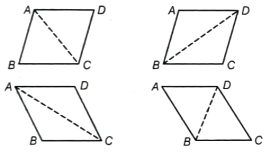
Take different parallelograms. Divide each of the parallelograms into two triangles by cutting along any of its diagonals. Are the triangles congruent?
Answer
Here, $A B C D$ is the given parallelogram and each of the parallelogram is divided into two triangles by cutting along its diagonal $B D$ or $A C$. Thus, the triangles formed are congruent.
Image
View full question & answer
Question 32 Marks
The minute hand of a circular clock is 15 cm long. How far does the tip of the minute hand move in 1 h ? (take $\pi=3.14$ )
TIPS Given, length of the minute hand of a circular clock $=15 cm$. We know that minute hand moves in a circular path, so radius of the circular path formed by minute hand $=15 cm$.
Answer
In 1 h i.e. 60 min , minute hand of the clock complete 1 rotation.
Distance covered by tip of minute hand in 1 h
$=$ Circumference of circular path formed by minute hand
$=2 \pi r=2 \times 3.14 \times 15=94.2$
Hence, the tip of the minute hand moves 94.2 cm in 1 h.
View full question & answer
Question 42 Marks
How many times a wheel of radius 28 cm must rotate to go 352 m ? $\left(\right.$ take $\left.\pi=\frac{22}{7}\right)$
TIPS Firstly, find the circumference of the wheel which gives distance covered by wheel in one rotation. Then, find the number of rotations on dividing total distance by distance covered in one rotation.
Answer
Given, radius of the wheel $=28 cm$
$\therefore$ Circumference of the wheel $=2 \pi r=2 \times \frac{22}{7} \times 28$
$=176 cm$
and thus, distance covered by wheel in one rotation $=\text { Circumference of wheel }=176 cm$
Total distance $=352 m=352 \times 100 cm\quad$ $[\because 1 m=100 cm]$
$\therefore$ Number of rotations taken to cover 352 m
$=\frac{352 \times 100}{176}=2 \times 100=200$
Hence, the required number of rotations made by wheel is 200.
View full question & answer
Question 52 Marks
Find the circumference of the inner and the outer circles, shown in the following figure? (take $\pi=3.14)$
Image
Answer
Given, radius of the outer circle, $R=19 m$ and width of circular path $=10 m$
$\therefore$ Radius of inner circle, $r=(19-10)=9 m$
Now, circumference of inner circle $=2 \pi r$
$\begin{array}{l}=2 \times 3.14 \times(9) \\ =3.14 \times 18 \\ =56.52 m\end{array}$
$\therefore$ Circumference of outer circle $=2 \pi R$
$\begin{array}{l}=2 \times 3.14 \times 19 \\ =119.32 m\end{array}$
Hence, the circumferences of the inner circle and outer circle are 56.52 m and 119.32 m .
View full question & answer
Question 62 Marks
A circular flower garden has an area of $314 m^2$. A sprinkler at the centre of the garden can cover an area that has a radius of $1 2 ~ m$. Will the sprinkler water the entire garden? (take $\pi=3.14$ )
TIPS Firstly, find the area of circular part that sprinkler can cover by using area $=\pi$ (radius) ${ }^2$. Then, if this area is larger than area of garden, then sprinkler can water the entire garden, otherwise not.
Answer
Given, radius of the circular part cover by sprinkler water $=12 cm$
$\therefore$ Area of the circular part cover by sprinkler water
$\begin{array}{l}=\pi r^2=3.14 \times(12)^2=3.14 \times 12 \times 12 \\=452.16 m^2\end{array}$
$\therefore$ Area of circular flower garden $=314 m^2$
Since, the area of the circular part cover by sprinkler water is greater than area of circular flower garden.
So, the sprinkler can water the entire garden.
View full question & answer
Question 72 Marks
The circumference of a circle is 31.4 cm . Find the radius and the area of the circle? (take $\pi=3.14$ )
Answer
Given, circumference of a circle $=31.4 cm$
Let $r$ be the radius of the circle.
$\begin{array}{l}\Rightarrow \quad 2 \pi r=31.4 \\\Rightarrow \quad 2 \times 3.14 r=31.4 \\\Rightarrow \quad =\frac{314 \times 100}{2 \times 314 \times 10}=\frac{10}{2}=5 cm \\\therefore \text { Area of the circle }=\pi r^2 \\=3.14 \times(5)^2 \\=3.14 \times 25=78.5\end{array}$
Hence, the radius and the area of the circle are 5 cm and $78.5 cm^2$.
View full question & answer
Question 82 Marks
A circle of radius 2 cm is cut out from a square piece of an aluminium sheet of side 6 cm. What is the area of the left over aluminium sheet? (take $\pi=3.14$ )
Answer
Given, side of square piece of an aluminium sheet $=6 cm$
$\therefore$ Area of square piece of an aluminium sheet
$
=(\text { Side })^2=(6)^2=6 \times 6=36 cm^2
$
Also, radius of the cut-out circle, $r=2 cm\qquad$[given]
$\therefore$ Area of cut-out circle $=\pi r^2=3.14 \times(2)^2$
$
=3.14 \times 4=12.56 cm^2
$
Now, area of left over aluminium sheet
$=$ Area of square piece of an aluminium sheet $-$ Area of cut-out circle
$
\begin{array}{l}
=36-12.56 \\
=23.44
\end{array}
$
Hence, the required area of the aluminium sheet is $23.44 cm^2$.
View full question & answer
Question 92 Marks
Find the cost of pollshing a circular table top of diameter 1.6 m, if the rate of polishing is ₹ $15$ per m2. (take $\pi=3.14$ )
Answer
Given, diameter of the circular table top $=1.6 m$
Then, radius of the circular table top $=\frac{1.6}{2}=0.8 m$
$\therefore$ Area of the circular table top $=\pi r^2=3.14 \times(0.8 m)^2$
$\begin{array}{l}=3.14 \times 0.8 \times 0.8 \\ =2.0096 m^2\end{array}$
Now, cost of polishing 1 sq $m=$ ₹ $ 15$
$\therefore$ Cost of polishing $2.0096 m^2=$ ₹ $(15 \times 2.0096)=$ ₹ $ 30.144$
= $ 30.14$ (approx.)
Hence, the cost of polishing the circular table top at the rate of ₹ 15 per sq $m$ is $$ ₹ $ 30.14$ (approx.).
View full question & answer
Question 102 Marks
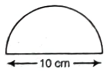
Find the perimeter of the adjoining figure which is a semi-circle including its diameter. (take $\pi=3.14$ )
Image
Answer
Given, diameter of a semi-circle $=10 cm$
$\therefore$ Radius of a semi-circle $=\frac{10}{2}=5 cm$
Now, circumference of semi-circle $=\pi r=3.14 \times 5=15.7 cm$
$\therefore$ Perimeter of the given figure $=$ Circumference of a semi-circle $+$ Diameter of a semi-circle
$=$ 15.7 $+$ 10 $=$ 25.7
Hence, the perimeter of given figure is 25.7 cm.
View full question & answer
Question 112 Marks
Saima wants to put a lace on the edge of a circular table cover of diameter 1.5 m . Find the length of the lace required and also find its cost, if one metre of the lace costs ₹ 15 . (take $\pi=3.14$ )
Answer
Given, diameter of a circular table cover $(d)=1.5 m$
$\therefore$ Length of the lace required
$
\begin{array}{l}
=\text { Circumference of circular table cover } \\
=\pi \times d=3.14 \times 1.5 m=4.71 m
\end{array}
$
$\because$ Cost of 1 m of lace $=$₹$ 15$
$\therefore$ Cost of 4.71 m of lace $=$₹$(15 \times 4.71)=$₹$ 70.65$
Hence, the length of the lace required is 4.71 m and cost of the lace is $$₹$ 70.65$.
View full question & answer
Question 122 Marks
From a circular sheet of radius 4 cm , a circle of radius 3 cm is removed. Find the area of the remaining sheet. (take $\pi=3.14$ )
Image
Answer
Given, radius of a circular sheet (outer circle), $R=4 cm$ and radius of removed circular sheet (inner circle), $r=3 cm$
We know that
Area of a circle $=\pi \times$ (Radius)$^2$
$\therefore$ Area of circular sheet of radius $4 cm=\pi \times(4)^2$
$
=3.14 \times 16=50.24 cm^2
$
and area of circular sheet of radius 3 cm
$
=\pi \times(3)^2=3.14 \times 9=28.26 cm^2
$
$\therefore$ Area of remaining sheet
$
\begin{aligned}
= & \text { Area of circular sheet of radius } 4 cm - \text { Area of circular sheet of radius } 3 cm \\
= & 50.24-28.26=21.98
\end{aligned}
$
Hence, the area of the remaining sheet is $21.98 cm^2$.
View full question & answer
Question 132 Marks
A gardener wants to fence a circular garden of diameter 21 m . Find the length of the rope he needs to purchase, If he makes 2 rounds of fence. Also, find the cost of the rope, if it costs ₹ 4 per m. $\left(\text {take } \pi=\frac{22}{7}\right)$
Answer
Given, diameter of the circular garden $=21 m$
$\therefore$ Circumference of the circular garden $=\pi d$
$=\frac{22}{7} \times 21=66 m$
$\because$ Length of the rope needed to make one round of fence $=$ Circumference of the circular garden $=66 m$
$\therefore$ Length of the rope needed to make two rounds of fence $=2 \times 66=132 m$
Now, cost of 1 m rope $=$ ₹ $4$
$\therefore$ Cost of 132 m rope $=$ ₹ $(4 \times 132)=$ ₹ $528$
Hence, the cost of the rope is ₹ 528.
View full question & answer
Question 142 Marks
If the circumference of a circular sheet is 154 m , then find its radius. Also, find the area of the sheet. $\left(\text { take } \pi=\frac{22}{7}\right)$
Answer
Given, circumference of a circular sheet $=154 m$
$
\begin{array}{ll}
\Rightarrow & 2 \pi r=154 \Rightarrow 2 \times \frac{22}{7} \times r=154 \\
\Rightarrow & r=\frac{154 \times 7}{2 \times 22}=\frac{49}{2} m
\end{array}
$
Now, area of the circular sheet $=\pi r^2$
$
\begin{array}{l}
=\frac{22}{7} \times \frac{49}{2} \times \frac{49}{2} \\
=\frac{154 \times 49}{4} \\
=\frac{7546}{4} \\
=1886.5 m^2
\end{array}
$
Hence, the radius and area of the circular sheet are $49 / 2 m$ and $1886.5 m^2$ respectively.
View full question & answer
Question 152 Marks
Find the circumference of the circles with the following radius. (take $\pi=\frac{22}{7}$ )
(i) 14 cm
(ii) 28 mm
(iii) 21 cm
Answer
(i) Given, radius of the circle $(r)=14 cm$
$\therefore$ Circumference of the circle
$ =2 \pi r=2 \times \frac{22}{7} \times 14 cm \\
=88 cm $
(ii) 176 mm
(iii) 132 cm
View full question & answer
Question 162 Marks
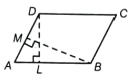
DL and BM are the heights on sides $A B$ and $A D$ respectively of parallelogram $A B C D$ (in the given figure). If the area of the parallelogram is $1470 cm^2$ $A B=35 cm$ and $A D=49 cm$, then find the length of BM and DL.
Image
Answer
Given, $A B=35 cm, A D=49 cm$ and area of a parallelogram $A B C D=1470 cm^2$. When $A D$ is base, then height is $B M$.
$
\begin{array}{l}
\therefore \text { Area of a parallelogram }=A D \times B M \\
\Rightarrow \quad 1470=49 \times B M \\
\Rightarrow \quad B M=\frac{1470}{49}=30 cm
\end{array}
$
When $A B$ is base, then height is $D L$.
$
\begin{array}{lc}
\therefore & \text { Area of parallelogram }=A B \times D L \\
\Rightarrow & 1470=35 \times D L \\
\Rightarrow & D L=\frac{1470}{35}=42 cm
\end{array}
$
Hence, the lengths of $B M$ and $D L$ are 30 cm and 42 cm .
View full question & answer
Question 172 Marks
Answer
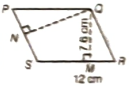
Here, $P Q R S$ is a parallelogram.
(i) Given, base $(S R)=12 cm$
and height $(Q M)=7.6 cm$
$\therefore$ Area of the parallelogram $P Q R S$
$\begin{array}{l}=\text { Base }(S R) \times \text { Height }(Q M) \\ =12 \times 7.6=91.2 cm^2\end{array}$
(ii) If base $(P S)=8 cm$ and height $=Q N$, then
Area of the parallelogram $=91.2 cm^2\quad$ [since, parallelogram is same in position]
$\begin{array}{lrl}\Rightarrow & P S \times Q N & =91.2 \\ \Rightarrow & 8 \times Q N & =91.2 \\ \therefore & Q N & =\frac{91.2 cm^2}{8 cm}=11.4 cm\end{array}$
View full question & answer
Question 182 Marks
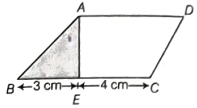
In the given figure, find the area of parallelogram $A B C D$, if the area of shaded triangle is $9 cm^2$.
Image
Answer
$\text {Given, area of shaded triangle}=9 \text{ cm}^2 $
$\text {and base of the triangle}=3 \text{ cm} $
$\because \text {Area of a triangle}=\frac{1}{2} \times \text {Base} \times \text {Height} $
$\Rightarrow 9=\frac{1}{2} \times 3 \times h \Rightarrow \frac{18}{3}=h \Rightarrow h=6 \text{ cm} $
$\because \text {Area of parallelogram}=\text {Height} \times \text {Base of parallelogram} $
$=6 \text{ cm} \times(3+4) \text{ cm} $
$=6 \text{ cm} \times 7 \text{ cm}=42 \text{ cm}^2$
View full question & answer
Question 192 Marks
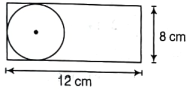
Find the area of circle with maximum radius that can be inscribed in the rectangle of length 12 cm and breadth 8 cm .
Answer
From the figure, diameter of largest circle that can be inscribed in the rectangle is equal to its breadth.
Image
Diameter of circle $=8 cm$
Radius of circle $=4 cm$
$\therefore$ Area of the circle $=\pi r^2=\frac{22}{7} \times 4 \times 4=50.28 cm^2$
View full question & answer
Question 212 Marks
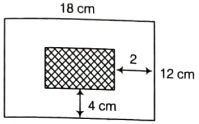
In the following figure, find the area of shaded portion.
Image
Answer
$\because$ Breadth of outer figure $=12 cm$
Breadth of inner figure $=12-4-4=4 cm$
Length of outer figure $=18 cm$
Length of inner figure $=18-4=14 cm$
So, area of inner shaded figure $=14 \times 4=56 cm^2$
View full question & answer
Question 222 Marks
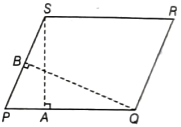
In the adjoining figure of parallelogram,
$S P=7 cm \text { and } B Q=21 cm$
Then, find
(i) the area of parallelogram PQRS.
(ii) $A S$, if $P Q=49 cm$
Image
Answer
When base $=S P=7 \text{ cm},$
then height $=B Q=21 \text{ cm}$
(i) Therefore, area of parallelogram $=S P \times B Q$
$=7 \times 21=147 \text{ cm}^2$
(ii) $\because$ Area of parallelogram $P Q R S=P Q \times A S$
$147=49 \times A S$
$\Rightarrow$ $A S=\frac{147}{49}=3 \text{ cm}$
View full question & answer
Question 232 Marks
Find the cost of painting a circular slogan of diameter 21 cm , If rate of painting is ₹ $20/m ^2$.
Answer
Diameter of circular slogan $(d)=21 cm$
Radius $(r)=\frac{d}{2}=\frac{21}{2} cm$
$\therefore$ Area of slogan $=\pi r^2=\frac{22}{7} \times\left(\frac{21}{2}\right)^2$
Cost of painting for $1 m^2=$ ₹ $ 20$
Cost of painting for circular slogan $=20 \times \frac{22}{7} \times\left(\frac{21}{2}\right)^2$
$=20 \times \frac{22}{7} \times \frac{21}{2} \times \frac{21}{2}=$ ₹ $ 6930$
Hence, the cost of painting is $$ ₹ $ 6930.$
View full question & answer
Question 242 Marks
If the circumference of a circular sheet is 154 m , then find its diameter.
Answer
Given, circumference of the circular sheet $=154 m$
$\because$ Circumference of a circular sheet $=2 \pi r$
$\Rightarrow \qquad 154=2 \pi r$
$\Rightarrow \quad r=\frac{154}{2 \pi}=\frac{154 \times 7}{2 \times 22}=\frac{7 \times 7}{2}=\frac{49}{2} m$
$\therefore \quad$ Diameter $=2 \times$ Radius $=2 \times \frac{49}{2}=49 m$
View full question & answer
Question 252 Marks
Find the area of a circle, if its circumference is 440 cm .
Answer
Given, circumference of the circle $=440 cm$
$\because$ Circumference of a circle $=2 \pi r$
$
\Rightarrow \quad 2 \pi r=440 \Rightarrow r=\frac{440}{2 \pi}=\frac{220}{\pi}
$
$\therefore \quad$ Area of the circle $=\pi r^2=\pi \times\left(\frac{220}{\pi}\right)^2$
$\begin{array}{l}=\frac{220 \times 220}{\pi}=\frac{48400}{\pi} \\ =48400 \times \frac{7}{22} \\ =2200 \times 7=15400 cm^2\end{array}$
View full question & answer
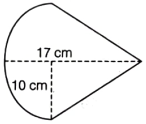
Question 262 Marks
Find the area of the closed region.
Image
Answer
$\begin{array}{l}\text { Area of enclosed region }=\text { Area of semi-circle } + \text { Area of triangle }\end{array}$
$\begin{array}{l}\text { Area of semi-circle }=\frac{1}{2} \times \pi r^2=\frac{1}{2} \times \frac{22}{7} \times 10 cm \times 10 cm \\ \text { Area of triangle }=\frac{1}{2} \times \text { Base } \times \text { Height }\end{array}$
$=\frac{1}{2} \times(10+10) \times(17-10)=\frac{1}{2} \times 20 \times 7$
$\therefore$ Area of enclosed region
$
\begin{array}{l}
=\frac{1}{2} \times \frac{22}{7} \times 10 \times 10+\frac{1}{2} \times 20 \times 7 \\
=\frac{11 \times 10 \times 10}{7}+10 \times 7=227.14 cm^2
\end{array}
$
View full question & answer
Question 272 Marks
The area of a triangular field is 2.5 hec. If its base is 500 m , then find the corresponding height.
Answer
Given, area of a triangular field $=2.5 hec$
We know that $1 hec =10000 m^2$
$
\begin{array}{l}
\text { So, } \quad 2.5 hec=2.5 \times 10000=25000 m^2 \\
\text { Area of a triangle }=\frac{1}{2} \times b \times h \\
\Rightarrow \quad 25000 m^2=\frac{1}{2} \times 500 \times h \qquad [\because base (b)=500 m, given ]
\end{array}
$
$\begin{array}{l}\Rightarrow \quad \frac{25000 \times 2}{500} m=h \Rightarrow 50 \times 2 m=h \\ \therefore \quad h=100 m\end{array}$
View full question & answer
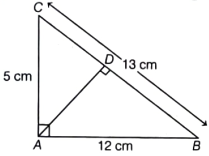
Question 282 Marks
$\triangle A B C$ is right angled at $A$. Shown in figure. Find $A D$.
Image
Answer
In $\triangle A B C$, when base $=A B=12 cm$, then height $h=A C=5 cm$
$\text{Area of}~\triangle A B C =\frac{1}{2} \times A B \times A C $
$ =\frac{1}{2} \times 12 \times 5=30 cm^2$
When base $=B C=13 cm$, then height $=A D$
$\therefore \text { Area of } \triangle A B C =\frac{1}{2} \times B C \times A D $
$30 =\frac{1}{2} \times 13 \times A D $
$\Rightarrow A D=\frac{2 \times 30}{13} =4.62 cm.$
View full question & answer
Question 292 Marks
Find the area of triangle whose base is 6 cm and each equal sides are 5 cm and height 4 cm .
Answer
Given, base $(b)=6 cm$ and height $(h)=4 cm$
$\therefore \quad$ Area of a triangle $=\frac{1}{2} \times b \times h$
$=\frac{1}{2} \times 6 \times 4=12 cm^2$
View full question & answer
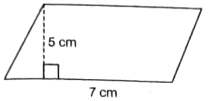
Question 302 Marks
In the following figure, find the area of the parallelogram.
Image
Answer
Here, base $=7 cm$ and height $=5 cm$
$\therefore \quad$ Area of the parallelogram $=$ Base $\times$ Height
$=7 \times 5=35 cm^2$
View full question & answer
Question 312 Marks
Find the area of parallelogram whose base is 8 m and altitude is 4 m .
Answer
Given, base $(b)=8 m$ and altitude $(h)=4 m$
Area of parallelogram $=8 \times 4=32 m^2$
View full question & answer
Question 322 Marks
Find the perimeter of semi-circle of diameter 14 cm .
Answer
Diameter $(d)=14 cm$
Radius of circle $(r)=\frac{d}{2}=\frac{14}{2}=7 cm$
Perimeter of semi-circle $=\frac{1}{2}(2 \pi r)+d$
$
\begin{array}{l}
=\frac{1}{2} \times 2 \times \frac{22}{7} \times 7+14 \\
=22+14=36 cm
\end{array}
$
View full question & answer
2 Marks Questions - MATHS STD 7 Questions - Vidyadip