Questions

3 Marks Question

🎯

Test yourself on this topic

11 questions · timed · auto-graded

Question 13 Marks
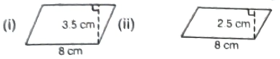
Find the area of the following parallelograms
Image
(iii) In a parallelogram $A B C D, A B=7.2 cm$ and the perpendicular from $C$ on $A B$ is 4.5 cm.
Answer
(i) Here, base $=8 cm$ and height $=3.5 cm$
$\therefore$ Area of the parallelogram $=$ Base $\times$ Height
$
=8 \times 3.5=28 cm^2
$
(ii) Here, base $=8 cm$ and height $=2.5 cm$
$\therefore$ Area of the parallelogram $=$ Base $\times$ Height
$
=8 \times 2.5=20 cm^2
$
(iii) Given, base of the parallelogram $A B C D, A B=7.2 cm$ and length of the perpendicular from $C$ on $A B$
$
=4.5 cm
$
$\therefore$ Area of the parallelogram $=$ Base $\times$ Height
$
=7.2 \times 4.5=32.4 cm^2
$
View full question & answer
Question 23 Marks
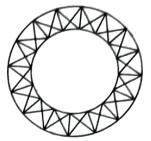
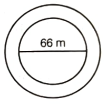
A circular flower bed is surrounded by a path 4 m wide. The diameter of the flower bed is 66 m . What is the area of this path? (take $\pi=3.14$ )
Image
Answer
Given, diameter of the flower bed $=66 m$
Let $r$ be the radius of circular flower bed.
Then, radius of the flower bed $=\frac{\text { Diameter }}{2}=\frac{66}{2}=33 m$
$\therefore$ Area of the flower bed $=\pi r^2$
$
=3.14 \times 33 \times 33=3419.46 m^2
$
Since, the path is 4 m wide.
$\therefore$ Radius of circular flower bed with path
$
=33+4=37 m
$
$\therefore$ Area of circular flower bed with path
$
\begin{array}{l}
=3.14 \times 37 \times 37 \\
=4298.66 m^2
\end{array}
$
Now, area of path = Area of circular flower bed with path - Area of circular flower bed
$
\begin{array}{l}
=4298.66-3419.46 \\
=879.2
\end{array}
$
Hence, the area of the path is $879.2 m^2$.
View full question & answer
Question 33 Marks
Shazli took a wire of length 44 cm and bent it into the shape of a circle. Find the radius of that circle. Also, find its area. If the same wire is bent into the shape of a square, what will be the length of each of its sides? Which figure encloses more area, the circle or the square? $\left(\right.$ take $\left.\pi=\frac{22}{7}\right)$
Answer
Let $r$ be the radius of the circle.
Here, length of the wire is 44 cm , which is bent into the shape of a circle.
$\therefore$ Circumference of circle $=$ Length of wire
$
\begin{array}{l}
\Rightarrow \quad 2 \pi r=44 cm \Rightarrow 2 \times \frac{22}{7} \times r=44 cm \\
\Rightarrow \quad r=\frac{44 \times 7}{2 \times 22}=\frac{44 \times 7}{44}=7 cm
\end{array}
$
$\therefore$ Area of the circle $=\pi r^2=\frac{22}{7} \times 7 \times 7=154 cm^2$
Also, this wire is bent into the shape of a square.
$\therefore$ Perimeter of a square $=$ Length of wire
$
\begin{array}{ll}
\Rightarrow & 4 \times \text { Side }=44 cm \\
\Rightarrow & \text { Side }=\frac{44 cm}{4}=11 cm
\end{array}
$
and area of a square $=(\text { Side })^2=(11)^2$
$
=11 \times 11=121 cm^2
$
Hence, the area of the circle is larger than the area of the square.
View full question & answer
Question 43 Marks
Find the area of the following circles, given that
(i) radius $=14 mm\left(\right.$ take $\left.\pi=\frac{22}{7}\right)$
(ii) diameter $=49 m$
(iii) radius $=5 cm$
Answer
(i) Given, radius of the circle $(r)=14 mm$
$\therefore$ Area of the circle $=\pi r^2=\frac{22}{7} \times(14)^2$
$=\frac{22}{7} \times 14 \times 14=22 \times 28=616 mm^2$
(ii) Given, diameter of the circle $=49 m$
Then, radius of the circle $(r)=\frac{\text { Diameter }}{2}=\frac{49}{2} m$
$\therefore$ Area of the circle $=\pi r^2=\frac{22}{7} \times\left(\frac{49}{2}\right)^2$
$\begin{array}{l}=\frac{22}{7} \times \frac{49}{2} \times \frac{49}{2}=\frac{154 \times 49}{4}=\frac{7546}{4} \\ =1886.5 m^2\end{array}$
(iii) $78.571 mm^2$
View full question & answer
Question 53 Marks
Answer
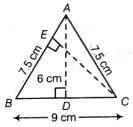
Given, $\triangle A B C$ is isosceles with $A B=A C=7.5 cm$ and $B C=9 cm$.
Let $B C$ be the base of triangle, then height $(A D)=6 cm$
$
\begin{aligned}
\therefore \text { Area of } \triangle A B C & =\frac{1}{2} \times \text { Base } \times \text { Height } \\
& =\frac{1}{2} \times 9 \times 6=\frac{54}{2}=27 cm^2
\end{aligned}
$
Now, let side $A B=7.5 cm$ be the base.
Then, $C E$ (the height from $C$ to corresponding side $A B$ ) be the height.
$
\begin{array}{l}
\therefore \text { Area of } \triangle A B C=\frac{1}{2} \times A B \times C E \\
\therefore \quad \frac{1}{2} \times A B \times C E=27 cm^2 \quad\left[\because \text { area of } \triangle A B C=27 cm^2\right] \\
\Rightarrow \quad \frac{1}{2} \times 7.5 \times C E=27 cm^2 \\
\therefore \quad C E=\frac{27 cm^2 \times 2}{7.5}=7.2 cm
\end{array}
$
Hence, the height from $C$ to $A B$ i.e. $C E$ is 7.2 cm .
View full question & answer
Question 63 Marks
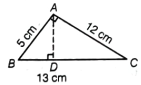
$\triangle A B C$ is right angled at $A$ (in the given figure). $A D$ Is perpendicular to $B C$. If $A B=5 cm, B C=13 cm$ and $A C=12 cm$, then find the area of $\triangle A B C$ Also, find the length of $A D$.
Image
Answer
Given, $\triangle A B C$ is right angled at $A, A B=5 cm, B C=13 cm$ and $A C=12 cm$.
On taking $A C$ as base and $A B$ as height, we get
Area of $\triangle A B C=\frac{1}{2} \times$ Base $\times$ Height
$=\frac{1}{2} \times 12 \times 5=\frac{1}{2} \times 60=30 cm^2$
Also, $A D$ is perpendicular to $B C$.
On taking $B C$ as base and $A D$ as height, we get
Area of $\triangle A B C=\frac{1}{2} \times B C \times A D$
$\Rightarrow \frac{1}{2} \times B C \times A D=30 \quad\left[\because\right.$ Area of triangle $\left.=30 cm^2\right]$
$\Rightarrow \frac{1}{2} \times 13 \times A D=30$
$\therefore \quad A D=\frac{30 \times 2}{13}$
$=\frac{60}{13}=4 \frac{8}{13}$
Hence, the length of $A D$ is $4 \frac{8}{13} cm$.
View full question & answer
Question 73 Marks
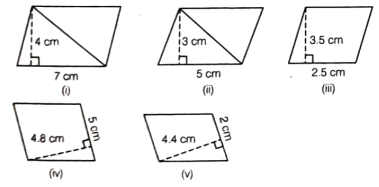
Find the area of each of the following parallelograms.
Image
Answer
(i) Given, base of a parallelogram $=7 cm$ and height of a parallelogram $=4 cm$
$\therefore \text {Area of a parallelogram} =\text {Base} \times \text {Height} $
$=7 \times 4=28 cm^2$
(ii) $15 cm^2$
(iii) $8.75 cm^2$
(iv) $24 cm^2$
(v) $8.8 cm^2$
View full question & answer
Question 83 Marks
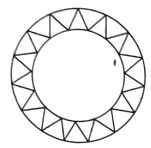
A dinner plate is in the form of a circle. A circular region encloses a beautiful design as shown in the given figure. The inner circumference is 352 mm and outer is 396 mm . Find the width of the circular design. (use $\pi=22 / 7$ )
Image
Answer
Let the radius of inner and outer circle be $r$ and $R$.
Given, inner circumference $=352 mm$
$
\begin{array}{l}
\Rightarrow \quad 2 \pi r=352 \quad[\because \text { Circumference }=2 \pi r] \\
\Rightarrow 2 \times \frac{22}{7} \times r=352 \Rightarrow r=\frac{352 \times 7}{2 \times 22}=\frac{2464}{44}=56 mm
\end{array}
$
and outer circumference $=396 mm \qquad$ [given]
Image
$\begin{array}{lr}\Rightarrow & 2 \pi R=396 \\ \Rightarrow & 2 \times \frac{22}{7} \times R=396\end{array}$
$\Rightarrow \quad R=\frac{396 \times 7}{2 \times 22}=63 mm$
$\therefore$ Width of circular design $=R-r=63-56=7 mm$
View full question & answer
Question 93 Marks
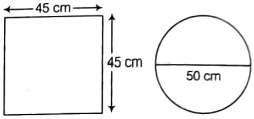
Pizza factory has come out with two kinds of pizzas. A square pizza of side 45 cm costs ₹ 150 and a circular pizza of diameter 50 cm cost ₹ 160. Which pizza is a better deal? (use $\pi=22 / 7$ )
Image
Answer
$\because$ Side of square pizza $=45 cm$
$\therefore$ Area of a square pizza $=(\text { Side })^2=(45)^2=2025 cm^2$
Diameter of circular pizza $=50 cm$
Radius $=\frac{50}{2}=25 cm$
$\because$ Area of a circle $=\pi r^2$
$\therefore$ Area of the circular pizza $=\pi r^2$
$\begin{array}{l}=\frac{22}{7} \times 25 \times 25=\frac{22}{7} \times 625 \\ =\frac{13750}{7}=1964.28 cm^2\end{array}$
Price of 1 cm square pizza $=\frac{2025}{150}=$ ₹ $13.5$
Price of 1 cm circular pizza $=\frac{1964.28}{160}=$ ₹ $12.27$
Hence, the circular pizza is a better deal.
View full question & answer
Question 103 Marks
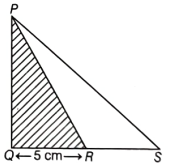
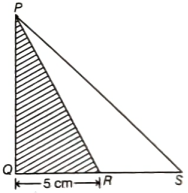
In the given figure, area of $\triangle P Q R$ is $20 cm^2$ and area of $\triangle P Q S$ is $44 cm^2$, if $P Q \perp QS$ and $Q R=5 cm$, then find the length $R S$,
Image
Answer
Given, area of $\triangle P Q R=20 cm^2$
and area of $\triangle P Q S=44 cm^2$
We know that
Area of triangle $=\frac{1}{2} \times$ Base $\times$ Height
Image
$\therefore$ Area of $\triangle P Q R=\frac{1}{2} \times P Q \times Q R \qquad [\because P Q \perp Q R]$
$\Rightarrow \quad 20=\frac{1}{2} \times P Q \times 5$
$\Rightarrow \quad \frac{20 \times 2}{5}=P Q \Rightarrow P Q=8 cm \quad[\because Q R=5 cm$ given $]$
Area of $\triangle P Q S=\frac{1}{2} \times P Q \times Q S$
$\Rightarrow \quad 44=\frac{1}{2} \times 8 \times Q S$
$\Rightarrow \quad Q S=\frac{44 \times 2}{8} \quad[\because P Q=8 cm]$
$\Rightarrow \quad Q S=11 cm$
Now, $R S=Q S-Q R=11-5=6 cm$
View full question & answer
Question 113 Marks
From a circular sheet of radius 40 cm , semi-circle of radius 4 cm and two parallelogram with base 5 cm and height 3 cm are cut off, then find the area of remaining region. (use $\pi=22 / 7$ )
Image
Answer
Area of circular sheet $=\pi r^2$
$\begin{array}{l}=\frac{22}{7} \times 40 cm \times 40 cm \\ =5028.57 cm^2\end{array}$
Area of parallelogram $=$ Base $\times$ Height $=5 \times 3$
$=15cm^2$
Area of semi-circle $=\frac{1}{2} \times \pi r^2=\frac{1}{2} \times \frac{22}{7} \times 4^2 cm^2$
$=25.14cm^2$
$\therefore$ Area of remaining region $=$ Area of circular sheet $-$ Area of two parallelograms $-$ Area of semi-circle
$\begin{array}{l}=5028.57-2 \times 15-25.14 \\ =4973.43 cm^2\end{array}$
$\therefore$ Area of shaded region is $4973.43 cm^2$
View full question & answer
3 Marks Question - MATHS STD 7 Questions - Vidyadip