Questions

3 Marks Question

🎯

Test yourself on this topic

17 questions · timed · auto-graded

Question 13 Marks
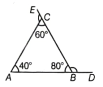
The three angles of a triangle are in the ratio $1: 2: 1$. Find all the angles of the triangle. Classify the triangle in two different ways.
Answer

Image
Given, ratio between three angles of a triangles is $1: 2: 1$.
Let three angles of a traingle be $n, 2 n$ and $n$, respectively.
Then, by angle sum property of a triangle,
$
\begin{array}{rlrl}
& n+2 n+n=180^{\circ} & \Rightarrow & 4 n=180^{\circ} \\
\Rightarrow \quad & n=\frac{180^{\circ}}{4} \Rightarrow n=45^{\circ}
\end{array}
$
Therefore, three angles of the given triangle are $45^{\circ}$, $2 \times 45^{\circ}$ and $45^{\circ}$ i.e. $45,90^{\circ}$ and $45^{\circ}$.
We observe that, one angle of given triangle is $90^{\circ}$ and each of the two other angles is of measure $45^{\circ}$.
Therefore, sides opposite of two equal angles are also equal.
Thus, we may classify the triangle in two different ways as follows:
(i) On the basis of angles, triangle is a right angled triangle.
(ii) On the basis of sides, triangle is an isosceles triangle.
View full question & answer
Question 23 Marks
One of the angles of a triangle is $80^{\circ}$ and the other two angles are equal. Find the measure of each of the equal angles.
Answer

Image
Let the measure of each of the equal angle be $x$. Then, by angle sum property of a triangle,
$
\begin{aligned}
& & x+x+80^{\circ} & =180^{\circ} \\
& \Rightarrow & 2 x+80^{\circ} & =180^{\circ} \\
& \Rightarrow & 2 x & =180^{\circ}-80^{\circ} \\
& \Rightarrow & 2 x & =100^{\circ} \\
& & x & =\frac{100^{\circ}}{2}=50^{\circ}
\end{aligned}
$
Hence, the measure of each of the equal angle is $50^{\circ}$.
View full question & answer
Question 33 Marks
Write the:
(i) side opposite to the vertex Q of $\triangle P Q R$.
(ii) angle opposite to the side LM of $\triangle L M N$.
(iii) vertex opposite to the side RT of $\triangle R S T$.
Answer
i. The side opposite to the vertex Q of $\triangle P Q R$ is $\overline{P R}$.
Image
ii. The angle opposite to the side LM of $\triangle L M N$ is $\angle M N L$.
Image
iii. The vertex opposite to the side RT of $\triangle R S T$ is $S$.
Image
View full question & answer
Question 43 Marks
What can you say about each of the interior opposite angles, when the exterior angle is
(i) a right angle?
(ii) an obtuse angle?
(iii) an acute angle?
Answer
i. When exterior angle is a right angle, then each of the interior opposite angles is complement to each other i.e. $90^{\circ}$.
ii. When exterior angle is an obtuse angle, then both the interior opposite angles may be acute or one of the interior opposite angle is obtuse and other is acute.
iii. When exterior angle is an acute angle, then both the interior opposite are acute angles.
View full question & answer
Question 53 Marks
Are the exterior angles formed at each vertex of a triangle equal?
View full question & answer
Question 63 Marks
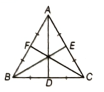
How many medians can a triangle have?
Answer

Image
A triangle has three vertices and three sides opposite to each of the vertices. So, for each vertex, there is a median of the triangle. Hence, a triangle has three medians. In the above figure $D$, $B$ and $F$ are the mid-points of line segments $B C, A C$ and $A B$ respectively. Therefore, line segments $A D, B E$ and $C F$ are three medians of $\triangle A B C$.
View full question & answer
Question 73 Marks
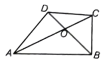
The diagonal of a rectangle produce by itself the same area as produced by its length and breadth'-This is Baudhayan theorem. Compare it with the Pythagoras property.
Answer

Image
From the figure, $A B C D$ is a rectangle and $B D$ is a diagonal.
According to the Baudhayan theorem,
$
\begin{aligned}
(\text {Diagonal})^2 & =(\text {Length})^2+(\text {Breadth})^2 \\
\Rightarrow \quad B D^2 & =C D^2+B C^2 \quad ...(i)
\end{aligned}
$
Now, $\triangle B C D$ is a right angled triangle and $B D$ is a hypotenuse.
By Pythagoras property,
$
\begin{array}{l}
B D^2=\text { Sum of the squares of two sides } \\
\Rightarrow \quad B D^2=C D^2+B C^2 \quad ...(ii)
\end{array}
$
From Eqs. (i) and (ii), we can say that the Baudhayan theorem and Pythagoras property are same.
View full question & answer
Question 83 Marks
The diagonals of a rhombus measure 16 cm and 30 cm. Then, find its perimeter.
View full question & answer
Question 103 Marks
$A B C D$ is a quadrilateral.
$
\text { Is } A B+B C+C D+D A<2(A C+B D) ?
$
View full question & answer
Question 113 Marks
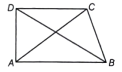
ABCD is a quadrilateral.
$
\text { Is } A B+B C+C D+D A>A C+B D \text { ? }
$
Image
Answer
Yes, given $A B C D$ is a quadrilateral. Here, diagonal $A C$ divides the quadrilateral $A B C D$ into two $\triangle A B C$ and $\triangle A C D$.
In $\triangle A B C, \quad A B+B C>A C\quad\quad ...(i)$
In $\triangle A C D, \quad C D+D A>A C\quad\quad ...(ii)$
On adding Eqs. (i) and (ii), we get
$
A B+B C+C D+D A>2 A C \quad\quad ...(iii)$
Similarly, the diagonal $B D$ divides the quadrilateral $A B C D$ into two $\triangle B C D$ and $\triangle A B D$.
$
\begin{array}{ll}
\text { In } \triangle B C D, & B C+C D>B D \quad ...(iv)\\
\text { In } \triangle A B D, & A B+D A>B D \quad ...(v)
\end{array}
$
On adding Eqs. (iv) and (v), we get
$
(B C+C D+A B+D A)>2 B D \quad ...(vi)
$
Again, adding Eqs. (iii) and (vi), we get
$
\begin{array}{l}
A B+B C+C D+D A+B C+C D+A B+D A>2 A C+2 B D \\
\Rightarrow 2(A B+B C+C D+D A)>2(A C+B D) \\
\Rightarrow \quad A B+B C+D C+D A>A C+B D
\end{array}
$
View full question & answer
Question 123 Marks
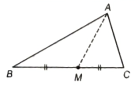
$A M$ is a median of a $\triangle A B C$.
Is $A B+B C+C A>2 A M$ ?
(Consider the sides of $\triangle A B M$ and $\triangle A M C$ )
Image
Answer
Yes, given $A M$ is a median of $\triangle A B C$. So, $M$ is the mid-point of $B C$ and $A M$ divides $\triangle A B C$ into two $\triangle A B M$ and $\triangle A M C$.
$
\begin{array}{ll}
\text { In } \triangle A B M, & A B+B M>A M & ...(i)\\
\text { In } \triangle A M C, & C A+M C>A M & ...(ii)
\end{array}
$
On adding Eqs. (i) and (ii), we get
$
\begin{aligned}
& & A B+B M+C A+M C>2 A M \\
\Rightarrow & & A B+(B M+M C)+C A>2 A M \\
\Rightarrow & & A B+B C+C A>2 A M
\end{aligned}
$
[from the figure, $B M+M C=B C$ ]
View full question & answer
Question 133 Marks
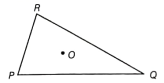
Take any point Oin the interior of a $\triangle P Q R$. Is
(i) $O P+O Q>P Q$ ?
(ii) $O Q+O R>Q R$ ?
(iii) $O R+O P>R P$ ?
Image
Answer

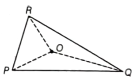
i. Image
Yes, $O P+O Q>P Q$, because on joining $O P$ and $O Q$, we get a $\triangle O P Q$ and in a triangle, sum of the lengths of any two sides is always greater than the third side.
ii. Yes, $O Q+O R>Q R$, because on joining $O Q$ and $O R$ we get a $\triangle O Q R$ and in a triangle, sum of the lengths of any two sides is always greater than the third side.
iii. Yes, $O R+O P>R P$, because on joining $O R$ and $O P$, we get a $\triangle O P R$ and in a triangle, sum of the lengths of any two sides is always greater than the third side.
View full question & answer
Question 143 Marks
Is it possible to have a triangle with the following sides?
(i) 2 cm, 3 cm, 5 cm
(ii) 3 cm, 6 cm, 7 cm
(iii) 6 cm, 3 cm, 2 cm
Answer
i. Given sides are 2 cm, 3 cm and 5 cm.
$\therefore$ Sum of two sides = 2 cm + 3 cm = 5 cm
and the third side = 5 cm
Since, the sum of lengths of two sides is equal to the length of the third side.
So, a triangle cannot be possible with these sides.
ii. Given sides are 3 cm, 6 cm and 7 cm . Here, the sum of lengths of any two sides of a triangle is greater than the length of third side.
i.e. 3 cm + 6 cm > 7 cm ; 3 cm + 7 cm > 6 cm
and 6 cm + 7 cm > 3 cm
So, a triangle can be possible with these sides.
iii. Given sides are 6 cm, 3 cm and 2 cm.
Here, sum of two sides = 3 + 2 = 5 and third side = 6
$\because \quad$ 5 < 6
So, a triangle cannot be possible with these sides.
View full question & answer
Question 153 Marks
Verify by drawing a diagram if the median and altitude of an isosceles triangle can be same.
Answer

Image
Draw a line segment $B C$. By paper folding locate the perpendicular bisector of $B C$. The folded crease meets $B C$ at $D$, its mid-point.
Take any point $A$ on this perpendicular bisector. Join $A B$ and $A C$. Thus, the triangle obtained is an isosceles $\triangle A B C$ in which $A B=A C$.
Since, $D$ is the mid-point of $B C$, so $A D$ is its median. Also, $A D$ is perpendicular bisector of $B C$.
So, $A D$ is the altitude of $\triangle A B C$.
Thus, it is verified that the median and altitude of an isosceles triangle are same.
View full question & answer
Question 163 Marks
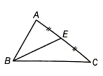
Draw rough sketches for the following
(i) In $\triangle A B C, B E$ is a median.
(ii) In $\triangle P Q R, P Q$ and $P R$ are altitudes of the triangle.
(iii) In $\triangle X Y Z, Y L$ is an altitude in the exterior of the triangle.
View full question & answer
3 Marks Question - MATHS STD 7 Questions - Vidyadip