Questions

2 Marks Questions

Take a timed test

21 questions · self-marked practice — reveal the answer and mark yourself.

Question 12 Marks
Boojho, Paheli and their friend Golu were provided with a test, each containing China rose solution which was pink in colour. Boojho added 2 drops of solution 'A' in his test tube and got dark pink colour. Paheli added 2 drops of solution 'B' to her test tube and got green colour. Golu added 2 drops of solution 'C, but could not get any change in colour. Suggest the possible cause for the variation in their results.
Answer
China rose (gudhal) is an acid-base indicator which shows the following changes in different mediums.
China rose + acid → Give dark pink colour
China rose + base → Give green colour
China rose + neutral → No change in colour
They got variation in their results because solution 'A' was acidic, solution 'B' was basic and solution 'C' was neutral which gave different results with China rose indicator.
View full question & answer
Question 22 Marks
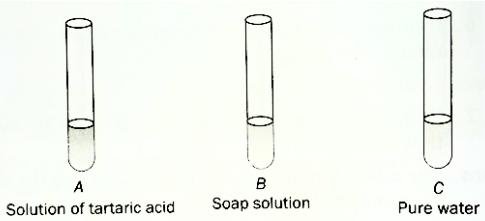
You are provided with three test tubes A, B and C as shown in figure with different liquids.
Image
What will you observe when you put
(i) a piece of blue litmus paper in each test tube?
(ii) a piece of red litmus paper in each test tube?
(iii) a few drops of phenolphthalein solution to each test tube?
Answer
Test tubeEffect on blue litmus paperEffect on red litmus paperEffect on phenolphthale in solution
ATurns redRemains redColourless
BRemains blueTurns bluePink colour
CRemains blueRemains redColourless
View full question & answer
Question 32 Marks
Look at the given reaction.
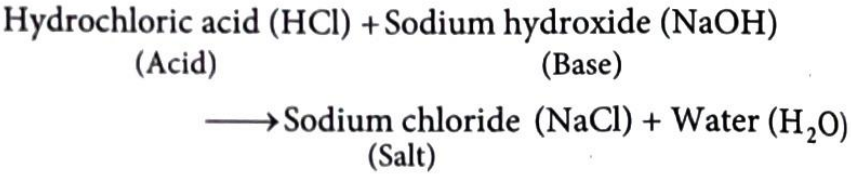
Hydrochloric acid + Sodium hydroxide (base) → Sodium chloride (salt) + Water
Sodium chloride formed in this reaction remains in solution form. Can we get solid sodium chloride from this solution? Suggest a method (if any).
Answer
We can get solid sodium chloride by evaporation method. It is the process by which water changes from a liquid to a gas or vapour by heating the solution.
Rate of evaporation increases with temperature.
View full question & answer
Question 42 Marks
Paheli observed that most of the fish in the pond of her village were gradually dying. She also observed that the wastes of a factory in their village are flowing into the pond which probably caused the fish to die.
(i) Explain why the fish were dying?
(ii) If the factory waste is acidic in nature, how can it be neutralised?
Answer
(i) If the wastes of a factory flow into waterbodies, it can cause a threat to the lives of sea creatures. Thus, fish were dying because factory waste may contain acids or bases or other toxic materials.
(ii) If the factory waste is acidic in nature, it can be neutralised by adding basic substances.
View full question & answer
Question 52 Marks
Paheli is suffering from indigestion due to acidity. Is it advisable to give her orange juice in this situation and why?
Answer
No, because orange juice is acidic in nature. Excess of acid in her stomach can increase indigestion. She should take an antacid such as milk of magnesia which contains magnesium hydroxide to neutralise the excess acid.
View full question & answer
Question 62 Marks
While playing in a park, a child was sting by a wasp. Some elders suggested applying paste of baking soda and others lemon juice as remedy. Which remedy do you think is appropriate and why?
Answer
Wasp sting inject a liquid in the skin which is acidic in nature. Hence, baking soda is the appropriate remedy as it is basic in nature and neutralises the acid.
View full question & answer
Question 72 Marks
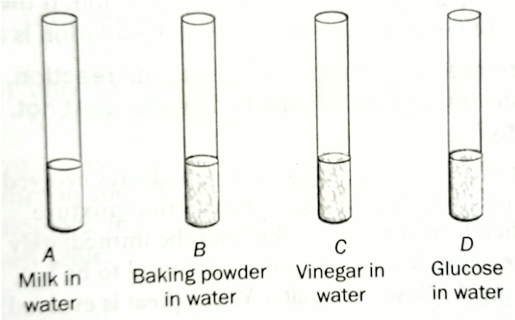
Look at the figure which shows solutions taken in test tubes A, B, C and D. What colour is expected, when a piece of red litmus paper is dropped in each test tube? Nature of the solutions is given in the table for your help.
Image
Test tubeNature of solutionChange in colour of red litmus
ANeutral 
BBasic 
CAcidic 
DNeutral 
Answer
Nature of solution is given below
Test tubeNature of solutionChange in colour of red litmus
ANeutralNo change 
BBasicTurn blue 
CAcidicNo change 
DNeutralNo change 
View full question & answer
Question 82 Marks
A small amount of hydrochloric acid is always produced in the stomach. Is it useful or harmful for us? If excess of acid is produced in the stomach, what should we do?
Answer
A small amount of hydrochloric acid produced in the stomach is useful as it can kill the harmful bacteria that may enter into the stomach along with the food. However, if excess of acid is produced, there is a burning sensation in the stomach. We should take milk of magnesia as an antacid medicine to neutralise the excess acid.
View full question & answer
Question 92 Marks
Explain neutralisation reaction with the help of an example, which indicator is used in this process.
Answer
The reaction in which an acid reacts with a base to form salt and water is called neutralisation. Acids and bases are chemically opposite substances. So, when an acid is mixed with a base, they neutralise (or cancel) the effect of each other. In this process, both the acidic nature of acid and basic nature of base are destroyed.
The solution formed is neutral, but salt produced during the reaction can be acidic, basic or neutral.
Some heat is always evolved, during the reaction, which raises the temperature of the mixture.
The general reaction takes place is given as
Acid + Base → Salt + Water (Heat is evolved)
This can be understand by following example
Image
View full question & answer
Question 102 Marks
A farmer was unhappy because of his low crop yield, He discussed the problem with an agricultural scientist and realised that the soil of his field was either too acidic or too basic. What remedy would you suggest the farmer to neutralise the soil?
Answer
The reason for low crop yield in farmer's field was that the soil at a place is either too acidic or too basic. The soil may be acidic or basic naturally. The excessive use of fertilisers in the fields also makes the soil too acidic. In this case, it is treated with base such as quicklime (calcium oxide) or slaked lime (calcium hydroxide) which neutralises the excess acid present in the soil and reduces its acidic nature.
If the soil is too basic, then decaying organic matter (called manure or compost) is added to it. The decaying organic matter releases acid which neutralises the excess bases present in the soil and reduces its basic nature.
View full question & answer
Question 112 Marks
Explain two neutralisation reactions related to daily life situation.
Answer
The neutralisation reactions play a very important role in our everyday life. Some of the examples that involves neutralisation reaction are as follows
Indigestion
Our stomach produces Hydrochloric Acid (HCl) which helps in digesting the food present in it. Sometimes, excess of hydrochloric acid causes indigestion. It can lead to pain and irritation in the stomach.
To relieve indigestion, we take an antacid which contains bases, e.g. milk of magnesia has magnesium hydroxide. It neutralises the excess acid present in the stomach and cures indigestion.
Ant Bite
When an ant bites, it injects an acidic liquid into the skin of the person which causes burning sensation. The sting of an ant contains an acid called formic acid.
The effect of the acid can be neutralised by rubbing a mild base, e.g. baking soda solution (sodium hydrogen carbonate) or calamine solution which contains zinc carbonate.
Thus, being a base, baking soda solution or calamine solution neutralises the acidic liquid injected by the ant and cancel its effect.
View full question & answer
Question 122 Marks
After carrying out the neutralisation reaction, the test tube immediately found to be somewhat hot. Explain why?
Answer
In neutralisation reaction, heat is always evolved which raises the temperature of the reaction mixture. Therefore, if we touch the test tube immediately after the neutralisation reaction, it is found to be hot.
Acid + Base → Salt + Water (heat is evolved)
View full question & answer
Question 132 Marks
To test the presence of an acid in any substance, what methods can be used?
Answer
Acid can be tested in any substance by the following methods
(i) Take a drop of the dilute solution of the substance on the tips of your tongue. If tastes sour, it is acidic.
(ii) Dip a blue litmus paper in the solution. If the colour of the litmus paper turns red, the solution is acidic.
View full question & answer
Question 142 Marks
Write the characteristics of acids by which we can identify them.
Answer
Characteristics of acids are
(i) They are sour in taste.
(ii) They turn blue litmus paper/solution to red.
(iii) They react with bases to form salt and water.
View full question & answer
Question 152 Marks
Consider the following statements
(i) Both acids and bases change colour of all indicators.
(ii) If an indicator gives a colour change with an acid, it does not give a change with a base.
(iii) If an indicator changes colour with a base, it does not change colour with an acid.
(iv) Change of colour with an acid and a base depends on the type of the indicator.
Which of the above statements is/are correct?
(a) Only (iv)
(b) (i) and (iv)
(c) (ii) (iii) and (iv)
(d) All of the above
Answer
(A) Only (iv)
All indicators do not change colour with acids as well as bases, e.g. turmeric changes its colour to pink with base, but it remains yellow with acid. Therefore, statement (i) is incorrect.
There are some indicators which changes colour with both acid and base, e.g. methyl orange, litmus, thus statement (ii) and (iii) are also incorrect. Change of colour with an acid and a base depends on the type of the indicator used. Hence, only statement (iv) is correct.
View full question & answer
Question 162 Marks
Three liquids are given to you. One is hydrochloric acid, another is sodium hydroxide and third is a sugar solution. How will you identify them? You have only turmeric indicator.
Answer
We will put a drop each of hydrochloric acid, sodium hydroxide and sugar solution on the turmeric indicator one by one. The liquid which changes the colour of turmeric indicator to red is basic in nature that is sodium hydroxide.
Now, this red turmeric paper may be used to identify which one of the remaining two liquids is hydrochloric acid. Put one drop of each of these remaining liquid on the red turmeric paper. The liquid whose drop will turn this red paper to yellow is hydrochloric acid. This is because hydrochloric acid neutralised the effect of sodium hydroxide on turmeric paper. There is no effect on turmeric solution by sugar solution as it is a neutral solution.
View full question & answer
Question 172 Marks
Describe the process of neutralisation with the help of an example.
Answer
The neutralisation reactions play a very important role in our everyday life.
Some of the examples that involves neutralisation reaction are as follows
Indigestion
Our stomach produces Hydrochloric Acid (HCl) which helps in digesting the food present in it. Sometimes, excess of hydrochloric acid causes indigestion. It can lead to pain and irritation in the stomach.
Ant Bite
When an ant bites, it injects an acidic liquid into the skin of the person which causes burning sensation. The sting of an ant contains an acid called formic acid.
View full question & answer
Question 182 Marks
State differences between acids and bases.
Answer
Differences between acids and bases are as follows
AcidsBases
They are sour in taste.They are bitter in taste.
They turn blue litmus to red.They turn red litmus to blue.
They are not soapy to touch.They are soapy to touch.
They are soluble in water.They may or may not be soluble in water.
View full question & answer
Question 192 Marks
What is the effect of ant bite? Explain its cure.
Answer
The effect of an ant bite is a burning and itching sensation on the skin due to the acid injected by the ant. The cure for an ant bite is to apply a mild base like baking soda or calamine lotion to neutralize the acid and relieve irritation.
View full question & answer
Question 202 Marks
Which acid is used in the making of paneer at home?
Answer
The acid used in the making of paneer at home is citric acid or lactic acid, which is present in lemon juice or curd.
View full question & answer
Question 212 Marks
Why does a yellow curry stain on a white shirt turn red when it is washed with soap?
Answer
A yellow curry stain contains turmeric, which is a natural indicator. When the stain is washed with soap, which is basic in nature, turmeric turns red in a basic solution.
View full question & answer