Question types

Earth, Moon, and the Sun question types

189 questions across 9 question groups — pick any mix to generate a Science paper with step-by-step answer keys.

189
Questions
9
Question groups
5
Question types
Sample Questions

Earth, Moon, and the Sun questions

One sample from each question group in this chapter. Select any group above to see the full set with answer keys.

Q 1MCQ (1 Marks)1 Mark
Four friends used the following ways to see the solar eclipse. Who among them was being careless?
  • A
    Ravikiran used a solar eclipse goggle.
  • B
    Jyothi used a mirror to project the Sun’s image.
  • Adithya saw the Sun directly with his eyes.
  • D
    Aruna attended a programme arranged by a planetarium.

Answer: C.

View full solution
Assertion (A): We should never look at the Sun directly during a solar eclipse.
Reason (R): Looking at the Sun through sunglasses or binoculars during a solar eclipse is completely safe.
  • A
    Both A and R are true and R is the correct explanation of A.
  • B
    Both A and R are true but R is not the correct explanation of A.
  • A is true but R is false.
  • D
    A is false but R is true.

Answer: C.

View full solution
Assertion (A): A total lunar eclipse occurs when the Moon completely blocks sunlight from reaching the Earth.
Reason (R): A total lunar eclipse happens when the Earth’s shadow completely covers the Moon.
  • A
    Both A and R are true and R is the correct explanation of A.
  • B
    Both A and R are true but R is not the correct explanation of A.
  • C
    A is true but R is false.
  • A is false but R is true.

Answer: D.

View full solution
Assertion (A): The Earth’s revolution around the Sun causes day and night.
Reason (R): The Earth takes about 24 hours to complete one rotation on its axis.
  • A
    Both A and R are true and R is the correct explanation of A.
  • B
    Both A and R are true but R is not the correct explanation of A.
  • C
    A is true but R is false.
  • A is false but R is true.

Answer: D.

View full solution
Assertion (A): The Sun appears to rise in the east and set in the west.
Reason (R): The Earth rotates from west to east.
  • Both A and R are true and R is the correct explanation of A.
  • B
    Both A and R are true but R is not the correct explanation of A.
  • C
    A is true but R is false.
  • D
    A is false but R is true.

Answer: A.

View full solution
Assertion (A): The Earth experiences different seasons during the year.
Reason (R): The Earth’s axis is tilted and it revolves around the Sun.
  • Both A and R are true and R is the correct explanation of A.
  • B
    Both A and R are true but R is not the correct explanation of A.
  • C
    A is true but R is false.
  • D
    A is false but R is true.

Answer: A.

View full solution
Abhay noticed that when it was daytime in India, his uncle who was in the USA was generally sleeping as it was night-time there. What is the reason behind this difference?
View full solution
Four friends used the following ways to see the solar eclipse. Who among them was being careless?
(i) Ravikiran used a solar eclipse goggle.
(ii) Jyothi used a mirror to project the Sun’s image.
(iii) Adithya saw the Sun directly with his eyes.
(iv) Aruna attended a programme arranged by a planetarium.
View full solution
Q 313 Marks Question3 Marks
Rahul was observing the sky one evening when he noticed that the Sun appeared to set in the western sky. The next day, his friend told him that the Earth rotates from west to east, which is why the Sun rises in the east and sets in the west. Rahul was curious and asked his teacher how this phenomenon happens.
(i) Why does the Sun appear to rise in the east and set in the west?
(ii) How does the Earth’s rotation affect the appearance of the Sun in the sky?
(iii) What is the reason for the Sun’s movement across the sky?
View full solution
Q 323 Marks Question3 Marks
During a visit to an observatory, Maya observed a solar eclipse through a special protective lens. The Moon was between the Earth and the Sun, blocking the Sun’s light. Maya was told that it was important never to look directly at the Sun during such an event.
(i) Why is it dangerous to look directly at the Sun during a solar eclipse?
(ii) What happens during a solar eclipse?
(iii) How should one safely observe a solar eclipse?
View full solution
Q 333 Marks Question3 Marks
Read the passage and answer the questions :
During a school science event, students watched a solar eclipse. Some used solar viewing goggles, some projected the image on a wall using a mirror, and one student tried looking directly at the eclipse.
Q.1. Which method of solar eclipse viewing is unsafe?
(a) Using a mirror to project the image
(b) Using solar eclipse glasses
(c) Watching a live stream online
(d) Looking at the eclipse directly with the naked eye
Q.2. Why does the Sun temporarily disappear during a total solar eclipse?
(a) The Earth comes between the Sun and the Moon
(b) The Sun moves behind the Moon
(c) The Moon blocks sunlight from reaching Earth
(d) The Sun burns out temporarily
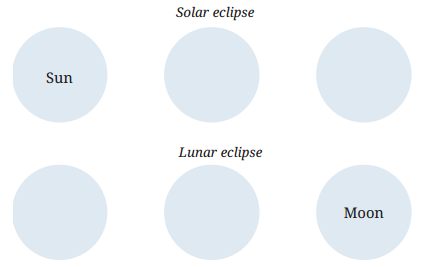
Q.3. What is the correct alignment of celestial bodies during a solar eclipse?
(a) Earth - Moon - Sun
(b) Moon - Sun - Earth
(c) Sun - Earth - Moon
(d) Sun - Moon - Earth
View full solution
Q 343 Marks Question3 Marks
Read the passage and answer the questions :
Rashmika noticed that the shadows of trees on her way to school were long in the morning and much shorter in the afternoon. She began to wonder why the size of the shadows changed throughout the day.
Q.1.  What causes the length of a shadow to change during the day?
(a) The shape of the object
(b) The movement of the Earth around the Sun
(c) The change in the Sun's position in the sky due to Earth's rotation
(d) The distance between the Earth and the Sun
Q.2. When would Rashmika observe the shortest shadow of a tree?
(a) Early morning$\quad$(b) Late evening
(c) Noon$\quad$$\quad$(d) Midnight
Q.3.  Which direction does a shadow point at noon in India?
(a) East$\quad$$\quad$(b) West
(c) South$\quad$$\quad$(d) North
View full solution
Column AColumn B
Q.1. Earth’s rotation(a) Causes seasons
Q.2. Earth’s revolution(b) Stellarium app
Q.3. Solar and Lunar eclipse(c) Causes day and night
Q.4. Revolution + Tilt(d) Sunlight falls unequally on Earth
View full solution
Column AColumn B
Q.1. Rotation(a) Causes change in seasons
Q.2. Revolution(b) Longest day in Northern Hemisphere
Q.3. Equator(c) 24 hours
Q.4. Lunar eclipse(d) Receives nearly equal sunlight all year
 (e) Earth between Sun and Moon
View full solution
Draw a diagram of the solar and lunar eclipse and write down about the
(i) total solar eclipse
(ii) partial solar eclipse
(iii) total lunar eclipse
(iv) partial lunar eclipse
View full solution

Generate a Earth, Moon, and the Sun paper free

Pick question groups from the list above, set marks and difficulty, and export a branded PDF with step-by-step answer keys. First 3 chapters free — no signup.

Download App