Questions

5 Marks Questions

Take a timed test

14 questions · self-marked practice — reveal the answer and mark yourself.

Question 15 Marks
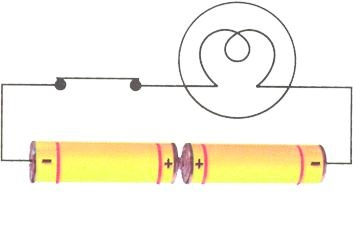
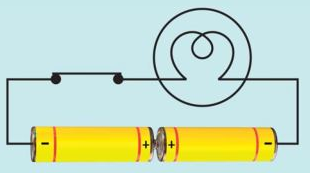
The bulb in the circuit shown in Figure does not glow. Can you identify the problem? Make necessary changes in the circuit to make the bulb glow.
Image
Answer
The bulb in the circuit is not glowing because the two cells are not connected properly.

To make the bulb glow, the negative terminal of one cell should be connected to the positive terminal of the other cell, as shown in the given figure.

Image

View full question & answer
Question 25 Marks
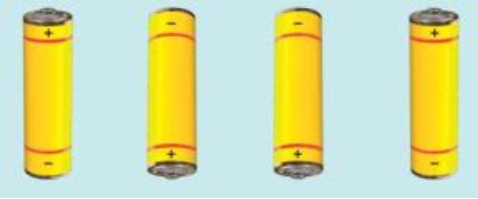
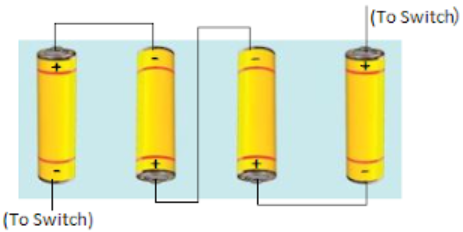
Figure shows four cells fixed on a board. Draw lines to indicate how you will connect their terminals with wires to make a battery of four cells.

Image

Answer
To make a battery, the negative terminal of one cell must be connected to the positive terminal of the next cell. The wire indicates the manner in which the given cells should be connected with each other, as shown in the following figure.

Image

View full question & answer
Question 35 Marks
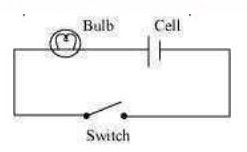
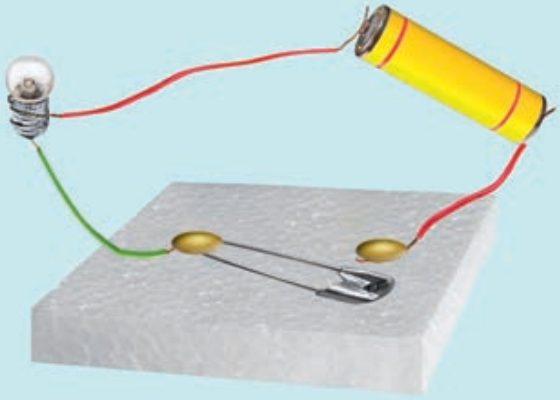
Draw the circuit diagram to represent the circuit shown in figure.

Image

Answer
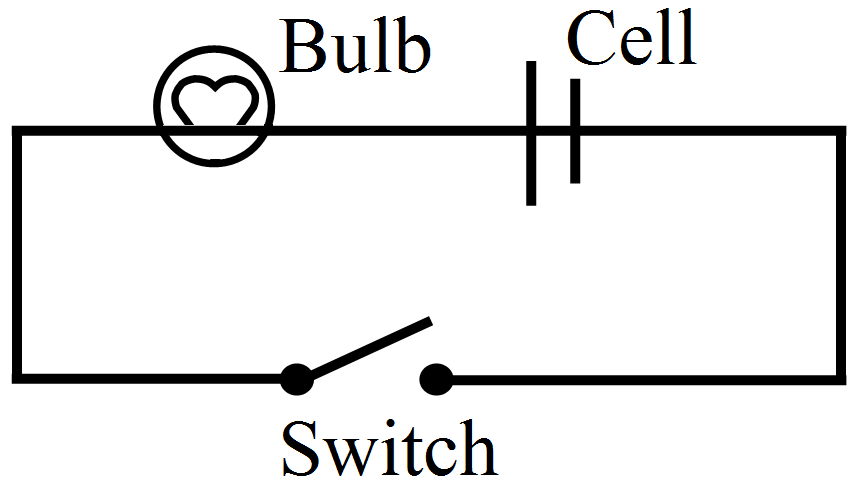
In the given circuit, one terminal of the bulb is connected with one terminal of the cell while their other terminals are connected to a safety pin. However, the safety pin is not connected with one of the drawing pins. Thus, the circuit is not complete. Hence, safety pin represents a switch in ‘OFF’ position. The circuit diagram of the given figure is shown in the following figure

Image

View full question & answer
Question 45 Marks
Draw in your notebook the symbols to represent the following components of electrical circuits: connecting wires, switch in the ‘OFF’ position, bulb, cell, switch in the ‘ON’ position, and battery
Answer
Component of electrical circuitSymbol
Connecting wiresImage
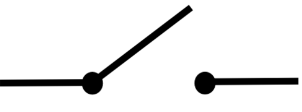
Switch in the ‘OFF’ positionImage
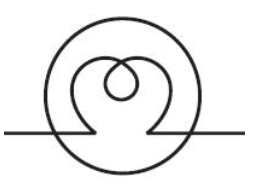
BulbImage
CellImage
Switch in the ‘ON’ positionImage
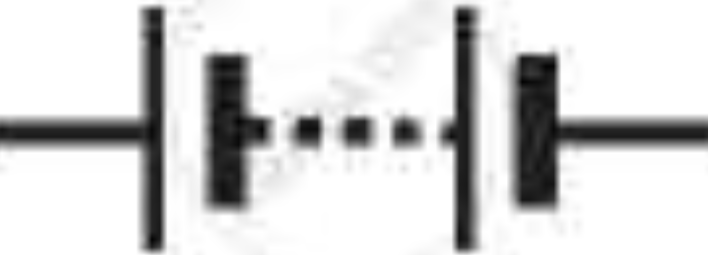
BatteryImage
View full question & answer
Question 55 Marks
Describe domestic household circuit.
Answer
From an electric pole or underground cables, we receive electric supply in our homes. Domestic electric circuit consists of three main wires. The wire with red insulation is called live wire. The wire with black insulation is called neutral wire. Potential difference between the neutral and the live wire is $220V$ The wire with green insulation is called earth wire. It is connected to a metallic body deep inside the earth. According to new International Convention, insulation of live wire should be of brown colour whereas neutral and earth wires should be of light blue and green (or yellow) insulation cover. In our homes, we receive $AC$ electric power of $220V$ with a frequency of $50Hz$. Live wire and neutral wire maintains the p.d. of $220V$ These wires pass through the fuse board. Fuse is specially connected with the live wire. Current rating of this fuse depends on house load. From the fuse board, these wires pass through the electric meter. From the meter, the earth wire is locally inserted inside the ground of the house. After the electric meter, these wires pass through the main switches and fuses in different rooms. Depending on the power of electrical appliances, two types of fuse ($5A$ or $15A$) are used. From the switch and fuse board, the power lines are distributed to different electrical appliances.
View full question & answer
Question 65 Marks
Draw the circuit diagram to represent the circuit shown in Fig.
Answer
In the given circuit, one terminal of the bulb is connected with one terminal of the cell while their other terminals are connected to a safety pin. However, the safety pin is not connected with one of the drawing pins. Thus, the circuit is not complete. Hence, safety pin represents a switch in ‘OFF’ position. The circuit diagram of the given figure is shown in the following figure.
View full question & answer
Question 75 Marks
Mention the differences between an electromagnet and a permanent magnet.
Answer
S.No. Electromagnet Permanent magnet
$1.$ It is temporary magnet and can be demagnetized. It is a permanent magnet and cannot be demagnetized easily.
$2.$ Magnetic strength can be changed. Its strength is fixed.
$3.$ Its polarity can also be changed. Its polarity is fixed.
$4.$ It is prepared from soft iron. It is prepared from hard steel.
View full question & answer
Question 85 Marks
Distinguish between an electric motor and generator?
Answer
Following are the points of difference between an electric motor and a generator:Electric Motor:
  • It converts electrical energy into mechanical energy.
  • It needs electrical energy for its working.
  • They are used as water pumps, marble grinders etc.
Generator:
  • It converts mechanical energy into electrical energy.
  • It needs mechanical energy for its working.
  • They are used as water pumps, marble grinders etc.
  • Diesel generator, hydro-electric generator are the examples of it.
View full question & answer
Question 95 Marks
What are the properties of magnetic field due to a current through a straight wire?
Answer
The properties of magnetic field due to a current flowing through a straight wire are:
  1. The magnitude of the magnetic field produced at a given point increases as the current through the wire increases.
  2. The magnetic field produced by a given current in the conductor decreases as the distance from it increases.
  3. The concentric circles representing the magnetic field around a current-carrying straight wire become larger and larger as we move away from it.
  4. If the direction of the current is reversed in the wire, the lines will still be circular, but the directions of the lines will be reversed, which can be verified using the compass needle.
View full question & answer
Question 105 Marks
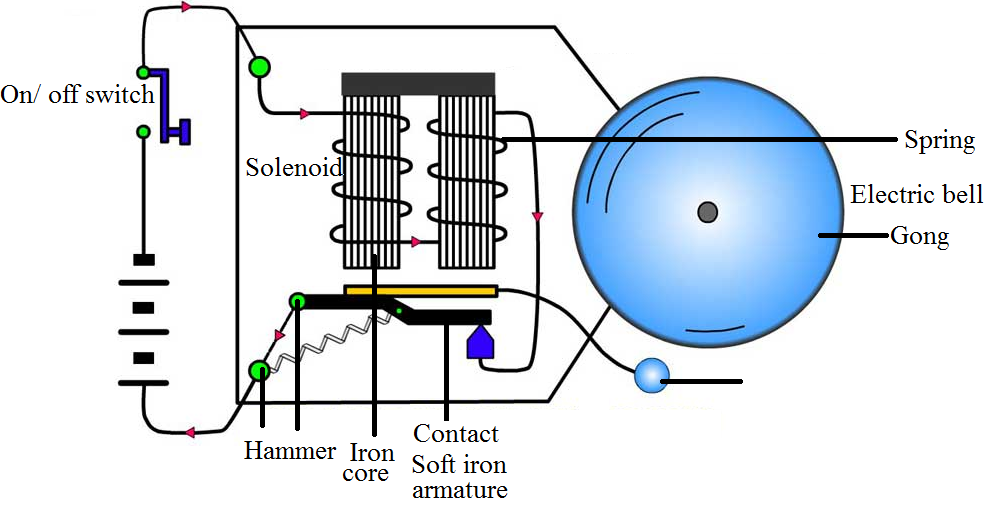
How does the magnetic effect of electric current help in the working of an electric bell? Explain with the help of a diagram.
Answer


As depicted in the diagram, when switch is in $ON$ position, electric current is passed through the coil or solenoid. By the phenomenon of magnetic effect of current, the coil or solenoid gets magnetised which attracts nearby soft iron armature and the hammer strikes the gong to produce a sound.
Thus, electric bell starts ringing and as soon as switch is $OFF$, no current flows through the coil and its magnetisation stops. So, bell stops ringing.
View full question & answer
Question 115 Marks
Explain with the help of a diagram, how does the magnetic effect of electric current help in the working of an electric bell.
Answer
In order to ring the bell first of all we press the push button switch in order to ring the bell. So, when we press the switch, then the electric circuit of the bell is completed and a current passes through the coil of the electromagnet and it gets magnetised. The electromagnet attracts the iron armature towards itself. So, as the armature moves towards the poles of the electromagnet, the clapper attached to it strikes the gong and produces a ringing sound. It implies that the bell rings. When the armature moves towards the magnet, its contact with the contact screw is broken. Due to this, the electric circuit breaks and no current flows in the electromagnet coil. The electromagnet loses its magnetism for a moment and the armature is no longer attracted by it. The flat spring brings back the iron armature to its original position and the clapper also moves away from the gong. As soon as the armature comes back and touches the contact screw the circuit is completed and current starts flowing in the electromagnet coil again. The electromagnet attracts the iron armature once again and the clapper strikes the gong again producing a ringing sound. So, this process of 'make and break' of the electric circuit continues as long as we are pressing the switch. Due to this, the armature vibrates forwards and backwards rapidly each time making the clapper strike the gong. Thus, the clapper strikes the gong rapidly producing almost continuous sound.
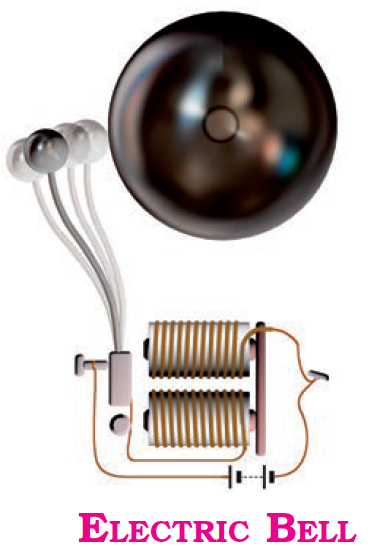
View full question & answer
Question 125 Marks
State few characteristics of magnetic field lines.
Answer
Following are the characteristics of magnetic field line:
  • They represent the magnetic field.
  • They are directed from north to South Pole outside a magnet and from south to North Pole inside a magnet.
  • The field lines are closed curves.
  • The strength of magnetic field in a region is determined by closeness of the field lines in that region.
  • The closer the field lines are, greater will be the field strength and vice-versa.
  • No two field lines ever cross each other as it would mean two different directions of field at point of intersection, which is not possible.
  • The parallel lines represent the uniform magnetic field whereas converging lines or diverging lines represents the non-uniform magnetic field.
View full question & answer
Question 135 Marks
Match the statements in Column $I$ with those in Column $II.$
S.No. Column I   Column II
$1.$ A magnetic device used for finding geographic directions. $(a)$ Magnetic needle.
$2.$ A device which is essential in an electric bell. $(b)$ Electromagnet
$3.$ A fuse used in expensive and sensitive electric devices. $(c)$ Cartridge fuse.
$4.$ An alloy used as a material of fuse wir. $(d)$ Fusible alloy.
$5.$ A material used for making filament of a bulb. $(e)$ Tungsten
$6.$ A material which does not allow the electric current to pass. $(f)$ Wax
$7.$ A material used for making electromagnets. $(g)$ Soft iron.
Answer
S.No. Column I   Column II
$1.$ A magnetic device used for finding geographic directions. $(b)$ Electromagnet
$2.$ A device which is essential in an electric bell. $(a)$ Magnetic needle.
$3.$ A fuse used in expensive and sensitive electric devices. $(d)$ Fusible alloy.
$4.$ An alloy used as a material of fuse wir. $(c)$ Cartridge fuse.
$5.$ A material used for making filament of a bulb. $(e)$ Tungsten
$6.$ A material which does not allow the electric current to pass. $(f)$ Wax
$7.$ A material used for making electromagnets. $(g)$ Soft iron.
View full question & answer
Question 145 Marks
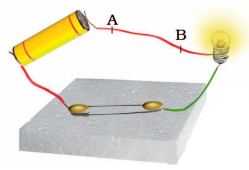
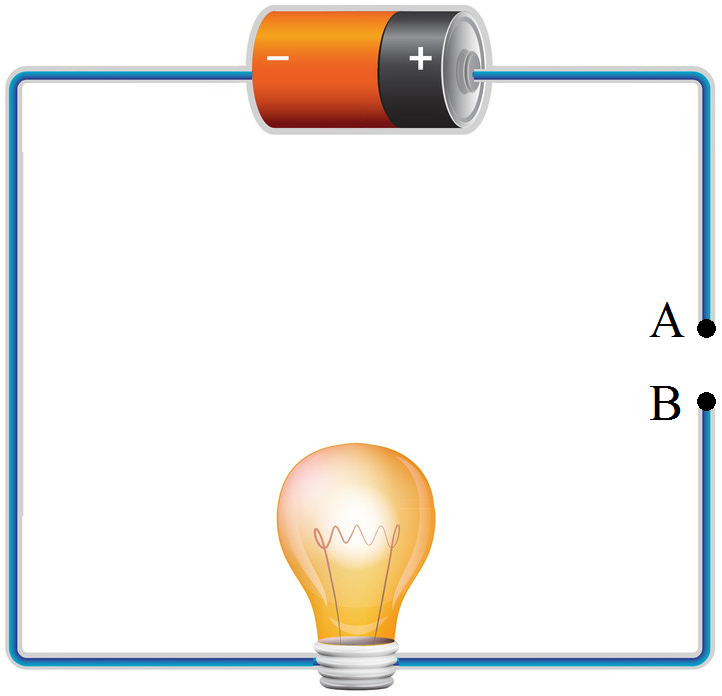
Describe a simple experiment to show that the bulb lights up when an electric circuit is complete and vice-versa.
Answer
  • Take a dry cell, a small torch bulb (fitted with a holder) and a copper connecting wire.
  • Connect the dry cell, the bulb and the copper wire as shown below.
  • Leave a gap in this connection and mark it as $AB.$
  • Due to the gap $AB$ the electric circuit is not complete and therefore the bulb does not glow.
  • Take a pencil and fit it in the gap $AB.$ You will find that the bulb glows as the circuit is complete.
View full question & answer
5 Marks Questions - Science STD 7 Questions - Vidyadip