Questions

5 Marks Questions

🎯

Test yourself on this topic

6 questions · timed · auto-graded

Question 15 Marks
Identify Conductors and Insulators
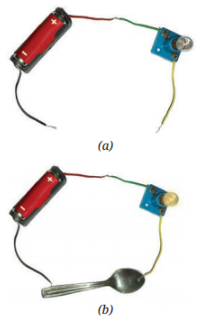
Image
Answer
Table : Identifying Conductors and Insulators
ObjectMaterial:
It is made up of
Lamp glows
(Yes/No)
Conclusion
(Conductor/ Insulator)
StickWoodNoInsulator
ScalePlasticNoInsulator
BangleGlassNoInsulator
Paper stripPaperNoInsulator
CandleWaxNoInsulator
KeyMetalYesConductor
EraserRubberNoInsulator
PaperclipMetalYesConductor
Copper wireCopperYesConductor
Aluminum foilAluminumYesConductor
Rubber bandRubberNoInsulator
Glass jarGlassNoInsulator

Observation and conclusion: This activity shows the difference between conductors and insulators. Conductors allow electricity to flow through them, making the lamp glow. Insulators, on the other hand, do not allow the current to pass through them, so the lamp stays off.
View full question & answer
Question 25 Marks
Explain the difference between an LED and an incandescent lamp.
Answer
Feature LED(Light Emitting Diode)Incandescent Lamp
How it WorksEmits light when current passes through itHeats a filament until it glows
EfficiencyVery energy-efficientInefficient
LifespanLong (thousands of hours)Short
HeatProduces very little heatProduces a lot of heat
PolarityRequires correct polarityNo polarity requirements
FilamentDo not have filamentsHave filaments
View full question & answer
Question 35 Marks
Describe how to make a simple switch.
Answer
 Materials Needed:
Two drawing pins,A safety pin (or paper clip),Two pieces of insulated wire},A small piece of cardboard
→ Take the small piece of cardboard. This will serve as the base for your switch.
→ Make sure the cardboard is dry and clean.
→ Push one of the drawing pins through the loop or head of the safety pin.
→ Insert this drawing pin into the cardboard.
→ Ensure the safety pin can rotate freely around the drawing pin. This will be the movable part of your switch.
→ Place the second drawing pin a short distance away from the first one on the cardboard.
→ Position it so that the free end of the safety pin can touch this drawing pin when rotated.
→ Push the second drawing pin firmly into the cardboard.
→ Take the two pieces of insulated wire.Wrap one end of the first wire around the first drawing pin (the one with the safety pin).
→ Wrap one end of the second wire around the second drawing pin.
→ Make sure the wire makes good contact with the metal of the drawing pins.
→ Now, switch is ready to be tested.
→ Connect the free ends of the wires into a circuit with a battery and a light bulb.
→ When the safety pin is touching the second drawing pin, the circuit is complete, and the bulb should light up.
→ When the safety pin is not touching the second drawing pin, the circuit is open, and the bulb should not light up.
View full question & answer
Question 45 Marks
What are the safety precautions while working with electricity?
Answer
→ Electricity can be dangerous, and it's crucial to handle it with care to prevent injury or accidents.
 → Firstly, never touch electrical switches or plugs with wet hands, as water increases the risk of electric shock.
 → Secondly, avoid using electrical devices in wet areas or near water sources.
→ Thirdly, always ensure that electrical equipment is properly insulated, and never handle equipment with damaged insulation or broken plugs.
→ Remember, our body is a conductor of electricity, so it's essential to take precautions to prevent electric current from passing through it.
View full question & answer
Question 65 Marks
Describe the working of a torchlight.
Answer
→ A torchlight works by using a simple electrical circuit to produce light.
→ It starts with a battery (or multiple batteries) as its power source. When you turn the switch on, it closes the circuit, allowing electric current to flow from the battery.
→ This current travels through a thin wire called a filament (in older torchlights) or a Light Emitting Diode (LED) in newer ones. As the current passes through the filament, it heats up and glows brightly, producing light. In an LED, the current causes the diode to emit light directly.
→ The light is then focused by a reflector, which is a shiny, curved surface behind the bulb or LED, directing the light forward to illuminate the path in front of you.
→ When you switch the torch off, it breaks the circuit, stopping the flow of current and turning off the light.
→ So, in summary, a torchlight uses electrical energy from a battery to create light through a closed circuit involving a bulb or LED and a reflector to direct the light.
View full question & answer
5 Marks Questions - Science STD 7 Questions - Vidyadip