Questions

2 Marks Questions

Take a timed test

28 questions · self-marked practice — reveal the answer and mark yourself.

Question 12 Marks
You must be familiar with the following nursery rhymes:
  1. ‘Baa baa black sheep, have you any wool.’
  2. ‘Mary had a little lamb, whose fleece was white as snow.’
Answer the following:
  1. Which parts of the black sheep have wool?
  2. What is meant by the white fleece of the lamb?
Answer
  1. Wool is obtained from the hairy fibres (hair) of the sheep.
  2. White fleece of the lamb refers to the white coloured hair of the lamb.
View full question & answer
Question 22 Marks
Why does silk have different varieties?
Answer
Silk-producing moth eats up different kinds of leaves, which accounts for the different varieties of silk. Thus, tassar silk, mooga silk, kosa silk, etc., are obtained from cocoons spun by different types of moths.
View full question & answer
Question 32 Marks
Why a cotton garment cannot keep us as warm in winter as a woollen sweater can?
Answer
Woollen sweater traps air in between whereas cotton allows the air to pass through it. Air being a bad conductor of heat does not let body heat to escape beyond the sweater. Therefore, it is much warmer.
View full question & answer
Question 42 Marks

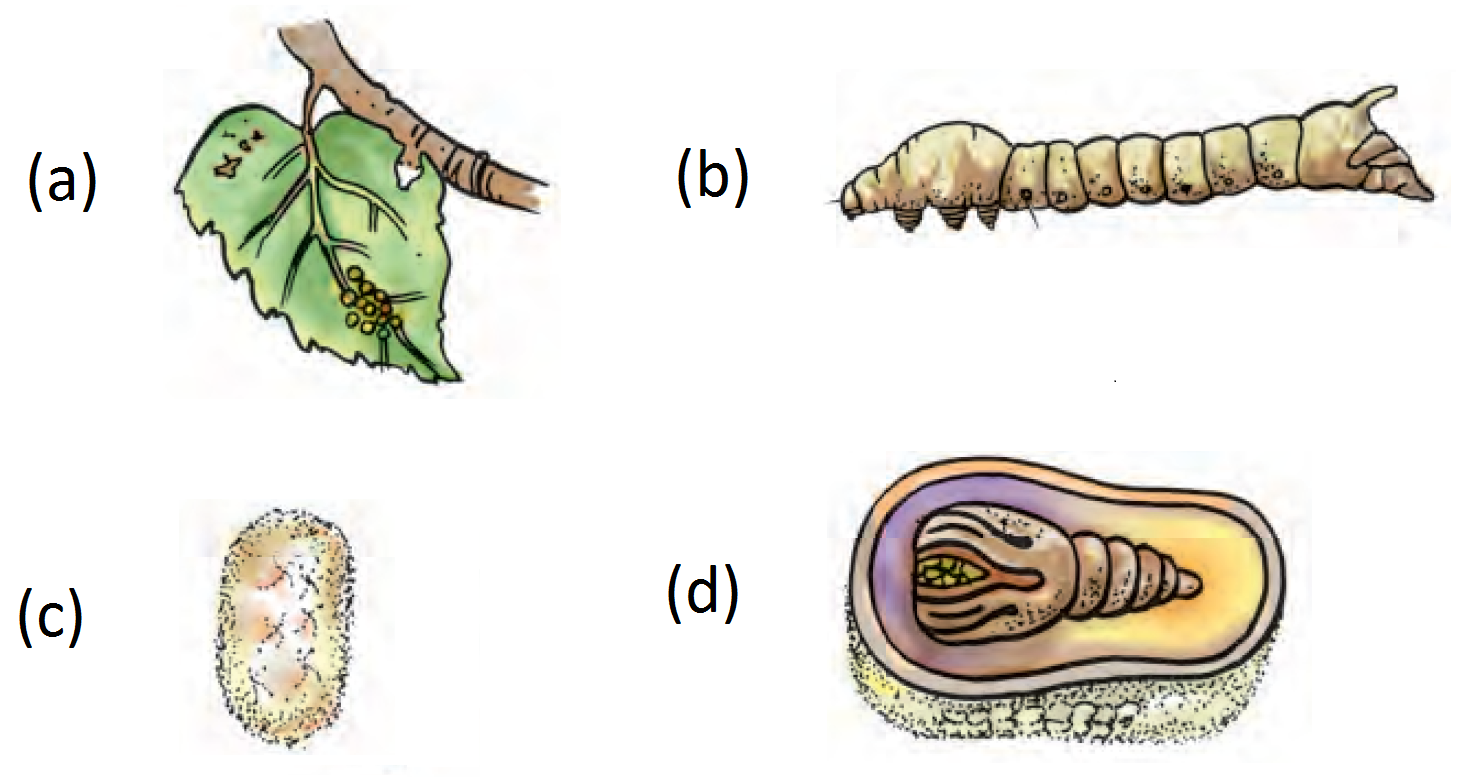
Write a caption for each of the figures given as figure (a-d).
Answer
  1. Eggs of silk moth on mulberry leaves.
  2. Silkworm.
  3. Cocoon.
  4. Cocoon with developing moth.
View full question & answer
Question 52 Marks
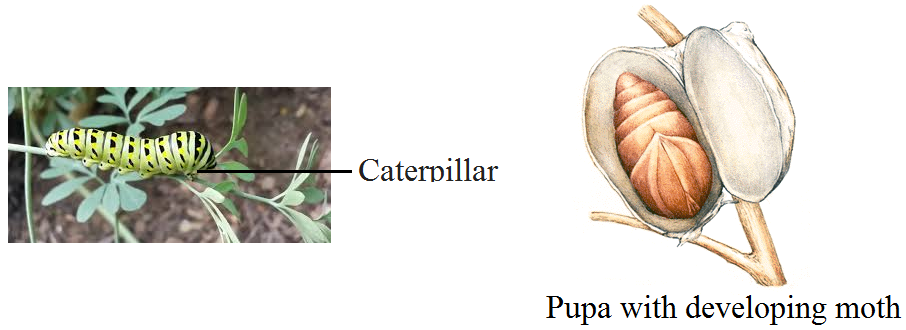
Why caterpillars need to shed their skin when they grow bigger?
Answer
The caterpillars eat their own shed skin during their growing stage and have no other food option. So they need to shed their skin when they grow bigger enter the next stage of its life history called pupa.
View full question & answer
Question 62 Marks
Explain the process of obtaining silk?
Answer
For obtaining silk, moths are reared and their cocoons are collected to get silk threads. The cocoons are boiled to separate out silk fibres from cocoon. Threads obtain from the cocoon spun into silk threads, which are woven into silk cloth by weavers. The process of taking out threads from the cocoon for use as silk is called reeling the silk.
View full question & answer
Question 72 Marks
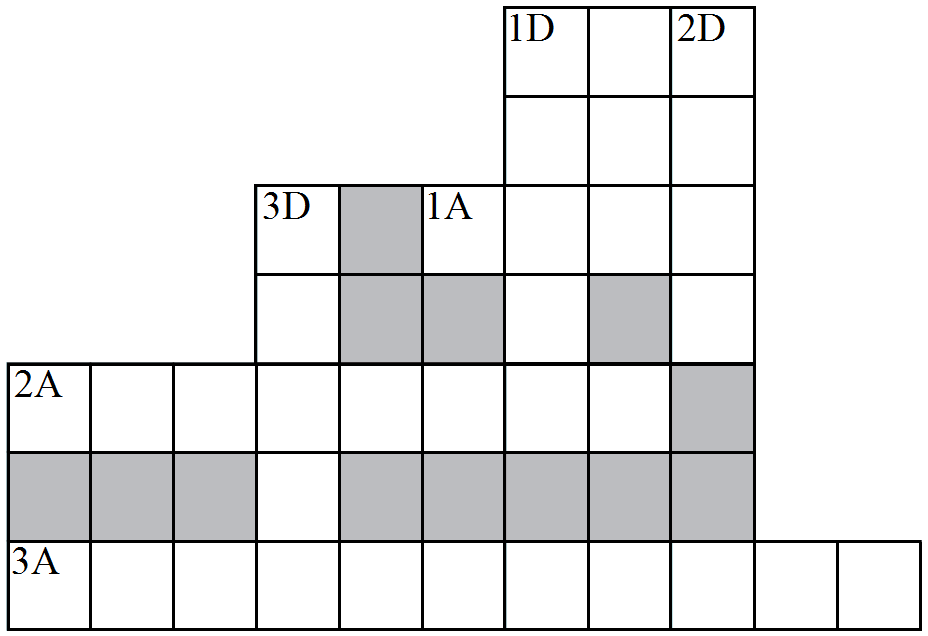
Given below is a crossword puzzle based on this lesson. Use hints to fill in the blank spaces with letters that complete the words.
Down
Across
(D)
$1.$
Thorough washing
(A)
$1.$
Keeps warm
 
$2.$
Animal fibre
 
$2.$
Its leaves are eaten by silkworms
 
$3.$
Long thread like structure
 
$3.$
Hatches from egg of moth
View full question & answer
Question 82 Marks
Write three uses of wool.
Answer
  1. It is used to make sweaters, shawls and other warm clothes.
  2. It is used to make blankets, upholstery, carpets, etc.
  3. It is used in sound proofing.
View full question & answer
Question 92 Marks
Cocoon is used to obtain silk thread. How?
Answer
A pile of cocoon is used for obtaining silk fibre. The cocoon are kept under the sun, boiled water or exposed to steam. The silk fibres separate out. The process of taking out threads from the cocoon for use as silk is called reeling the silk.
View full question & answer
Question 102 Marks
What are occupational hazards?
Answer
These are the dangers to human health due to the working conditions. For example, people working in woollen industry get infected by anthrax and those in sericulture industry suffer from backaches and leg deformities.
View full question & answer
Question 112 Marks
Write the difference between natural silk and artificial silk.
Answer
Natural silk is obtained from the cocoons of silkworms and it is made up of a protein. Natural silk is an animal fibre. Artificial silk is obtained from wood pulp and it is made up of modified plant material ‘cellulose’.
If we perform the burning test, then natural silk fibre burns giving a smell of burning hair while artificial fibre burns giving a smell of burning paper.
View full question & answer
Question 122 Marks
Name the most common silk moth. What are the characteristics of silk fibres obtained from the cocoons of this silk moth?
Answer
The most common silk moth is the mulberry silk moth. The silk obtained from the cocoons of mulberry silk moth is called mulberry silk. Mulberry silk is soft, lustrous (shiny) and elastic and can be dyed in different colours.
View full question & answer
Question 132 Marks
Distinguish between natural fibres and synthetic fibres.
Answer
S.No.
Natural fibres
Synthetic fibres
$(i)$
These are obtained naturally from plants and animals.
These are prepared by man in laboratory.
$(ii)$
For example, wool, cotton, jute, etc.
For example, nylon, rayon, etc.
View full question & answer
Question 142 Marks
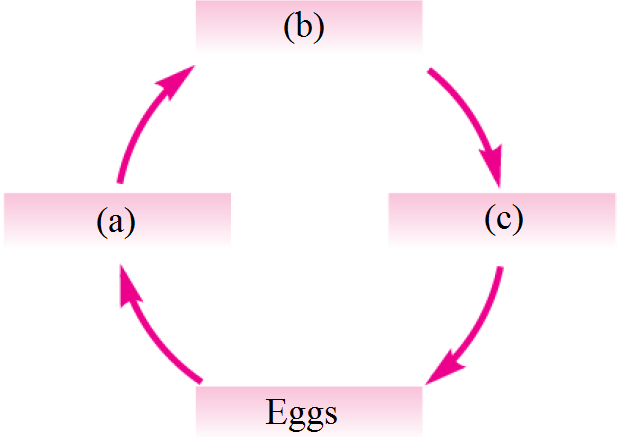
Draw a sketch showing stages in life cycle of silk moth.
Answer
For obtaining silk, moths are reared and their cocoons are collected to get silk threads. The cocoons are boiled to separate out silk fibres from cocoon. Threads obtain from the cocoon spun into silk threads, which are woven into silk cloth by weavers. The process of taking out threads from the cocoon for use as silk is called reeling the silk.
View full question & answer
Question 152 Marks
Why it hurts when someone pulls his hair but not when he goes for a haircut?
Answer
Hair is made up of proteins, which are dead cells. They are attached to the scalp with living cells, from where they grow. So, while getting a haircut a person does not feel pain because dead cells are being cut, but when it is pulled from scalp the living cells are also being pulled along.
View full question & answer
Question 162 Marks
Make sketches of the two stages in the life history of the silk moth which are directly related to the production of silk.
Answer

The two stages in the life history of silk moth directly related to silk production are:
View full question & answer
Question 172 Marks
Why artificial silk is much cheaper than natural silk?
Answer
Artificial silk is obtained from wood pulp and it is made up of cellulose, it is prepared in large scale in factories, so it is cheap while natural silk is made up of silk moth. To obtained silk for commercial purposes, a large number of cocoons are killed, so it is costly.
View full question & answer
Question 182 Marks
Various steps involved to obtain wool from fleece are given here.
  1. Picking out the burrs.
  2. Dyeing in various colours.
  3. Shearing.
  4. Scouring.
  5. Sorting.
Write the above steps in the correct sequence in which they are carried out.
Answer
Correct sequence is,
  1. Shearing.
  2. Scouring.
  3. Sorting.
  1. Picking out the burrs.
  2. Dyeing in various colours.
View full question & answer
Question 192 Marks
Given below is a sequence of steps in the processing of wool. Which are the missing steps? Add them. Shearing, __________, sorting, __________, __________, _________.
Answer
Shearing, scouring, sorting, picking of burrs, dying of fibres, making of yarn.
View full question & answer
Question 202 Marks
Write the different types of fibres that form the hair of sheep.
Answer
There are following two types of fibres that form the hair to sheep:
  1. The coarse beard hair.
  2. Fine soft under hair close to the skin.
View full question & answer
Question 222 Marks
What health problems do workers in the silk industry suffer from?
Answer
Workers in silk industry have breathing problems, infection due to handling of dead worms, vision problems, backaches, leg deformities like bow-leggedness and raw and blistered skin.
View full question & answer
Question 232 Marks
What is selective breeding?
Answer
Certain breeds of sheep have thick coat of hair on their body which yields good quality wool in large quantities. As these sheep are "selectively bred" with one parent being a sheep of good breed. The process of selecting parents for obtaining special characters in their offspring is known as selective breeding.
View full question & answer
Question 242 Marks
Four different types of fibres are given to us. Out of these, two fibres $(1$ and $2)$ are obtained from plants and other two $(3$ and $4)$ fibres are obtained from animals. Fibre
$(1)$ is used in filling quilts and the yarn made of fibre
$(2)$ is used in making gunny bags, The yarn made from fibre
$(3)$ is used for knitting sweaters and yarn of fibre
$(4)$ is used for weaving saries. Name the four given fibres marked $1,2, 3$ and $4$.
Answer
Fibre $($marked $1)$ which is used in filling quilts is cotton and fibre $($marked $2)$ is jute. $($cotton and jute are plant fibres$)$. Fibre $($marked $3)$ is wool and fibre $($marked $4)$ which is used for weaving saris is silk. $($wool and silk are animal fibres$)$.
View full question & answer
Question 252 Marks
Name different types of silk. Which variety of silk is most common and how it is obtained?
Answer
Different types of silk are mulberry silk, tassar silk, mooga silk and kosa silk. The most common variety of silk is mulberry silk. It is obtained from the cocoons of mulberry silkworm and is made up of protein. It is a natural silk and is an animal fibre.
View full question & answer
Question 262 Marks
Some words related with silk are jumbled up. Write them in their correct form:
  1. $TURECULRISE.$
  2. $WILSMORK.$
  3. $BELMURRY.$
  4. $RINGLEE.$
Answer
  1. $SERICULTURE.$
  2. $SILKWORM.$
  3. $MULBERRY.$
  4. $REELING.$
View full question & answer
Question 272 Marks
Silk yarn of different textures can be prepared. Define the statement.
Answer
The silk yarn is obtained from the cocoon of the silk moth. There is a variety of silk moths which look very different from one another and the silk yarn they yield is different in textures (coarse, smooth, shiny, etc.) Thus, tassar silk, mooga silk, kosa silk, etc are obtained from cocoons spun by different types of moths.
View full question & answer
Question 282 Marks
How do the hair of certain animals help in keeping their bodies warm?
Answer
Hair (or wool) of these animals trap a lot of air. Air is a poor conductor of heat. So, the air trapped in hair (or wool) of these animals prevents their body heat from being lost to cold surroundings and keeps them warm.
View full question & answer