Questions

2 Marks Questions

🎯

Test yourself on this topic

37 questions · timed · auto-graded

Question 12 Marks
We often sneeze when we inhale a lot of dust-laden air. What can be possible explanations for this?
Answer
When we inhale a lot of dust-laden air, the dust particles get trapped in the hair of our nasal cavity. These particles irritate the lining of the cavity. As a result, we sneeze to expel these dust particles. Sneezing expels these foreign particles from the inhaled air, and dust-free, clean air enters our bodies.
View full question & answer
Question 22 Marks
What is the role of the diaphragm in breathing?
(i) To help in inhalation and exhalation
(ii) To absorb oxygen
Answer
(i) To help in inhalation and exhalation. The diaphragm contracts and flattens during inhalation to allow the lungs to expand, and relaxes during exhalation to push air out.
View full question & answer
Question 32 Marks
What is the role of the diaphragm in breathing?
(i) To fi lter the air
(ii) To produce sound
Answer
It does not filter air or produce sound. Its main role is to help in the movement of air into and out of the lungs.
View full question & answer
Question 42 Marks
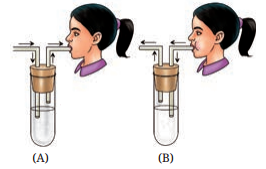
Rakshita designed an experiment taking two clean test tubes, A and B and filled them with lime water as shown in the figure. In test tube A, the surrounding air that we inhale was passed on by sucking air from the pipe, and in test tube B, the exhaled air was blown through the pipe (Fig.). What do you think she is trying to investigate? How can she confirm her findings?
Image
Answer
Rakshita is trying to inve stigate the gas we inhale and exhale while breathing. The lime water in test tube B turned milky (or cloudy), but the lime water in test tube A did not. Lime water turns milky when it reacts with carbon dioxide. Therefore, this indicates that the exhaled air contains more carbon dioxide than the air we inhaled.
View full question & answer
Question 52 Marks
What is the difference between breathing and respiration?
Answer
Breathing is the physical process of inhaling and exhaling air.
Respiration is the chemical process of breaking down food to release energy.
View full question & answer
Question 62 Marks
Write the differences between respiration taking place in humans and fish.
Answer
FeatureHumansFish
Respiratory organLungsGills
MediumAirWater
Gas exchangeOxygen in, carbon dioxide out via lungsOxygen in, carbon dioxide out via gills
Breathing methodInhalation and exhalationWater flows over gills
View full question & answer
Question 82 Marks
Give two reasons to explain why absorption of digested food occurs mainly in the small intestine.
Answer
1.The small intestine has a large surface area due to villi and microvilli.
2.It is lined with blood vessels, which help in quick absorption of nutrients into the bloodstream.
View full question & answer
Question 92 Marks
Give reasons why the diaphragm flattens, and the ribs are lifted when we breathe in.
Answer
The diaphragm flattens and the ribs are lifted to increase the volume of the chest cavity, which reduces pressure inside the lungs and allows air to flow in.
View full question & answer
Question 122 Marks
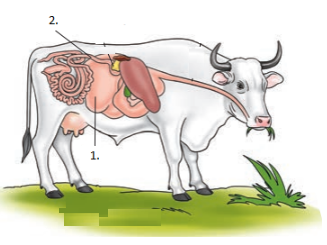
(a) Refer to the diagram of the digestive system and label the parts marked as 1 and 2.
Image
(b) Name the process by which food is digested.
Answer
(a) 1. Rumen 2. Pancreas
(b) Rumination
View full question & answer
Question 132 Marks
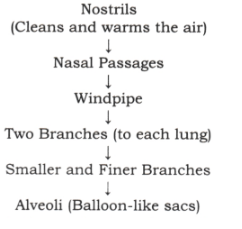
Give the pathway of air in the human respiratory system.
Answer
The pathway of air in the human respiratoiy system is given as:
Image
View full question & answer
Question 142 Marks
Pick the odd-one-out from each of the groups given below on the basis of respiratory organs. Give reason for your answer.
(a) cockroach, grasshopper, snail, ant
(b) lizard, cow, earthworm, snake
(c) crocodile, whale, dolphin, fish
(d) snake, tadpole, crow, goat
Answer
(a) Snail, as it does not breathe through trachea.
(b) Earthworm, because unlike others earthworm breathes through its skin and does not have lungs.
(c) Fish, because unlike others most fishes breathe through their gills and do not have lungs.
(d) Tadpole, because unlike others tadpole breathes through gills and does not have lungs.
View full question & answer
Question 152 Marks
What do you understand by passive smoking?
Answer
Passive smoking, also known as second¬hand smoking, happens when a non-smoker breathes in the smoke from someone else’s cigarette, cigar, or pipe. This smoke contains harmful chemicals, just like the smoke inhaled by the smoker.
View full question & answer
Question 182 Marks
Explain the process of digestion in the small intestine.
Answer
The small intestine is a long, coiled tube (6 metres) where most of the digestion and absorption of food happens. Digestive juices from the liver (bile) and the pancreas (pancreatic juice) are mixed with the food in the small intestine. These juices help to break down fats, proteins, and carbohydrates into simpler forms. After digestion, the tiny finger¬like structures on the inner walls of the small intestine absorb the nutrients into the blood.
View full question & answer
Question 192 Marks
Explain the process of breathing.
Answer
The process of breathing happens in two steps inhalation (breathing in) and exhalation (breathing out).
(i) When we inhale air, the diaphragm moves downwards and the chest cavity expands. This makes space for the lungs to fill with air. Air rushes in and fills the tiny air sacs in the lungs called alveoli.
(ii) When we exhale, the diaphragm moves upwards and the chest cavity becomes smaller. This pushes out the air containing carbon dioxide and water vapour from the lungs.
View full question & answer
Question 202 Marks
Ruminants such as cows and buffaloes swallow their food hurriedly and then sit restfully and chew their food. Can you give the reason?
Answer
Ruminants quickly swallow the food and store it in an isolated part of the stomach called the rumen, where the food gets partially digested and is called cud, which later on returns to the mouth in the form of small lumps and then is chewed up by the animal. This process is called rumination.
View full question & answer
Question 212 Marks
Image
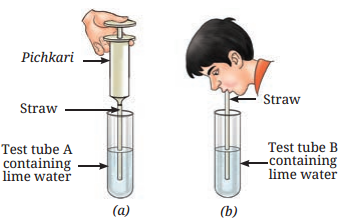
Fig. (a) Air is passed into lime water with a pichkari/syringe
(b) Air is exhaled into lime water
Observation: The lime water in test tube B turns milky as it receives exhaled air but the lime water in test tube A does not.
Answer
Conclusion: This indicates that exhaled air contains carbon dioxide. Lime water reacts with carbon dioxide to form calcium carbonate, which causes the milky appearance. The change only in test tube B confirms that more carbon dioxide is present in the air we breathe out than in the air we breathe in.
View full question & answer
Question 222 Marks
Conduct an experiment with chewed rice and iodine to show starch digestion.
Answer
Take a small piece of chewed rice in a test tube and add a few drops of iodine solution. The colour will not turn blue-black, showing that starch in the rice has been partially digested by saliva.
View full question & answer
Question 252 Marks
Compare and contrast the breathing mechanisms of a frog and a bird.
Answer
FeatureFrogBird
Primary OrganLungs (on land), Skin (in water), Gills (as tadpoles)Lungs
MechanismLungs: Positive pressure breathing (forces air into lungs). Skin: Gas exchange through moist skin. Gills: (as tadpoles) exchange gases between water and blood.Lungs: Air sacs and unidirectional airflow.
View full question & answer
Question 262 Marks
A person chews food fast but swallows it without proper chewing. What problems can arise?
Answer
The stomach and small intestine have to work harder to break down the larger food particles.This can lead to indigestion, bloating, and discomfort.Nutrient absorption may not be as efficient because the food isn't properly broken down.
View full question & answer
Question 272 Marks
In winter, people feel breathless in hilly areas. Why?
Answer
At higher altitudes, the air pressure is lower. This means there are fewer oxygen molecules in each breath you take compared to what you'd get at sea level.Cold air can irritate your lungs and airways, causing them to constrict. This makes it harder to breathe deeply and get enough oxygen.So, when people are in hilly areas during winter, the combination of less oxygen in the air and the constricting effect of cold air on their lungs can lead to feelings of breathlessness.
View full question & answer
Question 282 Marks
Priya observed that lime water turned milky on blowing through a straw. What did she conclude?
Answer
Priya likely concluded that the air she exhaled contains carbon dioxide. Lime water turns milky when it reacts with carbon dioxide, so by blowing through the straw and observing this change, Priya determined that her breath contained a significant amount of carbon dioxide, a key byproduct of respiration.
View full question & answer
Question 292 Marks
Sahil says that stomach acid is harmful. Do you agree or disagree? Justify.
Answer
I partially agree with Sahil. Stomach acid, or hydrochloric acid, is essential for digestion as it helps break down proteins and kills harmful bacteria. However, it can also be harmful because its corrosive nature can damage the stomach lining. The stomach produces mucus to protect itself from the acid's effects, but if this protection fails, it can lead to ulcers or other digestive issues.
View full question & answer
Question 302 Marks
What would happen if the mucus lining in the stomach were absent?
Answer
If the mucus lining in the stomach were absent, the stomach would be exposed to the corrosive effects of hydrochloric acid. This would lead to the stomach acid digesting the stomach's own tissues, causing ulcers and severe damage to the stomach lining. Consequently, the stomach's function would be impaired, leading to digestive problems and internal bleeding.
View full question & answer
Question 312 Marks
Why do athletes breathe heavily after a race?
Answer
Athletes breathe heavily after a race to replenish the oxygen debt incurred during intense physical activity. During the race, their muscles require more energy than the body can supply through normal oxygen intake, leading to anaerobic respiration and the build-up of lactic acid. The heavy breathing helps to clear the excess carbon dioxide, convert lactic acid back into glucose, and restore the body's oxygen levels to normal.
View full question & answer
Question 322 Marks
If bile were absent in the body, what impact would it have on digestion?
Answer
If bile were absent, fat digestion would be significantly impaired because bile emulsifies fats into smaller droplets, increasing the surface area for enzymes to act on. Additionally, the absorption of fat-soluble vitamins would be reduced, impacting overall nutrient uptake.
View full question & answer
Question 332 Marks
Mention two ways in which birds and mammals differ in food digestion.
Answer
(1) Presence of a Gizzard (Birds):
→ Birds lack teeth, so they have a specialized organ called a gizzard.
→ Mammals, on the other hand, use their teeth for the initial breakdown of food through chewing.
(2) Crop for Storage (Birds):
→ Many birds have a crop, which is an expanded part of the esophagus used for storing food temporarily.
 → Mammals do not have a crop; instead, their stomach is the primary storage site for ingested food.
View full question & answer
Question 342 Marks
What is the function of nasal hairs and mucus in the respiratory system?
Answer
Nasal hairs and mucus play a crucial role in the respiratory system by filtering and cleaning the air we breathe. The nasal hairs trap larger particles like dust and pollen, preventing them from entering the lungs. Simultaneously, the mucus moistens the incoming air and traps smaller particles, further ensuring that the air reaching the lungs is clean and humidified, which is essential for healthy respiratory function.
View full question & answer
Question 352 Marks
Explain the term "mechanical digestion" with an example.
Answer
Mechanical digestion is the physical breakdown of food into smaller pieces. This process increases the surface area of food, making it easier for chemical digestion to occur. An example of mechanical digestion is chewing food in your mouth. Your teeth break down large pieces of food into smaller ones, which helps your saliva mix with the food and start the process of chemical digestion.
View full question & answer
Question 362 Marks
Why does food taste sweet when chewed for a longer time?
Answer
Food, especially those rich in starch like chapati or rice, tastes sweeter when chewed for a longer time because of the action of saliva. Saliva contains an enzyme called amylase, which breaks down the complex starch molecules into simpler sugars, such as glucose and maltose. These sugars are what give the food a sweet taste as they are released during prolonged chewing.
View full question & answer
Question 372 Marks
Why is digestion important for animals?
Answer
Digestion is crucial for animals because it breaks down complex food components into simpler, absorbable forms that the body can use. This process is essential for obtaining nutrients needed for energy, growth, and repair. Without digestion, animals cannot effectively utilize the food they consume, leading to malnutrition and an inability to sustain life processes.
View full question & answer
2 Marks Questions - Science STD 7 Questions - Vidyadip