Questions

5 Marks Questions

🎯

Test yourself on this topic

9 questions · timed · auto-graded

Question 15 Marks
With the help of a diagram, explain the percentage of oxygen and carbon dioxide in inhaled and exhaled air.
Answer
self
View full question & answer
Question 25 Marks
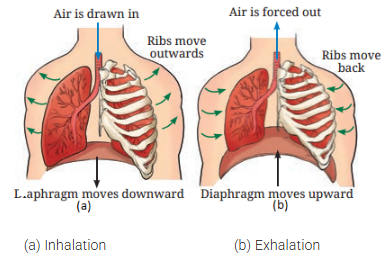
Explain the mechanism of breathing with the help of a diagram.
Answer
Breathing means taking in air (inhalation) and letting it out (exhalation). We breathe to get oxygen and remove carbon dioxide. Air enters through the nostrils, passes through the nasal passages, and goes into the windpipe. The windpipe splits into two branches, one for each lung. Inside the lungs, these divide into smaller tubes ending in alveoli, where gases are exchanged.
When we inhale, the ribs move up and out, and the diaphragm moves down. This increases space in the chest, and air enters the lungs. When we exhale, the ribs move down and in, and the diaphragm moves up. This pushes air out of the lungs.
Image
View full question & answer
Question 45 Marks
Differentiate between breathing and respiration.
Answer
FeatureBreathingRespiration
DefinitionPhysical process of inhaling and exhaling air.Chemical process of breaking down glucose to release energy.
LocationOccurs in the lungs.Occurs in the cells throughout the body.
EnergyNo energy is released.Energy is released.
Gases InvolvedIntake of oxygen and release of carbon dioxide.Oxygen is used, and carbon dioxide is produced as a waste product.
PurposeTo exchange gases between the body and the environment.To release energy for the body's functions.
View full question & answer
Question 55 Marks
Describe how the pancreas and liver help in digestion.
Answer
→ The pancreas and liver are vital organs that secrete digestive juices in the small intestine to aid the breakdown of food.
→ The liver produces bile, which neutralizes acids present in the food and breaks down fats into smaller droplets for easier digestion.
 → The pancreas secretes pancreatic juice, which contains enzymes that further break down carbohydrates, proteins, and fats.
→ These secretions from the liver and pancreas ensure that food is thoroughly digested and nutrients can be absorbed effectively in the small intestine.
View full question & answer
Question 65 Marks
Write about the test to confirm the action of saliva on starch.
Answer
→ To confirm the action of saliva on starch, a simple test can be performed using two test tubes.
 → In test tube A, boiled rice is mixed with water, and in test tube B, boiled rice that has been chewed for about a minute is mixed with water.
→ A few drops of iodine solution are then added to each test tube.
 → Iodine reacts with starch to produce a blue-black color. In test tube A, the presence of starch will cause the solution to turn blue-black.
 → However, in test tube B, the chewing action mixes the rice with saliva, which contains an enzyme called amylase.
→ Amylase breaks down the starch into simpler sugars.
 → As a result, the iodine solution in test tube B will either show no color change or turn only a light blue color, indicating that the starch has been partially or completely broken down by the saliva.
→ This test confirms that saliva aids in the digestion of starch by breaking it down into simpler sugars.
View full question & answer
Question 75 Marks
Compare respiration in humans, earthworms, and fish.
Answer
FeatureHumansEarthwormsFish
Respiratory OrganLungs with alveoliMoist skinGills
EnvironmentTerrestrial (land)Terrestrial (land)Aquatic (water)
MechanismInhalation and exhalation through nasal passages, windpipe, and lungsGas exchange through the skinWater flows over gills, oxygen extracted, carbon dioxide released
Gas ExchangeOxygen from air into blood, carbon dioxide from blood into airOxygen from air into blood, carbon dioxide from blood into airOxygen from water into blood, carbon dioxide from blood into water
AdaptationsLungs with large surface area (alveoli) for efficient gas exchangeMoist skin to facilitate gas diffusionGills with many filaments and lamellae to increase surface area
View full question & answer
Question 85 Marks
Explain the respiratory system in humans in detail.
Answer
→ The human respiratory system is responsible for the exchange of gases, primarily oxygen and carbon dioxide, enabling us to breathe and sustain life.
→ The process begins with air entering through the nostrils, where tiny hairs and mucus trap dust and dirt particles.
 → The air then passes through the nasal passages, which warm and moisten it before it enters the windpipe (trachea).
→ The trachea divides into two bronchi, one for each lung. Inside the lungs, the bronchi further branch into smaller and finer tubes called bronchioles, which end in tiny air sacs known as alveoli.
→ These alveoli are surrounded by a network of blood vessels.
→ Oxygen from the inhaled air diffuses across the thin walls of the alveoli into the blood, while carbon dioxide from the blood moves into the alveoli to be exhaled.
→ The diaphragm, a dome-shaped muscle below the lungs, and the rib cage play crucial roles in breathing. During inhalation, the diaphragm contracts and moves downward, while the rib cage expands, increasing the chest volume and allowing air to rush into the lungs.
→ During exhalation, the diaphragm relaxes and moves upward, while the rib cage contracts, decreasing the chest volume and forcing air out of the lungs.
 → This continuous exchange of gases ensures that the body receives the oxygen it needs and eliminates carbon dioxide, a waste product of cellular activities.
View full question & answer
Question 95 Marks
Describe the process of digestion from the mouth to the anus in humans.
Answer
(1) Mouth:
→ Your teeth break down food into smaller pieces through mechanical digestion.
→ Saliva contains enzymes that start to break down carbohydrates (chemical digestion).
(2) Oesophagus (Food Pipe):
→ The chewed food goes down the oesophagus.
→ The walls of the oesophagus contract and relax to push the food down to the stomach.
(3) Stomach:
→ The stomach churns the food and mixes it with digestive juices.
→ The stomach lining secretes acid and enzymes that break down proteins.
(4) Small Intestine:
→ This is where most of the digestion and absorption of nutrients occur.
→ The liver and pancreas contribute digestive juices (as we discussed earlier).
→ The inner lining of the small intestine has finger-like projections called villi, which increase the surface area for nutrient absorption into the bloodstream.
(5) Large Intestine:
→ Here, water and salts are absorbed from the undigested food.
→ The remaining waste becomes semi-solid and is stored as stool.
(6) Anus:
→ Finally, the stool is expelled from the body through the anus in a process called egestion.
View full question & answer
5 Marks Questions - Science STD 7 Questions - Vidyadip