Questions

2 Marks Questions

Take a timed test

38 questions · self-marked practice — reveal the answer and mark yourself.

Question 12 Marks
Design an experiment to observe if water transportation in plants is quicker in warm or cold conditions.
Answer
To test whether water transportation in plants is quicker in warm or cold conditions, take two identical potted plants. Place one plant in a warm location (near a heater or sunny spot) and the other plant in a cool place (like in the shade). Add a few drops of food colouring to the water and water both plants. After a few hours, observe the movement of the coloured water up the stem and into the leaves. The plant in the warm conditions will show faster movement of the coloured water, as higher temperatures increase the rate of evaporation and water transportation.
View full question & answer
Question 22 Marks
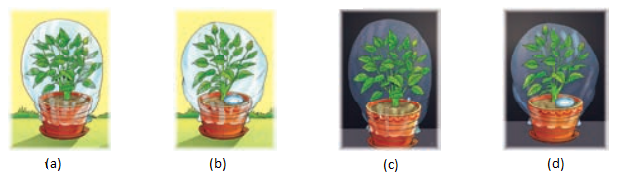
Vani believes that ‘carbon dioxide is essential for photosynthesis’. She puts an experimental set-up, as shown in Fig, to collect evidence to support or reject her idea.
Image
Fig. A potted plant with sufficient water is placed under the prescribed conditions.
(a) Sunlight with carbon dioxide
(b) Sunlight without carbon dioxide
(c) Dark with
(d) Dark without carbon dioxide carbon dioxide
Answer the following questions.
(i) In which plant(s) in the above set-up(s) will starch be formed?
(ii) In which plant(s) in the above set-up(s) will starch not be formed?
(iii) In which plant(s) in the above set-up(s) will oxygen be generated?
(iv) In which plant(s) in the above set-up(s) will oxygen not be generated?
Answer
(i) Only in plant kept in sunlight with carbon dioxide, starch will be formed.
(ii) In all plants except the plant kept in sunlight with carbon dioxide.
(iii) Oxygen will be generated in a plant kept in sunlight with carbon dioxide.
(iv) Except for the plant kept in sunlight with carbon dioxide, oxygen will not be generated in any of the other plants.
View full question & answer
Question 32 Marks
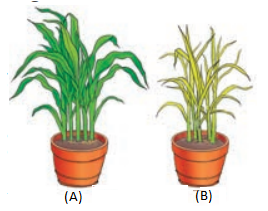
Krishna set-up an experiment with two potted plants of same size and placed one of them in sunlight and the other in a dark room, as shown in Fig.
Image
(i) What idea might she be testing through this experiment?
(ii) What are the visible differences in plants in both the conditions?
(iii) According to you, leaves of which plants confirm the iodine test for the presence of starch?
Answer
(i) Through this experiment, she is testing whether sunlight is necessary for photosynthesis in plants or not.
(ii) The plant kept in sunlight looks healthy and green as it performs photosynthesis while the plant kept in the dark room looks weak, pale, and yellowish because it cannot perform photosynthesis properly.
(iii) The leaves of the plant kept in sunlight will confirm the iodine test for starch.
View full question & answer
Question 42 Marks
Does the broad and flat structure of leaves make plants more efficient for photosynthesis? Justify your answer.
Answer
Yes, the broad and flat structure of leaves makes plants more efficient for photosynthesis. This shape increases the surface area, allowing more sunlight to be absorbed by the chlorophyll present in the leaves. It also helps in the exchange of gases through the stomata, thus enhancing the process of photosynthesis.
View full question & answer
Question 52 Marks
A potato slice shows the presence of starch with iodine solution. Where does the starch in potatoes come from? Where is the food synthesised in the plant, and how does it reach the potato?
Answer
The starch in potatoes comes from the glucose produced in the leaves during photosynthesis. Photosynthesis occurs in the leaves, where food is synthesised in the form of glucose. This glucose is then transported through the plant to the potato, where it is stored in the form of starch.
View full question & answer
Question 62 Marks
Imagine a situation where all the organisms that carry out photosynthesis on the earth have disappeared. What would be the impact of this on living organisms?
Answer
If all organisms that cany out photosynthesis disappeared, there would be no production of oxygen and food for other living organisms. This would disrupt the food chain, as plants provide food for herbivores and oxygen for respiration. Without plants, life on Earth would not be sustained.
View full question & answer
Question 72 Marks
Photosynthesis and respiration are essential to maintain balance in nature. Discuss.
Answer
Photosynthesis and respiration help maintain the balance of gases in nature. During photosynthesis, plants use sunlight, water, and carbon dioxide to make food and release oxygen. In respiration, plants and animals use oxygen to break down food for energy, releasing carbon dioxide. This exchange of gases keeps oxygen and carbon dioxide levels balanced, supporting life on Earth.
View full question & answer
Question 82 Marks
What is respiration in plants? How is it different from photosynthesis? Explain the importance of both processes.
Answer
Respiration in plants is the process of breaking down glucose to release energy.
Difference: Photosynthesis produces glucose using sunlight, while respiration releases energy from glucose.
Importance: Photosynthesis provides food and oxygen, while respiration provides energy for growth, reproduction, and other life processes.
View full question & answer
Question 92 Marks
Why is chlorophyll important for the production of starch in plants?
Answer
Chlorophyll absorbs sunlight, which provides the energy needed for photosynthesis. Without chlorophyll, plants cannot produce glucose, which is later stored as starch.
View full question & answer
Question 102 Marks
How do leaves exchange gases during the process of photosynthesis?
Answer
Leaves exchange gases through stomata, small openings on the surface of the leaf. Carbon dioxide enters the leaf through stomata, and oxygen produced during photosynthesis exits through them.
View full question & answer
Question 112 Marks
How is food produced by leaves transported to other parts of the plant?
Answer
Food produced in the leaves in the form of glucose is transported to other parts of the plant through phloem in the form of sucrose to provide energy for growth and storage.
View full question & answer
Question 132 Marks
What is the role of stomata in both photosynthesis and respiration?
Answer
Stomata are tiny pores present on the lower surface of leaves. During photosynthesis, stomata allow carbon dioxide to enter the leaves. During respiration, they help in the exchange of gases oxygen comes in, and carbon dioxide goes out. Stomata are very important because they help the plant breathe and make food. Without them, the plant would not be able to take in the gases needed for life processes.
View full question & answer
Question 142 Marks
Fill in the blanks of the paragraph given below with the words provided in the box.
chlorophyll, energy, food, carbon, dioxide, water, photosynthesis
Note: A word can be used more than once.
Leaves have a green pigment called _______ which captures _______ from sunlight. This energy is used in the process of _______ and, along with other raw materials like _______ and _______ synthesises _______.
Answer
Leaves have a green pigment called chlorophyll, which captures energy from sunlight. This energy is used in the process of photosynthesis and, along with other raw materials like carbon dioxide and water, synthesises food.
View full question & answer
Question 152 Marks
How do plants transport raw materials to the food factories of the plants?
Answer
Plants transport raw materials to the leaves through different methods. Water is absorbed by the roots and carried to the leaves viaxylem vessels, while carbon dioxide enters the leaves through stomata. Nutrients from the soil are also transported with water. These materials are used by the leaves to make food through photosynthesis. The food prepared in the leaves are transported to other parts of the plant through another set of thin tube-like structure called the phloem.
View full question & answer
Question 162 Marks
Give a brief description of the process of synthesis of food in green plants.
Answer
Green plants make their food using sunlight, carbon dioxide, and water. The chlorophyll in the leaves absorbs sunlight, while the plant takes in carbon dioxide from the air through small openings called stomata and water from the soil through the roots. Using sunlight’s energy, the plant combines carbon dioxide and water to produce glucose (food) and release oxygen as a by-product.
View full question & answer
Question 172 Marks
How do plants obtain the raw materials for photosynthesis from the surroundings?
Answer
Plants obtain the raw materials for photosynthesis from their surroundings in different ways. They absorb water through their roots from the soil, take in carbon dioxide from the air through stomata, and capture sunlight using the chlorophyll in their leaves.
View full question & answer
Question 182 Marks
Sunlight, chlorophyll, carbon dioxide, water, and minerals are raw materials essential for photosynthesis. Do you know where they are available? Fill in the blanks with the appropriate raw materials.
(a) Available in the plant : ______
(b) Available in the soil : ______
(c) Available in the air : ______
(d) Available during day : ______
Answer
(a) Chlorophyll
(b) Water, minerals
(c) Carbon dioxide
(d) Sunlight
View full question & answer
Question 192 Marks
A goat eats away all the leaves of a small plant (balsam). However, in a few days, new leaves could be seen sprouting in the plant again. How did the plant survive without leaves?
Answer
During the process of photosynthesis, the plant takes water, carbon dioxide, and essential nutrients from the surroundings, converts them to energy or carbohydrates, and stores them. The plant managed to survive in the absence of leaves due to the energy stored in the plant in the form of starch.
View full question & answer
Question 202 Marks
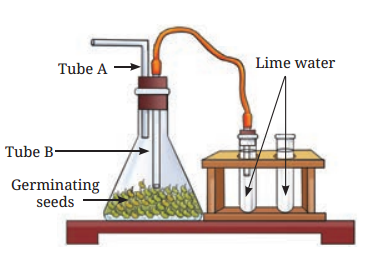
Fig. Set-up to test respiration in plants
(i) Does the lime water turn milky in both the test tubes?
(ii) Why does the lime water turn milky in the test tube connected to the flask?
Image
Answer
(i) The lime water turn milky only in the test tube connected to the flask.
(ii) Lime water turns milky due to the presence of carbon dioxide. This carbon dioxide is produced by the seeds during respiration.
Observation and Conclusion: Plants also respire like us and release carbon dioxide.
View full question & answer
Question 212 Marks
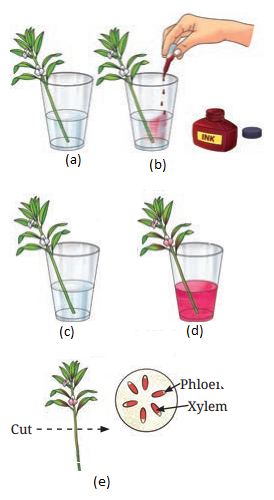
Fig. Experiment to check for water transportation in plants
(a) With water
(b) With coloured water, plant twigs placed in water with different treatments
(c) With water
(d) With coloured water, plant twigs after one day
(e) Enlarged view of cut end of the twig
Image
Answer
Observation and Conclusion :
This experiment shows that water and minerals are transported through the xylem in plants. Xylem is thin, tube-like structure found in the stem, branches, and leaves, carrying water and minerals from the roots to all parts of the plant.
View full question & answer
Question 222 Marks
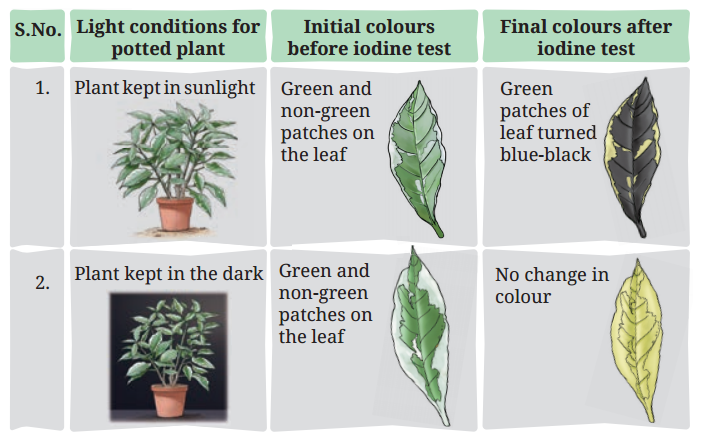
Table : Presence of starch in green and non-green parts of the leaves of plants
Image
Answer
Observation and Conclusion :
Only the green parts of the leaf can perform photosynthesis and make starch due to the presence of chlorophyll.
Sunlight is necessary for photosynthesis to occur and for starch to be produced in leaves.
View full question & answer
Question 232 Marks
How does sunlight contribute in the production of starch in plants?
Answer
Sunlight is important for photosynthesis, the process by which plants make food. The chlorophyll present in the leaves helps in capturing sunlight. In the process of photosynthesis, plants use the absorbed sunlight, carbon dioxide, and water to make glucose. This glucose is later stored in the plant as starch.
View full question & answer
Question 252 Marks
Colour and label the parts of the plant where photosynthesis occurs.
Answer
Photosynthesis primarily occurs in the leaves, which contain the pigment chlorophyll that captures sunlight. While leaves are the main sites, other green parts of the plant, such as stems, can also perform photosynthesis to a lesser extent.
View full question & answer
Question 272 Marks
How does respiration help in plant growth and energy supply?
Answer
Respiration is essential for plant growth and energy supply because:
→ It breaks down glucose to release energy, which is then used for various activities like growth, repair, and maintenance.
→ The energy produced helps in the development of new cells, tissues, and organs, supporting overall growth and health.
View full question & answer
Question 282 Marks
Why is transporting food from leaves necessary in large trees?
Answer
Transporting Food from Leaves is Necessary in Large Trees because Large trees have extensive structures (roots, branches, trunk) that require energy for growth and maintenance, which leaves provide through photosynthesis.Leaves produce food, but roots and interior cells cannot perform photosynthesis, so they depend on the transport of food (sugars) from the leaves to function and survive.
View full question & answer
Question 292 Marks
If stomata remain open all day, what impact would it have?
Answer
If stomata remained open all day,Plants would lose too much water through transpiration, potentially leading to dehydration.Although continuous carbon dioxide intake could boost photosynthesis, the risk of dehydration would outweigh the benefits, ultimately harming the plant.
View full question & answer
Question 302 Marks
Imagine you grow two plants - one in a greenhouse and one outdoors. What variables will affect photosynthesis?
Answer
Several variables will affect photosynthesis differently for plants grown in a greenhouse versus outdoors:
Sunlight is direct and intense outdoors, but it may be diffused or reduced in a greenhouse.Greenhouses can trap heat, leading to higher temperatures than outdoors.Greenhouses can sometimes have lower CO2 levels compared to open outdoor environments, depending on ventilation.Both environments require adequate water, but humidity levels and watering schedules can vary, impacting the plant.
View full question & answer
Question 312 Marks
Why do plants store food as starch instead of glucose?
Answer
Starch is insoluble in water, which prevents it from disrupting the water balance within cells. If glucose were stored, it would dissolve and potentially cause osmotic stress.Starch is a large, compact molecule, allowing plants to store a significant amount of energy in a small space. Glucose molecules would take up more space and be less efficient for storage.
View full question & answer
Question 322 Marks
Why do some red-coloured leaves still perform photosynthesis?
Answer
Red-colored leaves can still perform photosynthesis because:
They still contain chlorophyll, which is essential for photosynthesis. The red pigments (anthocyanins) simply mask the green chlorophyll.Although anthocyanins primarily provide the red color, chlorophyll still captures light energy for photosynthesis. The red pigments may even help in light absorption or protect the leaf from excess light.
View full question & answer
Question 332 Marks
Write the function of red pigments in photosynthetic plants.
Answer
(1) Light Absorption: Red pigments can absorb light energy, particularly in the green-blue region of the spectrum, that chlorophyll might miss.
(2) Energy Transfer: The energy absorbed by these pigments can be transferred to chlorophyll, enhancing the overall efficiency of photosynthesis.
View full question & answer
Question 342 Marks
Why is it important to destarch a plant before an experiment?
Answer
Destarching removes any starch already present in the leaves, ensuring that any starch detected after the experiment is solely due to the experimental conditions.This ensures accurate results by providing a clear baseline, allowing you to observe and measure new starch production without interference from pre-existing starch.
View full question & answer
Question 352 Marks
How can you test the presence of starch in a leaf?
Answer
To test for starch, first boil the leaf to soften it and remove the chlorophyll by soaking it in hot alcohol. Then, add iodine solution to the leaf. If starch is present, the leaf will turn blue-black.
View full question & answer
Question 362 Marks
Describe how xylem and phloem function differently.
Answer
Xylem transports water and minerals upward from the roots to the rest of the plant.
Pholem, on the other hand, transports food (sugars) produced during photosynthesis both upwards and downwards from the leaves to other parts of the plant.
View full question & answer
Question 372 Marks
How do desert plants modify photosynthesis for survival?
Answer
Desert plants have adapted to perform photosynthesis efficiently despite the harsh environmental conditions. Desert plants open their stomata at night to absorb carbon dioxide, reducing water loss during the hot daytime.The absorbed carbon dioxide is stored and used during the day for photosynthesis when sunlight is available.They use special acids to store carbon dioxide.
View full question & answer
Question 382 Marks
How do plants obtain carbon dioxide?
Answer
They take in carbon dioxide from the air through small pores called stomata, which are mostly present on the surface of their leaves.Carbon dioxide diffuses into the leaves and is then used for photosynthesis, where it's converted into glucose and other organic compounds.
View full question & answer