Questions

3 Marks Question

Take a timed test

12 questions · self-marked practice — reveal the answer and mark yourself.

Question 13 Marks
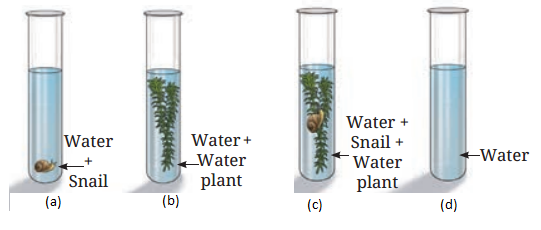
Ananya took four test tubes and filled three- fourth of each test tube with water. She labelled them A, B, C, and D (Fig). In test tube A, she kept a snail; in test tube B, she kept a water plant; in test tube C, she kept both a snail and a plant. In test tube D, she kept only water. Ananya added a carbon dioxide indicator to all the test tubes. She recorded the initial colour of water and observed if there are any colour changes in the test tubes after 2-3 hours. What do you think she wants to find out? How will she know if she is correct?
Image
Fig. Experimental set-up
Answer
Ananya wants to find out how plants and animals affect the amount of carbon dioxide in water. She is testing the role of respiration and photosynthesis. The carbon dioxide indicator changes colour depending on how much carbon dioxide is present in the water. Ananya will know she is correct by observing the colour changes in the carbon dioxide indicator in each test tube :
1. Test Tube A (Snail only): The indicator will turn yellow/orange, showing increased carbon dioxide due to the snail’s respiration.
2. Test Tube B (Plant only): The indicator will turn blue/purple, showing decreased carbon dioxide because the plant uses it during photosynthesis.
3. Test Tube C (Snail + Plant): The colour may stay neutral or slightly blue, showing a balance as the snail gives out carbon dioxide and the plant uses it.
4. Test Tube D (Only water): No colour change, as there is no living organism to add or remove carbon dioxide.
View full question & answer
Question 23 Marks
Answer
S. No.FeaturePhotosynthesisRespiration
1.Raw materialsSunlight, water, chlorophyll and carbon dioxide,Glucose (from food made during. photosynthesis),
oxygen (from the air)
2.ProductsGlucose and oxygen
(released in the air)
Carbon dioxide, water and energy (used for various activities in the plant)
3.Word equationCarbon dioxide + Water
$\xrightarrow[\text { Chlorophyll }]{\text { Sunlight }}$ Glucose + Oxygen
$\text { Glucose }+ \text { Oxygen } \longrightarrow \text { Carbon } $$ \text { dioxide }+ \text { Water }+ $ $\text { Energy }$
4.Impor-tanceIt helps plants make their own food and produces oxygen, which is essential for life on Earth.It provides energy to plants for growth, development, and other life processes.
View full question & answer
Question 43 Marks
Oxygen which is essential for the survival of all organisms is produced during photosynthesis. In the absence of photosynthesis, life would be impossible on the earth. During photosynthesis, chlorophyll containing cells of leaves, in the presence of sunlight, use carbon dioxide and water to synthesise carbohydrates. During the process oxygen is released. The presence of starch in leaves indicates the occurrence of photosynthesis. Starch is also a carbohydrate.
Q.1. Which component is essential for the survival of all the living organisms?
(a) Oxygen$\quad$(b) Carbon dioxide$\quad$(c) Carbon Monoxide$\quad$(d) Hydrogen
Q.2. Name the green pigment present in leaves.
Q.3. How we come to know the occurrence of photosynthesis in a plant?
Answer
1. (a) Oxygen
2. Chlorophyll
3. The presence of reserve food material (i.e. starch) in the leaves of plant indicates the occurrence of photosynthesis.
View full question & answer
Question 53 Marks
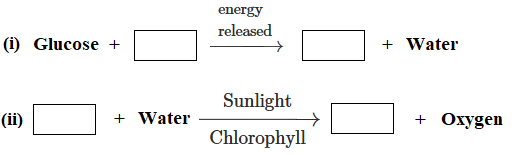
Complete the equations and name the processes:
Image

(iii) Differentiate between the two processes,
Answer
(i) Respiration :
Glucose + Oxygen $\xrightarrow{\substack{\text { energy } \\ \text { released }}}$ Carbon dioxide + Water
(ii) Photosynthesis :
Carbon dioxide + Water $\xrightarrow[\text { Chlorophyll }]{\text { Sunlight }}$ Glucose + Oxygen
(iii) Photosynthesis is the process by which green plants make food using sunlight, carbon dioxide, and water. It happens in the leaves during the day and gives out oxygen. Respiration is the process by which plants use oxygen to break down food and release energy. It happens in all parts of the plant, both day and night, and gives out carbon dioxide.
View full question & answer
Question 63 Marks
Answer the following:
(i) Draw a schematic diagram showing photosynthesis.
(ii) What are the products of photosynthesis?
(iii) Name the gases utilised and liberated in photosynthesis.
(iv) Can all plants do photosynthesis?
Answer
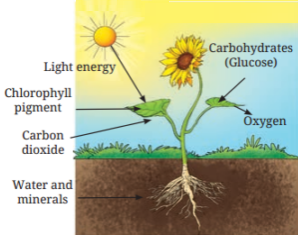
(i) A schematic diagram showing photosynthesis is as following:
Image

(ii) The products of photosynthesis are glucose and oxygen.
(iii) The oxygen is liberated, and carbon dioxide is utilised in photosynthesis.
(iv) All plants cannot do photosynthesis, only green plants, which contain chlorophyll pigment, can do photosynthesis.
View full question & answer
Question 73 Marks
How would you test the presence of starch in leaves?
Answer
To test the presence of starch in leaves, following steps is followed:
1. Keep the leaf in boiling water for 5 minutes to soften it.
2. Dip this leaf in a test tube containing alcohol to remove the chlorophyll,
3.Place the test tube in a beaker with boiling water.
4. Wait for the leaf to become colourless,
5. Take out the leaf and place it on a plate,
6. Finally, add a few drops of iodine solution to the leaf. Wait for few minutes and observe.
7. If the leaf turns blue-black, it indicates the presence of starch.
View full question & answer
Question 83 Marks
Answer
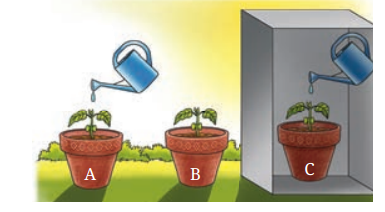
(i)The plants in the three pots showed noticeable differences after two weeks.
Pot A, which received both sunlight and water, grew the tallest, had the most leaves, and stayed green, showing healthy development.
Pot B, with sunlight but no water, showed very little growth, fewer leaves, and yellowing due to dehydration.
Pot C, kept in the dark but watered, exhibited limited growth, with slightly pale yellow leaves and fewer new leaves, indicating that light is essential for healthy, green plants.
(ii) Pot A
(iii) Pot C
View full question & answer
Question 93 Marks
Image
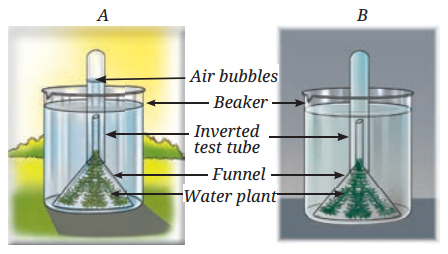
Fig. Activity showing the release of oxygen during photosynthesis
(i) What difference do you observe in the two set¬ups?
(ii) Do you observe air bubbles emerging in the inverted test tube in set-up A?
(iii) The gas produced in this set-up caused bubbles to emerge and get accumulated in the inverted test tube. Which gas is this?
Answer
(i) In set-up A (kept in sunlight), we observe bubbles on the inverted test tube. While in set¬up B (kept in the dark), no bubbles are seen.
(ii) Yes, air bubbles are seen rising and collecting in the inverted test tube in set-up A.
(iii) The gas produced is oxygen, which is released during photosynthesis.
Observation and Conclusion :
When a test tube is taken off the set-up and a lit matchstick is inserted into the tube, it produces an intense flame, which confirms that oxygen gas is released during the process of photosynthesis.
View full question & answer
Question 103 Marks
Design an experiment to observe if water transportation in plants is quicker in warm or cold conditions.
Answer
To test whether water transportation in plants is quicker in warm or cold conditions, take two identical potted plants. Place one plant in a warm location (near a heater or sunny spot) and the other plant in a cool place (like in the shade). Add a few drops of food colouring to the water and water both plants. After a few hours, observe the movement of the coloured water up the stem and into the leaves. The plant in the warm conditions will show faster movement of the coloured water, as higher temperatures increase the rate of evaporation and water transportation.
View full question & answer
Question 113 Marks
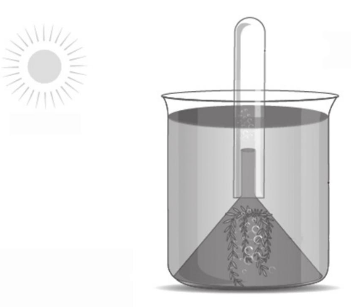
Observe the given picture and answer the questions that follow:
Image

1. Why is the plant placed in water for this experiment, and what would happen if the plant were not submerged?
2. Which gas is collected in the test tube, and what does its presence indicate about the process occurring in the plant?
3. Explain the role of sunlight in the setup and predict the result if the entire setup was placed in complete darkness
Answer
self
View full question & answer
Question 123 Marks
Read the passage and answer the questions :
Bhaskar conducted an experiment on green and non-green patches of leaves to test starch. He observed that only green-patches turned blue-black.
Q.1. Which test did he perform?
(a) Alcohol test$\quad$(b) Iodine test
(c) Red ink test$\quad$(d) Water test
Q.2. Why did only green patches turn blue-black?
(a) They absorbed oxygen
(b) They had stomata
(c) They had chlorophyll
(d) They were thicker
Q.3. What conclusion did he derive?
(a) Sunlight is essential for photosynthesis
(b) Starch is formed in green areas with chlorophyll
(c) Water is sufficient for photosynthesis
(d) Photosynthesis happens at night
Answer
(b) Iodine test
(c) They had chlorophyll
(b) Starch is formed in green areas with chlorophyll
View full question & answer
3 Marks Question - Science STD 7 Questions - Vidyadip