Questions

2 Marks Questions

Take a timed test

35 questions · self-marked practice — reveal the answer and mark yourself.

Question 12 Marks
Measure the length of your shadow at 9 AM, 12 PM, and 4 PM with the help of your friend. Write down your observations :
(i) At which of the given times is your shadow the shortest?
(ii) Why do you think this happens?
Answer
(i) The shadow will be shortest at 12 PM when the Sun is directly overhead.
(ii) This happens because, at 12 PM, the Sun is at its highest point in the sky, so the angle between the Sun and the ground is almost 90 degrees, casting a shorter shadow.
View full question & answer
Question 22 Marks
Write your name on a piece of paper and hold it in front of a plane mirror such that the paper is parallel to the mirror. Sketch the image. What difference do you notice? Explain the reason for the difference.
Answer
When you look at the paper through the plane mirror, the image will be laterally inverted (flipped horizontally). You will notice that the letters of your name appear backward, as the mirror reverses left and right.
View full question & answer
Question 32 Marks
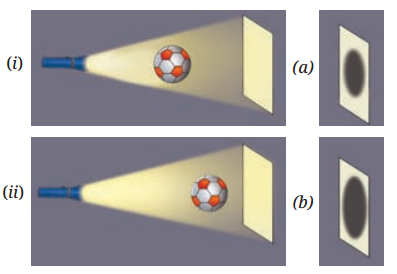
The shadow of a ball is formed on a wall by placing the ball in front of a fixed torch as shown in Fig. In scenario (i) the ball is closer to the torch, while in scenario (ii) the ball is closer to the wall. Choose the most accurate representation of the shadows formed in both scenarios from the options provided (a and b).
Image
Answer
In scenario (i), the ball is closer to the torch and away from the wall, so the shadow would be large and blurry on the wall. So the correct representation of scenario (i) will be (b). In scenario (ii), the ball is closer to the wall and away from the torch, so the shadow would be sharp and small. So the correct representation of scenario (ii) will be (a).
View full question & answer
Question 42 Marks
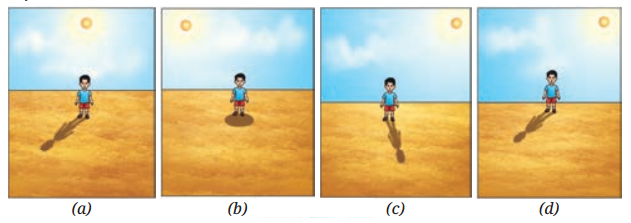
Look at the images shown in Fig. and select the correct image showing the shadow formation of the boy.
Image
Answer
The boy’s shadow is formed based on the light source. If the light is coming from above, the shadow will fall below. If the light comes from the side, the shadow will be cast in the opposite direction. Thus, option (d) is the correct image showing the shadow formation of the boy.
View full question & answer
Question 52 Marks
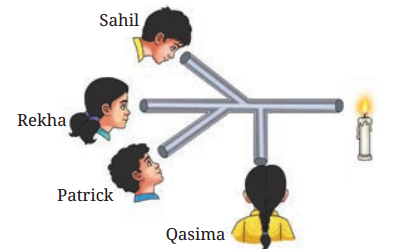
Sahil, Rekha, Patrick, and Qasima are trying to observe the candle flame through the pipe as shown in Fig. Who can see the flame?
Image
Answer
Only Rekha can see the flame of the candle because light travels in a straight line, and Rekha’s line of sight is aligned with the flame. The others cannot see the flame because they are not in the path of the pipe where the flame is visible
View full question & answer
Question 62 Marks
We do not see the shadow on the ground of a bird flying high in the sky. However, the shadow is seen on the ground when the bird swoops near the ground. Think and explain why it is so.
Answer
This happens because the Sun’s rays are coming from a high angle when the bird is flying high, making the shadow very small and hard to notice. When the bird is closer to the ground, the angle of the sunlight creates a larger, more noticeable shadow on the ground.
View full question & answer
Question 72 Marks
Write a short note on shadow puppetry.
Answer
Shadow puppetry is an art form in which flat, cut-out figures (puppets) are placed between a light source and a screen. The puppets block the light and cast shadows on the screen, which are manipulated to tell stories or perform plays.
View full question & answer
Question 82 Marks
What is lateral inversion? Give one example where it can be seen.
Answer
Lateral inversion is the reversal of left and right sides of an object in a mirror image. Example: When you look in a plane mirror, your left hand appears as the right hand in the image.
View full question & answer
Question 92 Marks
How does light behave when it passes through different materials?
Answer
Light behaves differently depending on the material:
-Transparent materials (like glass) allow light to pass through completely.
-Translucent materials (like wax paper) allow some light to pass through but scatter it.
-Opaque materials (like wood) do not allow light to pass through.
View full question & answer
Question 102 Marks
Describe how a shadow is formed.
Answer
A shadow is formed when an opaque object blocks the path of light, preventing light from reaching the surface behind it. The dark area that appears on the surface is called the shadow.
View full question & answer
Question 112 Marks
What do you mean by an opaque materials? Also give an example.
Answer
Opaque materials are those that do not allow light to pass through. Example: Wood or metal.
View full question & answer
Question 122 Marks
A student covered a torch with red cellophane sheet to obtain red light. Using the red light she obtains a shadow of an opaque object. She repeats this activity with green and blue light. Will the colour of the light affect the Shadow? Explain.
Answer
Changing the colour of light will not affect the shadow. This is due to the fact that shadow is a dark patch formed when the path of light is obstructed by an object which inhibits the light from reaching in the shadow region.
View full question & answer
Question 132 Marks
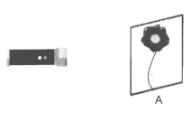
In Fig. a flower made of thick coloured paper has been pasted on the transparent glass sheet. What will be the shape and colour of shadow seen on the screen?
Answer
The shadow formed will be a dark patch and the shape of the shadow will be the shape of the flower along with the stalk.
Image
View full question & answer
Question 142 Marks
What are the essential conditions for the formation of shadow?
Answer
1. There should be an opaque material.
2. There should be a source of light and screen.
3. The object must be placed in the path of light. Then only shadow is formed on the screen.
View full question & answer
Question 152 Marks
You have to cast the shadow of your pencil on the wall with the help of candle in a dark room. How can you obtain the shadow of same size, small size and big size of the same pencil.
Answer
1. The shadow of the pencil will be small when the pencil is taken close to the wall and away from the candle.
2. The shadow will be big in size when the pencil is taken closer to the candle.
3. To get the same sized shadow as the pencil is, adjust the distance between the wall, pencil and candle at equal distances.
View full question & answer
Question 162 Marks
Write the characteristics of image formed by a plane mirror.
Answer
The characteristics of image formed by plane mirror:
1. The image formed is erect.
2. The image is laterally inverted.
3. The image is of same size as the object.
4. The image is formed at the same distance as object is placed from mirror.
View full question & answer
Question 192 Marks
Observe the formation of shadows by a glass plate, an wooden piece and a tracing paper and record your result.
Answer
When light shines on different materials, the shadows they form vary:
Glass Plate: Forms a very faint shadow because it is mostly transparent.
Wooden Piece: Creates a dark and distinct shadow because it is opaque.
racing Paper: Produces a lighter, blurry shadow because it is translucent.
View full question & answer
Question 202 Marks
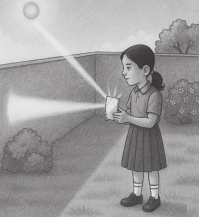
Observe the image carefully. A girl is standing outdoors on a sunny day, holding a shiny surface (likely a mirror) and reflecting sunlight onto a wall.
Image
Now, answer the following questions :
(a) What optical phenomenon is being demonstrated in this picture? Explain the principle involved using a suitable scientific term.
(b) If the girl tilts the mirror slightly, what will happen to the spot of light on the wall? Justify your answer with the law or rule that governs the change in the path of light.
Answer
self
View full question & answer
Question 212 Marks
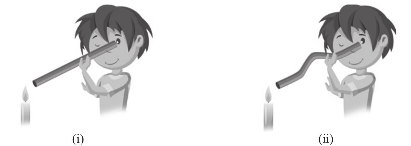
Observe the diagrams (i) and (ii) shown below.
Image

→ In Figure (i), a boy is looking at a candle flame through a straight pipe.
→ In Figure (ii), the candle flame is viewed through a bent pipe.
(a) Explain why the candle flame is visible through a straight pipe but not through a bent pipe.
(b) If a mirror is placed at the bend of the pipe in the second setup, can the candle flame be seen? Justify your answer with a scientific explanation.
Answer
self
View full question & answer
Question 222 Marks
Can a small mirror form an image of a whole tree? Predict and explain with a reason.
Answer
Yes, a small mirror can form an image of a whole tree. The size of the mirror doesn't restrict the extent of the scene it can reflect; it captures light from all parts of the tree. The image forms as light rays from the tree reflect off the mirror into our eyes. While the mirror must be large enough to capture sufficient light rays for a complete image, the tree's image size is determined by perspective and distance, not the mirror's dimensions.
View full question & answer
Question 232 Marks
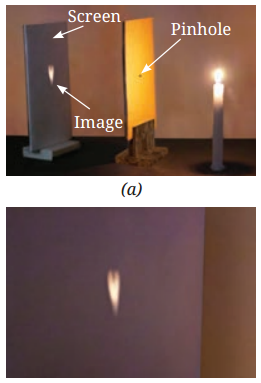
Amit uses a pinhole camera during the evening and does not see a clear image. Why?
Answer
A pinhole camera relies on light to project an image onto a screen. During the evening, the amount of light available is significantly reduced compared to daylight. This scarcity of light makes it difficult for the pinhole camera to capture a clear image. 
View full question & answer
Question 242 Marks
Suppose you place a red transparent sheet on the torch. What will happen to the shadow of such object?
Answer
When you place a red transparent sheet on the torch, the shadow of an object will still appear dark, but it may have a reddish tint around the edges. The shadow itself remains a dark area because the object blocks the light, but the red sheet changes the color of the light that passes around the object, slightly affecting the shadow's appearance.
View full question & answer
Question 252 Marks
Riya saw two shadows of a ball while using two torches. What could be the reason behind it?
Answer
The reason Riya observed two shadows of the ball when using two torches is that each torch acts as an independent light source. Each light source creates its own shadow of the ball, resulting in two distinct shadows appearing on the surface. This phenomenon occurs because the light from each torch is blocked by the ball, forming a shadow corresponding to each light source.
View full question & answer
Question 262 Marks
Why do we see the shadow of a bird flying close to the ground but not high up in the sky?
Answer
We see the shadow of a bird flying close to the ground because the closer the object is to a surface, the sharper and more defined its shadow appears. When a bird is high in the sky, its shadow becomes very faint and diffuse due to the distance, making it hard to distinguish from the background.
View full question & answer
Question 272 Marks
You are unable to see an image in a bent pipe. What does this prove about light?
Answer
The fact that you cannot see an image in a bent pipe proves that light travels in a straight line. When a pipe is bent, the light rays from an object cannot bend along with the pipe to reach your eye, thus preventing the formation of an image.
View full question & answer
Question 282 Marks
Write the differences between shadows and images.
Answer
FeatureShadowImage
FormationFormed when an opaque object blocks light.Formed by reflection or refraction of light.
AppearanceDark area showing the outline of the object.Resembles the object, showing details and colors (in mirrors or lenses).
View full question & answer
Question 292 Marks
What are the key features of an image formed by a plane mirror?
Answer
The image formed by a plane mirror is the same size as the object and upright (erect). It is a virtual image, meaning it cannot be projected onto a screen, and appears to be as far behind the mirror as the object is in front. Additionally, the image is laterally inverted, which means it is flipped horizontally, with left and right sides reversed.
View full question & answer
Question 312 Marks
Why does an image in a plane mirror appear laterally inverted?
Answer
Images in a plane mirror appear laterally inverted because the mirror does not actually flip the image left to right. Instead, it performs a front-to-back inversion. The mirror image is a direct rendering of what is in front, but the light reflecting back to your eyes makes it seem as though the image is flipped horizontally.
View full question & answer
Question 322 Marks
Describe the working principle of a pinhole camera.
Answer
A pinhole camera operates by allowing light rays from an object to pass through a tiny hole (the pinhole). These light rays then project an inverted image onto a screen inside the camera. This happens because light travels in straight lines; the pinhole ensures that only one ray of light from each point on the object passes through, creating a focused (though often dim) image on the screen.
View full question & answer
Question 332 Marks
What happens when light falls on a shiny surface like a mirror?
Answer
When light strikes a shiny surface like a mirror, it is mostly reflected. This means the light bounces off the surface, changing its direction. The reflection is specular, meaning the light rays bounce off in an organized manner, creating a clear image. The angle at which the light hits the mirror is equal to the angle at which it is reflected.
View full question & answer
Question 342 Marks
What is lateral inversion? Give an example where it is useful.
Answer
Lateral inversion is the perceived reversal of left and right in a mirror image compared to the object it is reflecting. In simpler terms, when you raise your left hand in front of a mirror, it looks like the right hand of your image is raised.
Example:The word "AMBULANCE" is written as "‎ƆИA˥UqMA" so that drivers looking in their rearview mirrors can read it correctly and make way.
View full question & answer
Question 352 Marks
Differentiate between transparent, translucent, and opaque objects with examples.
Answer
FeatureShadowImage
FormationFormed when an opaque object blocks light.Formed by reflection or refraction of light.
AppearanceDark area showing the outline of the object.Resembles the object, showing details and colors (in mirrors or lenses).
View full question & answer