Questions

3 Marks Question

🎯

Test yourself on this topic

10 questions · timed · auto-graded

Question 13 Marks
Describe the construction and working of a pinhole camera.
Answer
A pinhole camera is a simple device used to form images without a lens. It consists of a light-proof box or chamber with a tiny hole on one side called the pinhole. The opposite side of the box has a screen or photographic film where the image is formed.
Working: When light rays from an object pass through the tiny pinhole, they travel in straight lines and fall on the screen to form an inverted and real image of the object. The image is sharp if the pinhole is very small, but if the hole is too large, the image becomes blurred. This demonstrates the straight-line propagation of light.
View full question & answer
Question 23 Marks
Briefly explain the following:
(a) Periscope
(b) Kaleidoscope
Also, mention two applications of each.
Answer
self
View full question & answer
Question 43 Marks
Differentiate between transparent, translucent and opaque materials with one example each.
Answer
Material TypeDefinitionExample
TransparentMaterials that allow light to pass through completelyGlass, clear water
TranslucentMaterials that allow some light to pass through but scatter itWax paper, frosted glass
OpaqueMaterials that do not allow light to pass throughWood, metal
View full question & answer
Question 53 Marks
Differentiate between luminous and non-luminous objects.
Answer
FeatureLuminous ObjectsNon-luminous Objects
DefinitionObjects that produce their own lightObjects that do not produce light and are seen by reflected light
ExampleSun, bulb, candleMoon, table, book
View full question & answer
Question 63 Marks
What is reflection of light? Explain reflection of light with the help of an activity.
Answer
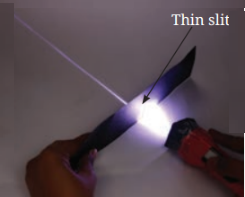
When light rays fall on a shiny surface or a mirror and it changes the direction of light that falls on it. This change in the direction of the light by a mirror or shiny surface is called reflection of light. Activity to show reflection of light: This activity should be done at night or in a dark room. Ask your friend to hold a mirror in his hand at one corner of the room. Stand at another corner with a torch in your hand. Cover the glass of torch with your fingers and switch it on. There should be small gap between your fingers. Direct the beam of torch-light on to the mirror that your friend is holding. Adjust the direction of torch so that patch of light falls on your friend standing in the room. This activity shows the reflection of light also that light travels in straight line.
Image
View full question & answer
Question 73 Marks
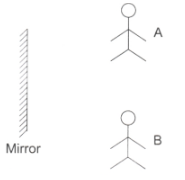
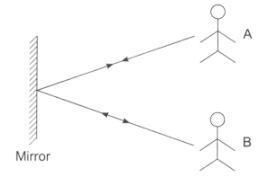
A and B are facing the mirror and standing in such a way that A can see B and B can see A. Explain this phenomenon
Image
Answer
Light from the surrounding environment illuminates both A and B, allowing them to reflect light. The light rays from A are directed toward the mirror, where they are reflected and then travel to B. Similarly, the light rays from B reach the mirror, are reflected, and finally travel to A. The paths of the light rays are reversed.
Image
View full question & answer
Question 83 Marks
Table : Observation of shadows
ActionObservations regarding shadow
The screen is removed.Shadow cannot be seen
The object is removed.No shadow is formed
The torch is switched off.No shadow is formed
The object is moved closer to the screen, keeping the torch and the screen fixed.Shadow becomes smaller
The object is moved closer to the torch, keeping the torch and the screen fixed.Shadow becomes larger
The object is tilted, keeping the torch and the screen fixed.Shape of shadow changes
The colour of the object is changed.Colour of shadow does not change
Answer
Observation and conclusion : A shadow is formed when an opaque object blocks the path of light. The source of light, opaque object, and screen are necessary for the formation of a shadow. Changing the colour of the object does not affect the colour of the shadow. The position of the object affects the size and shape of the shadow:
1. If the object is moved closer to the screen, the shadow becomes smaller.
2. If the object is moved closer to the light source, the shadow becomes larger.
3. Tilting the object changes, the shape of the shadow.
View full question & answer
Question 93 Marks
Read the passage and answer the questions :
Seema builds a periscope using plane mirrors and observes people behind a wall.
Q.1. The periscope works on the principle of:
(a) Refraction$\quad$(b) Reflection
(c) Dispersion$\quad$(d) Diffraction
Q.2. The number of mirrors required in a simple periscope is:
(a) 1$\quad$$\quad$(b) 2
(c) 3$\quad$$\quad$(d) 4
Q.3. Which angle do the mirrors make in a periscope?
(a) $45^{\circ}$$\quad$(b) $60^{\circ}$
(c) $90^{\circ}$$\quad$(d) $180^{\circ}$
Answer
(b) Reflection
(b) 2
(a) $45^{\circ}$
View full question & answer
Question 103 Marks
Read the passage and answer the questions :
Ravi uses a torch, a thin plastic sheet, and a cardboard to investigate how different materials affect the path of light.
Q.1.  What kind of object is a thin plastic sheet?
(a) Transparent$\quad$(b) Translucent
(c) Either (a) or (b)$\quad$(d) Opaque
Q.2. Which object will form the darkest shadow?
(a) Red plastic$\quad$(b) Glass
(c) Thick cardboard$\quad$(d) Tracing paper
Q.3. Light passes partially through which of the following?
(a) Wood$\quad$(b) Mirror
(c) Tracing paper$\quad$(d) Steel
Answer
(b) Translucent
(c) Thick cardboard
(c) Thick cardboard
View full question & answer
3 Marks Question - Science STD 7 Questions - Vidyadip