Questions

5 Marks Questions

🎯

Test yourself on this topic

6 questions · timed · auto-graded

Question 15 Marks
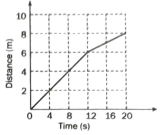
Given below in a figure is the distance-time graph of the motion of an object.
Image
(i) What will be the position of the object at 20 s?
(ii) What will be the distance travelled by the object in 12 s?
(iii) What is the average speed of the object?
Answer
i. From the graph, it is clear that the position at 20 s is 8 m.
ii. Distance travelled by the body object in 12 s is 6 m.
iii. As, average speed $=\frac{\text { total distance }}{\text { total time }}=\frac{8}{20}=0.4 m / s$
View full question & answer
Question 25 Marks
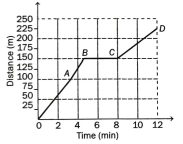
Boojho goes to the football ground to play football. The distance-time graph of his journey from his home to the ground is given as figure.
Image
(i) What does the graph between points B and C indicate about the motion of Boojho?
(ii) is the motion between 0 to 4 min uniform or non-uniform?
(iii) What is his speed between 8 to 12 min of his journey?
Answer
i. Since, the graph between B and C is parallel to time-axis, so it indicates that Boojho is at rest.
ii. Since, the graph is not straight line, so it is a non-uniform motion.
$\begin{aligned} \text {iii. As, speed } & =\frac{\text { distance }}{\text { time }}=\frac{225-150}{12-8} \\ & =\frac{75}{4}=18.75 m / min \end{aligned}$
View full question & answer
Question 35 Marks
Distance between Bholu's and Golu's house is 9 km. Bholu has to attend Golu's birthday party at 7 o' clock. He started his journey from his home at 6 o' clock on his bicycle and covered a distance of 6 km in 40 min. At that point, he met Chintu and he spoke to him for 5 min and reached Golu's birthday party at 7 o' clock. With what speed, did he cover the second part of the journey? Calculate his average speed for the entire Journey.
Answer
From the question, Bholu covers 3 km distance in 15 min.
$
\begin{aligned}
\text { So, speed of Bholu } & =\frac{3}{15} \times 60 \quad\left(1 min=\frac{1}{60} h\right) \\
& =12 km / h
\end{aligned}
$
Now, average speed is given by
$
\begin{array}{l}
=\frac{\text { Total distance travelled }}{\text { Total time taken }} \\
=\frac{9}{1}=9 km / h
\end{array}
$
View full question & answer
Question 45 Marks
The distances travelled by a car at various time intervals are given as follow
Distance (m)0510152025
Time (s)0246810
(a) Draw the distance-time graph for the car.
(b) What conclusion do you get from this graph about the nature of motion of the car?
Answer
(a) Distance-Time Graph:
Draw a graph with Time (s) on the x-axis and Distance (m) on the y-axis.
Mark the points:
(0, 0), (2, 5), (4, 10), (6, 15), (8, 20), (10, 25)
Join the points with a straight line.
Label the axes clearly and give the graph a title: Distance-Time Graph of a Car.
(b) Conclusion about the motion of the car:
From the graph, the distance increases equally in every equal interval of time.
The graph is a straight line, which indicates the speed of the car is constant.
Therefore, the car is moving with uniform motion.
Uniform motion means the car covers equal distances in equal intervals of time, without speeding up or slowing down.
View full question & answer
Question 55 Marks
Explain by giving example that how can we choose a suitable scale?
View full question & answer
Question 65 Marks

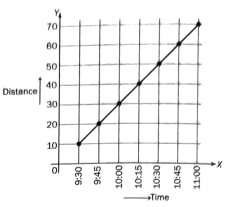
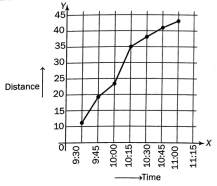
The given data regarding the motion of two different objects Cand Dis in a tabular form. Check them carefully and state whether the motion of the objects is uniform or non-uniform.

TimeDistance travelled by C (in m)Distance travelled by D (in m)
9:30 AM1012
9:45 AM2019
10:00 AM3023
10:15 AM4035
10:30 AM5037
10:45 AM6041
11:00 AM7044
View full question & answer
5 Marks Questions - Science STD 7 Questions - Vidyadip