Questions

2 Marks Questions

Take a timed test

41 questions · self-marked practice — reveal the answer and mark yourself.

Question 12 Marks
Why do we get instant energy from glucose?
Answer
Glucose is a simple sugar. Carbohydrates, when consumed, have to be digested into glucose. As glucose can be easily absorbed in blood, it provides energy to the body. Hence, when glucose is directly taken, it does not have to be digested and thus acts as an instant source of energy.
View full question & answer
Question 22 Marks
Name the type of carbohydrate that can be digested by ruminants but not by humans. Give the reason also.
Answer
Cellulose is a type of carbohydrate that can be digested by ruminants and not by humans. Ruminants have a large sac-like structure between small and large intestine where the food containing cellulose is digested by the action of certain bacteria. On the other hand, humans cannot digest cellulose, as the cellulose digesting enzymes are absent in them.
View full question & answer
Question 32 Marks
Can we survive only on raw, leafy vegetables/grass? Discuss.
Answer
No.Humans cannot survive only on raw, leafy vegetables, or grass. It is because the grass is rich in cellulose, which is a type of carbohydrate that humans are not able to digest due to the absence of cellulose-digesting enzymes
View full question & answer
Question 42 Marks
What are secreted inside the stomach?
Answer
Gastric juice is secreted by the walls of stomach which contains HCl and Pepsin. HCl helps to kill the germs present in food. After mixing with the food it provides an acidic medium to the food which is essential for the activation of pepsin enzyme. Pepsin digests protein into peptides.
View full question & answer
Question 52 Marks
Gastric glands in stomach release hydrochloric acid, enzyme pepsin and mucus. What will happen if mucus is not secreted by the gastric glands?
Answer
Mucus protects the inner lining of stomach form the action of hydrochloric acid and enzyme pepsin. If mucus is not released, it will lead to erosion of inner lining of stomach leading to acidity and ulcers.
View full question & answer
Question 62 Marks
Explain how assimilation is different from absorption.
Answer
The process by which nutrients from the digested food are absorbed by the body is called absorption whereas the process by which the absorbed nutrients are utilised by the body for providing energy is called assimilation.
View full question & answer
Question 72 Marks
Differentiate between assimilation and egestion.
Answer
Absorbed digested food materials are transported via the blood vessels to different organs of the body where they are used to build complex substances such as the proteins required by the body. This process is called assimilation but the process of removal of waste faecal matter through the anus from time-to-time is called egestion.
View full question & answer
Question 82 Marks
What role does villi performs in the small intestine?
Answer
The villi increase the surface area for absorption of the digested food. The surface of the villi absorbs the digested food materials and passes them into blood. The absorbed substances are transported via the blood vessels to different organs of the body.
View full question & answer
Question 92 Marks
Alimentary canal is different from digestive system. Comment.
Answer
Alimentary canal is a long, muscular coiled tube. It is also known as digestive tract. The alimentary canal with its associated glands constitute the digestive system. These glands are salivary glands, liver and pancreas.
View full question & answer
Question 102 Marks
Name and explain the type of carbohydrates that can be digested by ruminants but not by humans.
Answer
Cellulose is the carbohydrate that can be digested by ruminants. Ruminants have large sac like structure between the small intestine and large intestine which is responsible for digestion of cellulose in them. The cellulose of the food is digested by the action of certain bacteria which are not present in human beings.
View full question & answer
Question 112 Marks
Cellulose rich food substances are good source of roughage in human beings. Justify.
Answer
Cellulose rich food substances are good source of roughage in human beings. It is because the cellulose digesting bacteria are not present in the body of human beings due to which human beings cannot digest cellulose (present in plant foods).
View full question & answer
Question 122 Marks
Why do we get instant energy from glucose?
Answer
Glucose is the simplest form of sugar. It can directky be absorbed by intenstine and can easily be transported by blood to various cells of the body. Cells directly act on glucose along with oxygen to given energy.
While carbohydrates are complex forms of sugars and they need to be further broken down into simpler substances like glucose before absorption. Hence it requires extra time as compared to glucose which provides instant energy.
View full question & answer
Question 132 Marks
Explain digestive enzymes?
Answer
There are different types of enzymes which are used for the digestion of different food materials like carbohydrates, fats, protein etc. The process of digestion involves the association of several catalytic organic compounds such as amylase, pepsin, lipase, trypsin etc. These organic compounds are known as digestive enzymes.
View full question & answer
Question 142 Marks
Glucose is considered as the source of instant energy, why?
Answer
Glucose is the simplest form of carbohydrate that can be easily broken down to give energy. Hence, we get instant energy from glucose. Also, glucose mixes directly into the blood stream making it readily available to the body.
View full question & answer
Question 152 Marks
Discuss the position and number of molars in buccal cavity.
Answer
Molars are very large teeth which are present behind the premolar, towards the back of our mouth. They are only present in the permanent set of teeth and are $6$ in each jaw.
View full question & answer
Question 162 Marks
Distinguish between the following. Ingestion and Egestion.
Answer
S.No.
Ingestion
Egestion
$(i)$
The process of taking in of food inside the body.
The process of throwing out of undigested food materials from the body.
$(ii)$
It occurs through mouth.
It occurs through rectum.
View full question & answer
Question 172 Marks
What is the difference between human digestive system and alimentary canal?
Answer
Digestive system of human beings consists of an alimentary canal and associated glands while alimentary canal has mouth, oesophagus, stomach, small intestine, large intestine and Anus.
View full question & answer
Question 182 Marks
What happens to the food in stomach of the digestive tract?
Answer
The inner lining of the stomach secretes mucous, hydrochloric acid and Digestive juices. The mucous protects the lining of the stomach. The hydrochloric acid kills many bacteria that enter along with the food and makes the medium in the stomach acidic. The digestive juices break down the proteins into simpler substances.
View full question & answer
Question 192 Marks
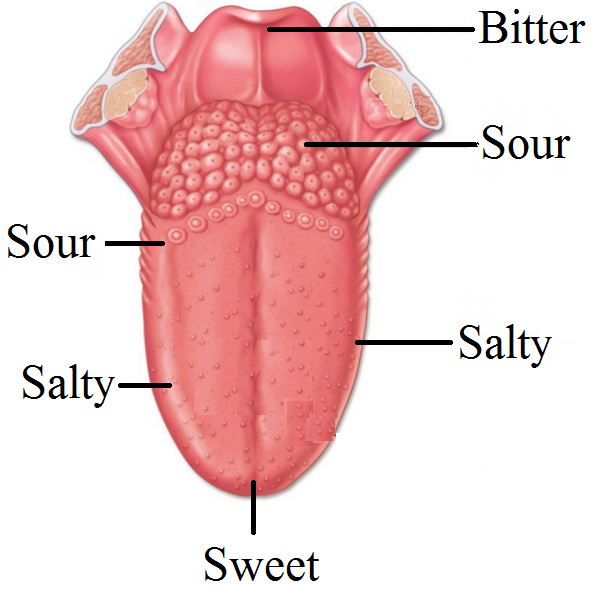
You were blindfolded and asked to identify the drinks provided in two different glasses. You could identify drink A as lime juice and B as bitter gourd juice. How could you do it inspite of being blindfolded?
Answer
Inspite of being blindfolded, one could identify tastes of different drinks with the help of different types of taste buds present in the tongue. Taste buds are sensory taste receptors that help to or perception of taste. There are four kinds of taste buds which detect sweet, salty, sour and bitter taste. These are located in different part of the tongue. Structure of tongue showing position of taste buds.
View full question & answer
Question 202 Marks
Boojho and Paheli were eating their food hurriedly so that they could go out and play during the recess. Suddenly, Boojho started coughing violently. Think of the reasons why he was coughing and discuss with your friends.
Answer
Sometimes, when we eat hurriedly or talk or laugh while eating, the flap-like valve (called epiglottis) which closes the passage of windpipe remains open. Therefore, the food may enter into the windpipe and it leads to coughing. Coughing helps to clear the passage.
View full question & answer
Question 212 Marks
Ruminants such as cows and buffaloes swallow their food hurriedly and then sit restfully and chew their food. Can you reason why?
Answer
This is done for complete digestion of the food. When the food is swallowed by ruminants, it is only partially digested. It is then again chewed for its completedigestion.
View full question & answer
Question 222 Marks
Can we survive only on raw, leafy vegetables/ grass? Discuss.
Answer
Raw leafy vegetables and grass are rich in cellulose, a type of carbohydrate. Many animals, including humans, cannot digest cellulose, because they do not have enzymes and certain type of bacteria which can digest cellulose. We cannot survive by taking vegetables in raw form. That's why we boil or cook vegetables which breaks down cellulose into simple carbohydrates. We can only survive by taking in vegetables in boiled/ cooked form.
View full question & answer
Question 232 Marks
Small intestine in herbivores is longer than in carnivores. Do you agree? Support your.
Answer
Yes, carnivores animals cannot digest cellulose, hence they have a shorter small intestine. In herbivores, digestion of cellulose takes a longer time.
Hence, herbivores need a longer small intestine to allow complete digestion of cellulose.
View full question & answer
Question 242 Marks
What happens to the food in large intestine of the digestive tract?
Answer
The food that remains undigested and unabsorbed enters into the large intestine from small intestine. It is about 1.5 metre in length. Its function is to absorb water and some salts from the undigested food material.
View full question & answer
Question 252 Marks
‘A’ got her gall bladder removed surgically as she was diagnosed with stones in her gall bladder. After the surgery, she faced problems in digestion of certain food items when consumed in bulk. Can you tell which kind of food items would they be and why?
Answer
After surgical removal of gall bladder, ‘A’ would face problems in digestion of fatty substances when consumed in bulk. This is because the bile juice stored in the gall bladder helps in digestion of fats. Removal of gall bladder, thus leads to difficulty in digestion of fatty substances.
View full question & answer
Question 262 Marks
How does food move in opposite direction during vomiting?
Answer
Food is pushed into the stomach by the peristaltic movement of the walls of oesophagus (food pipe). Sometimes, the food is not accepted by stomach, then the movement of walls of food pipe moves the food in opposite direction and food comes out as vomiting.
View full question & answer
Question 272 Marks
Briefly explain, why animals like cow cannot chew their food properly at the time they take it in.
Answer
Animals like cow cannot chew their food properly due to the presence of cellulose in their diet. At the time they take in food, the food is moistend and is sent for cellulose digestion and softening in rumen.
View full question & answer
Question 282 Marks
The swallowed food moves downwards in the alimentary canal. Explain.
Answer
The swallowed food moves downwards in the alimentary canal because of the atternate relaxation contraction movement of muscles in the wall of foodpipe called peristalsis.
View full question & answer
Question 292 Marks
Boojho took some grains of boiled rice in test tube $‘A’$ and Paheli took boiled and chewed rice in test tube $‘B’$. Both of them poured $1–2$ drops of iodine solution into the test tube and observed the colour change. What colour change would they have observed? Give reasons for your answer.
Answer
The food items would be fat because bile juice of the gall bladder helps in the digestion of fat. Removal of gall bladder leads to difficulty in digestion of fatty substances.
View full question & answer
Question 302 Marks
What are Milk teeth and permanent teeth?
Answer
The first set of teeth grows during infancy and they fall off at the age between six to eight years. These are termed as milk teeth. The second set that replaces them are the permanent teeth. The permanent teeth may last throughout our life or fall off during old age.
View full question & answer
Question 312 Marks
What are villi? What is their location and function?
Answer
The inner walls of the small intestine have thousands of finger-like outgrowths. These are called villi. The villi increase the surface area for absorption of the digested food. Each villus has a network of thin and small blood vessels close to its surface. The surface of the villi absorbs the digested food materials. The absorbed food is then transported to various organs via blood vessels.
View full question & answer
Question 322 Marks
What is the site of production of bile? Which component of the food does it digest?
Answer
Bile is produced in liver and is stored in a sac like structure called the gall bladder. The bile plays an important role in the digestion of fats, it acts on fat and convert them into simpler form.
View full question & answer
Question 332 Marks
Name the mode of feeding of ant and mosquitoes.
Answer
The mode of feeding of:Ant: scraping and the mode of feeding of.
Mosquitoes: sucking.
View full question & answer
Question 342 Marks
Food moves in the opposite direction during vomiting. How?
Answer
The intense pressure is formed in the stomach when the food is not accepted by the stomach. The content in the stomach is then pushed back. This returned content is expelled out from the mouth in the form of vomiting.
View full question & answer
Question 352 Marks
Name the three digestive glands in our body.
Answer
The three digestive glands are:
  1. Liver.
  2. Pancreas.
  3. Salivary glands.
View full question & answer
Question 362 Marks
Distinguish between the following. Milk teeth and Permanent teeth.
Answer
S.No. Milk teeth Permanent teeth
$(i)$ These are first set of teeth that grow during infancy. Milk teeth are replaced by a second set of teeth called permanent teeth.
$(ii)$ They fall off at the age of 6–8 years. They are never replaced.
View full question & answer
Question 372 Marks
Name the main organs of digestive system.
Answer
The main organs of digestive system are liver, Gall bladder Stomach, Pancreas, Small intestine, Large intestine, Rectum, Anus. The digestive tract and the associated glands together constitute the digestive system.
View full question & answer
Question 382 Marks
Explain how is small intestine designed to absorb digested food.
Answer
The finger-like projections called villi are present in the inner walls of the small intestine. The villi increase the surface area. The large surface area of small intestine helps in the rapid absorption of the digested food.
View full question & answer
Question 392 Marks
Write one similarity and one difference between the nutrition in amoeba and human beings.
Answer
Similarity: Both amoeba and human beings use digestive juices for digestion of food.
Difference: Humans need to chew food whereas in amoeba, there is no chewing of food.
View full question & answer
Question 402 Marks
How does digestion occur in ruminants grass-eating animals?
Answer
Ruminants quickly swallow the grass and store it in a separate part of the stomach called rumen. Here the food gets partially digested and is called cud. Later the cud returns to the mouth in small lumps and the animal chews it. This process is called rumination. The cellulose present in grass is digested here by the action of certain bacteria which are not present in humans.
View full question & answer
Question 412 Marks
Where is the bile produced? Which component of the food does it digest?
Answer
Cellulose, a type of carbohydrate present in grass and it can be digested by ruminants but not by humans. Ruminants have a large sac-like structure between the small intestine and large intestine called caecum. The cellulose of the food is digested here by the action of certain bacteria which are not present in humans.
View full question & answer