Questions

MCQ (1 Marks)

Take a timed test

169 questions · auto-graded multiple-choice test.

MCQ 11 Mark
Salivary glands are located in:
  • Mouth
  • B
    Liver
  • C
    Stomach
  • D
    Large intestine
Answer
Correct option: A.
Mouth
Salivary glands are located in the mouth. There are three pairs of large salivary glands.
Parotid glands are found in front of and just below each ear. Submandibular glands are below the jaw.
View full question & answer
MCQ 21 Mark
An amoeba ingests food with the help of:
  • A
    Cilia.
  • B
    Tentacles.
  • Pseudopodia.
  • D
    Buccal Cavity.
Answer
Correct option: C.
Pseudopodia.
Pseudopodia.
View full question & answer
MCQ 41 Mark
Which of the statement is or are incorrect about “teeth”?
  • A
    Premolar are four in numbers and help in chewing and grinding the food.
  • B
    Canine are four in numbers and help in piercing and tearing of food.
  • C
    Incisors are two in numbers and help to cut and bite food.
  • None of the above.
Answer
Correct option: D.
None of the above.
All statements are correct. Hence, your answer will be.
View full question & answer
MCQ 51 Mark
Amylase enzyme is present in:
  • A
    Bile juice.
  • Saliva.
  • C
    Gastric juice.
  • D
    Pancreatic juice.
Answer
Correct option: B.
Saliva.
Saliva.
View full question & answer
MCQ 61 Mark
The acid present in the stomach:
  • Kills the harmful bacteria that may enter along with the food.
  • B
    Protects the stomach lining from harmful substances.
  • C
    Digests starch into simpler sugars.
  • D
    Makes the medium alkaline.
Answer
Correct option: A.
Kills the harmful bacteria that may enter along with the food.

The inner lining of stomach secretes mucus, hydrochloric acid and digestive juices.
out of these $HCI$ kills any bacteria that may enter the stomach with food and makes the medium acidic.
Mucus protects the stomach lining from $HCI$ and digestive juices breakdown proteins in food into simpler substances.

View full question & answer
MCQ 71 Mark
Water from the undigested food is absorbed mainly in the:
  • A
    Stomach.
  • B
    Foodpipe.
  • C
    Small intestine.
  • Large intestine.
Answer
Correct option: D.
Large intestine.
Large intestine.
View full question & answer
MCQ 81 Mark
Which one is the largest gland in the human body?
  • A
    Pancreas
  • B
    Pituitary gland
  • Liver
  • D
    Gall bladder
Answer
Correct option: C.
Liver
Liver
View full question & answer
MCQ 91 Mark
Cud is the name given to the food of ruminants which is:
  • A
    Swallowed and undigested
  • Swallowed and partially digested
  • C
    properly chewed and partially digested
  • D
    properly chewed and completely digested
Answer
Correct option: B.
Swallowed and partially digested
Cud is the partially digested food in the rumen of ruminants like cow.
View full question & answer
MCQ 101 Mark
The enzymes predsent in the saliva convert:
  • A
    Fats into fatty acids and glycerol
  • Starch into simple sugars
  • C
    Proteins into amino acids
  • D
    Complex sugars into simple sugars
Answer
Correct option: B.
Starch into simple sugars
The saliva contains amylase enzyme that breaks down starch into simple sugar.
View full question & answer
MCQ 111 Mark
Read the following statements with reference to the villi of small intestine.
$i.$ They have very thin walls.
$ii.$ They have a network of thin and small blood vessels close to the surface.
$iii.$ They have small pores through which food can easily pass.
$iv.$ They are finger$-$like projections.
Identify those statements which enable the villi to absorb digested food.
  • $(i), (ii)$ and $(iv)$
  • B
    $(ii), (iii)$ and $(iv)$
  • C
    $(iii)$ and $(iv)$
  • D
    $(i)$ and $(iv)$
Answer
Correct option: A.
$(i), (ii)$ and $(iv)$
The inner surface of small intestine has many finger$-$like outgrowth called villi to help in absorption of food. They have very thin walls to pass digested nutrients through diffusion. The villi are connected to the blood vessels, so the circulating blood can carry these nutrients away.
View full question & answer
MCQ 121 Mark
Number of canines present in an adult are:
  • $4$
  • B
    $6$
  • C
    $8$
  • D
    $16$
Answer
Correct option: A.
$4$

Number of canines present in an adult are $4.$

View full question & answer
MCQ 131 Mark
Duodenum, Jejunum, ileum are parts:
  • Small Intestine
  • B
    Large Intestine
  • C
    Esophaguss
  • D
    Stomach
Answer
Correct option: A.
Small Intestine
The small intestine $($small bowel$)$ lies between the stomach and the large intestine $($large bowel$)$ and includes the duodenum, jejunum, and ileum. The small intestine is so called because its lumen diameter is smaller than that of the large intestine, although it is longer in length than the large intestine.
View full question & answer
MCQ 141 Mark
The process of breakdown of food particles into small pieces is called:
  • A
    Mastication
  • Digestion
  • C
    Peristalsis
  • D
    Diffusion
Answer
Correct option: B.
Digestion
Digestion
View full question & answer
MCQ 151 Mark
Salivary glands are located in:
  • Mouth
  • B
    Liver
  • C
    Stomach
  • D
    Large intestine
Answer
Correct option: A.
Mouth
Salivary glands are located in the mouth. There are three pairs of large salivary glands. Parotid glands are found in front of and just below each ear. Submandibular glands are below the jaw.
View full question & answer
MCQ 161 Mark
In amoeba, digestion of food takes place inside:
  • A
    Food pipe
  • B
    Gizzard
  • Food vacuole
  • D
    Stomach
Answer
Correct option: C.
Food vacuole
Food vacuole
View full question & answer
MCQ 171 Mark
The saliva breaks down the $........$ into sugars ?
  • Starch
  • B
    Proteins
  • C
    Both
  • D
    None of these
Answer
Correct option: A.
Starch
Starch
View full question & answer
MCQ 181 Mark
Cellulose$-$rich food substances are good source of roughage in human beings because:
  • Human beings do not have cellulose$-$digesting enzymes.
  • B
    Cellulose gets absorbed in the human blood and converts into fibres.
  • C
    The cellulose$-$digesting bacteria convert cellulose into fibres.
  • D
    Cellulose breaks down into smaller components which are egested as roughage.
Answer
Correct option: A.
Human beings do not have cellulose$-$digesting enzymes.
Human beings do not have cellulose digesting enzymes called cellulase but cellulose. is still a very important part of human diet. If forms a major part of roughage that is essential for proper digestion.
View full question & answer
MCQ 191 Mark
Amoeba obtain the food using finger-like projection called:
  • Pseudopodia
  • B
    Spiracles
  • C
    Diaphragm
  • D
    Mouth
Answer
Correct option: A.
Pseudopodia
Pseudopodia
View full question & answer
MCQ 201 Mark
Bile plays an important role in the digestion of:
  • A
    Proteins
  • B
    Starch
  • Fats
  • D
    None of these
Answer
Correct option: C.
Fats
Bile plays an important role in the digestion of fats.
View full question & answer
MCQ 211 Mark
The false feet of Amoeba are used for:
  • A
    Movement only.
  • B
    Capture of food only.
  • Capture of food and movement.
  • D
    Exchange of gases only.
Answer
Correct option: C.
Capture of food and movement.
The false feet or pseudopodia of Amoeba are finger$-$like projections that allow movement $($keep on appearing and disappearing as it moves$)$ and help to catch food particles from the surroundings.
View full question & answer
MCQ 221 Mark
The teeth of first set fall off at the age between:
  • A
    $10 – 20$
  • $6 – 8$
  • C
    $9 – 1$
  • D
    $0 – 2$
Answer
Correct option: B.
$6 – 8$

The first set of teeth grows during infancy and they fall off at the age between six to eight years. These are termed as milk teeth.

View full question & answer
MCQ 231 Mark
The Finger$-$Like Outgrowth Of “Amoeba” Helps To Ingest Food. However, The Finger$-$Like Outgrowths Of Human Intestine Helps To:
  • A
    Digest the fatty food substances.
  • B
    Make the food soluble.
  • Absorb the digested food.
  • D
    Absorb the undigested food.
Answer
Correct option: C.
Absorb the digested food.
Villi are the finger$-$like outgrowths of inner surface of human intestine. Their role is to increase the surface area for rapid absorption of digested food. However, in “Amoeba” the finger like projections are called “pseudopodia” that helps it to catch food particles and to move.
View full question & answer
MCQ 241 Mark
Base of tongue is sensitive to taste:
  • A
    Salty
  • B
    Sweet
  • Bitter
  • D
    Sour
Answer
Correct option: C.
Bitter
Tastes like sweet, salt, sour, bitter are sensed by all the sides of the tongue but the back of the tongue is very sensitive to bitter tastes.
View full question & answer
MCQ 251 Mark
The number of incisors, molars, premolars and canines in the buccal cavity is:
  • A
    $8, 4, 8, 8$
  • B
    $8, 4, 8, 4$
  • C
    $4, 8, 8, 8$
  • $8, 8, 8, 4$
Answer
Correct option: D.
$8, 8, 8, 4$

Incisors (8 total): The middlemost four teeth on the upper and lower jaws.

View full question & answer
MCQ 261 Mark
Paheli Wants To Know The Name Of The Insect Which Has Primitive Arrangement Of Mouth Parts For Biting And Chewing:
  • A
    Housefly.
  • Cockroach.
  • C
    Mosquito.
  • D
    Leech.
Answer
Correct option: B.
Cockroach.
The “primitive” arrangement of mouthparts is seen in the cockroach $($Arthropoda$).$ They are used for biting. There are five different structures which are used for the initial collection and processing of food: Labrum $–$ a cover which may be loosely referred to as the upper lip. Mandibles $–$ hard, powerful cutting jaws. Maxillae $–$ “Pincers” which are less powerful than the mandibles. They are used to steady and manipulate the food. They have a five segmented palp which is sensory and often concerned with taste. Labium $–$ the lower cover, often referred to as the lower lip. It actually represents the fused pair of ancestral second maxillae. They have a three segmented palp which is also sensory. Hypopharynx $–$ a tongue$-$like structure in the floor of the mouth. The salivary glands discharge saliva through it.
View full question & answer
MCQ 271 Mark
There Are Given Some Parts Of Digestive System, Choose The Odd One Out.:
  • A
    Liver
  • B
    Salivary gland
  • Starch
  • D
    Gallbladder
Answer
Correct option: C.
Starch
Starch is the odd one. It is a type of carbohydrate. All the others are parts of digestive system of human beings.
View full question & answer
MCQ 281 Mark
An example of heterotrophic organism which can synthesise food:
  • A
    Paramecium
  • Euglena
  • C
    Amoeba
  • D
    Hydra
Answer
Correct option: B.
Euglena
Euglena
View full question & answer
MCQ 291 Mark
Left over food in teeth release, which gradually damages teeth.
  • A
    Bases
  • B
    Salts
  • Acids
  • D
    None of these
Answer
Correct option: C.
Acids
Left over food in teeth release acids which gradually damages teeth.
View full question & answer
MCQ 301 Mark
Boojho Wants To Know The Name Of Insects Which Has Piercing And Sucking Mouth Parts That Pierce Food Items To Enable Sucking Of Internal Fluids?
  • Mosquito.
  • B
    Housefly.
  • C
    Cockroach.
  • D
    Ant.
Answer
Correct option: A.
Mosquito.
The mosquito’s mouth, also called a “proboscis”, isn’t just one tiny spear. It’s a sophisticated system of six thin, needlelike mouthparts that scientists call “stylets”. Each of which pierces the skin, finds blood vessels and makes it easy for mosquitoes to suck blood. $($Note: Only female mosquitoes drink blood is so that they can nourish their child$-$bearing bodies. Blood is full of proteins and amino acids, which makes it the perfect prenatal supplement for growing mosquito eggs, which is why only female mosquitoes drink blood$)$
View full question & answer
MCQ 311 Mark
Saliva is released from:
  • A
    Pinus gland
  • B
    Thyroid gland
  • C
    Adrenal gland
  • Salivary gland
Answer
Correct option: D.
Salivary gland
Salivary gland
View full question & answer
MCQ 321 Mark
Which Of The Following Statements Is Or Are Incorrect, About “Human Digestive System”?
  • A
    Food is pushed into the stomach by the peristaltic movement.
  • B
    In humans, the small intestine is about $6$ metre and large intestine is about $1.5$ metre long.
  • C
    The villi increase the surface area for absorption of the digested food.
  • None of the above.
Answer
Correct option: D.
None of the above.

Here, all the statements are correct. Hence, your answer will be option $[D].$

View full question & answer
MCQ 331 Mark
Humans cannot digest cellulose like cattle do because:
  • A
    They have a smaller stomach.
  • They do not have cellulose$-$digesting bacteria in their stomach.
  • C
    They do not consume cellulose.
  • D
    They have less digesting capacity than ruminants.
Answer
Correct option: B.
They do not have cellulose$-$digesting bacteria in their stomach.
Food is stored in the plants as cellulose. Cellulase is an enzyme synthesized by bacteria in stomach of ruminant which is used to digest cellulose. Humans do not have cellulase and hence they cannot digest cellulose.
View full question & answer
MCQ 341 Mark
Single celled organism among the following is:
  • A
    Human being.
  • B
    Yeast.
  • C
    Cow.
  • Amoeba.
Answer
Correct option: D.
Amoeba.
Amoeba.
View full question & answer
MCQ 351 Mark
Read carefully the terms given below. Which of the following set is the correct combination of organs that do not carry out any digestive functions?
  • Oesophagus, Large Intestine, Rectum
  • B
    Buccal Cavity, Oesophagus, Rectum
  • C
    Buccal Cavity, Oesophagus, Large Intestine
  • D
    Small Intestine, Large Intestine, Rectum
Answer
Correct option: A.
Oesophagus, Large Intestine, Rectum
Oesophagus. Large Intestine, Rectum" does not perform any digestive function in the human body. Oesophagus transfers food from the mouth to the stomach.
In the large intestine, a huge portion of the water from undigested food material is absorbed. The rectum is termed as storage of undigested food till egestion.
View full question & answer
MCQ 361 Mark
The function of the digestive juices present in the stomach is to breakdown.
  • The proteins into simpler substances.
  • B
    Starch into sugars.
  • C
    Fats into juices.
  • D
    Food into gases.
Answer
Correct option: A.
The proteins into simpler substances.
View full question & answer
MCQ 371 Mark
Bile juice is stored in:
  • A
    Liver.
  • B
    Pancreas
  • Gall bladder.
  • D
    Stomach.
Answer
Correct option: C.
Gall bladder.
Gall bladder.
View full question & answer
MCQ 381 Mark
An example of heterotrophic organism which can synthesise food:
  • A
    Paramecium
  • Euglena
  • C
    Amoeba
  • D
    Hydra
Answer
Correct option: B.
Euglena
Euglena
View full question & answer
MCQ 391 Mark
In Which Of The Following Statement Is Or Are Incorrect?
  • A
    The ruminants bring back swallowed grass into their mouth and chew it for some time.
  • B
    The gallbladder temporarily stores bile.
  • C
    The tongue helps in mixing food with saliva.
  • Digestion of starch starts in the stomach.
Answer
Correct option: D.
Digestion of starch starts in the stomach.
Digestion of carbohydrate like starch begins in the buccal cavity and the digestion of protein starts in the stomach.
View full question & answer
MCQ 401 Mark
What is Tooth decay?
  • Acids released by bacteria damages the teeth.
  • B
    Acids release by bacteria produces the teeth.
  • C
    Acids released by gums damages the teeth.
  • D
    Acids released by gums hold the teeth.
Answer
Correct option: A.
Acids released by bacteria damages the teeth.
The bacteria break down the sugars present from the leftover food and release acids. The acids gradually damage the teeth. This is called tooth decay.
If it is not treated in time, it causes severe toothache and in extreme cases results in tooth loss. Chocolates, sweets, soft drinks and other sugar products are the major culprits of tooth decay Thus.
View full question & answer
MCQ 411 Mark
The process of taking food into the body is called ?
  • A
    Ingestion
  • Digestion
  • C
    Both
  • D
    None of these
Answer
Correct option: B.
Digestion
Digestion
View full question & answer
MCQ 421 Mark
The teeth of the first set that grew during infancy are called:
  • A
    Permanent teeth
  • Milk teeth
  • C
    Starting teeth
  • D
    All of these
Answer
Correct option: B.
Milk teeth
Milk teeth
View full question & answer
MCQ 431 Mark
In Which Of The Statements Is Or Are Incorrect About “Amoeba”?
  • A
    It pushes out finger like pseudopodia which engulf the prey.
  • B
    Lysosome secretes digestive enzymes in the food vacuole.
  • C
    Prey is digested and the undigested material is expelled out by the vacuole.
  • None of the above.
Answer
Correct option: D.
None of the above.
None of the above.
View full question & answer
MCQ 441 Mark
The False Feet Of “Amoeba” Are Used For:
  • A
    Movement only.
  • B
    Capture of food only.
  • Capture of food and movement.
  • D
    Exchange of gases only.
Answer
Correct option: C.
Capture of food and movement.
The false feet or pseudopodia of “Amoeba” are finger$-$like projections that allow movement $($keep on appearing and disappearing as it moves$)$ and help to catch food particles from the surroundings.
View full question & answer
MCQ 461 Mark
The Pancreatic Juice Which Is Secreted By Pancreas, It Acts On:
  • A
    Carbohydrates.
  • B
    Proteins.
  • C
    Fats.
  • All the above.
Answer
Correct option: D.
All the above.
Pancreatic juice is a liquid secreted by the pancreas, which contains a variety of enzymes. The pancreatic juice which helps the digestion of starch, called pancreatic amylase. Lipase, helps the digestion of fats and “trypsin” helps the digestion of proteins. The pancreas is located in the visceral region, and is a major part of the digestive system required for proper digestion. Hence, pancreatic juice act on carbohydrates, proteins and fats.
View full question & answer
MCQ 471 Mark
The process of digestion taking place in grass$-$eating animals is called.
  • A
    Egestion.
  • Rumination.
  • C
    Assimilation.
  • D
    Absorption.
Answer
Correct option: B.
Rumination.
Rumination.
View full question & answer
MCQ 481 Mark
Humans cannot digest cellulose whereas cows can do so because:
  • Their gut contains certain bacteria capable of digesting cellulose
  • B
    They have a many$-$chambered stomach
  • C
    They have efficient grinding molars
  • D
    They produce an enzyme cellulase which can digest cellulose
Answer
Correct option: A.
Their gut contains certain bacteria capable of digesting cellulose
Humans lack the enzyme necessary to digest cellulose. Hay and grasses are particularly abundant in cellulose, and both are indigestible by humans $($although humans can digest starch$).$ Animals such as termites and herbivores such as cows, koalas and horses all digest cellulose, but even these animals do not themselves have an enzyme that digests this material.
Instead, these animals harbour microbes that can digest cellulose. Animals such as cows have anaerobic bacteria in their digestive tracts which digest cellulose. Cows are ruminants.
Ruminants have several stomachs that break down plant materials with the help of enzymes and bacteria.
View full question & answer
MCQ 491 Mark
The front part of tongue is sensitive to which of the following taste ?
  • Sweet
  • B
    Sour
  • C
    Salty
  • D
    Bitter
Answer
Correct option: A.
Sweet
Sweet
View full question & answer
MCQ 501 Mark
If, by chance, food particles enter the windpipe, we feel:
  • Hiccups and cough.
  • B
    Yawning.
  • C
    Sleep.
  • D
    None of these.
Answer
Correct option: A.
Hiccups and cough.
Hiccups and cough.
View full question & answer
MCQ 511 Mark
The type of digestion which takes place within the cell is termed as:
  • A
    Extra cellular digestion
  • B
    Intra tissue digestion
  • C
    Inter cellular digestion
  • Intracellular digestion
Answer
Correct option: D.
Intracellular digestion
View full question & answer
MCQ 521 Mark
Siphoning is the mode of feeding alone in which type of animal:
  • A
    Humming bird
  • Butterfly
  • C
    Ant
  • D
    Housefly
Answer
Correct option: B.
Butterfly
Siphoning is a mode of nutrition in which animal suck the food from substratum. $e.g.$ nectar sucking by butterflies.
Sponging is a mode of nutrition found in houseflies, in which insect secrete saliva over the food and dissolved food is drawn up into the mouth of insect in solution form.
View full question & answer
MCQ 531 Mark
Which is not digested by human?
  • A
    Protein
  • B
    Fats
  • C
    Glucose
  • Cellulose
Answer
Correct option: D.
Cellulose
Cellulose is not digested by human because human digestive system not have a system to digest cell is cellulose.
View full question & answer
MCQ 541 Mark
The digestion of starch starts in:
  • Mouth
  • B
    Stomach
  • C
    Small intestine
  • D
    None of these
Answer
Correct option: A.
Mouth
The digestion of starch starts in mouth.
View full question & answer
MCQ 551 Mark
In amoeba, ingestion of food takes place with the help of:
  • A
    Tentacles
  • Pseudopodia
  • C
    Stomata
  • D
    None of these
Answer
Correct option: B.
Pseudopodia
In amoeba, ingestion of food takes place with the help of pseudopodia
View full question & answer
MCQ 561 Mark
Which of the following is digested in mouth ?
  • A
    Sugar
  • B
    Protein
  • Starch
  • D
    All the above
Answer
Correct option: C.
Starch
Starch
View full question & answer
MCQ 571 Mark
Choose the correct order of terms that describe the process of nutrition in ruminants:
  • Swallowing $\rightarrow$ partial digestion $\rightarrow$ chewing of cud $\rightarrow$ complete digestion
  • B
    Chewing of cud $\rightarrow$ swallowing $\rightarrow$ partial digestion $\rightarrow$ complete digestion
  • C
    Chewing of cud $\rightarrow$ swallowing $\rightarrow$ mixing with digestive juices $\rightarrow$ digestion
  • D
    Swallowing $\rightarrow$ chewing and mixing $\rightarrow$ partial digestion $\rightarrow$ complete digestion
Answer
Correct option: A.
Swallowing $\rightarrow$ partial digestion $\rightarrow$ chewing of cud $\rightarrow$ complete digestion
The complete process of nutrition in ruminants occurs as: Swallowing $\rightarrow$ partial digestion $($cud$)\rightarrow$ cud brought back to mouth $\rightarrow$ chewing of cud $\rightarrow$ other compartments of stomach $\rightarrow$ small intestine $\rightarrow$ complete digestion.
View full question & answer
MCQ 581 Mark
Saliva breaks down the:
  • A
    Starch into amino acids
  • B
    Proteins into amino acids
  • Starch into sugar
  • D
    None of these
Answer
Correct option: C.
Starch into sugar
Saliva breaks down the starch into sugar.
View full question & answer
MCQ 591 Mark
The intestinal juice digests the fats into:
  • A
    Fatty acids
  • B
    Glycerol
  • Fatty acid and glycerol
  • D
    Amino acids
Answer
Correct option: C.
Fatty acid and glycerol
The intestinal juice digests the fats into fatty acid and glycerol.
View full question & answer
MCQ 601 Mark
Which of the following pair of teeth differ in structure but are similar in function?
  • A
    Canines and incisors.
  • Molars and premolars.
  • C
    Incisors and molars.
  • D
    Premolars and canines.
Answer
Correct option: B.
Molars and premolars.
Molars and premolars perform similar function of chewing and grinding the food. The molars are broader and have different ridge structure than molars. The other types of teeth are:
Inciors, chisel$-$shaped for biting and cutting food.
Canines, large and pointed for piercing and tearing food.
View full question & answer
MCQ 611 Mark
The teeth of first set fall off at the age between:
  • A
    $10 – 20$
  • $6 – 8$
  • C
    $9 – 1$
  • D
    $0 – 2$
Answer
Correct option: B.
$6 – 8$
$6 – 8$
View full question & answer
MCQ 621 Mark
Villi are present in the inner walls of:
  • A
    Stomach
  • Small intestine
  • C
    Large intestine
  • D
    None of these
Answer
Correct option: B.
Small intestine
Villi are present in the inner walls of small intestine.
View full question & answer
MCQ 631 Mark
The inner walls of the small intestine have millions of small finger like projections called
  • Villi.
  • B
    Trachea.
  • C
    Appendix.
  • D
    Oesophagus.
Answer
Correct option: A.
Villi.
Villi.
View full question & answer
MCQ 641 Mark
The finger$-$like outgrowths of Amoeba helps to ingest food. However, the finger-like outgrowths of human intestine helps to:
  • A
    Digest the fatty food substances.
  • B
    Make the food soluble.
  • Absorb the digested food.
  • D
    Absorb the undigested food.
Answer
Correct option: C.
Absorb the digested food.
Villi are the finger$-$like outgrowths of inner surface of human intestine. Their role is to increase the surface area for rapid absorption of digested food.
However, in Amoeba, the finger$-$like projections are called pseudopoida that helps it to catch food particles and to move.
View full question & answer
MCQ 651 Mark
The false feet of Amoeba are used for:
  • A
    Movement only
  • B
    Capture of food only
  • Capture of food and movement
  • D
    Exchange of gases only
Answer
Correct option: C.
Capture of food and movement
Amoeba uses false feet for capture of food and movement. This is the correct answer.
Pseudopodia are the extensions of their cytoplasm which helps them to capture food and move.
View full question & answer
MCQ 661 Mark
The finger$-$like projection presents on the inner lining of small intestine is called:
  • Villi.
  • B
    Stomach.
  • C
    Rumen.
  • D
    Diarrhoea.
Answer
Correct option: A.
Villi.
Villi.
View full question & answer
MCQ 671 Mark
The process of breakdown of food particles into small pieces is called:
  • A
    Mastication
  • Digestion
  • C
    Peristalsis
  • D
    Diffusion
Answer
Correct option: B.
Digestion
Digestion
View full question & answer
MCQ 681 Mark
Which of the following are components of food?
  • A
    Elements
  • Carbohydrates
  • C
    Oxygen
  • D
    Chitin
Answer
Correct option: B.
Carbohydrates
For humans, components of food include carbohydrates, proteins, good fats and essential sugars.
Water is also one of the essential components of the diet.
View full question & answer
MCQ 691 Mark
Bile is produced in:
  • A
    Gall bladder
  • B
    Blood
  • Liver
  • D
    Spleen
Answer
Correct option: C.
Liver
Bile is a fluid that is made and released by the liver and stored in the gallbladder. Bile helps with digestion.
View full question & answer
MCQ 701 Mark
The components of food absorbed in large intestine is:
  • A
    Carbohydrate
  • B
    Protein
  • Water
  • D
    Fats
Answer
Correct option: C.
Water
The component of food absorbed in large intestine is water.
View full question & answer
MCQ 711 Mark
Read The Statement Which Is Related To Digestive System And Choose A Word For It: “Transportation Of Absorbed Food Of Different Parts Of Body And Their Utilization”.
  • Assimilation.
  • B
    Absorption.
  • C
    Respiration.
  • D
    Digestion.
Answer
Correct option: A.
Assimilation.
Assimilation means utilisation of absorbed food for the purpose of generating energy or obtaining energy through the cells. After you eat, your body breaks down food during digestion, absorbs the nutrients, and distributes them to cells during assimilation. Absorption refers the flow of digested food from the digestive system into the blood system for movement around the body. And assimilation gets the nutrients from your food to your cells where they are.
View full question & answer
MCQ 721 Mark
The movement of food in food pipe is called:
  • A
    Linear movement
  • B
    Rectilinear movement
  • C
    Smooth movement
  • Peristaltic movement
Answer
Correct option: D.
Peristaltic movement
View full question & answer
MCQ 731 Mark
The largest gland in the human body is:
  • A
    Oesophagus.
  • B
    Salivary gland.
  • Liver.
  • D
    Villi.
Answer
Correct option: C.
Liver.
Liver.
View full question & answer
MCQ 741 Mark
Siphoning is the mode of feeding alone in which type of animal:
  • A
    Humming bird
  • Butterfly
  • C
    Ant
  • D
    Housefly
Answer
Correct option: B.
Butterfly
Butterfly
View full question & answer
MCQ 751 Mark
Humans can digest cellulose:
  • A
    Yes
  • No
  • C
    Can’t say
  • D
    None of these
Answer
Correct option: B.
No
Humans cannot digest cellulose.
View full question & answer
MCQ 761 Mark
Duodenum, Jejunum, ileum are parts:
  • Small Intestine
  • B
    Large Intestine
  • C
    Esophaguss
  • D
    Stomach
Answer
Correct option: A.
Small Intestine
Small Intestine
View full question & answer
MCQ 771 Mark
Tick the correct answer: The plant which traps and feeds on insects is:
  • A
    Cuscuta.
  • B
    China rose.
  • Pitcher plant.
  • D
    Rose.
Answer
Correct option: C.
Pitcher plant.
Pitcher plant.
View full question & answer
MCQ 781 Mark
The set of teeth that exists in the mouth during the period from six to eight years of a human being are called.
  • A
    Permanent teeth.
  • B
    Premolar teeth.
  • C
    Molar teeth.
  • Milk teeth.
Answer
Correct option: D.
Milk teeth.
Milk teeth.
View full question & answer
MCQ 791 Mark
In Which Of The Statements Is Or Are Incorrect About “Amoeba”?
  • A
    It pushes out finger like pseudopodia which engulf the prey.
  • B
    Lysosome secretes digestive enzymes in the food vacuole.
  • C
    Prey is digested and the undigested material is expelled out by the vacuole.
  • None of the above.
Answer
Correct option: D.
None of the above.

All statements are correct about “Amoeba”. Hence, your answer will be option $[D].$

View full question & answer
MCQ 801 Mark
Most Of The Animals Take Food In The Form Of Solids And This Process Of Nutrition Is Called:
  • Holozoic nutrition.
  • B
    Parasitic nutrition.
  • C
    Saprozoic nutrition.
  • D
    Symbiotic nutrition.
Answer
Correct option: A.
Holozoic nutrition.
Holozoic nutrition is a method of nutrition that involves the ingestion of liquid or solid organic material, digestion, absorption and assimilation of it to utilize it. It includes taking in the complex substances and converting them into simpler forms. Example, proteins can be broken into amino acids.
View full question & answer
MCQ 811 Mark
The tip or front of tongue taste:
  • A
    Sour.
  • B
    Bitter.
  • Salt and sweet.
  • D
    All of these.
Answer
Correct option: C.
Salt and sweet.
Salt and sweet.
View full question & answer
MCQ 821 Mark
Which of the following do not have teeth:
  • A
    Rats.
  • Birds.
  • C
    Snakes.
  • D
    Elephants.
Answer
Correct option: B.
Birds.
Birds.
View full question & answer
MCQ 831 Mark
Which teeth in the mouth are used for cutting and tearing ?
  • A
    Molar
  • B
    Incisors
  • C
    Premolar
  • Canine
Answer
Correct option: D.
Canine
Canine are used for cutting and tearing.
View full question & answer
MCQ 841 Mark
Grass is rich in $.........$ a special kind of carbohydrate which can only be digested by ruminants.
  • A
    Glucose.
  • Cellulose.
  • C
    Sucrose.
  • D
    Fructose.
Answer
Correct option: B.
Cellulose.
Cellulose.
View full question & answer
MCQ 851 Mark
The enzymes present in the saliva convert:
  • A
    Fats into fatty acids and glycerol.
  • Starch into simple sugars.
  • C
    Proteins into amino acids.
  • D
    Complex sugars into simple sugars.
Answer
Correct option: B.
Starch into simple sugars.
The salivary gland present in mouth secretes saliva. It contains the enzyme amylase $($ptyalin$)$ that breaks down into simple sugars. Only about $30\%$ starch digestion takes place in the mouth.
View full question & answer
MCQ 861 Mark
are complex substances ?
  • Carbohydrates
  • B
    Proteins
  • C
    Both
  • D
    None of these
Answer
Correct option: A.
Carbohydrates
Carbohydrates
View full question & answer
MCQ 871 Mark
The pancreatic juice acts on:
  • A
    Carbohydrates.
  • B
    Fats.
  • C
    Proteins.
  • All of the above.
Answer
Correct option: D.
All of the above.
All of the above.
View full question & answer
MCQ 881 Mark
The process through which undigested food is expelled out of the body is called:
  • A
    Digestion
  • B
    Absorption
  • C
    Assimilation
  • Egestion
Answer
Correct option: D.
Egestion
This leaves semi$-$solid waste material called faeces. The faeces are stored in the rectum, the last part of the large intestine. Egestion happens when these faeces pass out of the body through the anus.
View full question & answer
MCQ 891 Mark
Bile juice is secreted by which part of digestive system:
  • A
    Small Intestine
  • Liver
  • C
    Pituitary gland
  • D
    Digestive gland
Answer
Correct option: B.
Liver
Liver
View full question & answer
MCQ 901 Mark
In Which Of The Statements Is Or Are Incorrect, About Eating Habits Of Animals?
  • Animals that obtain their food by killing other animals, called scavengers.
  • B
    Organisms that obtain their food from other animals either by living inside or outside their body, called parasite.
  • C
    Animals that consume plants as well as other animals as their food, called omnivorous.
  • D
    Animals that obtain their food only from plants, called herbivorous.
Answer
Correct option: A.
Animals that obtain their food by killing other animals, called scavengers.
Animals that obtain their food by killing other animals, called carnivorous and animals which feed on the remains of dead animals preyed by predators, called scavengers.
View full question & answer
MCQ 911 Mark
Paheli wants to know the name of the organ that releases digestive juice into the small intestine?
  • A
    Liver
  • B
    Stomach
  • Pancreas
  • D
    Gall bladder
Answer
Correct option: C.
Pancreas
The pancreas is a large cream coloured gland located just below the stomach. It is connected to small intestine. Pancreatic enzymes break down food in the small intestine.
When food enters the duodenum, it is deluged with pancreatic juice, which is defined as an alkaline secretion of the pancreas containing enzymes that aid in the digestion of proteins, carbohydrates and fats. As: Pancreatic proteases $($such as trypsin and chymotrypsin$),$ which help to digest proteins.
Pancreatic amylase, which helps to digest sugars $($carbohydrates$).$ Pancreatic lipase, which helps to digest fat.
View full question & answer
MCQ 921 Mark
Mode of nutrition in animal is:
  • A
    Saprophytic
  • Heterotrophic
  • C
    Omnivores
  • D
    Autotrophic
Answer
Correct option: B.
Heterotrophic
Heterotrophic
View full question & answer
MCQ 931 Mark
Which Of The Following Pair Of Teeth Differ In Structure But Are Similar In Functions?
  • A
    Canines and incisors
  • Molars and premolars
  • C
    Incisors and molars
  • D
    Premolars and canines
Answer
Correct option: B.
Molars and premolars
Molars and premolars perform similar function of chewing and grinding the food. The molars are broader and have different ridge structure than molars. The other types of teeth are: $(a )$ Incisors, chisel$-$shaped for biting and cutting food. $(b)$ Canines, large and pointed for piercing and tearing food.
View full question & answer
MCQ 941 Mark
Read The Following Sentences And Choose Which Of The Statement Is Or Are Incorrect?
  • A
    The liver is situated in the upper part of the abdomen on the left side.
  • B
    The stomach is situated in the middle part of the abdomen on the right side.
  • C
    The pancreas is a cream coloured gland located just below the liver.
  • All the above.
Answer
Correct option: D.
All the above.
The liver is situated in the upper part of the abdomen on the “right side”. The stomach is situated in the middle part of the abdomen on the “left side”. The pancreas is a cream coloured gland located just below the “stomach”.
View full question & answer
MCQ 951 Mark
Plenty of boiled water mixed with a pinch of salt and sugar dissolved in it is called.
  • A
    An Acid.
  • B
    A base.
  • C
    An indicator.
  • Oral Rehydration solution.
Answer
Correct option: D.
Oral Rehydration solution.
View full question & answer
MCQ 961 Mark
The absorption of nutrients or food components in its simpler form takes place in:
  • Blood vessels of small intestine wall.
  • B
    Large intestine wall.
  • C
    Gall bladder.
  • D
    Liver.
Answer
Correct option: A.
Blood vessels of small intestine wall.
View full question & answer
MCQ 971 Mark
The breakdown of complex components of food into simpler substances is called?
  • A
    Nutrition
  • Digestion
  • C
     PseudopodiaB
  • D
     Food vacuole
Answer
Correct option: B.
Digestion
View full question & answer
MCQ 981 Mark
Grass eating animals quickly swallow the grass and store it in a part of stomach called:
  • A
    Gall bladder
  • Rumen
  • C
    Lower stomach
  • D
    None of these
Answer
Correct option: B.
Rumen
Grass eating animals quickly swallow the grass and store it in a part of stomach called rumen.
View full question & answer
MCQ 991 Mark
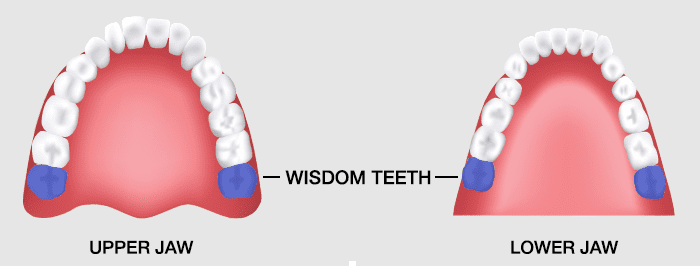
Wisdom tooth appears at _____ age:
  • $17-20$
  • B
    $50-60$
  • C
    $30-33$
  • D
    $25-30$
Answer
Correct option: A.
$17-20$

The last molars on each side of the tooth are called wisdom teeth. These appear at $17-20$ age.

View full question & answer
MCQ 1001 Mark
Read The Following Sentences Carefully And Choose Which Of The Statements Is Or Are Incorrect?
  • The digestion of food starts in stomach and the digestion is complete in large intestine.
  • B
    The stomach is widest part of alimentary canal.
  • C
    The $HCL$ kills many bacteria and makes the medium in the stomach acidic and help in digest.
  • D
    When we swallow food, the epiglottis flattens backward to cover the entrance to our larynx and prevent food from entering the lungs and windpipe.
Answer
Correct option: A.
The digestion of food starts in stomach and the digestion is complete in large intestine.

The digestion of food starts in mouth and the digestion is completed in small intestine and the rest options are correct.

View full question & answer
MCQ 1011 Mark
The teeth placed at the end of the buccal cavity and help in chewing food are which of the following?
  • A
    Incisors
  • Molars
  • C
    Canines
  • D
    Premolars
Answer
Correct option: B.
Molars
The teeth which are present at the end of the buccal cavity or at the end of each jaw are the molars.
They have a flat surface which makes them easier to chew and grind food.
View full question & answer
MCQ 1021 Mark
Which of the following pair of teeth differ in structure but are similar in function$?$
  • A
    Canines and incisors
  • Molars and premolars
  • C
    Incisors and molars
  • D
    Premolars and canines
Answer
Correct option: B.
Molars and premolars

The molars are the largest teeth of all. The premolars present next to molars. Molars are $12$ in number, whereas premolars are $8$ in number.
The function of these types of teeth is similar, i.e., crushing and grinding of food.

View full question & answer
MCQ 1031 Mark
The simplest form of protein is:
  • A
    Fatty acids.
  • B
    Glucose.
  • C
    Glycerol.
  • Amino acids.
Answer
Correct option: D.
Amino acids.
Amino acids.
View full question & answer
MCQ 1041 Mark
Enzymes which helps in digestion in amoeba:
  • A
    Amylase
  • B
    Proteinase
  • both $(a)$ and $(b)$
  • D
    None of the above
Answer
Correct option: C.
both $(a)$ and $(b)$
View full question & answer
MCQ 1051 Mark
Given below from $(i)$ to $(iv)$ are some food items.
$i.$ Boiled and mashed potato.
$ii.$ Glucose solution.
$iii.$ A slice of bread.
$iv.$ Mustard oil.
Which of the above will give blue$-$black colour when tested with iodine?
  • A
    $(i)$ and $(ii)$
  • $(i)$ and $(iii)$
  • C
    $(ii)$ and $(iii)$
  • D
    $(iii)$ and $(iv)$
Answer
Correct option: B.
$(i)$ and $(iii)$
The food containing starch $($carbohydrate$)$ on reaction. with iodine gives blue$-$black colour, $e.g.$ Boiled and mashed potato, a slice of bread.
Glucose solution and mustard oil would not give blue$-$black colour as they are not starch. Mustard oil is fat and glucose is simple unit of carbohydrate.
View full question & answer
MCQ 1061 Mark
Saliva is released $f$ rom:
  • A
    Pinus gland
  • B
    Thyroid gland
  • C
    Adrenal gland
  • Salivary gland
Answer
Correct option: D.
Salivary gland
Salivary gland
View full question & answer
MCQ 1071 Mark
There Are Given Some Parts Of Our Body, Choose The Odd One Out:
  • A
    Tongue.
  • Absorption.
  • C
    Taste.
  • D
    Swallow.
Answer
Correct option: B.
Absorption.
Absorption is the odd one. It is a digestive process that occurs in small intestine. All the others are related to mouth.
View full question & answer
MCQ 1081 Mark
Bile is responsible for the digestion of:
  • Fat.
  • B
    Protein.
  • C
    Vitamins.
  • D
    Both $a$ and $b.$
Answer
Correct option: A.
Fat.
Fat.
View full question & answer
MCQ 1091 Mark
The Swallowed Food Moves Down$-$Words In The Alimentary Canal Because Of:
  • A
    Force provided by the muscular tongue.
  • B
    The flow of water taken with the food.
  • C
    Gravitational pull.
  • The contraction of muscles in the wall of food$-$pipe.
Answer
Correct option: D.
The contraction of muscles in the wall of food$-$pipe.
As soon as the food enters the food pipe, the muscles in its wall start alternate contraction and relaxation producing a wave like movement called “Peristalsis”. These movements are essential for pushing the food downwards in the alimentary canal.
View full question & answer
MCQ 1101 Mark
Animal nutrition includes.
  • A
    Nutrient requirements.
  • B
    Mode of intake of food.
  • C
    Utilization of food in body.
  • All of the above.
Answer
Correct option: D.
All of the above.
All of the above.
View full question & answer
MCQ 1111 Mark
Amoeba digests its food in the __?
  • A
    Pseudopodia
  • Food vacuole
  • C
     Sugar productsB
     
  • D
     Salted products
Answer
Correct option: B.
Food vacuole
View full question & answer
MCQ 1121 Mark
Which of the following animals swallow its prey?
  • A
    Human beings
  • Snakes
  • C
    Humming birds
  • D
    Ant
Answer
Correct option: B.
Snakes
Snakes
View full question & answer
MCQ 1131 Mark
The walls of large intestine absorb:
  • Water.
  • B
    Proteins.
  • C
    Cellulose.
  • D
    Roughage.
Answer
Correct option: A.
Water.
Water.
View full question & answer
MCQ 1141 Mark
Which of the following component of food do not provide energy of body building?
  • Roughage
  • B
    Proteins
  • C
    Carbohydrates
  • D
    Fats
Answer
Correct option: A.
Roughage
Roughage
View full question & answer
MCQ 1151 Mark
Tick $\big(\checkmark\big)$ mark the correct answer in the following: Fat is completely digested in the:
  • A
    Stomach.
  • B
    Mouth.
  • Small intestine.
  • D
    Large intestine.
Answer
Correct option: C.
Small intestine.
Small intestine.
View full question & answer
MCQ 1161 Mark
Length of small intestine is:
  • A
    $10.5m$ long.
  • B
    $40m$ long.
  • C
    $23.4m$ long.
  • $7.5m$ long.
Answer
Correct option: D.
$7.5m$ long.
$7.5m$ long.
View full question & answer
MCQ 1171 Mark
Which of the following is a ruminant?
  • A
    Buffalo.
  • B
    Camel.
  • C
    Goat.
  • All of these.
Answer
Correct option: D.
All of these.
All of these.
View full question & answer
MCQ 1181 Mark
Read The Following Statement With Reference To The “Villi” Of Small Intestine And Choose The Correct Option.
  • They have very thin walls, they have a network of thin and small blood vessel close to the surface and they are finger like projections.
  • B
    They have a network of thin and small blood vessel close to the surface, they have small pores through which food can easily pass and they are finger like projections.
  • C
    They have small pores through which food can easily pass and they are finger like projections.
  • D
    They have very thin walls and they are finger like projections.
Answer
Correct option: A.
They have very thin walls, they have a network of thin and small blood vessel close to the surface and they are finger like projections.
The inner surface of small intestine has many finger-like outgrowth called “Villi” to help in absorption of food. They have very thin walls to pass digested nutrients through diffusion. The Villi are connected to the blood vessels, so the circulating blood can carry these nutrients away.
View full question & answer
MCQ 1191 Mark
The intestinal juice digests the proteins into:
  • A
    Fatty acids
  • B
    Glycerol
  • Amino acids
  • D
    None of these
Answer
Correct option: C.
Amino acids
The intestinal juice digests the proteins into amino acids.
View full question & answer
MCQ 1211 Mark
The digestion of food starts in which part of the digestive system:
  • A
    Small intestine
  • B
    Stomach
  • Mouth
  • D
    Large intestine
Answer
Correct option: C.
Mouth
Mouth
View full question & answer
MCQ 1221 Mark
The swallowed food moves downwards in the alimentary canal because of:
  • A
    Force provided by the muscular tongue.
  • B
    The flow of water taken with the food.
  • C
    Gravitational pull.
  • The contraction of muscles in the wall of food pipe.
Answer
Correct option: D.
The contraction of muscles in the wall of food pipe.
As soon as the food enters the food pipe, the muscles in its walls start alternate contractions and relaxation producing a wave$-$iike movement called peristaltic. These movements are essential for pushing the food downwards in the alimentary canal.
View full question & answer
MCQ 1231 Mark
Gastric digestion takes place efficiently in:
  • Acidic medium
  • B
    Alkaline medium
  • C
    Neutral medium
  • D
    Highly alkaline medium
Answer
Correct option: A.
Acidic medium
Acidic medium
View full question & answer
MCQ 1241 Mark
In amoeba, the food particles are trapped in:
  • A
    Pseudopodia
  • Food vacuole
  • C
    Stomach
  • D
    None of these
Answer
Correct option: B.
Food vacuole
In amoeba, the food particles are trapped in food vacuole.
View full question & answer
MCQ 1251 Mark
The semi$-$solid mass which is produced after thoroughly mix up of food and gastric juice is called:
  • A
    Bolus
  • Chyme
  • C
    Bile
  • D
    Villus
Answer
Correct option: B.
Chyme
In this phase, these movements of the stomach are also called “mixing waves”, since their primary function is to mix food $–$food bolus$-$ with stomach secretions or gastric juices.
Chyme is formed from this mixture, a semi-solid pasty mass made up of digested food.
View full question & answer
MCQ 1261 Mark
Dentine protects which part of human teeth?
  • A
    Enamel.
  • Pulp cavity.
  • C
    Gums.
  • D
    Dental cavity.
Answer
Correct option: B.
Pulp cavity.
Pulp cavity.
View full question & answer
MCQ 1271 Mark
The pointed teeth in the buccal cavity are called:
  • A
    Incisors.
  • Canines.
  • C
    Premolars.
  • D
    Molars.
Answer
Correct option: B.
Canines.
Canines.
View full question & answer
MCQ 1281 Mark
He way of taking food by bees is:
  • A
    Swallowing
  • Sucking
  • C
    Filtering
  • D
    None of these
Answer
Correct option: B.
Sucking
Sucking
View full question & answer
MCQ 1291 Mark
Read the following statements with reference to the villi of small intestine.
$i.$ They have very thin walls.
$ii.$ They have a network of thin and small blood vessels close to the surface.
$iii.$ They have small pores through which food can easily pass.
$iv.$ They are finger$-$like projections.
Identify those statements which enable the villi to absorb digested food:
  • A
    $(i), (ii)$ and $(iv).$
  • B
    $(ii), (iii)$ and $(iv).$
  • $(iii)$ and $(iv).$
  • D
    $(i)$ and $(iv).$
Answer
Correct option: C.
$(iii)$ and $(iv).$
$(iii)$ and $(iv).$
View full question & answer
MCQ 1301 Mark
The digestive juices break down the in to simpler substances ?
  • A
    Carbohydrates
  • Proteins
  • C
     Salted products
  • D
    Sugar products
Answer
Correct option: B.
Proteins
View full question & answer
MCQ 1311 Mark
The wall of the stomach is protected against the action of $HCl$ by:
  • A
    Pepsin
  • B
    Bile juice
  • Mucus
  • D
    Saliva
Answer
Correct option: C.
Mucus

$HCl$ is produced in the stomach to help in the digestion of food. $HCl$ is highly acidic.
Mucus protects the lining of the stomach from the harsh acidic conditions created by the $HCl.$

View full question & answer
MCQ 1321 Mark
The swallowed food moves downwards in the alimentary canal because of:
  • A
    Force provided by the muscular tongue
  • B
    The flow of water taken with the food
  • C
    Gravitational pull
  • The contraction of muscles in the wall of food pipe
Answer
Correct option: D.
The contraction of muscles in the wall of food pipe
When food goes into the food pipe, the muscles in its walls start alternate contraction and relaxation producing a wave$-$like movement that called 'peristalsis'.
These movements are necessary for forwarding the food downwards in the alimentary canal.
View full question & answer
MCQ 1331 Mark
Which Of The Pairs Will Give Blue$-$Black Colour When Tested With Iodine?
  • A
    Boiled and mashed potato glucose, glucose solution.
  • Boiled and mashed potato, a slice of bread.
  • C
    Glucose solution, a slice of bread.
  • D
    A slice of bread, mustard oil.
Answer
Correct option: B.
Boiled and mashed potato, a slice of bread.
The food containing starch $($carbohydrate$)$ on reaction with iodine gives blue$-$black colour, $e.g.$ boiled and mashed potato, a slice of bread. Glucose solution and mustard oil would not give blue$-$black colour as they are not starch. Mustard oil is fat and glucose is simple unit of carbohydrate.
View full question & answer
MCQ 1341 Mark
Which of the following is not a part of digestive system ?
  • A
    Mouth cavity
  • B
    Stomach
  • C
    Food pipe
  • Wind pipe
Answer
Correct option: D.
Wind pipe
The alimentary canal is a muscular tube, which extends from the mouth to the anus.
The main organs of the alimentary canal are: The Mouth: It is the first part of our digestive system.
View full question & answer
MCQ 1351 Mark
There Are Given Some Parts Of Digestive System, Choose The Odd One Out:
  • Stomach.
  • B
    Liver.
  • C
    Pancreas.
  • D
    Salivary gland.
Answer
Correct option: A.
Stomach.
Stomach is the odd one. It is a digestive organ. All the others are gland
View full question & answer
MCQ 1361 Mark
The acid secreted in the stomach is:
  • Hydrochloric acid
  • B
    Sulphuric acid
  • C
    Phosphoric acid
  • D
    Nitric acid
Answer
Correct option: A.
Hydrochloric acid
The acid secreted in our stomach is hydrochloric acid.
View full question & answer
MCQ 1371 Mark
is the largest gland in the body?
  • A
    Lungs
  • Liver
  • C
    Carbohydrates $B$
     
  • D
     Proteins
Answer
Correct option: B.
Liver
View full question & answer
MCQ 1381 Mark
The main function of the lacteals of intestine is the absorption of:
  • A
    Amino acids
  • B
    Glucose and vitamins
  • C
    Lactic acid
  • Fatty acids and glycerol
Answer
Correct option: D.
Fatty acids and glycerol
Lacteals are lymph vessels responsible for absorbing fat in the small intestine. Occurring in the finger-like villi of the ileum, lacteals have a milky appearance and drain into the lymphatic system.
Before fat can pass into the lacteal, bile from the liver causes its emulsification into small droplets for action of the enzyme lipase.
View full question & answer
MCQ 1391 Mark
In amoeba, digestion of food takes place inside:
  • A
    Food pipe
  • B
    Gizzard
  • Food vacuole
  • D
    Stomach
Answer
Correct option: C.
Food vacuole
Food vacuole
View full question & answer
MCQ 1401 Mark
The stomach is a thick-walled bag of shape.
  • A
    $V-$shape.
  • $U-$shape.
  • C
    $X-$shape.
  • D
    $Z-$shape.
Answer
Correct option: B.
$U-$shape.
$U-$shape.
View full question & answer
MCQ 1411 Mark
Why are nutrition in animals holozoic ?
  • A
    Because they depend on plants for food
  • B
    Because they are heterotrophs
  • C
    Because they can shallow food
  • All the above
Answer
Correct option: D.
All the above
All the above
View full question & answer
MCQ 1421 Mark
The teeth which helps in biting the food are the:
  • A
    Canines
  • Incisors
  • C
    Premolar
  • D
    Molars
Answer
Correct option: B.
Incisors
The teeth which helps in biting in food are the incisors.
View full question & answer
MCQ 1431 Mark
Mode of nutrition in amoeba is:
  • A
    Herbivores
  • Holozoic
  • C
    Omnivores
  • D
    Autotrophic
Answer
Correct option: B.
Holozoic
Holozoic
View full question & answer
MCQ 1441 Mark
The finger$-$like outgrowths of Amoeba helps to ingest food. However, the finger$-$like outgrowths of human intestine helps to:
  • A
    Digest the fatty food substances
  • B
    Make the food soluble
  • Absorb the digested food
  • D
    Absorb the undigested food
Answer
Correct option: C.
Absorb the digested food
Fingerlike projection are present in small intestine and they are called Villi. Villi absorbs nutrients from digested food by increasing space of small intestine.
View full question & answer
MCQ 1451 Mark
All organisms including humans require food for:
  • A
    Growth
  • B
    Repair
  • C
    Maintenance
  • All of the above
Answer
Correct option: D.
All of the above
All organisms including humans require food for growth, repair and functioning of the body $($Maintenance$).$
View full question & answer
MCQ 1461 Mark
Which of the following is not a part of nutrition?
  • A
    Digestion.
  • B
    Absorption.
  • C
    Assimilation.
  • Excretion.
Answer
Correct option: D.
Excretion.
Excretion.
View full question & answer
MCQ 1471 Mark
Read carefully the terms given below. Which of the following set is the correct combination of organs that do not carry out any digestive functions?
  • Oesophagus, Large Intestine, Rectum.
  • B
    Buccal cavity, Oesophagus, Rectum.
  • C
    Buccal cavity, Oesophagus, Large Intestine.
  • D
    Small Intestine, Large Intestine, Rectum.
Answer
Correct option: A.
Oesophagus, Large Intestine, Rectum.
In the human digestive system, parts such as oesophagus, large intestine and rectum do not carry out any digestive functions. Oesophagus carries food from the mouth to the stomach.
Large intestine absorbs most of the water from undigested food material. Rectum is the last part of the large intestine where undigested food is stored till it is egested out.
View full question & answer
MCQ 1481 Mark
Read The Statement And Choose A Word For It: “Organisms Which Take Food Hurriedly And Store It, In A Part Of The Stomach. This Digested Food Is Returned To The Buccal Cavity For The Complete Process Of Digestion”.
  • Cattles
  • B
    Omnivores
  • C
    Beetles
  • D
    Carrion feeders
Answer
Correct option: A.
Cattles
Cows, buffaloes and other grass$-$eating animals $($cattle$)$ chewing continuously. Actually, they quickly swallow the grass and store it, in a part of the stomach, called “rumen”. But later the partially digested food $($cud$)$ returns to the mouth in small lumps and the animal chews it. This process is called rumination and these animals are called ruminants.
View full question & answer
MCQ 1491 Mark
They Are Given Some Parts Of The Digestive System, Choose The Odd One:
  • A
    Oesophagus.
  • Small intestine.
  • C
    Large intestine.
  • D
    Rectum.
Answer
Correct option: B.
Small intestine.
Small intestine is the odd one. It releases intestinal juices and is involved in digestion. All others do not take part in the digestion process.
View full question & answer
MCQ 1501 Mark
Why cannot ruminants chew food at the same time they take in?
  • A
    Grass does not taste good.
  • Grass contains cellulose that cannot be digested easily.
  • C
    The grass is hard in structure.
  • D
    Ruminants eat a lot of grass at the same time.
Answer
Correct option: B.
Grass contains cellulose that cannot be digested easily.
View full question & answer
MCQ 1511 Mark
The process in which $f$ aucal matter is removed through the anus:
  • Egestion
  • B
    Digestion
  • C
    Absorption
  • D
    Ingestion
Answer
Correct option: A.
Egestion
Egestion
View full question & answer
MCQ 1521 Mark
The digestion of protein starts in the $....... ?$
  • A
    Oesophagus
  • Stomach
  • C
    small intestine
  • D
    pancreas
Answer
Correct option: B.
Stomach
Stomach
View full question & answer
MCQ 1531 Mark
What Do You Mean By “Salivary Digestion”?
  • A
    When fats breakdown into fatty acids and glycerol, called salivary digestion.
  • B
    When proteins breakdown into amino acids, called salivary digestion.
  • C
    When cud returns to the mouth in small lumps and the animal chews it, called salivary digestion.
  • None of the above.
Answer
Correct option: D.
None of the above.
The food enters into the buccal cavity through mouth. It is chewed by the teeth and mixed with saliva. Saliva contains and enzyme called ptyalin $($salivary amylase$)$ which converts complex carbohydrates like starch into sugars. That is why the bread taste become sweet after chewing. This type of digestion is called salivary digestion.
View full question & answer
MCQ 1551 Mark
Peristaltic movements found in different parts of alimentary canal. In which one of these there is least peristalsis?
  • A
    Stomach
  • B
    Duodenum
  • Rectum
  • D
    Oesophagus
Answer
Correct option: C.
Rectum
Peristalsis is the series of involuntary movements in the digestive tract. It is characterized by waves of alternate circular contraction and relaxation of the longitudinal smooth muscle of tube by which the contents are propelled onward. Medulla is responsible for the peristaltic movement of food. Muscle contraction also mixes food with the digestive juices. They also act as valves preventing back flow in the tract.
View full question & answer
MCQ 1561 Mark
Fat is completely digested in the:
  • A
    Stomach.
  • B
    Mouth.
  • Small intestine.
  • D
    Large intestine.
Answer
Correct option: C.
Small intestine.
Small intestine.
View full question & answer
MCQ 1571 Mark
Diarrhoea is caused due to:
  • A
    Infection.
  • B
    Indigestion.
  • C
    Poisoning.
  • All of the above.
Answer
Correct option: D.
All of the above.
All of the above.
View full question & answer
MCQ 1581 Mark
The acid present in the stomach:
  • Kills the harmful bacteria that may enter along with the food.
  • B
    Protects the stomach lining from harmful substances.
  • C
    Digests starch into simpler sugars.
  • D
    Makes the medium alkaline.
Answer
Correct option: A.
Kills the harmful bacteria that may enter along with the food.
View full question & answer
MCQ 1591 Mark
Tick $\big(\checkmark\big)$ mark the correct answer in the following: Water from the undigested food is absorbed mainly in the:
  • A
    Stomach.
  • B
    Foodpipe.
  • C
    Small intestine.
  • Large intestine.
Answer
Correct option: D.
Large intestine.
Large intestine.
View full question & answer
MCQ 1601 Mark
The breakdown of complex components of food into simpler substances is called.
  • Digestion.
  • B
    Nutrition.
  • C
    Breathing.
  • D
    Respiration.
Answer
Correct option: A.
Digestion.
Digestion.
View full question & answer
MCQ 1611 Mark
Animal nutrition includes:
  • A
    Nutrient requirement
  • B
    Mode of intake of food
  • C
    Utilization in the body
  • All of the above
Answer
Correct option: D.
All of the above
Animal nutrition includes nutrient requirement, mode of intake of food and its utilization in the body.
View full question & answer
MCQ 1621 Mark
Gastric digestion takes place efficiently in:
  • Acidic medium
  • B
    Alkaline medium
  • C
    Neutral medium
  • D
    Highly alkaline medium
Answer
Correct option: A.
Acidic medium
Acidic medium
View full question & answer
MCQ 1631 Mark
In Which Of The Statements Is Or Are Incorrect About “Amoeba”?
  • A
    Digest the fatty food substances.
  • B
    Make the food soluble.
  • Absorb the digested food.
  • D
    Absorb the undigested food.
Answer
Correct option: C.
Absorb the digested food.
Villi are the finger$-$like outgrowths of inner surface of human intestine. Their role is to increase the surface area for rapid absorption of digested food. However, in “Amoeba” the finger like projections are called “pseudopodia” that helps it to catch food particles and to move.
View full question & answer
MCQ 1641 Mark
The acid present in the stomach:
  • kills the harmful bacterial that may enter along with the food
  • B
    Protects the stomach lining from harmful substances
  • C
    Digests starch into simpler sugars
  • D
    Makes the medium alkaline
Answer
Correct option: A.
kills the harmful bacterial that may enter along with the food
'Hydrochloric acid' is an acid that is secreted in the stomach. It helps to kill the harmful bacteria that may enter the food.
View full question & answer
MCQ 1661 Mark
Raccoon is an example of which type of animal:
  • A
    Herbivore
  • Omnivore
  • C
    Carnivore
  • D
    Parasite
Answer
Correct option: B.
Omnivore
Omnivore
View full question & answer
MCQ 1671 Mark
The undigested food is eliminated through:
  • Anus
  • B
    Caecum
  • C
    Rectu
  • D
    None of these
Answer
Correct option: A.
Anus
The undigested food is eliminated through anus.
View full question & answer
MCQ 1681 Mark
Which part of the body is common between digestive and respiratory systems?
  • A
    Oesophagus
  • B
    Larynx
  • Pharynx
  • D
    Trachea
Answer
Correct option: C.
Pharynx
The pharynx connects the mouth to the oesophagus and the larynx in the throat. At the end of the pharynx, a flap$-$like structure called epiglottis is present.
The flap moves to one side for food $($towards the oesophagus$)$ and the other side as one breathes $($towards the larynx$).$
View full question & answer
MCQ 1691 Mark
Hydrochloric acid is secreted by:
  • A
    Linings of small intestine.
  • Inner lining of stomach.
  • C
    Pancreas.
  • D
    Lining of liver.
Answer
Correct option: B.
Inner lining of stomach.
View full question & answer