Questions

3 Marks Question

Take a timed test

12 questions · self-marked practice — reveal the answer and mark yourself.

Question 13 Marks
In the summer holidays, Karan went to Rann of Kutch In Gujarat with his parents. Karan was aware that in the coastal regions of India especially in the Rann of Kutch common salt is obtained from sea water. Karan was very excited to see that place. He requested his father that he want to see the process of obtaining salt from sea. His father helped him and they went to see the place where common salt was collecting. And he also explained the whole process. Karan was very happy to see the process.
Now, answer the following questions.
(i) How the crystals of common salt obtained from sea water?
(ii) Name the process by which salt is collected from sea water?
Answer
self
View full question & answer
Question 23 Marks
Rahul was a student of class VII. His father purchased a new bicycle for him on his birthday. After few months, he found that the cycle chain and the handle gets rusted. His father advised him to apply a coating of paint to the cycle and not to keep it in the open in future.
Now, answer the following questions
(i) Why his cycle gets rusted?
(ii) What do you mean by rusting of iron?
Answer
self
View full question & answer
Question 33 Marks
Give an example of a chemical reaction for each of the following situations
(i) A change in colour is observed.
(II) A gas is evolved.
(III) Sound is produced.
Answer
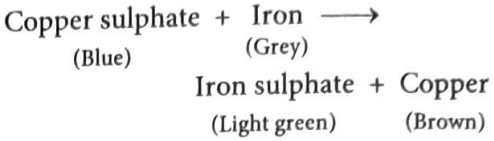
(i) Chemical reaction between copper sulphate solution and iron metal. In this reaction, blue colour of copper sulphate solution changes to light green colour due to the formation of iron sulphate.
Image
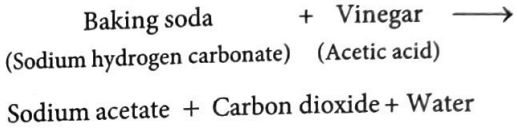
(ii) When baking soda and vinegar are mixed together then a chemical change takes place and bubbles of carbon dioxide gas are formed along with some other substances.
Image
(iii) Explosion of a firework produces heat, light, sound and unpleasant gases. Explosion of a firework is a chemical change.
View full question & answer
Question 43 Marks
Give two examples for each of the following cases
(i) Physical changes, which are reversible.
(ii) Physical changes, which are not reversible.
(iii) Chemical changes
Answer
(i) (a) Folding of paper $\quad$ (b) Melting of ice
(ii) (a) Tearing of paper $\quad$ (b) Breaking of glass
(iii) (a) Reaction between vinegar and baking soda.
(b) Burning of a matchstick.
View full question & answer
Question 53 Marks
Amit dissolved sugar in water and observed the change. His friend Raj took a little sugar in a spatula and directly heated it on a bunsen burner on a high flame.
Answer the following questions.
(i) Which type of changes is observed by the Amit? Is it reversible or irreversible?
(ii) Who of the two will observe chemical change?
Answer
self
View full question & answer
Question 63 Marks
Abhi burned a substance X over the candle flame and white dazzling light is observed. Also white powdery ash left behind. He mixed the white ash formed with small amount of water. Then he dipped red and blue litmus papers into the solution one by one.
(i) Identify the substance X.
(ii) Which substance is formed after substance X gets burnt?
(iii) What is the nature of solution formed after mixing the white ash into the water acidic or basic?
Answer
self
View full question & answer
Question 73 Marks
Write the differences between physical and chemical changes.
Answer
Differences between physical and chemical changes are as follows
Physical changeChemical change
No new substance is formedNew substance is formed.
It is a temporary changeIt is a permanent change.
Physical change is easily reversible.Chemical change is irreversible.
Very little energy (heat, etc.) is absorbed or given out in a physical change.A lot of energy (in the form of heat, light, sound etc.) is absorbed or given out in a chemical change.
View full question & answer
Question 83 Marks
Explain how painting of an iron gate prevents it from rusting?
Answer
Some methods of prevention of rusting are given below
(i) The simple method is to coat the iron with oil, grease or paint. These coats should be applied regularly to prevent rusting.
(ii) A more efficient method is to coat the iron with another metal such as zinc or chromium. The process of depositing a layer of zinc on iron is called galvanisation. The iron pipes used in our homes to carry water are galvanised to prevent rusting.
(iii) It can also be prevented by making alloys, e.g. stainless steel. Stainless steel is made by mixing iron with carbon and metals like chromium, nickel and manganese. It does not rust.
View full question & answer
Question 93 Marks
When baking soda is mixed with lemon juice, bubbles are formed with the evolution of a gas. What type of change is it? Explain.
Answer
When baking soda (sodium bicarbonate) is mixed with lemon juice (citric acid), a chemical change occurs. In this reaction, new substances like carbon dioxide is formed and heat is evolved. This change is irreversible hence, it is a chemical change.
The reaction takes place as
Image
View full question & answer
Question 103 Marks
Classify the changes involved in the following processes as physical or chemical changes.
(a) Photosynthesis
(b) Dissolving sugar in water
(c) Burning of coal
(d) Melting of wax
(e) Beating aluminium to make aluminium foil
(f) Digestion of food
Answer
(a) Photosynthesis - Chemical change
(b) Dissolving sugar in water - Physical change
(c) Burning of coal - Chemical change
(d) Melting of wax - Physical change
(e) Beating aluminium to make aluminium foil - Physical change
(f) Digestion of food - Chemical change
View full question & answer
Question 113 Marks
Explain, how rusting damages iron objects?
Answer
Rusting damages iron objects because it forms rust, which is a flaky and weak substance.
Rust causes the iron to lose its strength and shine, making it brittle and weak.
Over time, this leads to the gradual deterioration of iron objects, making them useless.
View full question & answer
Question 123 Marks
What happens when magnesium oxide is dissolved in water? Write a word equation for this process. Name the type of change which takes place.
Answer
When magnesium oxide is dissolved in water, it reacts with water to form magnesium hydroxide, which is slightly soluble in water and gives a basic solution.
The word equation for this reaction is:
Magnesium oxide + Water → Magnesium hydroxide
This is a chemical change because a new substance with different properties is formed.
View full question & answer